
Pakistan’s Federal Budget for the fiscal year 2026-27 aims to balance economic growth with fiscal discipline. This comprehensive guide details the Rs18.771 trillion outlay, new tax relief measures for the salaried class, and the government’s ambitious revenue generation strategy.
Key Takeaways
- Total Outlay: The budget stands at Rs18.771 trillion, focusing on sustainable growth and fiscal consolidation.
- Tax Relief: Significant relief for salaried individuals via revised income tax slabs and a reduction in property withholding tax.
- Revenue Target: The FBR has been set an ambitious tax collection target of Rs15.264 trillion.
- Core Expenditures: Debt servicing and defense constitute the largest allocations, at Rs8.054 trillion and Rs3.000 trillion respectively.
- Read More: CM Punjab Rental E-Bike Service Scheme (For Lahore Region)
- Read More: CM Punjab Maryam Nawaz She Threads Program (PKR 15K/Month)
- Read More: Top 5 Free Liver Transplant Hospitals In Lahore
- Read More: Top 5 Free Kidney Transplant Hospitals In Lahore
Budget 2026-27: Major Expenditures, Tax Relief, & Revenue Target
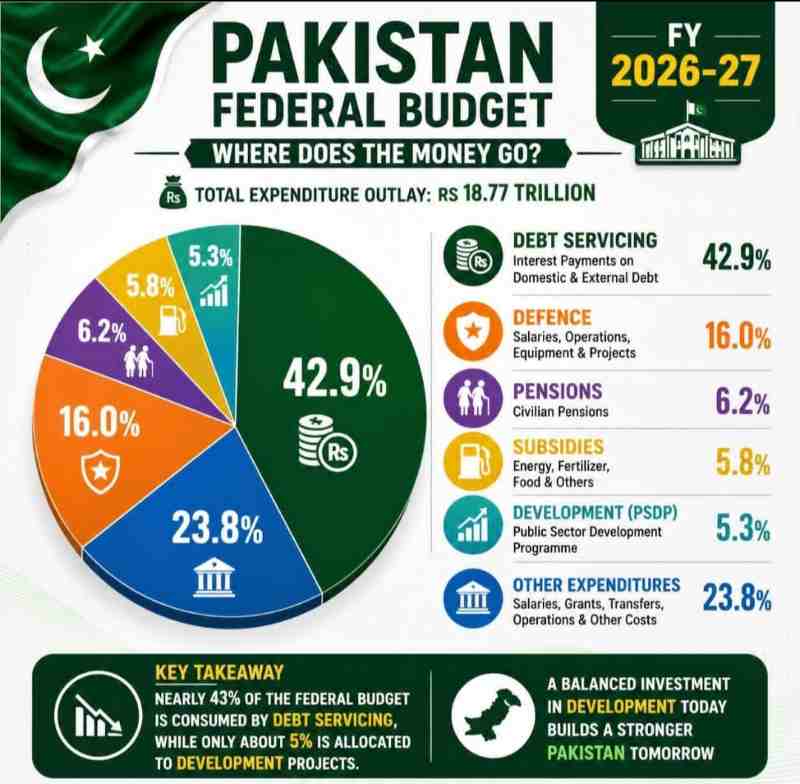
Table Of Contents
Read More: Top 5 Free Kidney Transplant Hospitals in Pakistan
What is the Total Outlay of Pakistan’s Federal Budget 2026-27?
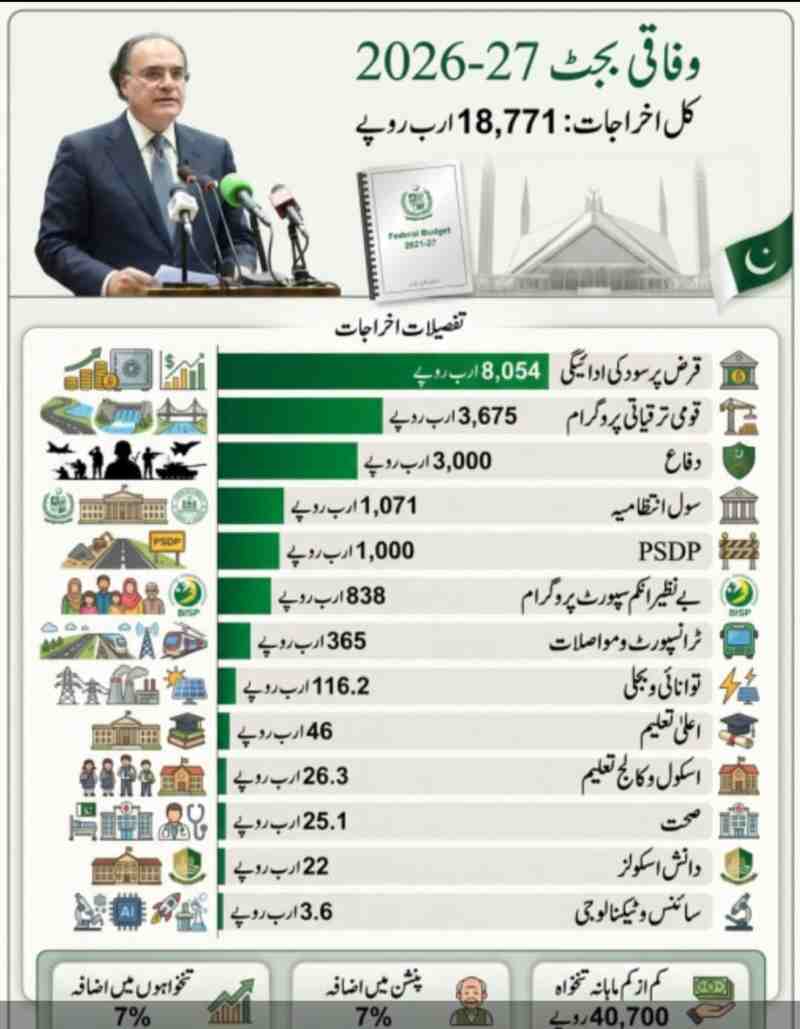
The total outlay of Pakistan’s Federal Budget 2026-27 is a record Rs18.771 trillion. This represents a 6.81% increase from the previous fiscal year’s outlay of Rs17.573 trillion. The budget, presented by Finance Minister Muhammad Aurangzeb, aims to transition the economy from a stabilization phase to an investment-driven growth phase. This fiscal plan is built on the pillars of fiscal discipline, targeted tax relief, and strategic public spending.
How Does the Rs18.771 Trillion Outlay Compare to Previous Fiscal Years?
The Rs18.771 trillion outlay marks a significant increase in absolute terms, reflecting inflationary pressures and an expanded development agenda. However, the government has prioritized reducing the fiscal deficit as a percentage of GDP. The focus has shifted from broad-based subsidies to targeted relief and enhanced capital expenditure in key sectors like water, climate resilience, and transport connectivity. This structured expansion aims to stimulate economic activity without destabilizing the country’s debt profile.
What are the Salient Features of Budget 2026-27 Regarding Fiscal Discipline?
A cornerstone of the budget is its commitment to fiscal discipline, primarily driven by conditions agreed upon with international financial partners. The government aims to achieve a primary surplus target of 2% of GDP, equivalent to approximately Rs2.9 trillion. This is a critical metric for debt stabilization. The overall fiscal deficit has been projected at 3.6% of GDP, a challenging target that requires strict control over current expenditures and a significant increase in tax revenues. Non-tax revenues, particularly from the petroleum sector, are also projected to play a crucial role in meeting these fiscal targets.
Who is the Current Finance Minister Who Presented Budget 2026-27?
Senator Muhammad Aurangzeb, the Federal Minister for Finance and Revenue, presented the Budget 2026-27 in the National Assembly. His budget speech outlined the government’s strategy to build on recent economic stability and steer the country toward sustainable growth. Senator Aurangzeb highlighted key relief measures for the salaried class, exporters, and the construction industry, alongside the government’s commitment to meeting its revenue collection goals through the Federal Board of Revenue (FBR).
What is the FBR Tax Collection Target for FY 2026-27?
The Federal Board of Revenue (FBR) tax collection target for FY 2026-27 is set at an ambitious Rs15.264 trillion. This target represents an 18% increase over the revised collection of the previous year. The government projects gross revenue receipts at Rs20.6 trillion, with non-tax revenue contributing Rs5.336 trillion of this sum. The ability to meet this target is crucial for achieving the budgeted expenditure levels and the targeted fiscal deficit.
Breaking Down the Gross Revenue Receipts of Rs20.6 Trillion.
The gross revenue of Rs20.6 trillion is composed of two main streams: tax revenue and non-tax revenue. Tax revenue, which is the FBR’s collection target, accounts for the majority at Rs15.264 trillion. Non-tax revenue, projected at Rs5.336 trillion, is expected to be heavily driven by levies and dividends from state-owned enterprises, particularly in the petroleum sector, which alone is expected to contribute Rs2.034 trillion. These projections rely on sustained economic growth and the effective implementation of new revenue-raising measures.
What is the New Non-Tax Revenue Target for Pakistan This Fiscal Year?
The non-tax revenue target for FY 2026-27 has been set at Rs5.336 trillion. This includes income from the petroleum levy, profits from the State Bank of Pakistan, dividends from public sector companies, and other miscellaneous receipts. The petroleum sector’s contribution is a key component, projected at Rs2.034 trillion. Achieving this target hinges on global oil prices and domestic consumption remaining stable, as well as the successful collection of new levies introduced in the budget, such as the Federal Excise Duty on petroleum-based solvents.
How Much Will Provinces Receive Under the NFC Award in 2026-27?
Under the National Finance Commission (NFC) award, provinces are set to receive a substantial transfer of Rs8.848 trillion from the federal revenue pool. This transfer represents the provinces’ constitutionally guaranteed share of federal taxes. After these transfers, the net federal revenue available for federal expenditures and debt servicing is Rs11.751 trillion. The provincial share is determined by a distribution formula that includes population, revenue generation, and inverse population density, with major shares going to Punjab and Sindh.
How Much Budget is Allocated for Debt Servicing in 2026-27?
Debt servicing receives the single largest allocation in the Budget 2026-27, with Rs8.054 trillion earmarked for mark-up payments on public debt. This allocation underscores the continued fiscal pressure from the country’s rising debt burden and high-interest rates. A significant portion of federal revenue is dedicated to servicing both domestic and external debt, leaving limited room for other developmental and current expenditures.
What is the Defense Budget Allocation for Pakistan in FY 2026-27?
The defense budget for FY 2026-27 has been set at Rs3.000 trillion. This marks a 17.6% increase from the previous year’s allocation, reflecting regional security considerations and the government’s emphasis on maintaining military preparedness. The defense budget forms a core component of federal expenditures, alongside debt servicing. This increase is intended to cover personnel costs, operational readiness, and a major component of ongoing military modernization programs.
How Much is the Development Budget (PSDP) for 2026-27?
The Public Sector Development Programme (PSDP) for 2026-27 has been allocated a restrained Rs1.000 trillion. While the PSDP remains a key tool for infrastructure development and economic growth, its growth has been limited by the high burden of debt servicing. The government has prioritized projects focused on water infrastructure, climate resilience, and transport connectivity within this allocation. The PSDP is expected to be supplemented by provincial development programs, with a combined federal-provincial development outlay also under consideration.
Did Pension Allocations Increase in Budget 2026-27?
Yes, pension allocations have been increased to Rs1.169 trillion in Budget 2026-27. This allocation is designed to absorb a 7% increase in civil and military pension packages. The rising pension bill is a significant long-term fiscal challenge, driven by the large number of retired public sector employees. The increase reflects the government’s commitment to fulfilling its obligations to retirees while seeking longer-term structural reforms to the pension system.
How Much Relief Did the Salaried Class Get in Budget 2026-27?

The salaried class received notable relief through the abolition of the standard income tax surcharge and a reduction in tax percentages across middle and high-income slabs. These measures are designed to increase disposable income, stimulate demand, and help stem the brain drain of skilled professionals. The government has also kept the tax exemption threshold unchanged, providing continued relief to lower-income earners.
What are the New Income Tax Slabs for FY 2026-27?
The new income tax slabs for the salaried class in FY 2026-27 have been revised for higher income brackets. The tax rate for income between Rs2.2 million and Rs3.2 million annually has been reduced from 23% to 20%. For the bracket of Rs3.2 million to Rs4.1 million, the rate was cut from 30% to 25%. Additionally, the rate for income between Rs4.1 million and Rs5.6 million has been reduced from 35% to 29%. Earnings up to Rs600,000 remain tax-free.
Income Tax Calculator 2026-27: How to Compute Savings for PKR 2.2mn–3.2mn Bracket.
To compute tax savings for a salaried individual in the PKR 2.2 million to PKR 3.2 million bracket, compare the previous 23% rate with the new 20% rate. The calculation for a person earning PKR 2.5 million annually would show a tax liability of PKR 500,000 at the new rate, compared to PKR 575,000 previously, resulting in a saving of PKR 75,000. This relief is applicable from July 2026, positively impacting the monthly take-home pay for employees in this segment.
Why Did the Rate for PKR 3.2mn–4.1mn Drop from 30% to 25%?
The reduction from 30% to 25% for the PKR 3.2 million to PKR 4.1 million income bracket was a strategic decision to provide meaningful tax relief to the core of the country’s middle and upper-middle management. This segment includes professionals whose skills are in high demand internationally. The tax cut is intended to increase their net income, encourage local spending, and reduce the incentive for these taxpayers to seek employment abroad, thereby retaining talent within the domestic economy.
Did the Government Reduce Property Tax in Budget 2026-27?
Yes, to stimulate the real estate and construction industry, the government significantly reduced withholding tax on property transactions. The withholding tax on property purchases by tax filers was reduced from 2.5% to 1.25%. Similarly, the withholding tax on property sales by tax filers was cut from 5.5% to 2.75%. These reductions are expected to activate over 40 allied industries, generate investment flows, and create employment opportunities.
What are the New Tax Rates for Selling Property in 2026-27?
For tax filers, the new withholding tax rate on selling property is 2.75% of the sale value, down from the previous 5.5%. This reduction is expected to encourage more documented transactions in the real estate sector, as sellers will have a lower tax burden, making it more attractive to declare the actual sale price. The rates for non-filers remain significantly higher, serving as an incentive for individuals to enter the tax net to benefit from these reduced rates.
How Will Budget 2026-27 Impact the Real Estate Sector?
The impact on the real estate sector is expected to be highly positive, driven by the reduction in transaction costs for filers. Lower withholding taxes are likely to increase the volume of documented property deals, bringing more activity into the formal economy. This, in turn, can lead to increased investment in the sector, stimulate demand for construction materials, and create jobs. The real estate sector’s revival is seen as a crucial multiplier effect for the broader economy.
Are Luxury SUVs Taxed Higher in Budget 2026-27?
Yes, luxury SUVs are taxed higher through the imposition of a Federal Excise Duty (FED) on vehicles with engine capacities between 2,000cc and 3,000cc. This measure is part of the government’s strategy to raise additional revenue while also reducing the consumption of high-end, fuel-inefficient vehicles. The new levy aims to tax luxury consumption without burdening the general public, contributing to the non-tax revenue target.
What Tax Relief Was Given to Exporters in Budget 2026-27?
Exporters received significant tax relief to boost the country’s foreign exchange earnings. Key measures include the complete abolition of the 0.25% Export Development Surcharge. Furthermore, the advance income tax and the minimum tax on exports were reduced from 2.0% to 1.25%. These reductions are designed to lower the cost of doing business for exporters, making Pakistani products more competitive in international markets.
Is There a Super Tax Reduction for Corporations in FY 2026-27?
Yes, for corporations, the Super Tax rate has been reduced by 2% for income exceeding Rs500 million. However, this reduction is not universal; it excludes banks, fertilizer companies, and exploration and production (E&P) companies. For these excluded sectors, the previous super tax rates remain applicable. The reduction for other corporations is intended to encourage private investment and expansion, contributing to the GDP growth target.
What is the Asaan Scheme for Small Retailers in the New Budget?
The “Asaan” scheme is a new fixed tax regime for small retailers, particularly those earning up to Rs200 million annually. It mandates a minimum annual tax payment of Rs25,000 or 1% of their total sales, whichever is higher. This scheme is designed to simplify tax compliance for small businesses, reduce the cost of collection, and broaden the tax base by bringing more retailers into the documented economy. It aims to create a more equitable tax system where all sectors contribute their fair share.
Did the Withholding Tax on International Credit Cards Decrease?
Yes, the withholding tax on international debit and credit card transactions has been drastically decreased from 5% to 0.5%. This reduction is a major relief for consumers who use their cards for overseas travel, online subscriptions, and international e-commerce. The government aims to encourage digital payments and discourage the use of unofficial channels for foreign transactions. This measure is expected to bring more foreign spending into the formal banking system.
How Much Funding is Allocated to the Benazir Income Support Programme (BISP)?
The allocation for the Benazir Income Support Programme (BISP) has been significantly expanded to Rs838 billion for FY 2026-27. This marks an increase of around 17% from the previous year’s allocation. The funding is intended to expand the Kafaalat Programme’s coverage to up to 12 million families and increase the quarterly stipend for beneficiaries. BISP remains the government’s primary social safety net, aimed at mitigating the impact of inflation and economic reforms on the most vulnerable segments of society.
What is the Minimum Wage Set in the Budget 2026-27?
The minimum wage for workers has been raised by 10%, increasing from Rs37,000 to Rs40,700 per month. This adjustment is aimed at providing relief to low-income earners facing the targeted inflation rate of 8.2%. While the wage increase is expected to improve the living standards of minimum-wage workers, its impact is partially offset by rising costs of essential goods. The new minimum wage applies to all industrial and commercial establishments across the country.
What are the New Levies on Petroleum-Based Solvents and Naphtha?
To meet revenue targets without directly increasing the price of petrol, the government introduced a new Federal Excise Duty (FED) of Rs80 per litre on previously exempt petroleum-based solvents, naphtha, and turpentine oil. These industrial inputs are used in manufacturing and as diluents. This levy is a targeted revenue measure designed to minimize the inflationary impact on the general public, as its primary effect will be on industrial production costs.
Did the Government Remove Taxes on Sanitary and Contraceptive Products?
Yes, the government has eliminated taxes on sanitary products and contraceptives. This decision removes the financial burden on essential healthcare and hygiene items for women. By making these products more affordable, the government aims to improve public health outcomes and support women’s health and empowerment. This exemption is a significant public welfare measure included in the budget’s relief package.
How Will Budget 2026-27 Impact the Real Estate Sector vs. Textile Sector?
The budget’s impact is sector-specific: the real estate sector benefits directly from reduced withholding taxes on property transactions, which lowers the cost of buying and selling property. In contrast, the textile sector benefits more from the abolition of the export development surcharge, reduced tax rates on exports, and lower duties on imported raw materials. While real estate gets a transaction cost boost, the textile sector receives production and export cost relief, each designed to spur activity in its respective area.
Frequently Asked Questions (FAQs)
What is the total outlay of Pakistan’s Federal Budget 2026-27?
The total outlay of the Federal Budget 2026-27 is Rs18.771 trillion.
What is the FBR tax collection target for FY 2026-27?
The FBR’s tax collection target for FY 2026-27 is set at Rs15.264 trillion.
How much relief did the salaried class get in Budget 2026-27?
The salaried class received relief through reduced tax rates for various income slabs and the abolition of the standard income tax surcharge.
What are the new income tax slabs for FY 2026-27?
New rates include 20% for Rs2.2m-3.2m, 25% for Rs3.2m-4.1m, and 29% for Rs4.1m-5.6m.
What is the defense budget allocation for Pakistan in FY 2026-27?
The defense budget for FY 2026-27 is Rs3.000 trillion.
How much funding is allocated to the Benazir Income Support Programme (BISP)?
BISP has been allocated Rs838 billion for the fiscal year 2026-27.
Who is the current Finance Minister who presented Budget 2026-27?
Senator Muhammad Aurangzeb, the Federal Minister for Finance and Revenue, presented the budget.

Add a Comment