
Punjab Chief Minister Maryam Nawaz is leading a transformative green agenda that simultaneously addresses urban smog through an expansive electric bus network and rural agricultural stagnation through digital farming reforms. This dual-pronged approach positions Punjab as Pakistan’s first province to integrate clean public transit with precision agriculture at scale, with billions invested in both sectors.
What you will learn from this guide:
- Complete details about Punjab’s electric bus fleet expansion, fare structure, routes, and onboard amenities
- How the Kisan Card scheme provides interest-free agricultural loans to nearly one million farmers
- The Lab on Wheels project bringing scientific soil testing directly to farmers’ doorsteps
- Green Tractor Program distribution details and agricultural mechanization initiatives
Key Takeaways
- Electric Bus Revolution: Punjab is deploying 5,000 electric buses over five years with flat Rs. 20 fares and free travel for students, women, senior citizens, and persons with disabilities.
- Digital Farming Transformation: The Kisan Card scheme has disbursed Rs. 360 billion in interest-free loans with a 99% recovery rate, while 900,000 cards have been issued to farmers.
- Agricultural Mechanization: 50,000 Green Tractors will be distributed over three years, with 34,000 currently being delivered across the province.
- Lab on Wheels Initiative: Mobile soil testing laboratories now provide on-site scientific analysis, with annual targets of 20,000 soil samples and development of a GPS-based digital soil map.
- Read More: CM Punjab Ration Card Program News Today (August)
- Read More: Apni Chhat Mahfooz Chhat Scheme (10Lakh Interest-Free Loan)
Green Revolution In Punjab: Launch of Electric Buses & Digital Farming
Table Of Contents
What is the Green Revolution in Punjab and why is 2026 a turning point?
The Green Revolution in Punjab under Chief Minister Maryam Nawaz represents a comprehensive transformation of both urban mobility and agricultural practices. This initiative marks a fundamental departure from conventional development models by simultaneously addressing environmental degradation through clean public transport and agricultural stagnation through digital farming reforms.
The 2026 Green Revolution differs fundamentally from the original Green Revolution of the 1960s. While the historical Green Revolution focused on high-yielding varieties and chemical-intensive agriculture to achieve food security, the current initiative emphasizes sustainability, digital precision, and financial inclusion.
The original Green Revolution in Indian Punjab began in the late 1960s, transforming the region into India’s grain bowl through the introduction of modern wheat and rice varieties. However, the wheat-paddy monoculture eventually led to depleted soil, vanishing water tables, and ecological degradation. The 2026 initiative represents a “Green Revolution 2.0” that combines clean transportation with digital, precision agriculture and sustainable farming practices.
Norman Borlaug is widely recognized as the father of the original Green Revolution for his work developing high-yielding wheat varieties. The 2026 Punjab Green Revolution, led by Maryam Nawaz, represents a fundamental departure—emphasizing digital precision, sustainability, clean energy, and farmer financial inclusion rather than chemical dependency. This new approach recognizes that sustainable development must address both urban environmental challenges and rural agricultural productivity.
The Electric Bus Revolution: Transforming Urban Mobility
What is the Punjab Electric Bus Project and when did it start?
The Punjab Electric Bus Project is the largest public transport initiative in Pakistan’s history, launched under Chief Minister Maryam Nawaz’s vision to phase out diesel-run public transport and establish a zero-emission urban mobility network across the province. The project officially commenced with digital inaugurations across multiple districts, representing a comprehensive overhaul of Punjab’s public transport infrastructure.
The initiative moves away from fossil fuel dependency toward sustainable, technology-enabled mobility solutions that prioritize affordability, safety, and environmental responsibility. The project represents a significant shift in how Punjab approaches public transportation, with a focus on reducing carbon emissions while improving accessibility for all citizens.
How many electric buses are currently operational in Punjab?
Approximately 1,100 electric buses are currently operational across various cities in Punjab, with more than 400 already on the roads and another 700 expected to be added soon. The provincial government has approved the first phase of 1,500 electric buses for 91 tehsils, with 189 new buses ready for launch.
The expansion follows a phased approach:
- 1,500 buses will be added during the current fiscal year
- The fleet will increase to nearly 3,000 buses in the near term
- 5,000 electric buses will operate across all 147 tehsils within five years
- 488 additional buses are expected to arrive from China by the end of August
This ambitious scaling plan demonstrates the government’s commitment to transforming public transportation throughout the province, ensuring that even remote areas benefit from clean, affordable mobility options.
Which cities and districts have received electric bus services?
Electric bus services are currently operational in multiple cities including Sialkot, Layyah, Chiniot, Okara, Murree, Lodhran, and Bahawalpur. The service was launched in five cities in mid-July, followed by an expansion to six more districts including Attock, Khushab, Mandi Bahauddin, Hafizabad, and Khanewal.
In late July, 77 electric buses were inaugurated across seven additional districts. The expansion plan aims to cover 14 additional districts by the end of July, with the broader goal of reaching every district and tehsil in the province.
Which cities are next in line for electric bus service expansion?
Gujranwala, Multan, Kasur, and Narowal are listed as the next cities expected to receive the service. Lahore, Gujranwala, and Multan will each receive 12 buses, while Murree will get 11 buses.
Will electric buses reach all 147 tehsils of Punjab?
Yes. The provincial government is determined to extend the service to all 147 tehsils of Punjab. The first phase of 1,500 electric buses will operate across 91 tehsils in the divisions of Gujranwala, Gujrat, Rawalpindi, Multan, Sahiwal, Bahawalpur, Dera Ghazi Khan, Faisalabad, and Sargodha.
The long-term target of 5,000 buses within five years is designed to ensure comprehensive tehsil-level coverage, making clean public transportation accessible to every corner of the province.
What are the electric bus routes and timings in Punjab?
The routes currently in service mainly link general bus stands with hospitals, educational institutions, commercial areas, and residential neighborhoods. In Faisalabad, the Red Line runs from Samundri Road to Sargodha Road and the Orange Line from Jaranwala Road to Jhang Road.
In Sahiwal, electric buses have successfully completed trial runs from Mission Chowk to Mall Mandi. The Punjab Mass Transit Authority is expected to issue updated route maps and schedules as the network grows.
What are the electric bus timings across Punjab?
Electric bus timings vary slightly from city to city, but the general schedule has the first bus departing at 6:30 AM and the last one at 9:30 PM. During peak hours, buses run every 20 to 25 minutes, while during off-peak hours, the frequency is every 35 to 40 minutes.
Where can I download the electric bus route list?
The Punjab government and PMTA are expected to release comprehensive route lists in PDF format as the network expands. For Gujranwala specifically, 150 modern electric buses with AC and CCTV have been planned, with dedicated bus stops under development.
What is the fare structure for Punjab electric buses?
The general public transit fare is set at a flat rate of Rs. 20 per trip. Travel is 100% free for students, women, senior citizens aged 65 and above, and differently-abled individuals.
The free travel policy details include:
- Students need a valid student ID card to avail free travel
- Senior citizens must be aged 65 or above
- Persons with disabilities are required to carry an official certificate
- The free travel policy is designed to ease financial burden on those who rely most on public transport
This affordable fare structure ensures that public transportation remains accessible to all segments of society while encouraging the shift from private vehicles to public transit.
What onboard amenities do Punjab electric buses offer?
The state-of-the-art electric buses come with a comprehensive range of modern amenities:
- Air-conditioned cabins for comfortable travel throughout the year
- Free Wi-Fi connectivity for passengers to stay connected
- USB charging ports at every seat
- CCTV surveillance cameras for passenger safety
- GPS tracking for real-time location monitoring
- Low-floor boarding for easy access
- Wheelchair access ramps for persons with disabilities
- Dedicated women’s compartments for enhanced safety
- Cashless payment options for convenience
- Panic buttons for emergency situations
The buses have successfully completed trial runs even on the steep and mountainous roads of Murree, demonstrating their reliability, durability, and suitability for challenging terrain. This performance validates the quality of the vehicles and their ability to serve diverse geographic conditions across Punjab.
What is the investment and charging infrastructure for electric buses?
The Punjab government is investing Rs. 200 billion to build an environmentally friendly, affordable, and comfortable transport network. An additional Rs. 40 billion has been allocated specifically for electric bus charging infrastructure.
The 160-kilowatt charging stations installed can fully charge an electric bus in 105 minutes. Chief Minister Maryam Nawaz has directed that the electric bus charging system be shifted to solar energy, further enhancing the environmental benefits of the initiative.
How many charging stations exist and what is the future plan?
Punjab currently has charging facilities for 41 electric buses. As 488 additional electric buses arrive, the charging infrastructure is being rapidly expanded. The Chief Minister has instructed officials to identify new routes for green electric buses and accelerate the solarization of charging stations.
The charging infrastructure expansion plan includes:
- Installation of additional charging stations at strategic locations
- Solarization of existing charging stations to reduce operational costs
- Integration with the electricity grid for efficient power management
- Capacity building for maintenance and operations of charging facilities
How is Punjab locally assembling electric buses?
Punjab has started assembling electric buses locally, marking a significant milestone in building domestic manufacturing capacity. The provincial government has established an electric bus manufacturing plant to locally assemble eco-friendly public transit vehicles.
This local assembly capability offers several advantages:
- Reduction in dependence on completely built units
- Creation of local employment opportunities
- Development of technical skills in the workforce
- Cost reduction in procurement and maintenance
- Knowledge transfer and technology localization
- Boost to the local automotive industry
The establishment of local assembly operations represents a strategic move toward self-reliance in the public transport sector while supporting economic growth through industrial development.
What has been the public response to Punjab’s electric bus service?
The electric bus project has become one of the most popular public transport initiatives in Punjab. Over 6 million passengers traveled on Punjab’s green buses within the first 15 days of service.
Passenger breakdown reveals:
- 3.8 million women traveled on the buses
- 1.5 million students utilized the service
- 750,000 elderly passengers traveled free of cost
- Chief Minister Maryam Nawaz expressed satisfaction that a large number of women are benefiting
The Punjab Mass Transit Authority has already helped move over 1.8 billion people since its inception. This overwhelming public response demonstrates the strong demand for clean, affordable, and comfortable public transportation options in Punjab.
When was the Green Revolution started in Punjab historically?
The original Green Revolution in the Indian Punjab began in the late 1960s as an initiative to secure India’s food supply. It transformed Punjab’s agricultural landscape, turning it into India’s grain bowl. However, the wheat-paddy monoculture eventually led to depleted soil, vanishing water, and ecological degradation.
The 2026 Green Revolution in Pakistani Punjab, led by Maryam Nawaz, represents a fundamentally different approach—one that combines clean transportation with digital, precision agriculture, and sustainable farming practices rather than intensive chemical-based monoculture. This new vision recognizes that environmental sustainability and agricultural productivity must go hand in hand.
Digital Farming: The Agricultural Revolution
What is the Kisan Card scheme and how does it work?
The Kisan Card is a flagship initiative of the Punjab government designed to provide interest-free agricultural loans to small and subsistence farmers. The scheme has issued 900,000 Kisan Cards so far, with a target of reaching one million by August 31.
Farmers holding up to 12.5 acres of land are eligible for the scheme. The program represents a fundamental shift in how agricultural credit is delivered to smallholders, moving from traditional banking channels to a digital, transparent system.
How much loan can farmers get through the Kisan Card?
Farmers can access up to Rs. 150,000 in interest-free loans. The system has distributed over Rs. 360 billion in interest-free loans through a transparent, automated mechanism, enabling smallholders to buy certified seeds, pesticides, and fertilizers.
Key statistics about the Kisan Card program:
- 99% loan recovery rate has been achieved
- 80% of the funds are being used to purchase fertilizers
- The program operates through a fully automated mechanism
- The next installment is credited within 24 hours of payment of dues
This high recovery rate demonstrates the program’s success and the commitment of farmers to repay their loans promptly, creating a sustainable cycle of credit access.
How do farmers apply for the Kisan Card?
The Punjab government has streamlined the Kisan Card registration process through online platforms. Upon payment of dues, the next installment of interest-free agricultural loans is credited to farmers’ Kisan Cards within 24 hours, enabling them to continue their farming activities without delay.
The application process features:
- Online registration through dedicated portals
- Verification of landholding status
- Issuance of digital Kisan Cards
- Direct credit of loan amounts to farmer accounts
- Automated disbursement and recovery mechanisms
What is the Lab on Wheels project for soil testing?
The Lab on Wheels project, launched by Chief Minister Maryam Nawaz, provides farmers with scientific soil and water testing services at their doorsteps. Under this initiative, farmers can request a mobile laboratory through a single call.
Field teams visit farms to collect soil and water samples, conduct on-site scientific analysis, and issue test reports immediately along with expert recommendations. This brings laboratory-quality testing directly to farmers’ fields, eliminating the need for them to travel to distant testing facilities.
What parameters do the mobile labs test?
The mobile laboratories measure critical soil parameters:
- Soil pH levels
- Electrical conductivity
- Essential nutrients including nitrogen, phosphorus, and potassium
Each report includes recommendations on suitable crops and fertilizer requirements based on soil conditions. This scientific approach enables farmers to make informed decisions about crop selection and fertilizer application.
How do farmers receive their soil test results?
Test results are uploaded instantly through a mobile application, enabling immediate generation of scientific reports. Farmers receive digital copies of the reports through SMS and WhatsApp, allowing easy access to soil and water analysis on their mobile phones.
Agricultural experts also provide on-site advisory services, offering practical guidance on implementing the test recommendations. This combination of digital delivery and personal advisory ensures farmers receive comprehensive support.
How is the Lab on Wheels project monitored?
A central control room has been established to ensure transparency and effective monitoring. All mobile laboratories are tracked through GPS, with live camera streaming and dashboard monitoring systems assessing the performance of field teams in real time.
A mobile application ensures on-site attendance registration of field staff. This monitoring framework ensures accountability and quality of service delivery.
What are the annual targets for the Lab on Wheels project?
The government has set ambitious annual targets:
- 20,000 soil samples will be collected
- 500 farmers’ field days will be organized
- 15,000 farmers will receive training
A digital GPS-based soil map of Punjab will be developed through real-time cloud data storage. This comprehensive database will serve as a valuable resource for agricultural planning and policy development.
What is the Green Tractor Program and how many tractors are being distributed?
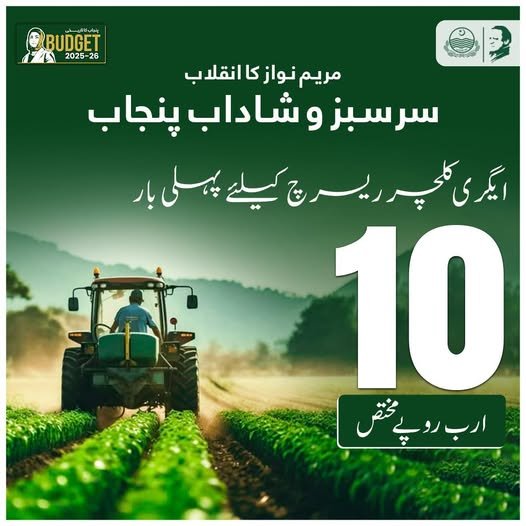
The Green Tractor Program is a large-scale agricultural mechanization initiative under Chief Minister Maryam Nawaz. For the first time in the province’s history, 50,000 tractors will be provided to farmers over a three-year period.
This program recognizes that mechanization is essential for improving agricultural productivity and reducing the physical burden on farmers. The subsidized distribution model ensures that even small farmers can access modern machinery.
How many tractors have been distributed so far?
Two phases of the program have already been completed, with 21,000 tractors distributed. Currently, 34,000 Green Tractors are being distributed across Punjab in three phases.
The subsidy structure includes:
- Rs. 1 million subsidy on 9,500 high-power tractors
- Rs. 500,000 subsidy on 10,000 tractors ranging from 50 to 65 horsepower
What are the future targets for tractor distribution?
In the next fiscal year, 20,000 additional Green Tractors will be distributed among farmers. In the next phase, a subsidy of Rs. 1.5 million will be offered on high-horsepower tractors and Rs. 750,000 on those of 50 to 65 horsepower.
This phased approach ensures sustainable distribution and allows the government to expand the program based on demand and budget availability.
How transparent is the distribution process?
The entire distribution process has been fully computerized to eliminate human intervention. The government has completed the physical verification of 12,650 tractors through a new field survey.
This transparency ensures that tractors reach the intended beneficiaries without corruption or favoritism. The digital system tracks each tractor from allocation to delivery.
What is the Agriculture Internship Program for graduates?
The Punjab government has enrolled 3,000 agriculture graduates in a paid internship program, providing agricultural extension services to farmers across 12 million acres of farmland. Interns receive a monthly stipend of Rs. 60,000.
The government has approved the induction of an additional 1,500 agriculture graduates in the next phase of the program. This initiative provides young professionals with practical experience while delivering modern advisory services to farmers.
What is the impact of the internship program?
The program has shown impressive results:
- 30% of graduates who completed the program have secured permanent employment
- 50% have been placed in public and private sector jobs
- The program provides hands-on field experience to young professionals
- Modern advisory services are delivered to farmers across the province
This dual benefit of creating employment opportunities while improving agricultural extension services makes the program a model for agricultural sector development.
What are Model Agri Malls and how do they help farmers?
The Punjab government has approved the establishment of 10 state-of-the-art Model Agri Malls equipped with modern facilities across the province. These malls will provide farmers with modern agricultural services, quality inputs, and technical assistance under one roof.
The Model Agri Malls will offer:
- Quality agricultural inputs including seeds, fertilizers, and pesticides
- Modern agricultural services
- Technical assistance from agricultural experts
- Access to market information
- Training and capacity building programs
What is the Thal Transformation Programme?
The Thal Transformation Programme, approved by Chief Minister Maryam Nawaz, envisages the construction of 1,000 water storage ponds and irrigation schemes across the Thal region. The program also includes planting orange orchards on 10,000 acres in underdeveloped areas of Thal.
This comprehensive program aims to:
- Improve water availability through storage infrastructure
- Promote horticulture through orchard development
- Enhance rural livelihoods in underdeveloped areas
- Diversify agricultural production in the Thal region
What is the agricultural mechanization program?
Under the agricultural mechanization program, 280 modern agricultural machines have already been distributed to farmers. The government aims to provide a total of 2,000 modern machines by June 2027 to further improve farm productivity and efficiency.
The program also includes:
- Distribution of free laser land levelers to scale up mechanization
- Provision of various agricultural implements
- Modernization of farming practices
- Reduction of cultivation costs
What is the digital soil mapping initiative?
A digital GPS-based soil map of Punjab is being developed through real-time cloud data storage. Soil test results and customized fertilizer recommendations are uploaded to a central cloud network, generating a comprehensive digital soil map of the province.
Farmers receive recommendations directly via SMS and WhatsApp. This digital infrastructure enables:
- Real-time data collection and analysis
- Customized recommendations for individual farms
- Tracking of soil health over time
- Evidence-based agricultural policy formulation
What robotic and AI technologies are being introduced?
Punjab has signed agreements with international agritech firms, including China’s AI Force Tech, to assemble robotic agricultural equipment locally. The province is transitioning from conventional agricultural practices to a scientific and digital model.
The introduction of robotic and AI technologies aims to:
- Reduce production costs through automation
- Increase per-acre farm income
- Improve precision in agricultural operations
- Reduce labor requirements for repetitive tasks
- Enable data-driven decision making in farming
Comprehensive Comparison and Impact Analysis
How do the electric bus and digital farming initiatives compare?
| Program Feature | Electric Bus Transit | Digital & Smart Farming |
|---|---|---|
| Primary Goal | Zero-emission urban mobility & smog reduction | Precision resource management & higher crop yields |
| Current Scale | ~1,100 buses active; expanding to 5,000 | 900,000+ active digital Kisan Cards |
| Target Area | Urban routes and 147 provincial tehsils | 12 million acres of rural farmland |
| Tech Stack | GPS tracking, CCTV, real-time fleet dashboards | Cloud-based soil mapping, mobile apps, automated SMS/WhatsApp |
| Financial Relief | Flat Rs. 20 fare; Free for students/women/seniors | Rs. 360 billion in interest-free loans & paid tech internships |
What is the total investment in Punjab’s Green Revolution?
The electric bus project alone represents a Rs. 200 billion investment, with an additional Rs. 40 billion allocated for charging infrastructure. The Kisan Card scheme has disbursed Rs. 360 billion in interest-free agricultural loans.
The Green Tractor Program involves substantial subsidy allocations:
- Rs. 1 million subsidies on high-power tractors
- Rs. 500,000 subsidies on 50-65 horsepower tractors
- Additional Rs. 1.5 million subsidies in the next phase
This combined investment demonstrates the government’s commitment to transforming both urban and rural sectors of the economy.
What is the environmental impact of these initiatives?
The electric bus project is designed to reduce the province’s reliance on diesel-run transport and cut vehicular emissions in urban centers. The buses are air-conditioned, emission-free, and designed for sustainable urban mobility.
On the agricultural front, the biomass steam plant inaugurated in Sheikhupura is expected to reduce carbon dioxide emissions by 24,345 tonnes per year while discouraging the open burning of agricultural waste. This dual approach to environmental protection addresses both transportation and agricultural sources of pollution.
Who is the father of the Green Revolution?
Norman Borlaug is widely recognized as the father of the Green Revolution for his work developing high-yielding wheat varieties in the mid-20th century. The original Green Revolution in the 1960s focused on chemical-intensive, high-yield monoculture.
The 2026 Punjab Green Revolution, led by Maryam Nawaz, represents a fundamental departure—emphasizing digital precision, sustainability, clean energy, and farmer financial inclusion rather than chemical dependency. This new approach recognizes the lessons learned from the original Green Revolution and incorporates modern technology and sustainability principles.
What is the Green Revolution in Pakistan?
In Pakistan, the Green Revolution has historically referred to agricultural modernization efforts that began in the 1960s, similar to India’s experience. However, the 2026 initiative under Chief Minister Maryam Nawaz represents a “Green Revolution 2.0” that combines agricultural modernization with clean public transport, digital farming, and sustainable environmental practices.
This new phase of the Green Revolution in Pakistan incorporates:
- Digital farming technologies
- Clean public transportation
- Financial inclusion for small farmers
- Sustainable agricultural practices
- Environmental protection measures
What is the impact of the Green Revolution on Punjab’s agriculture?
The 2026 Green Revolution is transforming Punjab’s agricultural sector through several mechanisms:
- Interest-free credit access through the Kisan Card
- Precision soil testing through Lab on Wheels
- Mechanization through the Green Tractor Program
- Digital advisory services through agriculture graduates
- Modern agricultural inputs through Model Agri Malls
- Water management through the Thal Transformation Programme
These initiatives aim to reduce production costs, increase per-acre farm income, and promote sustainable farming practices. The comprehensive approach ensures that farmers have access to the resources and knowledge they need to improve their productivity and profitability.
Future Outlook and Conclusion
What is the long-term vision for Punjab’s Green Revolution?
The long-term vision encompasses a comprehensive green transformation across multiple sectors. The electric bus fleet is targeted to reach 5,000 buses within five years, covering all 147 tehsils. The Kisan Card program aims to reach one million farmers.
The Green Tractor Program will distribute 50,000 tractors over three years. The Punjab government is also planning Green Economic Zones featuring integrated clean energy infrastructure including solar, wind, hydro, ground-source energy, battery storage, and HVO backup systems.
This integrated vision recognizes that sustainable development requires simultaneous progress in multiple sectors, from clean energy to sustainable agriculture to modern transportation.
How is Punjab balancing urban and rural development?
The dual-pronged approach ensures balanced development across urban and rural areas. Urban centers benefit from clean, affordable public transport that reduces smog and improves mobility. Rural areas benefit from digital farming tools, interest-free credit, mechanization, and scientific advisory services.
This integrated approach recognizes that sustainable development must address both urban environmental challenges and rural agricultural productivity. The simultaneous focus on both sectors ensures that no region is left behind in Punjab’s development journey.
What are the key success metrics of Punjab’s Green Revolution?
Key success metrics include:
- Number of electric buses deployed and passengers served
- Kisan Card distribution and loan disbursement
- Loan recovery rate (currently 99%)
- Tractor distribution numbers
- Soil samples tested through Lab on Wheels
- Reduction in carbon emissions
- Increase in agricultural productivity
- Improvement in farmer incomes
These metrics provide a comprehensive picture of the program’s impact and guide future policy decisions.
What challenges does Punjab’s Green Revolution face?
Challenges include the fiscal sustainability of transport subsidies—the 69-day free travel subsidy cost the Punjab government Rs. 4.209 billion—and the need to rapidly expand charging infrastructure to match fleet growth.
On the agricultural front, challenges include:
- Ensuring widespread adoption of digital farming practices
- Maintaining the impressive 99% loan recovery rate as the program scales
- Building capacity for new technologies
- Addressing infrastructure gaps in rural areas
- Ensuring sustainable water management
These challenges require careful planning and continuous monitoring to ensure the long-term success of the initiatives.
Conclusion: A New Chapter in Punjab’s Development
The year 2026 marks a watershed moment in Punjab’s development trajectory. Under Chief Minister Maryam Nawaz’s leadership, the province is executing the most comprehensive green transformation in its history—one that simultaneously addresses urban environmental challenges through electric mobility and rural agricultural stagnation through digital farming.
With Rs. 200 billion invested in clean transport, Rs. 360 billion disbursed in interest-free agricultural loans, and ambitious targets for fleet expansion and farmer outreach, Punjab is laying the foundation for a sustainable, inclusive, and prosperous future. The 2026 Green Revolution represents not just a policy shift but a fundamental reimagining of how public services, technology, and environmental stewardship can work together to improve the lives of millions of Punjabis.
The success of this dual-pronged approach will serve as a model for other provinces and countries seeking to achieve sustainable development while improving the quality of life for their citizens. The combination of modern technology, financial inclusion, andenvironmental protection offers a comprehensive path forward for Punjab’s continued development.
Disclaimer
This article is based on official government announcements and program documentation. Readers are advised to verify current information through official Punjab government channels as programs may be updated or modified.
Frequently Asked Questions
When was the Green Revolution started in Punjab?
The original Green Revolution in Punjab began in the late 1960s, but the 2026 initiative under Maryam Nawaz represents a “Green Revolution 2.0” focused on digital farming, clean transport, and sustainability rather than chemical-intensive monoculture.
What was the Green Revolution in Pakistan?
In Pakistan, the Green Revolution historically referred to agricultural modernization efforts that began in the 1960s. The 2026 initiative represents an updated version combining agricultural modernization with clean public transport and digital farming.
When did the Green Revolution start in Pakistan?
Agricultural modernization efforts in Pakistan began in the 1960s, similar to India’s experience. The current Green Revolution initiative in Punjab started in 2026 under Chief Minister Maryam Nawaz’s leadership.
Who is the father of the Green Revolution?
Norman Borlaug is widely recognized as the father of the original Green Revolution for his work developing high-yielding wheat varieties in the mid-20th century.
How many electric buses are currently operational in Punjab?
Approximately 1,100 electric buses are currently operational across various cities in Punjab, with more being added regularly to reach the target of 5,000 buses within five years.
What is the fare for electric buses in Punjab?
The general public transit fare is set at a flat rate of Rs. 20 per trip, with 100% free travel for students, women, senior citizens aged 65 and above, and differently-abled individuals.
How many Kisan Cards have been distributed?
The scheme has issued 900,000 Kisan Cards so far, with a target of reaching one million by August 31.
What is the Lab on Wheels project?
The Lab on Wheels project provides farmers with scientific soil and water testing services at their doorsteps through mobile laboratories, with annual targets of 20,000 soil samples.
How many Green Tractors are being distributed?
34,000 Green Tractors are currently being distributed across Punjab in three phases, with a target of 50,000 tractors over three years.
What is the total investment in Punjab’s Green Revolution?
The electric bus project represents a Rs. 200 billion investment with an additional Rs. 40 billion for charging infrastructure, while the Kisan Card scheme has disbursed Rs. 360 billion in interest-free agricultural loans.

Add a Comment