
The Wazir-e-Azam Apna Ghar Program is a government-subsidized housing finance scheme offering low-income and middle-income Pakistani families the opportunity to purchase, build, or renovate a home with financing of up to PKR 10 million at a fixed 5% markup rate for the first ten years. This flagship initiative makes homeownership attainable for the first time for millions of citizens who cannot afford to build houses on their own.
Here is what you will learn from this complete guide:
- Maximum loan limits, markup rates, and repayment tenure details.
- Step-by-step eligibility criteria for salaried, self-employed, and informal workers.
- Exact monthly installment amounts for different loan sizes.
- Complete list of 15+ participating banks including Meezan Bank, HBL, UBL, and Allied Bank.
- Online registration process via the official apnaghar.gov.pk portal.
- Mandatory documentation for salaried individuals and business owners.
- Latest SBP policy updates including increased Debt Burden Ratio of 65%.
Key Takeaways
- 5% Fixed Markup for 10 Years: The government subsidizes the first ten years at a flat 5% rate, after which the loan transitions to 1-Year KIBOR + 3%.
- 90:10 Loan-to-Value Ratio: Borrowers only need to contribute a 10% down payment; banks finance the remaining 90% of the property’s forced sale value.
- Zero Processing Fees: The scheme strictly prohibits any processing charges or prepayment penalties, ensuring transparent and affordable financing.
- DBR Now 65%: The State Bank increased the Debt Burden Ratio to 65% of net monthly income, significantly expanding eligibility for applicants with existing consumer debt.
- First-Time Homeowner Requirement: Applicants must not already own any residential property registered in their name.
- Read More: Apna Ghar Scheme – Wazir-e-Azam Apna Ghar Program (1CR Home Loan)
- Read More: Prime Minister House Loan Scheme In Pakistan Online Apply
- Read More: Apna Ghar Scheme – Wazir-e-Azam Apna Ghar Program (1CR Home Loan)
- Read More: Zarai Qarza Scheme – Farmer Loan Scheme (10 Lakh Zarkhez-e App)
Apna Ghar Scheme – Wazir-e-Azam Apna Ghar Program (1CR Home Loan)
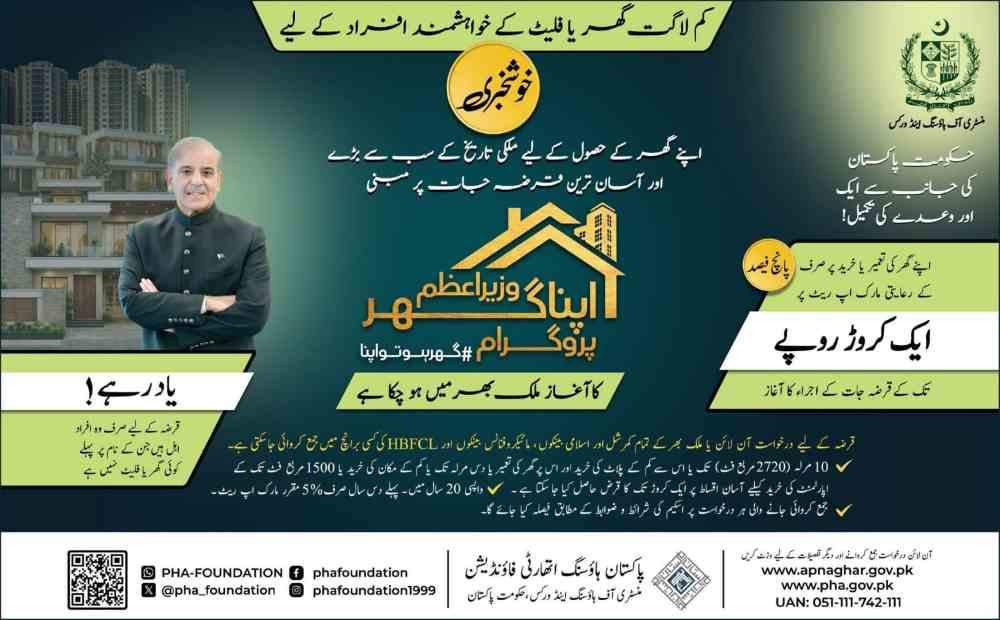
Table Of Contents
What Is the Wazir-e-Azam Apna Ghar Program and How Does It Work?
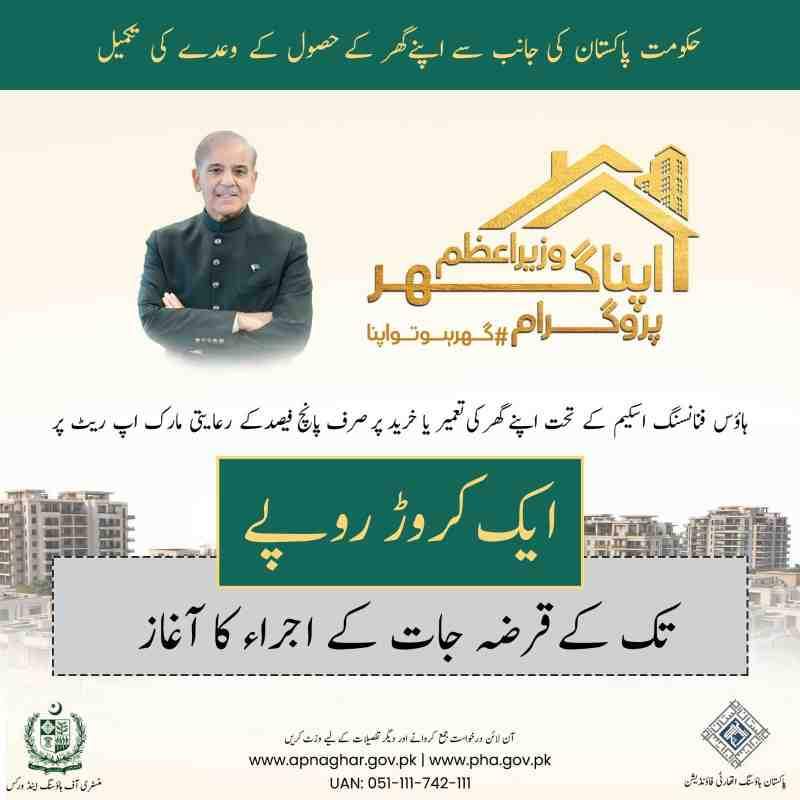
The Wazir-e-Azam Apna Ghar Program (also known as Ghar Ho Tu Apna) is a federal subsidized housing finance initiative supervised by the State Bank of Pakistan that provides dynamic financing of up to PKR 10 million at affordable, government-subsidized rates to buy, build, or renovate a home. The scheme is designed as a risk-sharing facility between the government, participating financial institutions, and the borrower, with the government absorbing a portion of the markup cost for the first ten years.
The program operates through a simple process: eligible citizens apply through designated banks or the official online portal, undergo credit assessment, and upon approval, receive financing to purchase a ready house, construct on owned land, or buy a plot and build simultaneously. The government provides a markup subsidy that caps the customer’s payable rate at 5% per annum for the first decade, after which the loan transitions to standard bank pricing based on the 1-Year KIBOR plus 3%.
The Wazir-e-Azam Apna Ghar Program replaces the earlier “Mera Ghar-Mera Ashiana” initiative and has been formally renamed by the State Bank of Pakistan to reflect the expanded scope and increased financing limits.
What Is the Official Name of the Apna Ghar Scheme?
The official name of the scheme is “Wazir-e-Azam Apna Ghar Program – Ghar Ho Tu Apna” . The State Bank of Pakistan issued a formal notification renaming the previous “Mera Ghar-Mera Ashiana” initiative to this new title. All participating banks have updated their product literature, application forms, and online portals to reflect this change. Many people continue to search for the program under its previous names, but the official branding for all regulatory and banking documentation is now “Wazir-e-Azam Apna Ghar Program.”
Wazir-e-Azam Apna Ghar Program vs Apni Chhat Apna Ghar: What Is the Difference?
The Wazir-e-Azam Apna Ghar Program is a federal initiative operating nationwide through commercial banks with loans up to PKR 10 million. In contrast, Apni Chhat Apna Ghar is a provincial program specific to Punjab, offering interest-free loans through the Bank of Punjab to low-income families with specific PMT (Poverty Means Test) score requirements. The federal program does not impose PMT score restrictions and is available to all resident Pakistanis who meet the standard eligibility criteria, regardless of which province they reside in.
What Is the Total Budget and National Housing Target Under This Scheme?
The federal government has allocated Rs3.2 trillion for the program, targeting the construction of 500,000 homes nationwide over a five-year period. In the first year alone, an initial allocation of Rs321 billion has been set aside to fund 50,000 homes. The scheme covers all four provinces (Punjab, Sindh, Khyber Pakhtunkhwa, Balochistan), as well as the federal capital Islamabad, Azad Jammu and Kashmir (AJK), and Gilgit-Baltistan (GB).
What Is the Maximum Loan Amount Under the Wazir-e-Azam Apna Ghar Program?
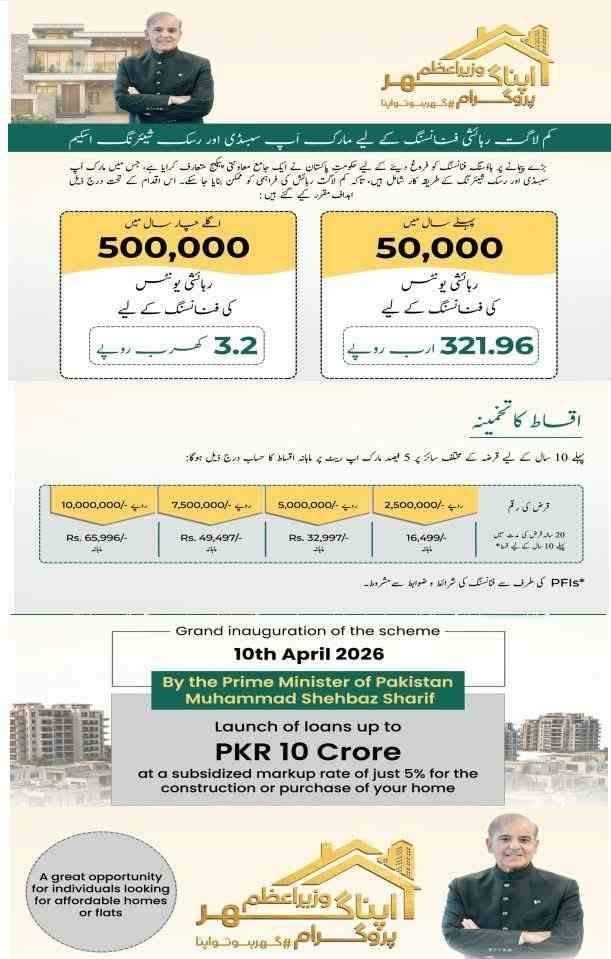
The maximum financing amount under the scheme is PKR 10 million. The program is structured into four distinct loan slabs: PKR 2.5 million, PKR 5 million, PKR 7.5 million, and PKR 10 million, allowing borrowers to select the amount that best aligns with their income and property requirements. The minimum financing amount is PKR 0.3 million (300,000 PKR), ensuring that even lower-income households can access the scheme for small homes or basic construction needs.
What Is the Maximum Repayment Tenure for the PKR 10 Million Home Loan?
The maximum repayment tenure under the Wazir-e-Azam Apna Ghar Program is 20 years. Borrowers are not required to take the full tenure; they can choose shorter repayment periods of 10 years or 15 years based on their financial capacity and preference for higher monthly installments with lower total interest cost.
Can the Loan Cover Only the Purchase of a Ready House, or Can It Finance Construction as Well?
The loan can be utilized for three distinct purposes:
- Type 1(A): Residential construction on the applicant’s owned land (building a house on a plot you already possess).
- Type 1(B): Combined purchase of land and residential construction (buying a plot and building a house simultaneously).
- Type 2: Purchase of a ready-made house or an apartment/flat.
The scheme does not currently permit financing for pure renovation of an existing house or for commercial property acquisition.
What Are the Maximum Permissible Property Sizes for Houses and Flats?
The program imposes strict size limitations on eligible properties:
- Houses: Up to 10 Marla (maximum covered area of 2,720 square feet). Properties between 5 Marla and 10 Marla are fully eligible.
- Flats and Apartments: Maximum covered area of 1,500 square feet.
There is no maximum cap on the total property value, meaning the property’s market price can exceed the loan amount; the borrower simply pays the difference as additional equity.
What Is the Markup Rate for the First 10 Years of the Loan?
The government has fixed the customer markup rate at 5% per annum for the first ten years of the loan term. This subsidized rate is one of the most competitive housing finance rates available in the Pakistani market and remains fixed regardless of fluctuations in KIBOR or other market conditions during the initial decade.
What Happens to the Interest Rate After the 10th Year of the Loan?
After the initial ten-year subsidized period, the markup rate transitions to the standard bank market rate, calculated as 1-Year KIBOR + 3% per annum. This transition applies from the 11th year onward for the remainder of the loan tenure. Borrowers should plan for potentially higher monthly payments in years 11 through 20, although the loan balance by that point will be substantially reduced due to ten years of principal repayment.
How Does the Subsidized Rate Compare to Conventional Bank Home Loan Rates?
Conventional home loans in Pakistan without government subsidy typically range between 18% to 24% per annum, depending on the borrower’s credit profile and the bank’s pricing policy. The 5% fixed rate under the Wazir-e-Azam Apna Ghar Program represents a reduction of 13 to 19 percentage points, translating to hundreds of thousands of rupees in interest savings over the first ten years. For a PKR 5 million loan, the difference in monthly payments between a conventional 20% loan and the subsidized 5% rate is approximately PKR 50,000 per month.
What Is the Minimum Monthly Income Required to Qualify for This Scheme?
The minimum monthly income requirement for salaried individuals applying for the Wazir-e-Azam Apna Ghar Program is PKR 35,000 net income per month. This threshold ensures that basic loan affordability is maintained while still allowing lower-middle-income families to access the program. Self-employed individuals may face slightly higher effective requirements due to the additional documentation needed to verify business income.
What Is the Minimum Monthly Income for Salaried and Self-Employed Individuals?
Income requirements vary slightly by participating bank, but the following general thresholds apply:
- Salaried individuals (permanent employment): Minimum net monthly income of PKR 35,000 after all statutory deductions.
- Salaried individuals (contractual employment): Minimum net monthly income of PKR 35,000 with at least one year of continuous contract history.
- Self-employed businessmen: Minimum gross monthly income of PKR 40,000 with two years of business continuity.
- Self-employed professionals (doctors, lawyers, engineers): Minimum gross monthly income of PKR 40,000 with relevant professional certification.
- Pensioners: Minimum net monthly pension income of PKR 35,000.
SBP Increases Debt Burden Ratio to 65%: What Does This Mean for Applicants?
The State Bank of Pakistan has increased the allowable Debt Burden Ratio (DBR) to 65% of the borrower’s net disposable income. This means that total monthly repayment obligations, including the proposed housing loan installment and any existing consumer debt (credit cards, personal loans, auto loans), can now reach up to 65% of the applicant’s net monthly income. Previously, the DBR limit was set lower, which excluded many otherwise eligible applicants. This expansion significantly widens access for families with existing financial commitments.
Practical example of the 65% DBR:
If your net monthly disposable income is PKR 100,000, you can now allocate up to PKR 65,000 per month toward total debt servicing, including the new Apna Ghar installment and any other existing loan payments.
Can Two Family Members Club Their Income to Apply for a Higher Loan Amount?
Yes, income clubbing is permitted under the Wazir-e-Azam Apna Ghar Program. Co-applicants such as spouses, parents, or adult children can combine their documented incomes to meet the eligibility requirements and qualify for a higher loan amount. For example, Meezan Bank allows 100% income clubbing between spouses, meaning both incomes are fully considered when calculating maximum loan eligibility. This feature is particularly valuable for dual-income households where neither individual alone meets the required income threshold for a PKR 10 million loan.
What Is the Required Down Payment or Equity Contribution for This Loan?
The required minimum equity contribution (down payment) from the borrower is 10% of the property’s forced sale value. The bank provides financing for the remaining 90% under the 90:10 Loan-to-Value (LTV) ratio mandated by the State Bank of Pakistan. The LTV is calculated based on the forced sale value of the property as determined by the bank’s approved valuation panel, not necessarily the market purchase price.
Can You Contribute More Than 10% Equity to Reduce the Loan Burden?
Borrowers are encouraged to contribute more than the minimum 10% equity if their financial situation permits. Increasing your down payment:
- Proportionally reduces the loan amount and therefore the total monthly installment.
- Lowers the total interest paid over the full loan tenure.
- Improves the LTV ratio, potentially resulting in more favorable credit terms.
- May accelerate the credit approval process by demonstrating stronger financial commitment.
What Is the Loan-to-Value (LTV) Ratio for the Apna Ghar Program?
The LTV ratio is fixed at 90:10 throughout the program’s framework. The bank finances 90% of the forced sale value of the property, and the borrower contributes the remaining 10% as equity. This ratio applies uniformly across all participating banks and all approved property types (houses, flats, or plots). For construction financing on owned land, the LTV is calculated based on the total estimated construction cost plus the land value, with the borrower still required to contribute 10% of that total.
What Documents Are Required to Apply for the Apna Ghar Program?
The documentation requirements differ based on the applicant’s employment status and income source. All documents submitted must be clear, legible, and up to date.
Documents Required for Salaried Individuals
Salaried applicants must submit the following complete documentation package to apply for the Wazir-e-Azam Apna Ghar Program:
- Valid Computerized National Identity Card (CNIC) copy for the applicant and any co-applicant or guarantor.
- Original bank statements for the last six months showing salary credit and regular transactions.
- Certified copy of the most recent pay slip or salary certificate from the employer.
- Employment letter or contract confirming position, length of service, and salary details.
- Copy of title document for the property being purchased or constructed.
- Passport-sized photographs as specified by the bank.
- Any other document requested by the bank during the processing phase.
Documents Required for Self-Employed Businessmen and Business Owners
Self-employed applicants must submit a more extensive documentation package to verify business income continuity:
- Valid Computerized National Identity Card (CNIC) copy.
- Bank statements for the last 12 months from all business accounts.
- Three years of proof of business operations, including:
- Tax returns filed with the Federal Board of Revenue (FBR).
- Bank certificate of business continuity.
- Professional association membership certificate or practice license for professionals.
- Business registration documentation (Partnership deed, Proprietorship registration, or Company incorporation certificate).
- Copy of title document for the property.
- Passport-sized photographs.
- Any other document requested by the bank.
Documents Required for Informal Income Applicants
For freelancers, daily wagers, shopkeepers, and other individuals with informal income sources, the Bank of Punjab and other participating banks provide a dedicated “Informal Income Person” application form in both English and Urdu. Informal income applicants may need to provide:
- Affidavits of income declaration.
- Utility bill payment history to demonstrate residence stability.
- Letters from community leaders or trade associations vouching for income and character.
- Alternative transaction records such as remittance receipts or digital payment history.
Which Banks Are Offering the Wazir-e-Azam Apna Ghar Program?
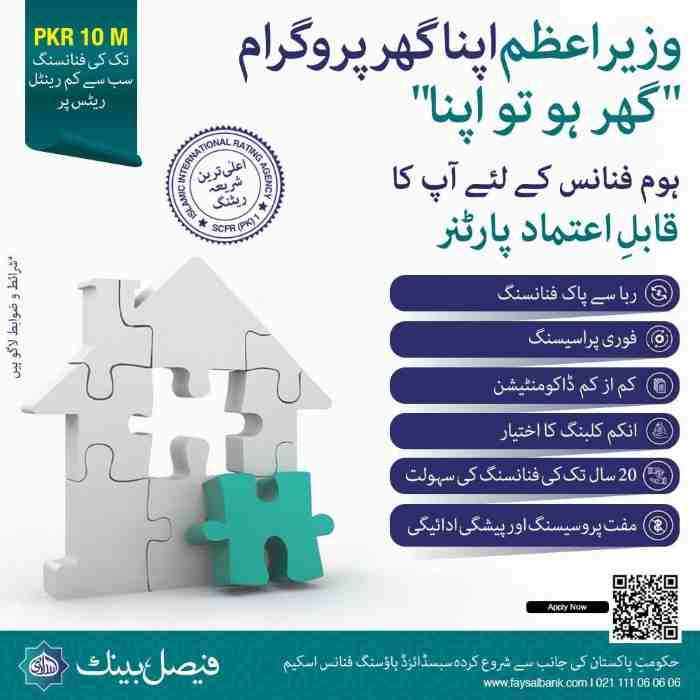
The program is available through a nationwide network of Participating Financial Institutions (PFIs) , including conventional commercial banks, Islamic banks, microfinance banks, and the House Building Finance Corporation (HBFCL). Applications are accepted at designated branches of each participating bank.
Wazir e Azam Apna Ghar Scheme Meezan Bank
Meezan Bank offers the facility under its flagship Islamic home financing product using the Diminishing Musharakah mode of financing. The bank maintains designated branches across all cities where it has a presence, and applications are processed through the official portal as well as in-branch submissions. Meezan Bank’s rental rate is 5% for the first ten years and variable at KIBOR+3% for subsequent years.
Wazir azam Apna Ghar Scheme HBL (Habib Bank Limited)
Habib Bank Limited (HBL) is one of the primary participating banks under the program, accepting applications through its designated branches nationwide. HBL offers both conventional and Islamic financing options for the scheme.
Wazir e azam Apna Ghar scheme UBL (United Bank Limited)
United Bank Limited (UBL) actively participates in the Wazir-e-Azam Apna Ghar Program, offering comprehensive housing finance solutions through its nationwide branch network.
Wazir e azam Apna Ghar Program Allied Bank
Allied Bank offers the housing finance facility under Shariah-compliant Diminishing Musharakah guidelines. Every Allied Bank branch is designated to receive and process applications for the Wazir-e-Azam Apna Ghar Program – Ghar Ho Tu Apna scheme.
Wazir azam Apna Ghar Program Meezan Bank and Other Islamic Banks
In addition to Meezan Bank, several other Islamic banks participate in the program:
- Bank Islami Pakistan Limited
- MCB Islamic Bank
- Faysal Bank (Islamic banking division)
- Askari Bank (Shariah-compliant Diminishing Musharakah)
- Al Baraka Bank (Pakistan) Limited
These Islamic banks use the Diminishing Musharakah or Ijarah modes of financing, which are fully Shariah-compliant and structured as partnership-based transactions rather than interest-bearing loans.
Complete List of All Participating Banks in the Apna Ghar Program
The following banks and financial institutions accept applications under the Wazir-e-Azam Apna Ghar Program:
- Meezan Bank Limited
- Habib Bank Limited (HBL)
- United Bank Limited (UBL)
- Allied Bank Limited
- Bank Alfalah
- MCB Islamic Bank
- Faysal Bank
- Bank Al Habib
- Standard Chartered Bank (Pakistan)
- JS Bank
- HABIBMETRO Bank
- Bank of Punjab (BOP)
- Askari Bank
- BankIslami Pakistan Limited
- SAMBA Bank Limited
- Soneri Bank
- National Bank of Pakistan (NBP)
How to Apply for the Wazir-e-Azam Apna Ghar Program Online
The application process has been significantly simplified with the launch of the official government portal. Eligible citizens can now complete most of the process digitally, tracking their application status online.
Step-by-Step Online Registration on the Apna Ghar Portal
Step 1: Access the Official Portal Visit the official government website at apnaghar.gov.pk. Click the ‘Create Account’ button and enter your name, CNIC number, mobile number, email address, and create a secure password.
Step 2: Log In to Your Account Sign in using your CNIC and the password you created. Read the portal instructions carefully and click ‘Apply Now’ to begin a new application.
Step 3: Select Your Income Category Choose your exact income category from three options: Salaried Person, Business Income, or Informal/Other Income.
Step 4: Enter Personal and Financial Details Input your preferred bank, branch name, and city. Provide your exact net monthly income (after taxes and deductions). Salaried individuals should use their active salary account for verification purposes.
Step 5: Set Financing Goals Select the exact purpose of your loan (purchase, construction, or plot+construction), the total loan amount needed, your intended equity contribution percentage, the property city, and your preferred repayment tenure (10, 15, or 20 years).
Step 6: Provide Personal Information Fill out your complete personal identity details, current residence status, and exact mailing addresses. If you have a co-applicant, select ‘Yes’ and provide their complete information. You must also add details for a guarantor.
Step 7: Upload Documents Upload clear PDF or JPG copies of all required documents: CNIC (front and back), recent photograph, employment certificates, salary slips, a six-month bank statement, an account maintenance certificate, and your next of kin’s CNIC.
Step 8: Submit the Application Review all entered information for accuracy and completeness. Submit the application and you will receive a confirmation message or email with your unique application tracking number.
How Long Does It Take for a Bank to Approve and Disburse the Loan?
The State Bank of Pakistan has mandated that lending institutions must complete the credit approval process within 15 working days from the moment they receive a fully documented application under the Apna Ghar scheme. This strict timeline addresses previous complaints about processing delays and ensures faster disbursement. After approval, disbursement timelines vary by bank but typically range from 7 to 21 working days depending on property documentation and valuation completion.
Can I Apply for the Apna Ghar Loan at a Physical Bank Branch Instead of Online?
Yes, applications can be submitted in person at designated branches of participating financial institutions. Each bank maintains dedicated counters or officers specifically trained to handle Wazir-e-Azam Apna Ghar Program applications. Walk-in applicants receive the same processing timelines as online applicants. Some individuals prefer in-branch submission to receive hands-on assistance with documentation.
Who Is Eligible to Apply for the Wazir-e-Azam Apna Ghar Scheme?
Eligibility is governed by citizenship, property ownership status, age, income, and employment history. All criteria must be met for an application to proceed to credit assessment.
Citizenship and CNIC Requirements
You must be a resident Pakistani citizen holding a valid Computerized National Identity Card (CNIC). Overseas Pakistanis are not eligible for this specific subsidized scheme, although they may be eligible for conventional housing finance products offered by the same banks.
First-Time Homeowner Requirement: Can I Apply If I Already Own an Apartment?
The program is strictly for first-time homeowners. You cannot apply if you already own any residential housing unit (house or apartment) registered in your name in Pakistan. If you currently own any residential property, even a small apartment, you are not eligible. This requirement ensures that the subsidized financing benefits those without any existing housing asset.
Can Single Women or Widows Apply for This Subsidized Housing Scheme?
Single women and widows are fully eligible to apply for the Wazir-e-Azam Apna Ghar Program, provided they meet all other eligibility criteria including income requirements, first-time homeowner status, and age limits. The program is gender-neutral and does not discriminate based on marital status. Women are actively encouraged to apply, and many participating banks have dedicated female relationship managers to assist with applications.
Can a Government Employee Apply for the Wazir-e-Azam Apna Ghar Program?
Yes, government employees at the federal, provincial, and local levels are fully eligible to apply. They must submit the same documentation as other salaried individuals, including a certified copy of their recent pay slip. Pensioners who have retired from government service are also eligible, provided they meet the age at maturity requirements.
Can Non-Salaried Individuals or Freelancers Apply for This Housing Loan?
Yes, freelancers and individuals with informal income sources are eligible to apply. They must select the “Informal/Other Income” category during online registration and provide alternative documentation as described earlier. Freelancers should maintain regular bank statements showing consistent income deposits to facilitate verification.
What Is the Age Limit for Salaried Individuals and Businessmen Applying for This Scheme?
Age requirements differ based on employment status:
For salaried individuals:
- Minimum age: 21 to 25 years (varies slightly by bank).
- Maximum age at loan maturity: Must not exceed 60 years or the official retirement age, whichever is earlier.
For self-employed individuals and businessmen:
- Minimum age: 25 years.
- Maximum age at loan maturity: 70 years.
For co-applicants without income clubbing:
- Maximum age: 70 years at the time of financing maturity.
What Are the Employment History Requirements?
Salaried individuals:
- Permanent employment: Minimum 6 months of continuous work history in the same industry or field.
- Contractual employment: Minimum 1 year of continuous work history in the same industry or field, plus total documented experience of 2 years.
Self-employed individuals and business owners:
- Minimum 2 years in the current business or industry.
- Business continuity must be verifiable through tax returns or bank statements.
What Is the Estimated Monthly Installment for a PKR 5 Million Loan?
Based on the 5% subsidized markup rate for the first ten years, the tentative monthly installments under the Wazir-e-Azam Apna Ghar Program are as follows:
| Financing Amount | Monthly Installment (10-Year Tenure) | Monthly Installment (15-Year Tenure) | Monthly Installment (20-Year Tenure) |
|---|---|---|---|
| PKR 2.5 Million | PKR 26,516 | PKR 19,770 | PKR 16,499 |
| PKR 5.0 Million | PKR 53,033 | PKR 39,540 | PKR 32,998 |
| PKR 7.5 Million | PKR 79,549 | PKR 59,310 | PKR 49,497 |
| PKR 10.0 Million | PKR 106,066 | PKR 79,079 | PKR 65,996 |
Source: Askari Bank Housing Finance Schedule
What Is the Monthly Installment for a PKR 3 Million Loan Under This Scheme?
For a PKR 3 million loan: The monthly installment is PKR 19,799 for a 10-year tenure, PKR 23,724 for a 15-year tenure, and PKR 31,820 for a 20-year tenure.
Is There a Processing Fee or Hidden Charges for the Apna Ghar Loan?
There are zero processing fees for the Wazir-e-Azam Apna Ghar Program. The scheme explicitly prohibits any processing charges, ensuring transparency and affordability for all applicants regardless of loan amount.
Are There Any Hidden Costs or Additional Charges?
Beyond the zero processing fee, there are no prepayment penalties or balloon payment penalties. However, borrowers may be responsible for actual charges incurred for:
- Legal report charges (at actual cost).
- Property valuation charges (at actual cost).
- Income estimation charges (applicable only for business applicants; at actual cost).
- Documentation charges collected at the time of signing the Musharakah Agreement according to financing limits.
All these charges are transparently disclosed before disbursement, and the borrower is not required to pay any hidden or unexpected fees.
Is This Home Loan Program Shariah-Compliant or Available Through Islamic Banking?
Yes, the Wazir-e-Azam Apna Ghar Program is available in both conventional and Shariah-compliant Islamic versions. Islamic banks offer the facility under the Diminishing Musharakah mode of financing, which is fully compliant with Islamic principles and has been certified by their respective Shariah boards.
How Does Diminishing Musharakah Work for the Apna Ghar Program?
Under Diminishing Musharakah, the bank and the customer enter into a partnership as joint owners in the property. The bank then leases its proportionate share of the property to the customer against periodic rental payments. Simultaneously, the customer purchases the bank’s share of the property gradually over the financing period through additional payments. At the end of the term, the customer becomes the complete owner of the asset. This structure avoids interest (riba) by replacing it with rental income and asset transfer.
Which Islamic Banks Offer Shariah-Compliant Versions of the Scheme?
- Meezan Bank (using Diminishing Musharakah)
- Bank Islami Pakistan Limited
- MCB Islamic Bank
- Faysal Bank (Islamic banking division)
- Askari Bank (Shariah-compliant Diminishing Musharakah)
- Al Baraka Bank (Pakistan) Limited
- Standard Chartered Bank (Saadiq Islamic banking)
Is There a Penalty If I Pay Off the Entire Loan Before 20 Years?
No, the scheme explicitly states there are no prepayment penalties or balloon payment penalties. You can pay off the entire loan before the maximum 20-year tenure without incurring any additional charges. This feature encourages borrowers to clear their debts early when their financial situation improves, without fear of punitive fees. Early repayment reduces total interest cost and accelerates full property ownership.
Does the Property Need to Be Located Within a Specific City or Housing Society?
No, the property can be located in any city across Pakistan where the participating bank has a presence. Meezan Bank and other participating banks explicitly allow financing for properties in all cities where they have branch networks. There is no restriction to specific housing societies or government-approved schemes, provided the property meets the size limitations (10 Marla or 2,720 sq ft for houses; 1,500 sq ft for flats).
Is There a Restriction on Selling the Property After Obtaining the Loan?
The property is mortgaged in favor of the bank as collateral security throughout the loan term. If you wish to sell the property before completing loan repayment, you must either:
- Settle the outstanding loan amount in full from the sale proceeds before transferring title to the buyer, or
- Obtain the bank’s explicit consent for transfer with the buyer assuming the remaining loan liability.
Standard banking practices apply to property disposal during the loan tenure. The bank’s lien must be released before the property can be legally transferred to a new owner.
Common Reasons Why Apna Ghar Loan Applications Are Rejected
Insufficient Income Proof
Cash earners without proper documentation frequently face application rejection. Maintaining regular bank transactions and proper income records is essential to demonstrate income stability.
Poor Credit History
Banks check previous loan repayment behavior through the e-CIB system. Negative history, including overdue payments, write-offs, or waivers, remains on record for two years after settlement and can lead to rejection. Applicants with prior defaults should clear all outstanding obligations and wait two years before reapplying.
Incorrect CNIC Information
Mismatches between application details and NADRA records lead to immediate rejection. Ensure your CNIC information is exactly correct across all documents, including name spelling, CNIC number, and date of birth.
Incomplete Documents
Missing bank statements, affidavits, or other required documents delay processing and often result in rejection. Double-check the complete documentation list for your income category before submission.
How Do I Calculate My Debt Burden Ratio (DBR) for This Loan?
Your DBR is calculated as total monthly debt obligations divided by net monthly disposable income. Under the revised SBP framework, the maximum allowable DBR is 65% of net disposable income.
Example calculation:
- Net monthly income: PKR 100,000
- Existing debt payments (car loan, credit cards, personal loan): PKR 20,000 per month
- Proposed Apna Ghar installment: PKR 35,000 per month
- Total monthly obligations: PKR 55,000
- DBR: 55,000 / 100,000 = 55% (eligible, as it is below the 65% limit)
If the total obligations exceed 65% of net income, the application will be rejected unless additional income can be documented or existing debts reduced.
Can I Buy a Plot and Construct a House Simultaneously Using This Scheme?
Yes, the program specifically allows the financing of plot purchase and house construction simultaneously. This is categorized as “Type 1(B) – Purchase of land and residential construction” under the product structure. The bank will finance both the land acquisition cost and the construction cost, subject to the 90:10 LTV ratio and the property size limitations.
Will the Bank Finance the Construction If I Already Own the Plot?
Yes, if you already own a residential plot, you can use the financing to construct a house on that land. This is categorized as “Type 1(A) – Residential construction on applicant‘s owned land” . The bank will finance the construction cost up to the PKR 10 million limit, subject to the 90:10 LTV ratio based on the total estimated construction value.
Can I Use the PKR 10M Loan Solely for the Renovation of an Existing House?
No, the program is designed for purchase of new housing units, construction of new houses, or combined plot purchase and construction. Pure renovation of an existing house is not an eligible purpose under the scheme. Renovation financing may be available through other conventional home improvement loans offered by participating banks outside of this subsidized program.
SBP Relaxation: Simplified Property Valuation for Properties Up to PKR 5 Million
The State Bank of Pakistan has relaxed property valuation requirements under the Wazir-e-Azam Apna Ghar Program. For properties valued up to PKR 5 million, banks and HBFCL may rely on internal valuation mechanisms rather than requiring external evaluators. For higher-value properties exceeding PKR 5 million, at least one valuation must be conducted by an evaluator from the Pakistan Banks’ Association (PBA)-approved panel. This relaxation reduces processing time and costs for lower-value properties.
Frequently Asked Questions (FAQs)
1. Is the Wazir-e-Azam Apna Ghar Program available to overseas Pakistanis?
No, the program is strictly available only to resident Pakistani citizens holding a valid CNIC. Overseas Pakistanis are not eligible for this subsidized scheme.
2. Can two family members club their income to qualify for a higher loan amount?
Yes, income clubbing is permitted. Co-applicants such as spouses or adult children can combine their documented incomes. Meezan Bank allows 100% income clubbing between co-applicants.
3. What happens if I default on the Apna Ghar loan?
Default triggers standard banking recovery procedures, including legal action and potential foreclosure of the mortgaged property. Negative credit history will be reflected in e-CIB reports for two years after settlement.
4. Is the 5% markup rate guaranteed for the entire first ten years?
Yes, the 5% customer rate is fixed and guaranteed by the government for the first ten years. There is no market fluctuation risk during this period regardless of changes in KIBOR.
5. Can I change my bank after applying for the Apna Ghar Program?
You must select your bank at the time of application. Switching banks may require a fresh application through the new bank, with potential delays in processing.
6. What is the Apna Ghar Scheme online registration last date?
The scheme is a continuous five-year program. There is no single “last date” for registration, as the government aims to process applications throughout the program‘s duration.
7. Is property insurance mandatory under the Apna Ghar Program?
Yes, the financed property must be insured for the full loan amount. Insurance requirements vary by bank and are charged at actual cost. Borrowers may choose their preferred insurance provider subject to bank approval.
Disclaimer: This guide is for informational purposes only and does not constitute financial or legal advice. Program terms, eligibility criteria, and participating bank policies are subject to change. Applicants should verify all details directly with their chosen participating bank before submitting an application.

Add a Comment