
The Suthra Punjab Grand Cleanliness Operation for Eid-ul-Adha is the largest integrated waste management and sanitation campaign in Pakistan’s history, mobilizing over 184,000 workers across all 36 districts to ensure zero-waste disposal of sacrificial animal remains.
What readers will learn from this guide:
- Workforce scale and the 24/7 operational strategy before, during, and after Eid.
- AI-powered monitoring, real-time surveillance, and the new smart cleanliness drive.
- Accessing free biodegradable waste bags and reporting issues via helpline 1139.
- Enforcement of the Rs50,000 fine for illegal waste dumping.
- Designated disposal sites, collection centers, and hygiene protocols.
Key Takeaways
- Record Workforce Mobilized: More than 184,000 sanitation professionals and 40,000 vehicles operate non-stop from the night before Eid until the fourth day.
- AI-Powered Accountability: The first AI-driven sanitation system uses camera-equipped motorbikes, real-time image capture, and biometric attendance to prevent negligence.
- Severe Penalties Enforced: Dumping animal waste in streets, drains, or vacant plots triggers an immediate on-spot fine of Rs50,000.
- Free Biodegradable Bags: Over 1.5 million eco-friendly waste bags are distributed via 319+ camps and door-to-door to facilitate proper offal packing.
- Single Helpline Works: The centralized helpline 1139 operates 24/7 for complaints, bag requests, and tracking waste collection vehicles.
- Read More: Prime Minister House Loan Scheme In Pakistan Online Apply
- Read More: Apna Ghar Scheme – Wazir-e-Azam Apna Ghar Program (1CR Home Loan)
- Read More: Zarai Qarza Scheme – Farmer Loan Scheme (10 Lakh Zarkhez-e App)
- Read More: Zarkhez-e-Asaan Digital Zarai Qarza | 10 Lakh Agriculture Loan Scheme
Maryam Nawaz Suthra Punjab Grand Cleanliness Operation For Eid-ul-Adha

Table Of Contents
What Is the Suthra Punjab Grand Cleanliness Operation for Eid-ul-Adha?
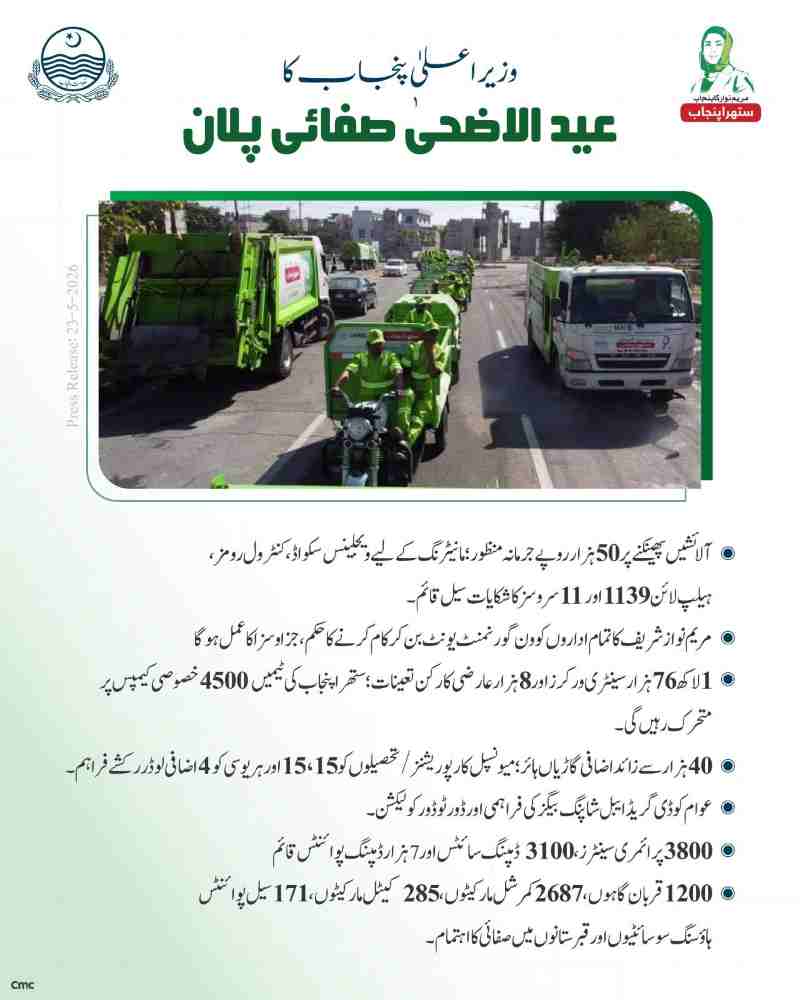
The Suthra Punjab Grand Cleanliness Operation for Eid-ul-Adha is a province-wide, AI-monitored sanitation drive launched by Punjab Chief Minister Maryam Nawaz Sharif to ensure zero-waste disposal of sacrificial animal remains across all 36 districts during the three days of Eid-ul-Adha.
What Is the Official Definition and Scope of the Suthra Punjab Grand Cleanliness Operation?
The campaign is formally defined as Pakistan’s first integrated, technology-enabled waste management system designed to handle the annual surge in sacrificial waste. It covers every urban and rural union council, with operations beginning the night before Eid and continuing until the fourth day of the festival. The scope includes door-to-door collection, designated dumping sites, temporary collection centers, and real-time monitoring through centralized digital dashboards.
Who Launched the Suthra Punjab Eid Cleanliness Campaign?
Chief Minister Maryam Nawaz Sharif personally launched and oversees the operation. She chairs high-level meetings, reviews district-level performance, and has approved the Rs50,000 fine for illegal waste dumping. Her direct involvement ensures that administrative and police officers remain in the field during Eid days.
Which Government Departments Are Involved in the Operation?
Multiple departments coordinate under the Suthra Punjab umbrella: the Suthra Punjab Agency Lahore (SPAL), Lahore Waste Management Company (LWMC), Rawalpindi Waste Management Company (RWMC), district administrations, and the Punjab Police. Each entity handles specific geographic zones while sharing data through the central AI monitoring system.
How Many Districts in Punjab Are Covered by the Suthra Punjab Eid Cleanliness Drive?
All 36 districts of Punjab are covered, including major cities like Lahore, Rawalpindi, Multan, Faisalabad, Sargodha, and Sahiwal, as well as smaller tehsils and rural union councils. The operation leaves no administrative unit unattended.
Is the Suthra Punjab Operation Active in Rural Areas of Punjab?
Yes, the campaign explicitly covers rural areas. Village-level sanitation teams collect waste from doorsteps and transport it to designated dumping sites. However, some rural regions have reported challenges, including absentee staff and clogged drains, prompting the government to strengthen oversight in remote zones.
How Does the Suthra Punjab Grand Cleanliness Operation for Eid-ul-Adha 2026 Differ from Previous Years?

The 2026 operation introduces AI-based real-time surveillance, a unified digital monitoring system, and a dramatically increased workforce. Unlike previous years where manual oversight led to gaps, this year every vehicle and worker is tracked through a centralized dashboard.
What Are the Key Technological Upgrades Implemented in 2026?
AI-equipped motorbikes fitted with automated cameras now patrol streets, identifying garbage points through live image capturing. These images feed into a central monitoring system that runs around the clock, providing continuous field visibility. An AI-based complaint cell has also been established for the first time.
How Many Sanitary Workers Are Deployed for Eid in Punjab This Year?
The total workforce exceeds 184,000, including permanent staff and over 8,000 temporary workers hired specifically for the 72-hour peak period. In Lahore alone, SPAL has cancelled leaves for more than 17,000 sanitary workers, drivers, and support staff.
What Is the Total Number of Vehicles and Machinery Deployed?
More than 40,000 waste management vehicles and loaders are actively deployed. This includes mini dumpers, trolleys, arm-roll trucks, compactors, and dumper trucks, all monitored via AI for route compliance and disposal verification.
How Long Will the Suthra Punjab Eid Operation Last?
The operation begins the night before Eid and continues non-stop until the fourth day of Eid. The 72-hour active period covers all three days of sacrifice plus the fourth day for final clearance.
Will Waste Management Companies Work on the First Day of Eid?
Yes, all waste management companies operate on the first day of Eid without interruption. Leaves for all sanitation staff have been cancelled, and workers operate in three shifts to maintain 24/7 field presence.
What Are the Core Objectives of the Suthra Punjab Grand Cleanliness Operation?

The primary objectives are zero-waste disposal of sacrificial animal remains, prevention of environmental pollution and foul odors, elimination of disease vectors like flies, and conversion of waste into economic value through composting and energy projects.
How Does the Operation Aim to Achieve “Zero Waste Punjab”?
Zero waste is achieved through door-to-door collection, designated temporary dumping points, and immediate transfer to sanitary landfills. The goal is that no sacrificial waste remains on streets, in drains, or in open plots beyond four hours of disposal.
What Environmental and Public Health Goals Has the Government Set?
Key goals include eliminating foul smells through rose water and lime spraying, preventing zoonotic diseases by rapid offal removal, and reducing greenhouse gas emissions through waste-to-energy conversion. The operation also aims to set a global benchmark for religious festival cleanliness.
How Does the Operation Align with Climate-Smart Governance?
The program converts waste into compost and biogas, participates in carbon credit trading, and reduces methane emissions from open dumping. These actions align with Punjab’s climate action plan and Pakistan’s international commitments.
How Can Citizens Access Suthra Punjab Helpline and File Complaints?

Citizens can report uncollected waste, request biodegradable bags, log negligence complaints, or seek assistance 24/7 by calling the centralized Suthra Punjab helpline at 1139 or using the Suthra Punjab Shehri mobile app.
What Is the Suthra Punjab Helpline Number for General Complaints?
The official helpline is 1139, a toll-free number accessible from any mobile or landline across Punjab. The helpline operates 24 hours a day, including Eid holidays, with dedicated operators trained to handle cleanliness complaints.
Is the Suthra Punjab Helpline 1139 Toll-Free and Available 24/7?
Yes, 1139 is completely toll-free. Citizens pay no call charges. The helpline is staffed in three shifts to ensure continuous coverage, and the response time for complaints is set at two to three hours.
What Is the Response Time for Complaints Lodged via Helpline 1139?
The official response time is two to three hours. Upon receiving a complaint, the control room dispatches a field team to the location. Citizens receive a follow-up call once the issue is resolved.
Can I Use the Helpline to Request Free Biodegradable Waste Bags?
Absolutely. Citizens can call 1139 to request free biodegradable waste bags. The operator notes the address, and the nearest Suthra Punjab collection camp or door-to-door team delivers the bags within hours.
How to Report Foul Smell During Eid Using the Suthra Punjab Helpline?
Call 1139, select the option for “odor complaints,” and provide your exact address and a brief description. The control room alerts the nearest disinfection team, which sprays lime, rose water, or industrial-grade disinfectants at the location.
How to File an Online Complaint via Suthra Punjab Shehri App?
The Suthra Punjab Shehri app is available for download on Google Play. After installation, users register with their CNIC and mobile number. Complaints are filed by selecting the issue type, adding geo-tagged photos, and submitting. The app generates a unique tracking ID for each complaint.
How Can I Download and Register on the Suthra Punjab Shehri App?
Search “Suthra Punjab Shehri” on Google Play, download the app, and open it. Register using your CNIC number and a valid mobile number. An OTP is sent for verification. After registration, you can access all features.
What Is the Suthra Punjab Online Complaint Process Using Geo-Tagged Photos?
Open the app, tap “File Complaint,” choose a category (uncollected waste, foul smell, missed collection, etc.), and use the camera icon to take a geo-tagged photo. The app automatically records the location and timestamp. Submit the complaint; it enters the central AI system instantly.
How Can I Track the Status of My Complaint on the Suthra Punjab App?
Go to the “My Complaints” section and enter your tracking ID. The app shows the current status: “Received,” “Assigned to Team,” “In Progress,” or “Resolved.” You can also view the name and contact number of the assigned field officer.
What Is the Suthra Punjab Login Process for Citizens?
Use the same CNIC and mobile number you registered with. If you forget your password, use the “Forgot Password” option to receive an OTP for reset. There is also a guest login option for one-time complaints without registration.
How Long Does It Take to Resolve a Complaint Lodged via the Suthra Punjab Online Portal?
Resolution time is typically two to three hours for routine complaints. For complex issues like blocked drains, resolution may take up to six hours. The app updates the status in real time.
What Is the Suthra Punjab Helpline Number for Specific Cities?
While 1139 is the centralized number, some cities have additional local helplines for faster response.
What Is the Suthra Punjab Helpline Number for Lahore?
For Lahore, citizens can call 1139, which routes calls to the LWMC control room. LWMC also has a dedicated social media team that monitors WhatsApp and Facebook messages.
Is There a Dedicated WhatsApp Number for Suthra Punjab Complaints in Lahore?
Yes, LWMC operates a WhatsApp complaint line. Citizens can send a message with their location and photos to the official LWMC WhatsApp number, which is displayed on LWMC’s social media pages and awareness banners.
What Is the Suthra Punjab Multan Contact Number?
Multan residents call 1139, which connects to the Multan Waste Management Company control room. The same helpline handles bag requests and collection point inquiries.
How Can Multan Residents Request Biodegradable Waste Bags?
Call 1139, ask for bag delivery, and provide your address. Alternatively, visit the nearest Suthra Punjab collection camp in Multan, where bags are distributed free of charge.
What Are the Designated Collection Points for Sacrificial Waste in Multan?
The district administration has announced specific collection points for each union council. A list is available on the Suthra Punjab website and through the helpline.
What Is the Suthra Punjab Contact Number for Sahiwal?
Sahiwal residents call 1139. The helpline operator forwards the complaint to the Sahiwal district Suthra Punjab control room for immediate action.
Is There a Dedicated Suthra Punjab Complaint Number for Sahiwal District?
The only dedicated number is 1139. However, Sahiwal’s district administration has also published a local mobile number for WhatsApp complaints, which is shared through local media.
How to File a Suthra Punjab Complaint via WhatsApp?
Send a message to the official Suthra Punjab WhatsApp number (published on the official website and social media). Include your location, a brief description, and photos or videos of the issue. The WhatsApp team logs the complaint into the central system and provides a tracking number.
What Is the Official Suthra Punjab Complaint WhatsApp Number?
The official WhatsApp number is displayed on the Suthra Punjab website and official social media channels. It changes occasionally, so always verify from official sources.
How Does the WhatsApp Complaint Process Work Compared to the Helpline?
WhatsApp allows photo and video evidence, which speeds up verification. Helpline calls are better for immediate assistance, especially for urgent issues like blocked drains or large waste accumulations. Both channels feed into the same central complaint management system.
Are WhatsApp Complaints Tracked with the Same Response Time as Helpline Calls?
Yes, WhatsApp complaints receive the same priority as helpline calls. The response time target of two to three hours applies equally to both channels.
How Is AI Used in the Suthra Punjab Grand Cleanliness Operation?
The Suthra Punjab operation is monitored through Pakistan’s first AI-enabled sanitation management system that oversees more than 40,000 sanitation vehicles and over 176,000 workers via centralized digital surveillance, real-time image capture from AI-equipped motorbikes, and an AI-based complaint cell.
What Is the Role of AI in the Suthra Punjab Grand Cleanliness Operation?
AI provides end-to-end digital monitoring from worker attendance to vehicle tracking to waste clearance verification. The system automatically flags delays, identifies garbage hotspots, and ensures that no area remains unattended for more than the prescribed time.
How Does the AI-Powered ‘Smart Cleanliness Drive’ Work?
The smart cleanliness drive uses a centralized AI framework that integrates data from multiple sources: GPS trackers on vehicles, biometric attendance devices, camera-equipped motorbikes, and citizen complaints. The AI analyzes this data in real time and generates alerts for field supervisors.
How Are AI-Equipped Motorbikes with Automatic Cameras Deployed Across Punjab?
Specially equipped motorbikes fitted with automated cameras patrol streets in both urban and rural areas. These cameras capture live images and identify garbage points automatically. The images are transmitted instantly to the central monitoring system.
What Is the Centralized AI Monitoring System and How Does It Track Vehicles and Workers?
The system uses a digital dashboard that shows the real-time location of every vehicle and the attendance status of every worker. Supervisors can zoom in to street level, view live images from camera bikes, and see pending complaints for each zone.
How Does AI Support Digital Mapping of Service Areas and Beat Systems for Sanitation Workers?
AI creates digital maps of each union council, dividing it into beats assigned to specific workers and vehicles. The system tracks whether each beat has been completed on time. If a beat is missed, the AI automatically reassigns it to the nearest available team.
How Is Real-Time Surveillance Conducted Using AI?
AI enables continuous field monitoring through automated cameras on motorbikes, live image capturing, and real-time video feeds from strategically placed surveillance points.
How Does Live Image Capturing Enable Continuous Field Monitoring?
As camera-equipped motorbikes move through streets, they capture images at regular intervals. These images are compared against baseline images of clean streets. Any discrepancy triggers an alert, and a cleaning team is dispatched immediately.
How Are Field Workers and Vehicles Monitored Live via AI-Equipped Motorbikes?
The motorbikes serve as mobile surveillance units. Their cameras feed live video to the central dashboard, allowing control room staff to see exactly what is happening in any part of the province at any moment.
What Is the AI-Based Complaint Cell and How Does It Improve Response Times?
The AI-based complaint cell automatically categorizes incoming complaints by type, location, and urgency. It assigns each complaint to the nearest available field team and tracks resolution. This eliminates manual sorting and reduces response times significantly.
How Does AI Ensure Transparency and Accountability in Workforce Management?
AI eliminates human manipulation by automating attendance verification, route tracking, and performance measurement.
How Is Digital Attendance and Biometric Verification Enforced Using AI?
Workers use a mobile app that requires biometric verification and geo-tagged selfies at the start and end of each shift. This ensures that only physically present workers are counted, eliminating “ghost workers.”
How Does AI Detect and Eliminate “Ghost Workers” and Operational Negligence?
The system compares biometric attendance data with field performance data. If a worker is marked present but no waste collection activity is recorded in their assigned beat, the AI flags the discrepancy for investigation.
How Are Vehicle Movements, Routes, and Disposal Records Tracked Through a Centralized AI System?
Every vehicle has a GPS tracker. The AI system logs the vehicle’s route, stoppages, and disposal site visits. Disposal records are cross-checked with landfill weighbridge data to ensure waste is actually delivered, not dumped illegally.
What Is the Role of Time-Stamped, Picture-Based Attendance in Ensuring Worker Accountability?
Workers must take a time-stamped photo of themselves at designated landmarks within their beat at the start and end of their shift. These photos are stored in the system and can be audited at any time.
How Is AI Monitoring Being Used Specifically for Eid-ul-Adha Cleanliness?
For Eid, the AI system is programmed to handle the surge in sacrificial waste. It identifies sacrifice sites in real time and automatically routes collection vehicles to those locations.
How Will AI Be Used to Monitor Waste Collection During the 72-Hour Eid Operation?
The AI system operates at maximum capacity during Eid, refreshing data every five minutes. It tracks every collection vehicle, monitors the fill level of every temporary collection point, and automatically dispatches backup vehicles when needed.
How Does the AI System Identify Garbage Points and Trigger Immediate Collection Alerts?
AI algorithms analyze live camera feeds to detect piles of animal waste. Once detected, the system calculates the volume, estimates the number of vehicles needed, and sends an alert to the nearest available team.
What Is the Beat-Based Monitoring Structure for Eid Sanitation Workers?
Each worker is assigned a specific beat covering 50 to 100 households. The AI tracks whether the worker has visited every house in their beat. Unvisited houses trigger a supervisor alert.
How Can I Get Free Biodegradable Waste Bags in Punjab for Eid-ul-Adha?
Citizens can obtain free biodegradable waste bags for sacrificial animal waste disposal through door-to-door distribution by Suthra Punjab teams, by visiting designated Suthra Punjab collection camps established across each district, or by contacting the Suthra Punjab helpline at 1139 to request delivery.
How Many Free Biodegradable Waste Bags Are Being Distributed for Eid-ul-Adha?
More than 1.5 million eco-friendly waste bags are being distributed free of cost across Punjab.
How Many Eco-Friendly Waste Bags Will Be Distributed Across Punjab?
The total distribution exceeds 1.5 million bags, covering the majority of households in urban areas and a significant portion of rural households.
How Many Free Waste Bags Are Being Distributed in Lahore by SPAL?
SPAL is distributing over 1.5 million bags in Lahore alone through 319 Eid camps and door-to-door teams.
What Is the Household Coverage Percentage for Waste Bag Distribution?
In major cities, coverage exceeds 60% of households. In some districts like Lodhran, the target is 419,000 households, approximately 60% of all homes. Rural coverage is lower but expanding.
Where Can I Find the Nearest Suthra Punjab Collection Center for Waste Bags?
Collection centers are established at mosques, Eidgahs, cattle markets, and main intersections. The Suthra Punjab Shehri app shows the nearest center on a map.
How Many Suthra Punjab Eid Camps Are Established Across Punjab for Bag Distribution?
At least 4,500 awareness and distribution camps are established province-wide. In Lahore alone, 319 camps are operational. Rawalpindi has over 49 camps.
What Is the Suthra Punjab Helpline Number for Multan to Request Waste Bags?
Call 1139, select the option for “bag request,” and provide your address. Bags are delivered within hours.
How Can I Locate the Nearest Suthra Punjab Collection Center in My Tehsil?
Use the Suthra Punjab Shehri app’s “Find Nearest Center” feature, or call 1139 and ask the operator for directions.
Are Biodegradable Bags Mandatory for Sacrificial Waste in Punjab?
While not legally mandatory, the government strongly encourages their use. Citizens using biodegradable bags receive faster collection priority. Those dumping waste without proper packing may face fines.
What Are the Specifications of the Biodegradable Waste Bags?
The bags are made from plant-based materials that decompose within 90 days. They are leak-proof and large enough to hold the waste of one medium-sized animal.
Are the Waste Bags Environmentally Friendly and Degradable?
Yes, the bags are 100% biodegradable and compostable. They meet international standards for eco-friendly packaging.
What Is the Size and Capacity of the Free Waste Bags Provided?
Each bag is approximately 30 inches by 40 inches, with a load capacity of 20 to 25 kilograms, sufficient for the offal of one goat or sheep.
How Should Citizens Properly Pack Sacrificial Waste into the Provided Bags?
Place the waste inside the bag, tie the top securely, and keep the bag in a shaded area until collection. Do not overfill; use multiple bags for large animals.
How Does Door-to-Door Waste Bag Distribution Work in Residential Areas?
Teams on motorbikes or small vehicles go street by street, handing bags to residents. In high-density areas, distribution happens through community representatives.
Will Suthra Punjab Teams Distribute Bags Before Eid or After Sacrifice?
Distribution begins two days before Eid and continues through the morning of the first day of sacrifice. Citizens who miss distribution can call 1139 for delivery.
How Are Rural Settlements and Chaks Covered in the Bag Distribution Plan?
Rural areas are covered through union council offices. Residents can collect bags from the local council office or request delivery via the helpline.
What Is the Fine for Dumping Animal Waste on Roads in Punjab During Eid-ul-Adha?
The Punjab government has imposed a strict fine of Rs50,000 on any citizen caught dumping sacrificial animal waste, offal, or remains on roads, streets, residential areas, open grounds, or inside public drainage networks, with additional legal action possible for repeat offenders.
What Is the Official Penalty for Improper Animal Waste Disposal?
The penalty is an on-the-spot fine of Rs50,000. The violator must pay the fine immediately to the designated officer; failure to pay results in legal proceedings and potential imprisonment.
Who Announced the Rs50,000 Fine for Illegal Offal Disposal During Eid?
Chief Minister Maryam Nawaz approved the fine during a high-level meeting reviewing province-wide cleanliness arrangements. The decision was publicly announced and widely circulated through media.
What Specific Actions Constitute a Violation Under the New Fine Policy?
Violations include throwing waste in streets, roads, drains, canals, vacant plots, parks, or any public place outside designated collection points. Even placing waste without a biodegradable bag at a collection point is a violation.
Is There a Fine for Throwing Offal in the Sewer Line?
Yes. Throwing offal into any sewer line, drain, or nullah triggers the same Rs50,000 fine. Sewer blockages are a major concern, and the government is strictly enforcing this provision.
What Are the Penalties for Dumping Waste into Drains and Nullahs?
Beyond the Rs50,000 fine, violators may face legal action under the Punjab Local Government Act. Repeat offenders can be charged with environmental pollution, leading to imprisonment of up to six months.
How Will the Rs50,000 Fine Be Enforced During Eid-ul-Adha?
Enforcement is through vigilance squads comprising police officers, district administration officials, and Suthra Punjab field staff. These squads patrol high-risk areas.
Which Authorities Have the Power to Issue On-the-Spot Fines?
Designated officers include assistant commissioners, magistrates, and senior police officers. All have been empowered to issue fines on the spot after witnessing a violation.
Will There Be Dedicated Monitoring Teams Patrolling Streets and Neighborhoods?
Yes. In each district, multiple vigilance squads operate in shifts. They are supported by AI-equipped motorbikes that capture violations automatically, even when no squad is physically present.
What Happens If a Citizen Refuses to Pay the On-the-Spot Fine?
The officer issues a citation, and the case is referred to the relevant magistrate. The citizen may be summoned to court, and if found guilty, penalties can include imprisonment in addition to the fine.
Can Citizens Be Jailed for Repeat Waste Dumping Violations?
Yes. The law allows for imprisonment for repeat offenses. The first offense results in a fine; subsequent offenses can lead to legal proceedings and jail time.
What Are the Exceptions or Permitted Disposal Methods Under the Fine Policy?
The only permitted methods are using biodegradable bags and placing them at designated collection points or leaving them for door-to-door pickup.
Is There Any Fine for Properly Using Designated Collection Points?
No. Proper use of designated collection points carries no penalty. Citizens who follow the guidelines are actively appreciated.
Are There Designated Places for Animal Slaughtering in Punjab to Avoid Fines?
Yes. The government has designated 1,200 collective sacrifice points across the province. Citizens slaughtering at these points receive on-site waste collection assistance and are exempt from fines.
What Is the Fine Structure for Commercial Entities and Shopkeepers?
Commercial entities and shopkeepers face the same Rs50,000 fine. In addition, their business license may be suspended for repeat violations.
How Does the Punjab Government Plan to Monitor Compliance with the Fine Policy?
Compliance is monitored through AI cameras, vigilance squads, and citizen reports via helpline 1139.
How Will AI and Surveillance Cameras Be Used to Catch Violators?
AI-equipped motorbikes capture time-stamped, geo-tagged images of waste dumping incidents. These images serve as evidence for issuing fines, even if no squad is present.
What Role Do Civil Society and Citizen Reporting Play in Enforcement?
Citizens can report violations by sending photos and location details to 1139 or the Suthra Punjab WhatsApp number. Each report is investigated, and if confirmed, the fine is issued.
Where Should I Dispose of Animal Waste on Eid-ul-Adha?
Sacrificial animal waste must be placed in the provided biodegradable bags and deposited at the nearest designated Suthra Punjab collection point, temporary dumping site, or waste enclosure, or kept at your doorstep for scheduled door-to-door collection by Suthra Punjab sanitation teams.
What Are the Official Designated Dumping Sites for Eid Waste in Punjab?
Official dumping sites include primary collection centers, temporary dumping sites established for Eid, and permanent waste enclosures. Each union council has at least one designated site.
How Many Temporary Dumping Sites and Collection Points Have Been Established Province-Wide?
More than 7,000 temporary dumping sites and 3,800 primary collection centers have been established across Punjab.
What Are the Official Dumping Sites for Eid Waste in Lahore Specifically?
Lahore has 3,800 primary collection centers and 49 Eid camps serving as temporary dumping sites. A complete list is available on the SPAL website and through helpline 1139.
How Many Waste Collection Camps Are Set Up in Punjab for Eid-ul-Adha?
At least 4,500 awareness and collection camps are operational across the province, including 319 in Lahore alone.
What Are the Designated Collection Points for Sacrificial Waste in Multan?
Multan has designated collection points at each union council office, major mosques, and key intersections. The list is available through helpline 1139.
What Is the Difference Between Primary Collection Centres and Dumping Sites?
Primary collection centers are smaller points where citizens drop waste bags. From there, the waste is transferred to dumping sites (also called transfer stations). Dumping sites are larger facilities where waste is consolidated before final transport to sanitary landfills.
How Many Primary Collection Centres Have Been Designated Across Punjab?
A total of 3,800 primary collection centers are operational province-wide.
What Is a Waste Enclosure and How Does It Function as an Organized Collection Point?
A waste enclosure is a designated fenced area with concrete flooring where residents can deposit waste bags. Enclosures have scheduled collection times, and waste is never left open or exposed.
How Are Geo-Tagged Waste Enclosures Used Across Punjab?
Every waste enclosure is geo-tagged and marked on the Suthra Punjab Shehri app. Citizens can see the nearest enclosure, its collection schedule, and its current fill status.
How Does Door-to-Door Waste Collection Work for Residential Areas?
Teams on mini dumpers or trolleys follow a scheduled route. They stop at each house, collect the waste bags, and leave empty bags for the next day.
Should Citizens Place Waste Bags Outside Their Homes for Scheduled Pickup?
Yes. On designated collection days, place the tied bag outside your main gate before 8:00 AM. Teams collect between 8:00 AM and 2:00 PM.
What Is the Scheduled Pickup Time for Different Residential Zones?
Each zone has a specific schedule. The schedule is available on the Suthra Punjab Shehri app and through helpline 1139. Typically, morning slots are for residential areas, and afternoon slots for commercial zones.
How Can Citizens Track the Waste Collection Vehicle in Their Area?
The Suthra Punjab Shehri app shows the real-time location of collection vehicles. Citizens can see when the vehicle is approaching their street.
Can Citizens Request Doorstep Collection via the Suthra Punjab Helpline?
Yes. Call 1139 and request doorstep collection. The operator schedules a vehicle to visit your address within the next two hours.
How to Dispose of Camel Sacrificial Waste Safely?
Camel waste is significantly larger and requires special handling. Do not use standard biodegradable bags; instead, contact the helpline for bulk waste collection.
What Special Precautions Are Needed for Large Animal Waste Disposal?
Large animal waste (camel, cow, buffalo) requires multiple bags or direct loading into collection vehicles. Citizens should call 1139 immediately after sacrifice to arrange a bulk collection vehicle.
Are There Dedicated Collection Points for Large Sacrificial Animals Like Camels?
Yes. Designated large-animal collection points are established at the 1,200 collective sacrifice sites and at selected locations in each district. These points have heavy-duty containers and lifting equipment.
How Is the Punjab Government Monitoring Eid-ul-Adha Cleanliness Across Districts?
The Punjab government monitors Eid-ul-Adha cleanliness through a three-tier command structure with AI-enabled control rooms established at tehsil, district, and division levels, overseen by the Chief Minister’s personally monitored performance dashboards and real-time field reporting from all 36 districts.
What Is the District-Level Command Structure for the Suthra Punjab Eid Operation?
Each district has a Suthra Punjab control room headed by the deputy commissioner. Below that, each tehsil has a sub-control room. The structure ensures that every area has a responsible officer.
Who Is Responsible for Monitoring the Suthra Punjab Operation at the District Level?
The deputy commissioner is the district-level responsible officer. They report directly to the Chief Minister’s office and are held accountable for cleanliness outcomes in their district.
How Do District Administrations Coordinate with LWMC, RWMC, and SPAL?
The district administration acts as the coordinator. LWMC, RWMC, and SPAL are executing agencies that report to the deputy commissioner. Weekly review meetings ensure alignment.
How Are Weekly Review Meetings Used to Track Cleanliness Progress?
Every Friday, the Chief Minister or a senior minister chairs a video-link meeting with all deputy commissioners. Each district presents its performance data, including waste collected, complaints received, and fines issued.
What Role Do Control Rooms Play in Monitoring the Cleanliness Operation?
Control rooms serve as the nerve centers for each district. They receive complaints, dispatch vehicles, track resolution, and generate reports.
How Many Control Rooms Have Been Established at Tehsil, District, and Division Levels?
Every tehsil has a control room, every district has a main control room, and every division has a supervisory control room. This creates a network of approximately 200 control rooms.
What Is the Function of the Centralized AI-Based Control Room?
The centralized control room in Lahore integrates data from all district control rooms. It provides the Chief Minister’s office with a real-time dashboard showing province-wide cleanliness status.
How Do Control Rooms Handle Emergency Cleanliness Complaints During Eid?
Emergency complaints (e.g., blocked drain causing flooding, large waste pile blocking a road) are flagged in the system and assigned the highest priority. A response team is dispatched within 30 minutes.
How Is Performance Data Collected and Reported from the Field?
Field data is collected through the Suthra Punjab mobile app used by supervisors, from AI-equipped motorbikes, and from citizen complaints.
What Is the Role of Geo-Tagging and Time-Stamped Images in Field Reporting?
Supervisors take geo-tagged, time-stamped photos of cleared sites. These photos are stored in the system and can be compared with pre-clearing images to verify work completion.
How Are Field Officers Assigned to Physically Verify Operations at the Union Council Level?
Each union council has a designated field officer. The officer visits every beat daily, takes verification photos, and submits a digital report through the Suthra Punjab app.
How Does the Central Monitoring System Relay Field Conditions in Real Time?
The system uses a color-coded dashboard: green for clean, yellow for partial completion, red for uncleaned. The dashboard refreshes every 10 minutes using data from field reports and AI cameras.
How Does Chief Minister Maryam Nawaz Personally Oversee the Suthra Punjab Operation?
The Chief Minister receives daily performance briefings and personally reviews the central dashboard. She also conducts surprise field visits.
How Frequently Does the Chief Minister Chair Review Meetings for the Eid Cleanliness Drive?
During Eid week, the Chief Minister chairs daily review meetings, often multiple times per day. These meetings are video-linked to all district headquarters.
What Are the Key Performance Indicators Tracked by the Chief Minister’s Dashboard?
KPIs include: tons of waste collected, percentage of households covered, complaint resolution rate, average response time, number of fines issued, and real-time location of all vehicles.
How Has the Chief Minister’s Personal Involvement Improved Operational Accountability?
District officials know their performance is being watched directly by the Chief Minister. This has significantly reduced negligence and improved response times.
How Can Citizens Help the Suthra Punjab Team During Eid-ul-Adha?
Citizens can support the Suthra Punjab Grand Cleanliness Operation by using only the provided biodegradable waste bags, depositing waste at designated collection points or waiting for door-to-door pickup, avoiding any dumping on roads or in drains, and promptly reporting any collection issues or foul smells via helpline 1139 or the Suthra Punjab Shehri app.
What Are the Recommended Best Practices for Citizens to Follow During Eid?
The most effective citizen actions are simple but impactful: using biodegradable bags, keeping waste in the shade until collection, and not mixing offal with regular household waste.
How Should Citizens Properly Pack and Seal Sacrificial Waste in Biodegradable Bags?
Place all offal and remains into the bag, leaving no loose parts. Tie the top securely with the provided strings. Double-bag if the waste is very wet.
Why Should Citizens Avoid Using Non-Biodegradable Plastic Bags for Waste Disposal?
Non-biodegradable plastic bags do not decompose and can cause environmental pollution. They also interfere with the composting process at waste treatment facilities.
What Should Citizens Do to Prevent Foul Odors and Attraction of Pests?
Keep the tied bag in a shaded, elevated area away from direct sunlight. Sprinkle lime or baking soda inside the bag before sealing. Do not leave bags open overnight.
How Can Citizens Ensure That Waste Collection Teams Can Easily Access Their Waste Bags?
Place the bag at the designated pickup point (e.g., outside the main gate) before 8:00 AM. Ensure the bag is visible and not hidden behind parked cars or gates.
How Can Citizens Report Cleanliness-Related Issues Effectively?
When reporting, provide precise information to help the control room dispatch the right team quickly.
What Information Should Citizens Provide When Lodging a Complaint via Helpline 1139?
Provide your full address (house number, street name, sector name), the type of issue (uncollected waste, foul smell, missed collection), and a contact number. If possible, describe the amount of waste and its location.
How Can Citizens Upload Geo-Tagged Photos to Expedite Complaint Resolution?
Use the Suthra Punjab Shehri app to file complaints. The app automatically adds geo-tags and timestamps to photos. This eliminates manual location entry and speeds up verification.
How Can Citizens Track the Status of Their Reported Issues?
Use the tracking ID provided by the helpline or the app. The system shows whether the complaint has been received, assigned, in progress, or resolved.
How Can Communities and Neighborhoods Organize Collective Cleanliness Efforts?
Communities can designate a single collection point for the entire street, assign a volunteer to coordinate with Suthra Punjab teams, and ensure all households follow the guidelines.
How Can Resident Welfare Associations Coordinate with Suthra Punjab Teams?
Associations can contact the local Suthra Punjab field officer through the helpline to arrange a dedicated collection schedule for the community. Bulk bag requests are also easier through associations.
What Is the Role of Volunteers and Civil Society in the Suthra Punjab Operation?
Volunteers help distribute bags, educate neighbors about correct disposal methods, and report violations or service gaps to the helpline.
How Can Mosques and Eidgahs Assist in Spreading Cleanliness Awareness?
Mosques can announce the cleanliness guidelines before Eid prayers, display awareness posters, and serve as collection points for waste bags.
What Awareness Campaigns Has the Government Launched to Educate Citizens?
The government uses social media, local newspapers, posters, and mosque announcements to spread awareness. Suthra Punjab teams also conduct door-to-door information sessions.
How Are Social Media Platforms Used to Disseminate Cleanliness Guidelines?
Suthra Punjab has official pages on Facebook, Twitter, and Instagram. These pages post instructional videos, maps of collection centers, and daily updates.
What Role Do Local Media and Press Clubs Play in Raising Public Awareness?
Press clubs hold briefings where district officials explain the cleanliness plan. Local TV channels and radio stations broadcast public service announcements.
Are There Specific Awareness Programs Targeting Rural and Peri-Urban Communities?
Yes. In rural areas, announcements are made through village mosques and union council offices. Mobile vans with loudspeakers also move through villages, spreading the message.
What Hygiene and Disinfection Measures Are Implemented During the Suthra Punjab Eid Operation?
To prevent disease outbreaks and eliminate foul odors, Suthra Punjab teams are spraying thousands of liters of rose water, phenyl, lime, and industrial-grade disinfectants around mosques, Eidgahs, residential zones, slaughter areas, and waste collection points throughout the Eid period.
What Chemicals Are Used to Eliminate Odor After Animal Sacrifice?
The primary odor-control chemicals are rose water (for pleasant fragrance), phenyl (for disinfection), lime (for absorption and drying), and industrial-grade disinfectants (for pathogen elimination).
How Are Rose Water, Phenyl, and Lime Used in the Disinfection Process?
Rose water and water mixtures are sprayed in public areas to provide a pleasant smell. Phenyl is used on waste collection points and around drains. Lime is sprinkled directly on blood pools and wet waste to absorb moisture and neutralize odors.
What Industrial-Grade Disinfectants Are Deployed for Disease Prevention?
The disinfectants used include chlorine-based compounds and quaternary ammonium compounds. These kill bacteria, viruses, and fungi that can cause diseases like gastrointestinal infections.
How Often Are Disinfection Sprays Applied at High-Risk Locations?
At high-risk locations (slaughter points, collection centers, waste transfer stations), disinfection occurs every two hours during peak Eid days. Residential areas are sprayed three times daily.
How Does the Operation Prevent Vector-Borne Diseases (Flies, Mosquitoes)?
Rapid waste removal eliminates breeding grounds for flies. Disinfection sprays kill existing fly populations. Additionally, all waste is sealed in bags, preventing fly access.
What Measures Are Taken to Prevent Fly Breeding Around Waste Collection Points?
Collection points are sprayed with larvicides. Waste is never left uncovered. Emptying is so frequent that organic material does not have time to decay and attract flies.
How Does the Timely Disposal of Offal Reduce the Risk of Zoonotic Diseases?
Offal is collected within two to four hours of sacrifice and transported directly to treatment facilities. This eliminates the time window for pathogens to multiply or infect animals or humans.
What Sanitation Measures Are Implemented at Slaughterhouses and Temporary Slaughter Points?
Slaughter points have dedicated wash areas, drainage systems, and waste containers. After each slaughter, the area is hosed down and sprayed with disinfectant.
Are There Designated Slaughter Areas with Proper Drainage and Waste Collection?
Yes, 1,200 designated collective sacrifice points have been established. These points have proper drainage, waste containers, and on-site Suthra Punjab staff to assist with disposal.
How Is Wastewater from Slaughtering Activities Managed to Prevent Environmental Contamination?
Wastewater is channeled to temporary collection tanks and then transported to treatment facilities. None is allowed to enter open drains or natural water bodies.
How Are Public Health Risks Addressed in High-Density Urban Areas?
In high-density areas like Lahore’s inner city, the frequency of collection and disinfection is doubled. Additional teams are deployed, and the AI monitoring system pays special attention to these zones.
What Precautions Are Taken for Waste Collection Near Hospitals and Schools?
Hospitals and schools are designated as “sensitive zones.” Collection from these areas is prioritized, and only sealed, disinfected bags are handled. Workers in these zones wear enhanced PPE.
How Is the Operation Coordinated with the Punjab Health Department?
The Health Department provides guidelines for disinfection protocols and monitors disease outbreaks. Any unusual increase in gastrointestinal or vector-borne diseases is reported to Suthra Punjab for immediate action.
How Are 184,000 Sanitary Workers Deployed for Eid-ul-Adha Cleanliness in Punjab?
The Punjab government has deployed over 184,000 sanitation workers, drivers, and support staff for the Eid-ul-Adha cleanliness operation, with the leaves of all personnel cancelled to ensure uninterrupted 24/7 field presence across all 36 districts, supplemented by over 8,000 temporary workers for the 72-hour peak period.
How Many Sanitary Workers Are Participating in the Suthra Punjab Eid Operation?
The total workforce exceeds 184,000, including permanent staff and more than 8,000 temporary workers hired specifically for Eid.
What Is the Breakdown of Permanent vs. Temporary Workers Deployed?
Permanent workers number approximately 176,000. Temporary workers add another 8,000, bringing the total to 184,000. Temporary workers are used only for peak Eid days.
How Many Drivers and Support Staff Are Operating the 40,000+ Waste Management Vehicles?
Approximately 40,000 drivers and vehicle support staff are deployed. Each vehicle operates with a driver and at least one helper.
What Is the Worker-to-Population Ratio in Major Cities Like Lahore and Multan?
In Lahore, the ratio is approximately 1 worker per 600 residents. In smaller cities, the ratio is slightly lower but still exceeds international benchmarks for emergency waste management situations.
How Is the Workforce Organized Across Different Zones and Shifts?
The workforce operates in three shifts: morning (6:00 AM to 2:00 PM), evening (2:00 PM to 10:00 PM), and night (10:00 PM to 6:00 AM). Night shifts focus on waste transport and disposal while morning and evening shifts handle collection.
How Many Shifts Are Sanitary Workers Scheduled to Work During the Three Days of Eid?
Workers are assigned fixed shifts, typically 8 hours each. No worker works more than two consecutive shifts. The rotation ensures continuous coverage without burnout.
How Is the Beat System Used to Assign Workers to Specific Geographical Areas?
Each worker is assigned a beat covering 50 to 200 households, depending on population density. The beat map is digital, and the AI system tracks whether each beat is completed on schedule.
How Are Workers Deployed to Temporary Collection Points and Eidgahs?
Eidgahs and large mosques have dedicated teams of 10 to 20 workers who remain on-site from before Eid prayers until all waste is cleared. These teams are not rotated and work continuous shifts during peak hours.
What Measures Ensure Worker Safety and Well-Being During the Intense Eid Operation?
Workers are provided with PPE including gloves, masks, boots, and protective suits. Rest areas with drinking water and first aid are established in each zone. Medical teams are on call.
Are Workers Provided with Personal Protective Equipment (PPE) for Handling Animal Waste?
Yes. Every worker handling sacrificial waste receives gloves, masks, goggles, and protective suits. Used PPE is disposed of safely, and fresh PPE is provided at the start of each shift.
What Health and Hygiene Facilities Are Available for Sanitary Workers During Eid?
Each zone has a worker rest area with handwashing stations, soap, clean drinking water, and basic medical supplies. Emergency medical transport is available for serious cases.
How Is Worker Fatigue Managed During Continuous 72-Hour Operations?
Workers are rotated every 8 hours. No worker remains on duty for more than 8 consecutive hours. Supervisors monitor for signs of fatigue and can authorize early relief if needed.
Have Public Holidays Been Cancelled for Punjab Waste Management Staff?
Yes, leaves for all waste management staff have been cancelled for the Eid period. Workers are required to report for duty on all three Eid days and the following day.
Which Categories of Government Staff Have Had Their Eid Holidays Cancelled?
All categories of waste management staff have had leaves cancelled: sanitary workers, drivers, loaders, supervisors, and control room staff. Only medical and emergency leave is exempted.
What Compensation or Incentives Are Offered to Workers for Working on Public Holidays?
Workers receive double pay for Eid duty. Additionally, the government distributes Eid gifts and sweets to field staff as a morale booster.
What Is the Role of LWMC and Other Waste Management Companies in the Suthra Punjab Eid Operation?
The Lahore Waste Management Company (LWMC) serves as the primary executing agency for the Suthra Punjab Grand Cleanliness Operation in the provincial capital, deploying over 15,000 sanitary workers and 1,400 machines in three shifts, while similar companies like RWMC in Rawalpindi and district-level waste management entities coordinate operations across Punjab.
What Is the Specific Role of LWMC in the Suthra Punjab Eid Cleanliness Plan?
LWMC is responsible for all waste collection, transportation, and disposal in Lahore. It operates the fleet of vehicles, manages the control room, and coordinates with SPAL for AI monitoring.
How Many Service Delivery Camps Has LWMC Established in Lahore?
LWMC has established 319 service delivery camps across Lahore. These camps distribute bags, receive complaints, and serve as collection points.
How Many Temporary Collection Points and Dumping Sites Has LWMC Designated in Lahore?
LWMC has designated 3,800 primary collection centers and 49 temporary dumping sites within the city.
What Is the LWMC Helpline Number for Cleanliness Complaints in Lahore?
The centralized helpline 1139 routes complaints to the LWMC control room. LWMC also has a dedicated WhatsApp number for Lahore residents.
How Does RWMC Contribute to the Suthra Punjab Operation in Rawalpindi?
RWMC is the executing agency for Rawalpindi. It has deployed its own workforce and vehicle fleet, established 49 Eid camps, and operates a dedicated control room.
What Is the Saaf Rawalpindi App and Hotline for Cleanliness Complaints?
Rawalpindi residents can use the “Saaf Rawalpindi” app (available on Google Play) or call the RWMC hotline. Both are integrated with the central Suthra Punjab system.
How Is RWMC Coordinating with the Suthra Punjab AI Monitoring System?
All RWMC vehicles and workers are tracked through the same AI system used province-wide. RWMC’s field data flows into the central dashboard.
What Is the RWMC Helpline Number for Rawalpindi Residents?
Rawalpindi residents call 1139, which connects to the RWMC control room. The same number works for bag requests and complaints.
How Do Other District-Level Waste Management Companies Participate?
Each district has a designated waste management company or district administration team that executes the Suthra Punjab plan locally. These include Multan Waste Management Company, Faisalabad Waste Management Company, and others.
How Is the Suthra Punjab Operation Being Implemented in Multan?
The Multan district administration, supported by the Multan Waste Management Company, has established collection points, deployed workers, and set up a control room. Free bags are distributed through local camps.
What Is the Role of District Administrations in Faisalabad, Gujranwala, and Sialkot?
District administrations in these cities have developed local cleanliness plans aligned with the Suthra Punjab framework. They coordinate with the central AI monitoring system and report performance data daily.
How Are Waste Management Activities Coordinated Across Multiple Agencies?
The Suthra Punjab Authority acts as the central coordinator. All agencies feed data into the same AI platform, and the central control room ensures no duplication or gap in coverage.
How Is Financial Oversight and Accountability Ensured for These Companies?
The Suthra Punjab Authority audits each company’s performance and expenditure. Payment is linked to performance metrics captured by the AI system.
What Is the Suthra Punjab Salary Structure for Waste Management Workers?
Permanent workers are paid through government scales. Temporary workers receive daily wages. The government has ensured timely salary disbursement to avoid the protests seen in some regions.
How Are Companies Audited for Performance and Financial Compliance?
Performance audits are conducted by the Suthra Punjab Authority using AI-collected data. Financial audits are conducted by the Auditor General of Pakistan.
What Are the Consequences for Companies Failing to Meet Cleanliness Targets?
Companies that consistently miss targets face financial penalties, and senior managers may be replaced. In extreme cases, the contract may be terminated.
What Is the Suthra Punjab Grand Cleanliness Operation Contact Number for Major Cities?
The centralized Suthra Punjab helpline for all cities is 1139, available 24/7 for complaints, waste bag requests, and information; for city-specific assistance, residents can contact LWMC Lahore, RWMC Rawalpindi, or the respective district Suthra Punjab control rooms through the same central number which routes calls to relevant local teams.
What Is the Suthra Punjab Helpline Number for Lahore?
Lahore residents call 1139. The call is routed to the LWMC control room. For WhatsApp complaints, the LWMC official WhatsApp number is also available.
Is There a Dedicated WhatsApp Number for Suthra Punjab Complaints in Lahore?
Yes. LWMC’s WhatsApp number is publicly displayed on LWMC vehicles, posters, and social media. Send a message with your location and photos.
What Is the LWMC Helpline Number for Lahore Residents?
The primary number is 1139. For emergencies, LWMC has also published a local landline number, but 1139 remains the fastest channel.
How Can Lahore Residents Track Their Complaints via the Suthra Punjab Shehri App?
Download the app, register, file a complaint, and use the tracking ID to monitor status. The app also shows the assigned field officer’s contact information.
What Is the Suthra Punjab Contact Number for Multan?
Multan residents call 1139. The call is routed to the Multan district Suthra Punjab control room.
What Is the Suthra Punjab Multan Helpline Number for Waste Collection?
The official number is 1139. For bulk waste or large-animal disposal, ask the operator to connect you to the special collections team.
How Can Multan Residents Request Biodegradable Waste Bags?
Call 1139 and request bag delivery. Alternatively, visit any Suthra Punjab collection camp in Multan.
What Are the Designated Collection Points for Sacrificial Waste in Multan?
A list of all collection points is available by calling 1139 or through the Suthra Punjab Shehri app.
What Is the Suthra Punjab Helpline Number for Sahiwal?
Sahiwal residents call 1139. The call is routed to the Sahiwal district control room.
Is There a Dedicated Suthra Punjab Complaint Number for Sahiwal District?
Only 1139 is the official number. However, the district administration has also published a local mobile number for WhatsApp complaints.
How Can Sahiwal Residents Report Uncollected Waste During Eid?
Call 1139, provide your address, and describe the issue. A team is dispatched within two hours.
What Is the Suthra Punjab Contact Number for Faisalabad?
Faisalabad residents call 1139. The call is routed to the Faisalabad Waste Management Company control room.
How Are Cleanliness Complaints Handled in Faisalabad Under the Suthra Punjab Operation?
Complaints are logged in the central AI system and assigned to the nearest field team. The resident receives a tracking ID and can follow progress via the app.
What Is the Faisalabad Waste Management Company Helpline Number?
The primary number is 1139. The company also has a local number, but 1139 is preferred for integration with the central system.
How to File a Suthra Punjab Complaint via WhatsApp?
Send a message to the official Suthra Punjab WhatsApp number. Include your address, a brief description, and photos or videos. You will receive a tracking ID.
What Is the Official Suthra Punjab Complaint WhatsApp Number?
The number is displayed on the official Suthra Punjab website and social media channels. It changes occasionally, so always verify from official sources.
How Does the WhatsApp Complaint Process Work Compared to the Helpline?
WhatsApp allows visual evidence, which speeds up verification. Helpline calls are better for immediate assistance. Both channels feed into the same system.
Are WhatsApp Complaints Tracked with the Same Response Time as Helpline Calls?
Yes. The target response time of two to three hours applies to WhatsApp complaints as well.
What Are the Environmental and Waste-to-Value Initiatives Under the Suthra Punjab Operation?
Beyond Eid cleanliness, the Suthra Punjab Grand Cleanliness Operation is part of a larger “waste-to-value” program that converts collected waste into energy via biogas plants, compost for agriculture, and carbon credits, with the Lakhodare landfill site near Lahore expected to generate substantial revenue annually from carbon credit sales.
How Is Collected Waste Converted into Energy and Economic Value?
Organic waste is processed in biogas plants to produce methane for electricity generation. Inorganic waste is recycled or processed into refuse-derived fuel for cement kilns.
How Many Waste-to-Energy Plants Are Operational Under the Suthra Punjab Program?
Several waste-to-energy projects are at various stages. The Lakhodare landfill site is the flagship project, generating electricity from captured methane.
How Does Biogas Production from Organic Waste Contribute to Punjab’s Energy Needs?
Biogas plants convert animal waste and organic municipal waste into methane, which fuels generators. This reduces reliance on fossil fuels and lowers greenhouse gas emissions.
How Is Compost Produced from Agricultural and Organic Waste for Farming?
Organic waste is processed in composting facilities. The resulting compost is sold to farmers, reducing the need for chemical fertilizers and improving soil health.
What Is the Carbon Credit Trading Initiative Under Suthra Punjab?
The program captures methane from landfills and converts it to energy, preventing its release into the atmosphere. These emission reductions are certified as carbon credits and sold internationally.
How Does the Lakhodare Waste Dumping Site Generate Revenue from Carbon Credits?
Methane captured at Lakhodare is flared or used for energy, preventing approximately 1.5 million tons of CO2 equivalent emissions annually. The verified emission reductions are sold as carbon credits on international markets.
How Is Punjab Participating in Carbon Credit Trading Under Article 6 of the Paris Agreement?
Punjab has registered its waste-to-energy projects with international carbon credit registries. The credits are purchased by corporations seeking to offset their emissions.
What Are the Long-Term Environmental Benefits of Carbon Credit Trading?
Revenue from carbon credits funds further waste management infrastructure. The program also helps Pakistan meet its international climate commitments under the Paris Agreement.
How Does Suthra Punjab Promote a Circular Economy Model?
The program treats waste as a resource, not a problem. Materials are recovered, energy is extracted, and residuals are minimized.
How Are Landfill Sites Being Converted into Income-Generating Assets?
Landfills are equipped with gas capture systems that generate electricity. The electricity is sold to the national grid, creating a revenue stream from what was previously a liability.
How Does the Program Create Jobs and Attract Foreign Investment in Waste Management?
The waste-to-value industry creates jobs in collection, sorting, processing, and energy generation. International investors are attracted by the reliable revenue streams from carbon credits and energy sales.
What Is the Role of Public-Private Partnerships (PPPs) in Scaling Waste-to-Value Projects?
The government provides policy support and land, while private companies bring technology and capital. PPPs have been successful in developing waste-to-energy plants.
What Is the “Zero Waste Punjab” Vision and How Is It Being Achieved?
The vision is to eliminate open dumping and maximize resource recovery from waste. It is achieved through universal door-to-door collection, segregation at source, and investment in processing facilities.
What Is the 90-Day Zero Waste Plan Announced by the Punjab Government?
The 90-day plan is a rapid implementation strategy to clean up all legacy dumpsites and establish door-to-door collection in all urban areas. Progress is reviewed weekly.
How Does Door-to-Door Collection Contribute to Achieving Zero Waste?
When every household has collection service, there is no incentive for illegal dumping. All waste is captured and routed to processing facilities.
How Is the Program Handling 50,000 Tons of Waste Daily Across Punjab?
The daily waste generation is managed through a fleet of 40,000 vehicles, 184,000 workers, and multiple processing facilities. The AI system optimizes routes and schedules to maximize efficiency.
What Are the Challenges and Criticisms of the Suthra Punjab Grand Cleanliness Operation?
Despite its ambitious scale, the Suthra Punjab Grand Cleanliness Operation has faced significant challenges including allegations of corruption, ghost workers, delayed waste collection in certain areas, inadequate coverage of rural zones, and logistical difficulties during peak waste generation periods like Eid-ul-Adha.
What Operational Difficulties Have Been Reported in the Suthra Punjab Program?
Citizens in rural areas, particularly Sargodha, have complained of absent sanitation staff for months, clogged drains, and uncollected garbage. Videos of workers protesting over unpaid salaries have also circulated.
What Incidents of “Ghost Workers” and Corruption Have Been Uncovered?
In some districts, investigations found workers on payroll who were not physically present. The AI biometric system is designed to eliminate this, but legacy issues remain.
How Have Delays in Waste Collection Affected Public Trust in the Operation?
Residents in affected areas report that collection is irregular, leading to waste accumulation and foul smells. This has eroded trust in the program’s effectiveness.
What Complaints Have Been Raised About Inadequate Coverage of Rural Union Councils?
Rural residents say that while the program is heavily visible in cities, villages are largely ignored. Some rural union councils have not seen a Suthra Punjab vehicle for weeks.
What Criticisms Have Been Levelled by Civil Society and Media?
Civil society groups have criticized the program for lack of transparency in budgeting and procurement. Media reports have highlighted the gap between the government’s claims and ground realities.
How Has the Media Covered the Transition from “Suthra” to “Kachra” Punjab in Some Areas?
In localities where cleanliness has deteriorated, media outlets have used the ironic label “Kachra Punjab” (Dirty Punjab) to contrast with the program’s name “Suthra Punjab” (Clean Punjab).
What Concerns Have Been Raised About the Transparency of the Multi-Billion Rupee Budget?
Opposition parties and civil society have demanded a full audit of Suthra Punjab expenditures, citing lack of publicly available details on contracts and payments.
How Have Environmental Groups Responded to the Program’s Waste Management Practices?
Some environmental groups argue that the program focuses too heavily on collection and not enough on reducing waste generation. Others raise concerns about the environmental impact of large landfills.
How Is the Government Addressing These Challenges and Improving Accountability?
The government has introduced AI monitoring to eliminate ghost workers, held district officials accountable through the central dashboard, and ordered performance audits.
What Actions Have Been Taken Against Officials and Contractors Found Guilty of Corruption?
Several officials have been suspended or dismissed. Contractors found submitting false claims have been blacklisted from future government contracts.
How Is AI Monitoring Helping to Eliminate Ghost Workers and Operational Negligence?
Biometric attendance and geo-tagged selfies ensure that only physically present workers are paid. Real-time vehicle tracking prevents diversion of vehicles for unauthorized use.
What Measures Are Being Implemented to Improve Rural Coverage and Service Delivery?
The government is expanding the workforce in rural areas and increasing the frequency of supervisory visits. Rural complaints receive priority in the AI complaint system.
What Lessons Have Been Learned from Previous Eid Cleanliness Operations?
Previous operations suffered from poor coordination, lack of real-time data, and inadequate worker deployment. These lessons led to the introduction of AI monitoring and the centralized complaint system.
How Have Past Eid Operations Informed the 2026 Suthra Punjab Grand Cleanliness Plan?
The 2026 plan incorporates continuous field visibility, real-time complaint tracking, and automated vehicle dispatch—all features absent in previous years.
What Improvements Have Been Made in Waste Bag Distribution and Collection Logistics?
Bag distribution is now door-to-door rather than reliant on citizens visiting camps. Collection logistics use dynamic routing based on real-time waste generation data.
What Is the Future of the Suthra Punjab Grand Cleanliness Operation Beyond Eid-ul-Adha?
The Suthra Punjab Grand Cleanliness Operation is designed as a permanent, year-round waste management system that will continue beyond Eid-ul-Adha, with planned expansions including full AI integration across all districts, establishment of additional waste-to-energy plants, and extension of door-to-door collection to all cities and the entire population of Punjab.
What Are the Phase 2 and Phase 3 Plans for the Suthra Punjab Program?
Phase 2 extends door-to-door collection to all secondary cities. Phase 3 completes the transition to a circular economy with full waste-to-energy conversion and zero landfill.
What Is the Timeline for Achieving “Zero Waste Punjab” Status?
The government has set a multi-year timeline, with major urban centers achieving zero waste within a few years and the entire province following thereafter.
How Will the Program Scale Door-to-Door Collection to All Urban and Rural Areas?
Scaling involves recruiting additional workers, procuring more vehicles, and expanding the AI monitoring system to cover all union councils.
What Additional Waste-to-Energy and Composting Facilities Are Planned?
New biogas plants and composting facilities are planned for each division. The Lakhodare model will be replicated in other districts.
How Will AI and Technology Be Further Integrated into the Suthra Punjab Operation?
Future upgrades include AI-powered predictive analytics to forecast waste generation, blockchain for transparent complaint tracking, and IoT sensors on waste bins to monitor fill levels.
What Upgrades Are Planned for the AI Monitoring and Complaint Management System?
The system will evolve to include predictive routing, where AI forecasts waste generation and pre-positions vehicles. Automatic fine issuance for violations captured on camera is also planned.
How Will Real-Time Waste Tracking Be Expanded to Cover All Waste Collection Vehicles?
Every vehicle will have a GPS tracker, and the data will be publicly accessible through the Suthra Punjab Shehri app. Citizens will see exactly where each vehicle is.
What Role Will Blockchain or Advanced Digital Ledgers Play in Ensuring Transparency?
Blockchain can provide an immutable record of complaints, resolutions, and payments, eliminating any possibility of tampering.
How Will the Suthra Punjab Program Contribute to Pakistan’s Climate Goals?
By reducing methane emissions from landfills and generating renewable energy, the program directly supports Pakistan’s Nationally Determined Contributions (NDCs) under the Paris Agreement.
How Does the Program Align with Pakistan’s Nationally Determined Contributions (NDCs) Under the Paris Agreement?
The NDCs include targets for reducing methane emissions and increasing renewable energy. Suthra Punjab’s waste-to-energy projects contribute directly to both.
What Are the Projected Emissions Reductions from Waste-to-Energy and Composting Initiatives?
Full implementation of waste-to-energy across Punjab could reduce greenhouse gas emissions by millions of tons annually, equivalent to taking hundreds of thousands of cars off the road.
How Is the Punjab Government Attracting Green Investment and Climate Finance for the Program?
The government is marketing carbon credits to international buyers and seeking green bonds to finance infrastructure expansion.
What Is the Long-Term Economic Impact of the Suthra Punjab Grand Cleanliness Operation?
The program is expected to create tens of thousands of permanent jobs, generate significant revenue from carbon credits and energy sales, and improve public health outcomes, reducing healthcare costs.
How Many Permanent Jobs Will Be Created by the Program Over the Next Five Years?
Estimates suggest the program will create tens of thousands of direct jobs in collection, processing, and administration, plus indirect jobs in recycling and composting industries.
What Is the Projected Annual Revenue from Carbon Credits, Energy Sales, and Compost?
Revenue projections are significant, with carbon credits alone generating tens of millions of dollars annually. Energy sales and compost provide additional income streams.
How Will Improved Sanitation and Cleanliness Boost Tourism and Local Economies?
Clean cities attract investment and tourism. Improved sanitation also increases property values and reduces disease burden, boosting overall economic productivity.
Frequently Asked Questions (FAQs)
What is the Suthra Punjab Grand Cleanliness Operation for Eid-ul-Adha?
The operation is a province-wide sanitation drive launched by Chief Minister Maryam Nawaz, deploying 184,000 workers and 40,000 vehicles to ensure zero-waste disposal of sacrificial animal remains across all 36 districts of Punjab.
What is the helpline number for Suthra Punjab waste collection?
The centralized helpline is 1139, available 24/7 for complaints, bag requests, and information. Calls are routed to the respective district control room.
How can I get free biodegradable waste bags in Punjab for Eid-ul-Adha?
Call 1139 to request door-to-door delivery, or visit any Suthra Punjab collection camp established near mosques, Eidgahs, and major intersections. Over 1.5 million bags are distributed free of cost.
What is the fine for dumping animal waste on roads or in drains during Eid in Punjab?
The fine is Rs50,000 for any citizen caught dumping sacrificial waste on roads, streets, open grounds, drains, or canals. Repeat violations can lead to imprisonment.
How does the Punjab government monitor cleanliness during Eid-ul-Adha?
The government uses an AI-based centralized monitoring system with live camera feeds from AI-equipped motorbikes, real-time vehicle tracking, and biometric attendance for workers.
Are biodegradable bags mandatory for sacrificial waste in Punjab?
While not legally mandatory, the government strongly encourages their use. Using them ensures faster collection, and dumping without proper packing may result in fines.
What should I do if the waste collection team skips my street during Eid?
Immediately report the issue by calling 1139 or using the Suthra Punjab Shehri app. Provide your address and a description. The response time is two to three hours.
How can I track the waste collection vehicle in my area?
Download the Suthra Punjab Shehri app. The app shows the real-time location of collection vehicles in your zone and provides an estimated arrival time.
Disclaimer
The information provided in this article is based on publicly available announcements, government reports, and credible news sources. While every effort has been made to ensure accuracy, readers are advised to verify details through official channels such as the Suthra Punjab helpline 1139 or the official Suthra Punjab website.

Add a Comment