
Punjab Chief Minister Maryam Nawaz Sharif has launched a comprehensive list of agriculture schemes designed to transform farming through subsidies, credit access, and mechanization. Farmers across the province now have access to seven flagship initiatives: Green Tractor Scheme, Kisan Card, Livestock Card, Solarization for Tube Wells, Model Agriculture Malls, Modern Agriculture Machinery distribution, and the Agriculture Graduates Internship Program.
What you are going to learn from this guide:
- Complete breakdown of each scheme including subsidy amounts and eligibility
- Step-by-step application processes for online and offline registration
- Document requirements and verification procedures
- How to check application status and winner lists
- Common mistakes that lead to rejection and how to avoid them
- The relationship between different schemes and how to apply for multiple programs simultaneously
Key Takeaways
- Green Tractor Subsidy: Up to Rs. 1.5 million subsidy available on high-horsepower tractors with 30,000 total units targeted and 20,000 already delivered.
- Kisan Card Credit Limit: Interest-free loans from Rs. 30,000 to Rs. 150,000 per acre with SMS registration to 8070.
- Solar Tube Well Savings: Farmers receive Rs. 500,000 to Rs. 1,000,000 subsidy covering up to 75% of system costs.
- Internship Stipend: Agriculture graduates earn Rs. 60,000 to Rs. 70,000 monthly for one year of field training.
- Read More: Maryam Nawaz All Scheme List – (Social Welfare Schemes)
- Read More: Maryam Nawaz All Scheme List – (Infrastructure Programs)
- Read More: Deceased Care Service Punjab | سرکاری ہسپتال سے گھر تک میت منتقلی سروس
- Read More: Wheat Price In Pakistan | 100Kg Wheat Price In Pakistan
Maryam Nawaz All Scheme List – (List of Agriculture Schemes)
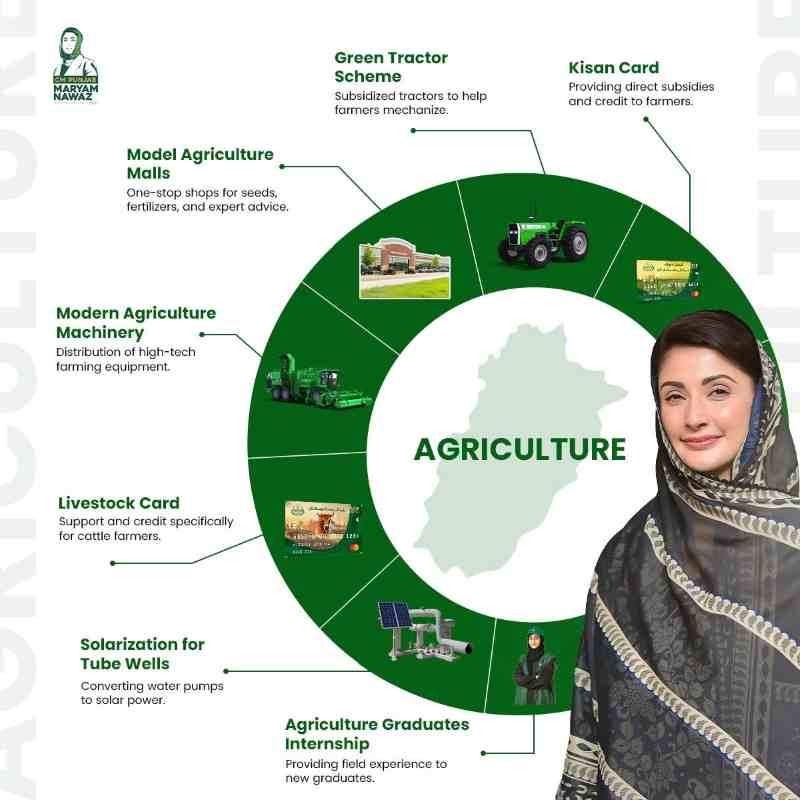
Table Of Contents
1. What Are All the Agriculture Schemes Launched by Maryam Nawaz in Punjab?
Chief Minister Maryam Nawaz Sharif has launched seven flagship agriculture schemes in Punjab including the Green Tractor Scheme, Kisan Card, Livestock Card, Solarization for Tube Wells, Model Agriculture Malls, Modern Agriculture Machinery distribution, and the Agriculture Graduates Internship Program. These initiatives collectively represent a multibillion-rupee investment aimed at modernizing the agricultural sector, reducing input costs, and improving farmer livelihoods.
Scheme Details and Budget Allocation
| Scheme Name | Target Beneficiaries | Subsidy/Loan Amount |
|---|---|---|
| Green Tractor Scheme | 30,000 farmers | Up to Rs. 1.5 million per tractor |
| Kisan Card | 750,000+ farmers | Rs. 30,000 – 150,000 per acre |
| Livestock Card | 80,000+ cattle farmers | Rs. 135,000 – 540,000 interest-free |
| Solarization for Tube Wells | 8,000+ farmers | Rs. 500,000 – 1,000,000 subsidy |
| Modern Agriculture Machinery | 6,500 farmers | 30% – 60% subsidy on equipment |
| Agriculture Internship | 2,000 graduates | Rs. 60,000 – 70,000 monthly stipend |
| Model Agriculture Malls | All farmers | One-stop shop services |
1.1 What is the complete list of CM Punjab agriculture schemes for 2026?
The complete list includes the Green Tractor Scheme providing subsidized tractors for farm mechanization, the Kisan Card offering direct subsidies and credit facilities, the Livestock Card specifically for cattle farmers, Solarization for Tube Wells converting diesel/electric pumps to solar power, Model Agriculture Malls as one-stop shops for inputs and advice, Modern Agriculture Machinery distribution for high-tech equipment, and the Agriculture Graduates Internship Program providing field experience. Additionally, the Apna Khet Apna Rozgar scheme provides land on nominal rent of Rs. 1,000 per year with financial assistance of Rs. 50,000 per acre.
1.2 How do these schemes align with the Apna Khet Apna Rozgar program?
The Apna Khet Apna Rozgar program integrates directly with the agriculture schemes by providing state land to landless farmers at Rs. 1,000 annual rent, then enabling those farmers to access Kisan Card credit, Green Tractor subsidies, and solar tube well support. Agriculture graduates serving as interns have been approved for inclusion in this program, receiving enhanced stipends to support rural families and create self-employment opportunities across the province. The Board of Revenue Punjab has prepared a new policy for allotment of agricultural land under this initiative.
1.3 Are these agriculture schemes only for Punjab or also for other provinces?
All seven schemes are exclusively for Punjab province residents with valid Punjab domicile. Each scheme requires applicants to be permanent residents of Punjab with land holdings or farming operations located within Punjab province. Farmers from other provinces such as Sindh, Khyber Pakhtunkhwa, Balochistan, or Gilgit-Baltistan are not eligible for these specific initiatives. However, other provincial governments have launched their own agriculture support programs based on their respective budgets and priorities.
1.4 What is the total budget allocated for the CM Punjab agriculture schemes 2026?
The total budget allocation across all agriculture schemes exceeds Rs. 100 billion. The Green Tractor Scheme alone has a multiyear target of 30,000 tractors with subsidies totaling billions of rupees. The CM High-Tech Mechanization Financing Program includes a dedicated loan allocation of Rs. 30 billion for farmers and service providers to access advanced machinery including combine harvesters and high-power tractors. The Livestock Card program has a budget of Rs. 11 billion for interest-free loans distributed to farmers over two years.
Read More: 50 Kg Wheat Price In Pakistan Today -Gandum Rates Today
1.5 How many farmers have been registered under the Kisan Card so far?
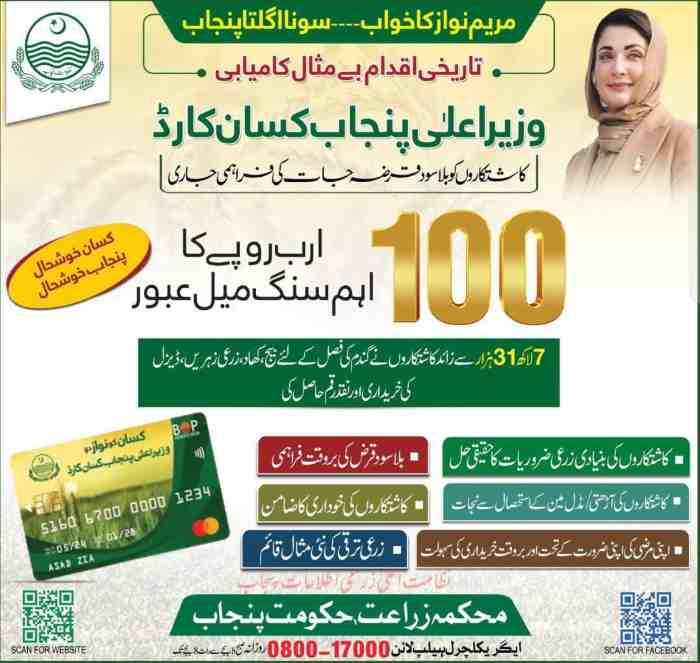
Over 750,000 farmers have been registered under the Kisan Card program, with purchases worth Rs. 18 billion made using the card. The registration process continues through SMS and online portals, with the government actively working to expand coverage to reach more farmers across all districts of Punjab. The Kisan Card has achieved an impressive 85% loan repayment rate, demonstrating strong farmer participation and program sustainability.
1.6 What is the official website to apply for Maryam Nawaz agriculture schemes?
The official Punjab Agriculture Department website is www.agripunjab.gov.pk. Specific scheme portals include gts.punjab.gov.pk for the Green Tractor Scheme, livestock.punjab.gov.pk for the Livestock Card, and for the Modern Agriculture Machinery program. Farmers should only use these official government domains for applications and should avoid third-party websites that may charge fees or collect personal information fraudulently.
1.7 How to contact the helpline for Maryam Nawaz agriculture schemes?

The centralized agricultural helpline number is 0800-17000, operational daily from 8:00 am to 8:00 pm. For Green Tractor Scheme and general agriculture subsidies, farmers can also call 1063. The Livestock Card has a dedicated helpline at 08000-9211 available 24/7. For Kisan Card SMS registration, farmers send PKC followed by their CNIC number to 8070. These helplines provide assistance in Urdu and Punjabi languages for farmer convenience.
1.8 Can I apply for multiple agriculture schemes at the same time?
Yes, farmers can apply for multiple schemes simultaneously provided they meet the eligibility criteria for each program. A farmer holding a Kisan Card can also apply for the Green Tractor Scheme, Solarization for Tube Wells, and Livestock Card if they operate both crop and livestock farming. The digital application systems are interconnected through the Punjab Land Revenue Authority verification system, allowing farmers to submit separate applications without conflict.
1.9 Is there any scheme for small farmers under Maryam Nawaz government?

Small farmers are explicitly prioritized across multiple schemes. The Green Tractor Scheme Phase 3 targets farmers owning 5 acres or more, making subsidized tractors accessible to small landholders. The Kisan Card requires minimum 1 acre of agricultural land for eligibility. The Apna Khet Apna Rozgar scheme provides land on nominal rent specifically for landless farmers. Wheat growers owning up to 25 acres receive direct financial assistance including a diesel subsidy of Rs. 150 per liter on ten liters per acre.
1.10 Is there any scheme for dairy farmers under Maryam Nawaz?
The Livestock Card is the primary scheme for dairy and cattle farmers, providing interest-free loans ranging from Rs. 135,000 for 5 animals up to Rs. 540,000 for larger herds. Farmers receive loans to purchase quality fodder, silage, mineral mixtures, vaccines, and medicines. The program includes a specific focus on rural women, with a Rs. 2 billion allocation providing livestock assets to 11,000 deserving rural women in South Punjab.
1.11 How to check application status of Kisan Card Punjab?

Farmers can check their Kisan Card application status by sending an SMS with their CNIC number to 8070, visiting the official Punjab Agriculture Department website at www.agripunjab.gov.pk, or calling the helpline at 0800-17000. The status update typically takes 7 to 14 working days after submission. Approved applicants receive confirmation via SMS and can collect their Kisan Card from designated Bank of Punjab branches.
1.12 Which banks are providing Kisan Card in Punjab?
The Bank of Punjab is the primary financial institution responsible for Kisan Card issuance and management. Farmers approved for the Kisan Card receive their cards from designated Bank of Punjab branches in their respective districts. The card functions as both an identity document and a debit card for accessing credit and subsidies at registered agricultural input dealers.
2. Green Tractor Scheme: How to Get Up to Rs. 1.5 Million Subsidy
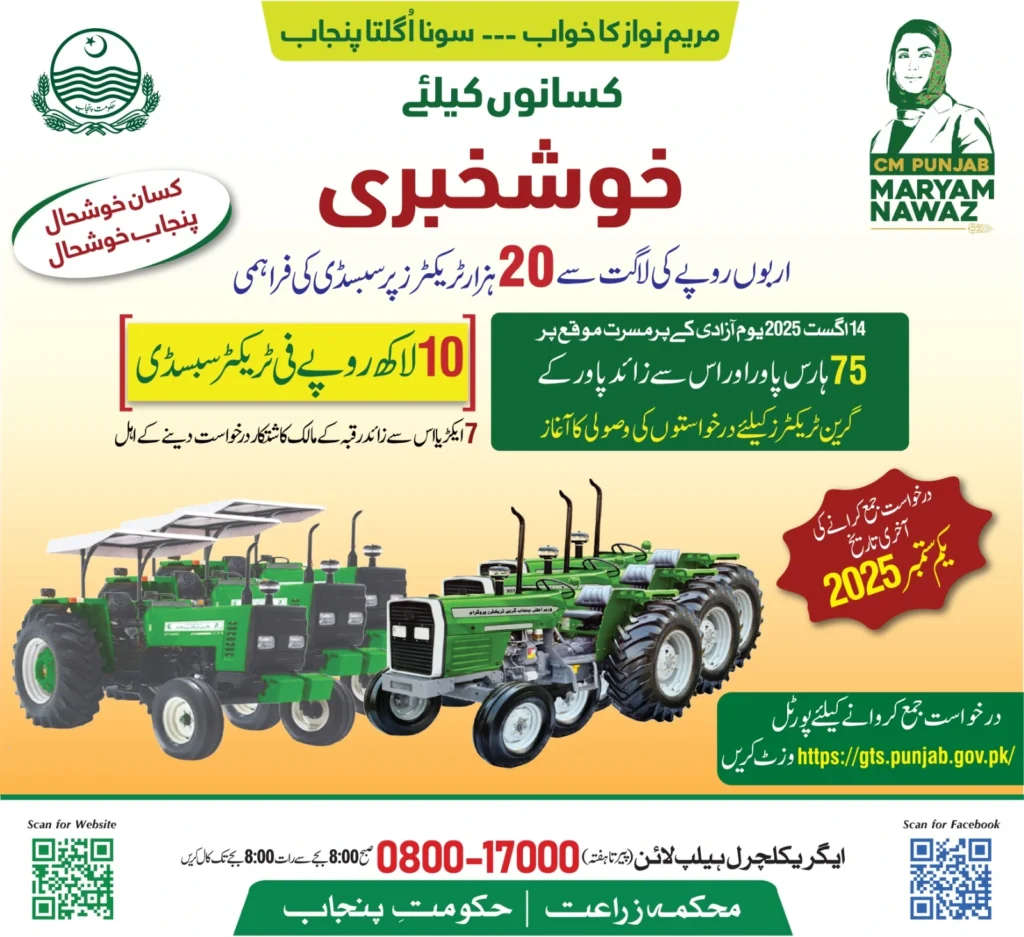
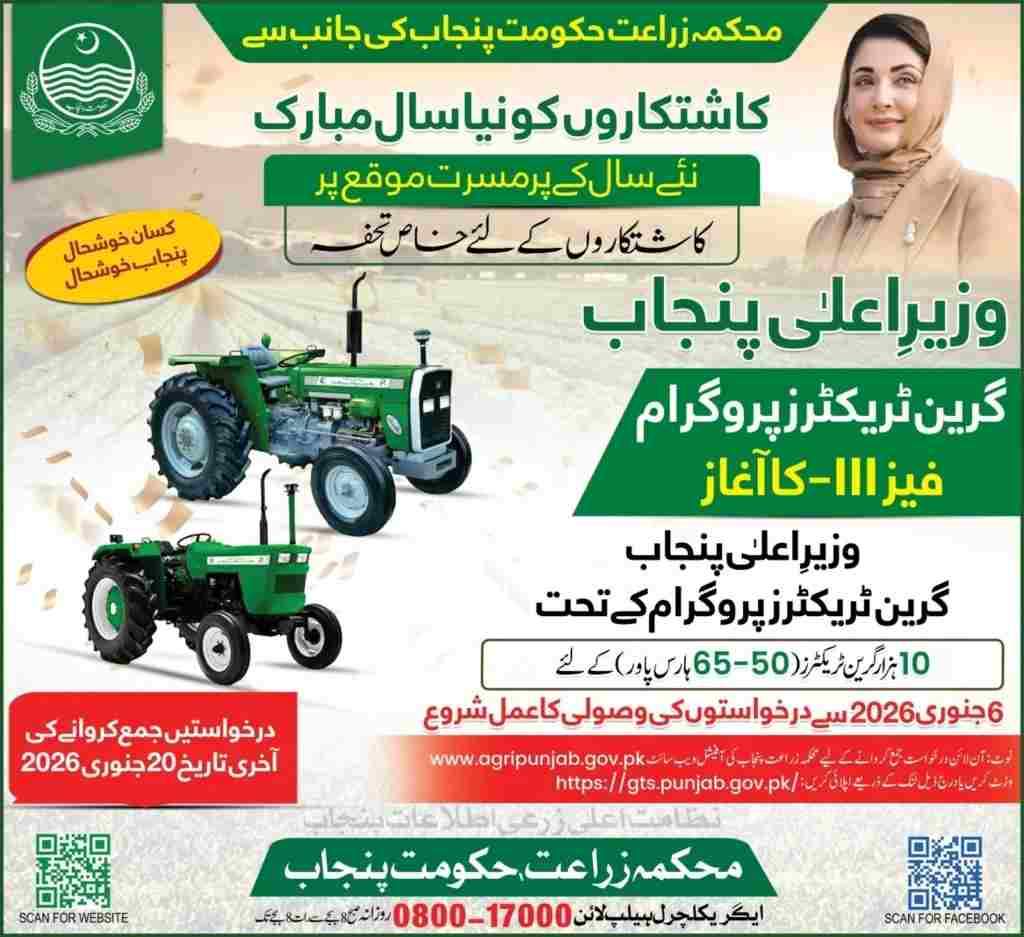
The Green Tractor Scheme provides farmers with a subsidy of up to Rs. 1.5 million per tractor, depending on horsepower and scheme phase, with 30,000 tractors targeted and 20,000 already delivered under the current administration. The program operates through transparent digital balloting to ensure fair distribution across all districts of Punjab.
2.1 What is the eligibility criteria for the Green Tractor Scheme Punjab?
Applicants must meet these requirements:
- Permanent resident of Punjab with valid CNIC
- Own or lease minimum 5 acres of agricultural land (Phase 3)
- For higher horsepower tractors (75-125 HP), minimum 7 acres required
- Land ownership verified through Punjab Land Revenue Authority
- Mobile number registered in applicant’s name
- No previous receipt of subsidized tractor under Phase 1 or Phase 2
2.2 How many acres of land are required for the CM Punjab Green Tractor Scheme?

The land requirement varies by scheme phase. Phase 3 requires minimum 5 acres for tractors ranging from 40 to 65 horsepower. For tractors ranging from 75 to 125 horsepower in the High-Tech Mechanization Financing Program, farmers must own at least 7 acres. Small farmers with 5 to 7 acres are prioritized for the 40-65 HP category, while larger landholders qualify for higher horsepower options.
2.3 Can a farmer who already received a tractor in Phase 1 or Phase 2 apply again?
Farmers who received subsidized tractors under Phase 1 or Phase 2 are not eligible to apply again in Phase 3 or subsequent phases. The program is designed to maximize distribution across the maximum number of farming households. However, farmers who were unsuccessful in previous balloting rounds may reapply in new phases provided they continue to meet eligibility criteria.
2.4 What is the subsidy amount for 50–65 HP vs. 75–125 HP tractors?
Tractor Horsepower Categories and Subsidy
| Category | Horsepower Range | Subsidy Amount |
|---|---|---|
| Small Category | 40-65 HP | Rs. 500,000 |
| Standard Category | 50-85 HP | Rs. 750,000 to 1,000,000 |
| High Horsepower | 75-125 HP | Up to Rs. 1,500,000 |
2.5 How to apply online for the Green Tractor Scheme in Punjab?
Step-by-Step Online Application Process
Step 1: Visit official portal at gts.punjab.gov.pk or agripunjab.gov.pk
Step 2: Click on Apply Online button on homepage
Step 3: Enter CNIC number and registered mobile number to receive OTP
Step 4: Complete application form with land ownership details verified through PLRA
Step 5: Upload scanned copies of required documents including CNIC and land record
Step 6: Submit application before deadline and note confirmation number
2.6 What documents are required for Green Tractor Scheme registration?
Required documents include:
- Computerized National Identity Card (CNIC)
- Punjab domicile certificate
- Land ownership document (Fard/Malikana) verified by PLRA
- Passport-size photograph
- Mobile number registered in applicant’s name
- For tenant farmers: valid lease agreement registered with revenue department
2.7 How does the digital balloting process work for tractor distribution?
The digital balloting system uses a transparent computerized draw conducted at the district level. All eligible applicants are entered into a database, and the system randomly selects winners based on available tractor quotas per district. The Chief Minister personally contacts several winners via telephone to congratulate them. Complete results are published online at gts.punjab.gov.pk/ballot/result for public verification.
2.8 What is the farmer’s contribution after the government subsidy?
Farmers must pay the remaining amount after deducting the government subsidy. For a Rs. 1,000,000 tractor with Rs. 500,000 subsidy, farmer contribution is Rs. 500,000. The government has arranged easy installment plans through partner banks, allowing farmers to pay their contribution over extended periods. The High-Tech Farm Mechanization Financing Program offers interest-free loans for tractors in the 100 to 120 horsepower category.
2.9 Is the tractor ownership transferable before the 3-year lock-in period?
No, tractors received under the Green Tractor Scheme cannot be sold or transferred to any other person for a period of three years from the date of possession. This lock-in period ensures that subsidies reach genuine farmers who will use the tractors for their own agricultural operations rather than reselling for profit. Violation of this condition results in recovery of full subsidy amount plus penalties.
2.10 How to check the Green Tractor Scheme winners list and result?
Farmers can check results using these methods:
- Visit gts.punjab.gov.pk and enter CNIC number in result checker
- Download district-wise PDF winner list from official portal
- Check SMS notification sent to registered mobile number
- Visit nearest Agriculture Department Extension Office for assistance
- Call helpline 0800-17000 for result inquiry
2.11 What is the last date to apply for the Green Tractor Scheme?
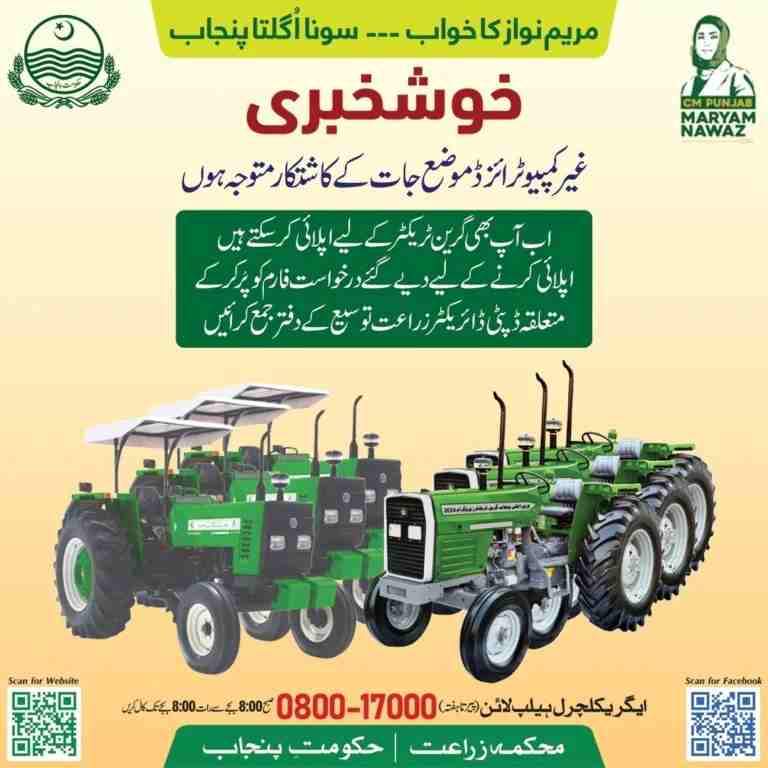
Application deadlines are announced for each phase separately. Phase 3 applications were accepted until January 20, with extensions announced for farmers from non-computerized villages. Farmers should regularly check the official website and local newspapers for upcoming phase announcements. Late applications are not accepted under any circumstances.
2.12 Can women farmers apply for Green Tractor Scheme?
Yes, women farmers who own agricultural land in their name are fully eligible to apply for the Green Tractor Scheme. The application process treats male and female applicants equally with no gender-based discrimination. Women landowners meeting the minimum acreage requirement can submit applications through the same online portal and are included in the digital balloting process.
2.13 How many tractors have been distributed under Green Tractor Scheme so far?
Over 20,000 tractors have been distributed under the Green Tractor Scheme across completed phases. Phase 3 launched through a formal draw ceremony where winners were personally contacted by the Chief Minister. The total target of 30,000 tractors is expected to be achieved with the completion of Phase 4 and subsequent phases.
3. Kisan Card: Unlocking Credit and Direct Subsidies
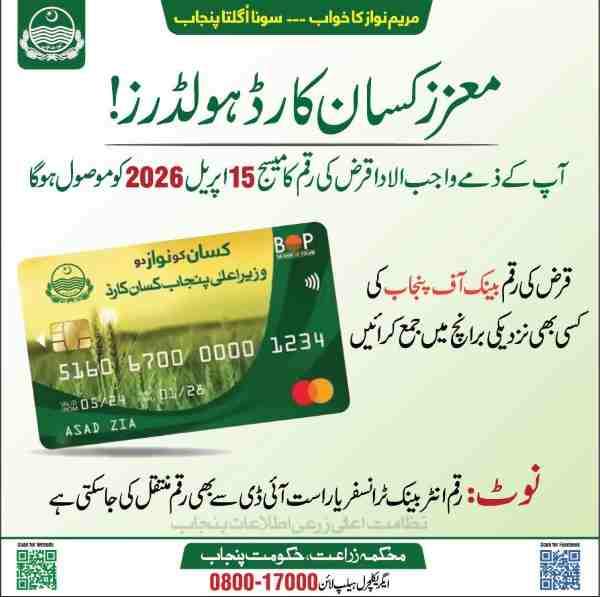
The Kisan Card is a digital identity card for farmers that provides access to interest-free loans ranging from Rs. 30,000 to Rs. 150,000 per acre, along with direct per-acre subsidies on inputs like wheat and diesel. The program has achieved an 85% loan repayment rate, demonstrating strong farmer participation and program sustainability.
3.1 What is the eligibility criteria for Kisan Card Punjab?
Eligibility requirements include:
- Permanent resident of Punjab province with valid domicile
- Minimum 1 acre of agricultural land ownership or legal lease
- Land record verified through Punjab Land Revenue Authority (PLRA)
- Valid CNIC with matching mobile SIM registration
- Minimum age 18 years
- Active farming operations
3.2 What documents are required for Kisan Card registration?
Document Checklist for Kisan Card
| Document Type | Specific Requirements |
|---|---|
| Identity Proof | Valid CNIC with clear photograph |
| Residency Proof | Punjab domicile certificate |
| Land Ownership | Fard (land record) verified by PLRA |
| Contact Details | Mobile number registered on applicant’s CNIC |
| Photograph | Recent passport-size photograph |
3.3 How to apply online for the CM Punjab Kisan Card?
SMS Registration Method (Most Common)
Step 1: Open SMS application on mobile phone registered in applicant’s name
Step 2: Type PKC followed by space and then 13-digit CNIC number without dashes
Step 3: Send SMS to 8070
Step 4: Receive confirmation message acknowledging registration
Step 5: Wait for verification process completion
Online Portal Method
Farmers can also visit www.agripunjab.gov.pk, navigate to Kisan Card section, complete online application form, upload required documents, and submit for processing. The online portal provides real-time status tracking.
3.4 How much credit limit is given on Kisan Card per acre?
The Kisan Card provides credit limits ranging from Rs. 30,000 to Rs. 150,000 per acre depending on land quality, crop type, and farmer’s repayment history. Standard credit limits are Rs. 50,000 per acre for wheat cultivation and Rs. 100,000 per acre for rice or cotton. Farmers can access this credit at any registered agricultural input dealer for purchasing seeds, fertilizers, pesticides, and other farming inputs.
3.5 Is Kisan Card and Livestock Card the same thing?
No, Kisan Card and Livestock Card are completely different schemes. The Kisan Card is designed for crop farmers, providing input subsidies and credit for seeds, fertilizers, and diesel. The Livestock Card is specifically for cattle and dairy farmers, providing interest-free loans for animal feed, silage, vaccines, and veterinary services. Farmers operating both crop and livestock operations may be eligible for both cards through separate applications.
3.6 How to check Kisan Card application status and registration?
Farmers can check their Kisan Card application status through:
- SMS: Send CNIC number to 8070 to receive status update
- Online portal: Visit www.agripunjab.gov.pk and enter CNIC number
- Helpline: Call 0800-17000 for assistance
- Bank of Punjab branch: Visit nearest branch with CNIC for inquiry
3.7 What is the wheat support subsidy available through Kisan Card?
Kisan Card holders receive direct per-acre subsidies on wheat production including Rs. 3,500 per maund procurement price for wheat, free gunny bags worth Rs. 6 billion distributed across the province, and diesel subsidy of Rs. 150 per liter on ten liters per acre for wheat growers owning up to 25 acres. Registered wheat farmers also receive ten free bags per acre from purchase centers.
3.8 Is there a diesel subsidy for Kisan Card holders?
Yes, wheat producers owning up to 25 acres receive a diesel subsidy of Rs. 150 per liter on ten liters of diesel per acre. This subsidy is provided through direct transfer to Kisan Card, which can be used at registered fuel stations. The initiative prioritizes small and medium-scale farmers most affected by rising fuel expenses for irrigation, ploughing, and harvesting operations.
3.9 How to register for Kisan Card via SMS?
Exact SMS Format for Kisan Card Registration
| Step | Action |
|---|---|
| 1 | Open SMS application |
| 2 | Type: PKC [space] [13-digit CNIC without dashes] |
| 3 | Example: PKC 1234567890123 |
| 4 | Send to number: 8070 |
| 5 | Wait for confirmation reply |
3.10 What is the Kisan Card interest rate and repayment terms?
Kisan Card loans are completely interest-free with no markup charged to farmers. The repayment period is crop cycle-based, typically 6 to 12 months depending on crop type. Farmers must repay the loan amount after harvest before the next cropping season. The program has achieved an 85% repayment rate, making it one of the most successful agricultural credit initiatives in Pakistan’s history.
4. Livestock Card: Interest-Free Loans for Cattle Farmers
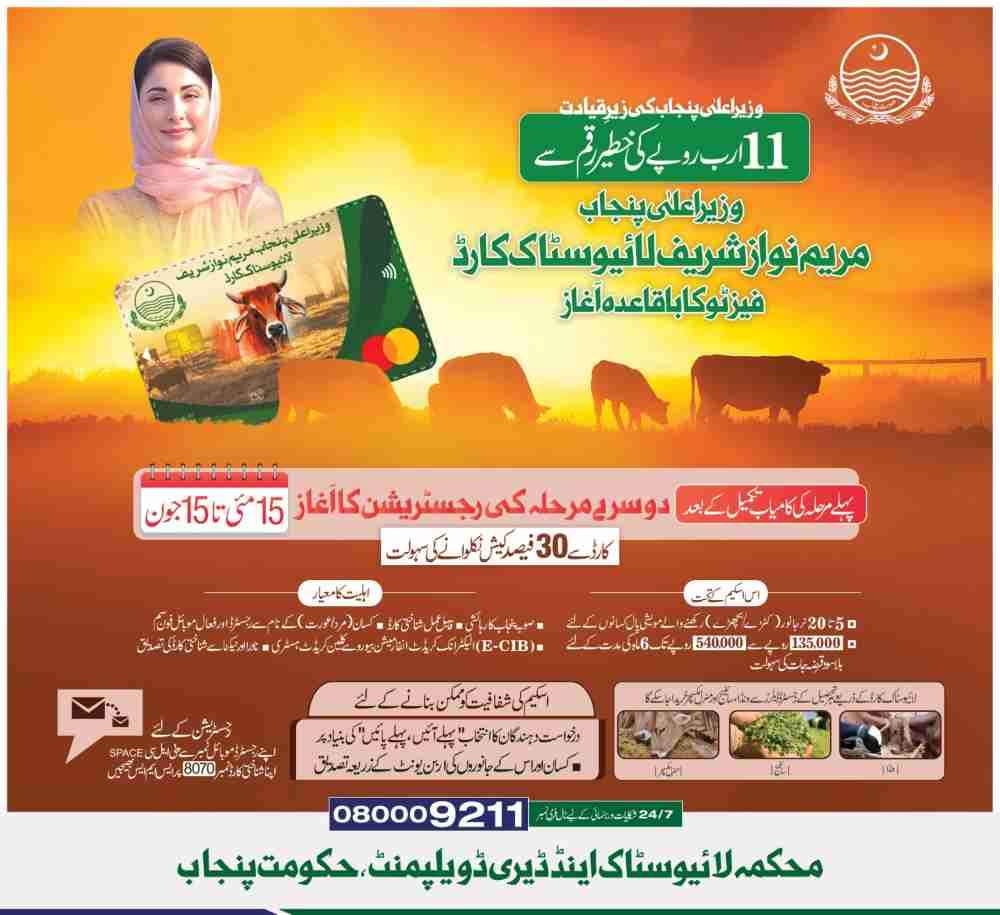
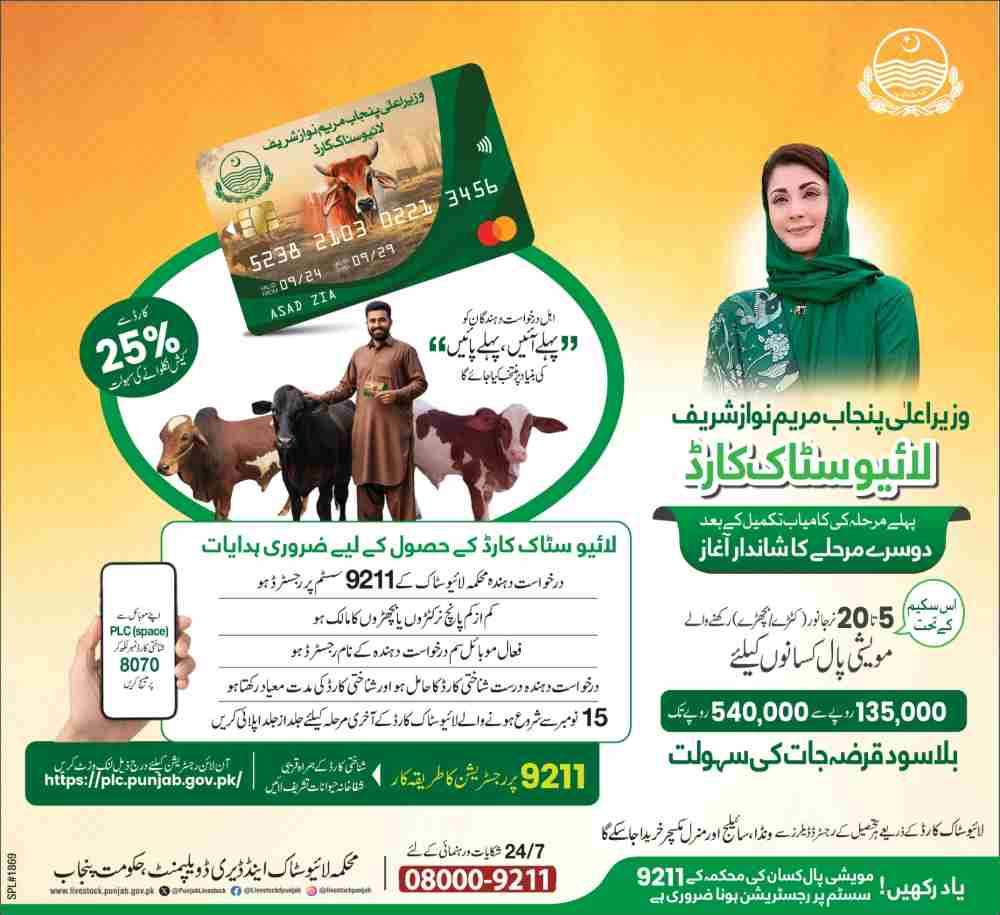
The Livestock Card is specifically designed for cattle farmers, offering interest-free loans of Rs. 135,000 to Rs. 540,000 to purchase animal feed, silage, and mineral mixtures for calf fattening. The program includes a Rs. 2 billion allocation specifically for rural women in South Punjab, providing 11,000 deserving women with livestock assets for stable income generation.
4.1 Is Livestock Card only for cattle farmers?
Yes, the Livestock Card is exclusively for cattle and livestock farmers. Eligible animals include buffalo, cows, calves, and young stock. Farmers must maintain a minimum of 5 to 10 male calves or young stock to qualify for the loan. The card cannot be used for crop farming activities or non-livestock agricultural purposes.
4.2 What is the eligibility criteria for the Livestock Card in Punjab?
Eligibility requirements for Livestock Card:
- Permanent resident of Punjab province
- Valid CNIC with mobile SIM registered in applicant’s name
- Minimum 5 male calves or young stock (buffalo or cattle)
- Active livestock farming operations
- For rural women scheme: residency in South Punjab districts
4.3 How many calves or bulls are required to qualify for the Livestock Card?
Farmers must have minimum 5 to 10 male calves or young stock (buffalo or cattle) to qualify for the Livestock Card. The loan amount varies with herd size: Rs. 135,000 for 5 animals and Rs. 270,000 for 10 animals. Farmers with larger herds may qualify for higher loan amounts up to Rs. 540,000 through additional verification.
4.4 How to apply for the Maryam Nawaz livestock card online?
Livestock Card Application Process
| Method | Procedure |
|---|---|
| SMS | Send PLC [space] CNIC to 8070 |
| Online Portal | Visit livestock.punjab.gov.pk and complete registration |
| Helpline | Call 08000-9211 for assistance |
| Veterinary Hospital | Visit nearest veterinary hospital for manual application |
4.5 What is the loan amount and repayment period under the Livestock Card?
The Livestock Card provides interest-free loans of Rs. 27,000 per animal for a maximum duration of 150 days. Farmers have 120 days to utilize the funds for purchasing feed, silage, and medicines, followed by a 30-day repayment period. Total allocation for the program is Rs. 11 billion distributed to farmers over two years, with over 80,000 livestock farmers expected to benefit.
4.6 How to register in the Livestock Department’s 9211 system?
Farmers can register by sending PLC followed by CNIC to 8070, which connects to the Livestock Department’s 9211 system. The helpline 08000-9211 provides 24/7 assistance for registration queries. Upon successful registration, farmers receive confirmation and are guided to the nearest veterinary hospital for verification of livestock numbers.
4.7 What is the Maryam Nawaz cow scheme?
The Maryam Nawaz cow scheme refers to the Livestock Card program specifically focused on providing cattle assets to rural women. Under this Rs. 2 billion government program, 11,000 deserving rural women in South Punjab receive livestock assets to help them earn stable income. Women are provided with cows along with training and veterinary support for sustainable dairy farming operations.
4.8 Can livestock cardholders withdraw cash from their loan amount?
No, the Livestock Card functions as a restricted-use card similar to the Kisan Card. Farmers cannot withdraw cash directly. The loan amount is only usable at registered livestock supply dealers for purchasing specific items including animal feed, silage, mineral mixtures, vaccines, and veterinary medicines. This restriction ensures that funds are used for their intended livestock development purpose.
4.9 What is the process for Livestock Card SMS registration?
SMS Registration Format for Livestock Card
| Step | Action |
|---|---|
| 1 | Open SMS application on registered mobile |
| 2 | Type: PLC [space] [13-digit CNIC] |
| 3 | Example: PLC 1234567890123 |
| 4 | Send to number: 8070 |
| 5 | Receive confirmation and further instructions |
4.10 Is there a livestock scheme for small farmers with fewer than 5 animals?
Farmers with fewer than 5 animals may qualify for the rural women livestock scheme which provides direct livestock assets rather than loans. Additionally, small farmers can access veterinary services and subsidized feed through Model Agriculture Malls even without the Livestock Card. The government has announced plans to expand Livestock Card coverage to smaller herds in upcoming phases.
5. Solarization for Tube Wells: Converting to Solar Power with up to 80% Subsidy
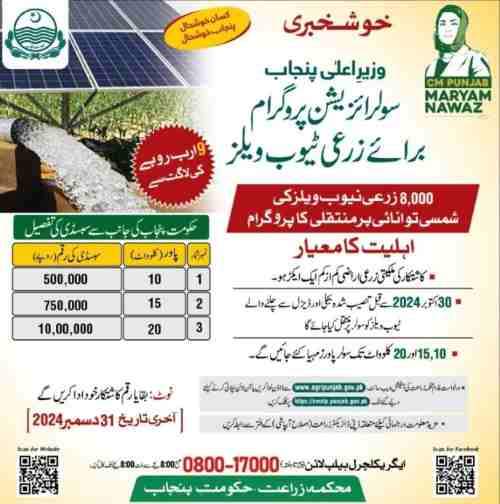
The Punjab government offers up to 80% subsidy for converting diesel or electric tube wells to solar power, targeting 8,000 tube wells in the initial phase, with subsidies ranging from Rs. 500,000 to Rs. 1,000,000 depending on system capacity. The program aims to reduce farmers’ energy costs and promote green energy adoption across the agricultural sector.
5.1 How to apply for Solarization of Tube Wells scheme in Punjab?
Farmers can apply through the Agriculture Department website at www.agripunjab.gov.pk or by visiting their nearest Agriculture Extension Office. The application requires land ownership verification, existing tube well registration, and consent for solar system installation. Approved farmers are connected with empaneled solar system providers for installation.
5.2 What is the subsidy amount for solar tube wells in Punjab?
Solar System Subsidy Structure
| System Capacity | Subsidy Amount | Farmer Payment |
|---|---|---|
| 10 Kilowatt | Rs. 500,000 | 25% of total cost |
| 15 Kilowatt | Rs. 750,000 | 25% of total cost |
| 20 Kilowatt | Rs. 1,000,000 | 25% of total cost |
The government covers up to 75% of system costs, while farmers pay only 25% through flexible installments.
5.3 Who is eligible for the solar tubewell scheme?
Eligible farmers must:
- Own agricultural land with existing tube well in Punjab
- Have valid electricity connection or diesel pump registration
- Possess verified land ownership through PLRA
- Not have previously received solar subsidy under any government program
5.4 What documents are required for solar tube well application?
Required documents include:
- Valid CNIC of applicant
- Punjab domicile certificate
- Land ownership document (Fard) verified by PLRA
- Existing tube well registration or electricity bill
- Mobile number registered in applicant’s name
- Passport-size photograph
5.5 How much can farmers save annually by converting to solar power?
Farmers operating diesel tube wells currently spend Rs. 10,000 or more per day on fuel during peak irrigation seasons. Solar conversion eliminates daily fuel costs completely, providing savings of over Rs. 300,000 annually for a typical farm. Electric tube well users save Rs. 100,000 or more annually on electricity bills. The system typically pays for itself within 2 to 3 years through fuel savings.
5.6 What is the last date for solar tubewell scheme registration?
Registration deadlines are announced for each phase separately. The program launched with immediate effect, and farmers are encouraged to apply as early as possible due to limited quotas per district. Extensions may be announced based on application volume and budget availability. Farmers should regularly check official website announcements.
5.7 How to check the solar tubewell scheme list and status?
Farmers can check their application status by:
- Visiting www.agripunjab.gov.pk and entering CNIC number
- Calling helpline 0800-17000 for status update
- Visiting Agriculture Extension Office in their district
- Checking SMS notifications sent to registered mobile number
5.8 What is the process for solar system installation after approval?
Solar Installation Process Flow
| Step | Action |
|---|---|
| 1 | Application approval and subsidy confirmation |
| 2 | Farmer selects from empaneled solar system providers |
| 3 | Site survey and system design completion |
| 4 | Installation of solar panels, inverter, and pump |
| 5 | Government inspection and final approval |
| 6 | System commissioning and farmer training |
5.9 Is there a separate scheme for solar panels for home use?
The solarization scheme is specifically for agricultural tube wells and irrigation purposes. Residential solar panels for home electricity are covered under separate programs including the Roshan Gharana scheme and net metering policies of electricity distribution companies. Farmers interested in residential solar should contact their local electricity distribution company for available programs.
6. Model Agriculture Malls: One-Stop Shops for Farmers
Model Agriculture Malls are operational in four major cities (Multan, Bahawalpur, Sargodha, Sahiwal) offering farmers access to seeds, fertilizers, pesticides, expert advice, financial services, and machinery under one roof, with 10 additional malls under construction. These malls represent a total investment exceeding Rs. 1.3 billion across all locations.
6.1 What is the benefit of Model Agriculture Malls?
Model Agriculture Malls eliminate middlemen and provide farmers with:
- Quality agricultural inputs at government-regulated fixed rates
- Access to certified seeds, fertilizers, and pesticides
- Expert agricultural advice from qualified extension staff
- Farm machinery rental services at affordable rates
- Banking and credit facilities through partner banks
- Training sessions on modern farming techniques
6.2 How to register for Model Agriculture Mall services?
Farmers can register at any Model Agriculture Mall by presenting their CNIC and land ownership documents at the registration counter. Registration is free and open to all farmers in the district. Registered farmers receive a membership card enabling access to all mall services including machinery rental, expert consultation, and input purchase.
6.3 What products and services are available at Model Agriculture Malls?
Services Available at Model Agriculture Malls
| Category | Specific Offerings |
|---|---|
| Inputs | Seeds, fertilizers, pesticides, herbicides |
| Machinery | Tractors, harvesters, laser land levelers, sprayers |
| Advisory | Expert consultation, soil testing, crop planning |
| Financial | Banking services, loan processing, credit access |
| Training | Workshops, demonstrations, field visits |
6.4 Where are Model Agriculture Malls located in Punjab?
Model Agriculture Malls are currently operational in Multan, Bahawalpur, Sargodha, and Sahiwal. The Bahawalpur mall is constructed on eight acres of land with total investment of Rs. 284 million. Additional malls are under construction in other districts, with plans to establish 10 more malls in the second phase across Punjab.
6.5 Is there any fee for using Model Agriculture Mall facilities?
No, there is no fee for entering or using Model Agriculture Mall facilities. Farmers can visit the mall free of charge, receive expert advice at no cost, and compare input prices before purchasing. Machinery rental and input purchase fees apply at market-competitive rates that are typically lower than open market prices due to government subsidies.
6.6 How do Model Agriculture Malls help farmers avoid middlemen?
By providing direct access to quality inputs at fixed government-regulated prices, Model Agriculture Malls eliminate multiple layers of middlemen who traditionally increased costs for farmers. Farmers purchase directly from government-verified suppliers, ensuring product quality and fair pricing. The malls display price boards transparently, allowing farmers to compare rates before purchase.
6.7 What is the investment and land area for each Model Agriculture Mall?
Each Model Agriculture Mall requires significant investment and land allocation. The Bahawalpur mall spans eight acres with Rs. 284 million investment. The Sargodha mall represents Rs. 1.25 billion investment across the four-mall network. Each mall includes storage blocks, machinery blocks, training blocks, retail areas, and administrative offices designed for efficient farmer service delivery.
7. Modern Agriculture Machinery: Subsidies for High-Tech Equipment
Under the CM High-Tech Mechanization Financing Program and Punjab Farm Mechanization Program, farmers can receive subsidies of 30% to 60% on modern equipment including combine harvesters, laser land levelers, seed drills, sprayers, and chisel ploughs, with easy installment plans over five years. The program has a dedicated loan allocation of Rs. 30 billion for farmers and service providers.
7.1 What is the subsidy amount on high-tech machinery in Punjab?
Machinery Subsidy Structure
| Equipment Type | Subsidy Percentage |
|---|---|
| Tractors (50-100 HP) | 50% – 70% |
| Combine Harvesters | Interest-free loans up to Rs. 50 lakh |
| Laser Land Levelers | 50% subsidy |
| Modern Seed Drills | 30% – 50% subsidy |
| Power Sprayers | 30% – 40% subsidy |
7.2 How to apply for modern agriculture machinery on subsidy?
Farmers can apply through the Agriculture Department portal at by visiting www.agripunjab.gov.pk. The online application requires uploading scanned copies of CNIC, land ownership documents, and machinery requirement details. Approved farmers receive subsidy certificates redeemable at empaneled machinery dealers.
7.3 What types of machinery are covered under the Farm Mechanization Program?
The Farm Mechanization Program covers multiple equipment categories:
- Combine harvesters (wheat, rice, maize)
- Laser land levelers for precision farming
- High-horsepower tractors (100-120 HP)
- Transplanters for rice and vegetable crops
- Balers for straw and fodder
- Super seeders for conservation agriculture
- Chisel ploughs for deep tillage
- Power sprayers for crop protection
7.4 Is there an easy installment facility for purchasing machinery?
Yes, the High-Tech Farm Mechanization Financing Program provides interest-free loans for machinery purchase with repayment terms up to five years. Farmers pay a down payment of 20% to 30%, with the remaining amount financed through easy installments deducted from crop proceeds or paid directly to the financing bank. The program targets distribution of 6,500 modern agricultural machines by 2028.
7.5 What is the laser land leveler subsidy scheme?
The laser land leveler subsidy scheme provides 50% subsidy on purchase of laser-guided land leveling equipment. Laser land leveling improves water efficiency by 30% to 40%, reduces irrigation time, and increases crop yields. Farmers can apply through the Agriculture Department portal and receive subsidy directly credited to their Kisan Card for equipment purchase.
7.6 Is there a subsidy for battery-operated spray pumps?
Yes, battery-operated spray pumps are included under the Modern Agriculture Machinery program with subsidies ranging from 30% to 40%. Battery-operated pumps reduce manual labor, improve spraying efficiency, and eliminate fuel costs associated with traditional sprayers. Small farmers with limited land holdings are prioritized for this equipment category.
7.7 What is the chisel plough subsidy amount?
The chisel plough subsidy covers 40% to 50% of equipment cost depending on farmer category and land holding size. Chisel ploughs are essential for deep tillage operations that break hardpan layers and improve soil water infiltration. The equipment is particularly beneficial for farmers in areas with compacted soil conditions.
7.8 How to apply for the Cotton Model Farms subsidy?
Farmers interested in cotton cultivation can apply for the Cotton Model Farms initiative which provides subsidized equipment including bed planters, laser land levelers, and cotton pickers. The program targets cotton-growing districts and includes technical training on modern cotton production techniques. Applications are submitted through district Agriculture Extension Offices.
8. Agriculture Graduates Internship: Monthly Stipend of Rs. 60,000 to Rs. 70,000
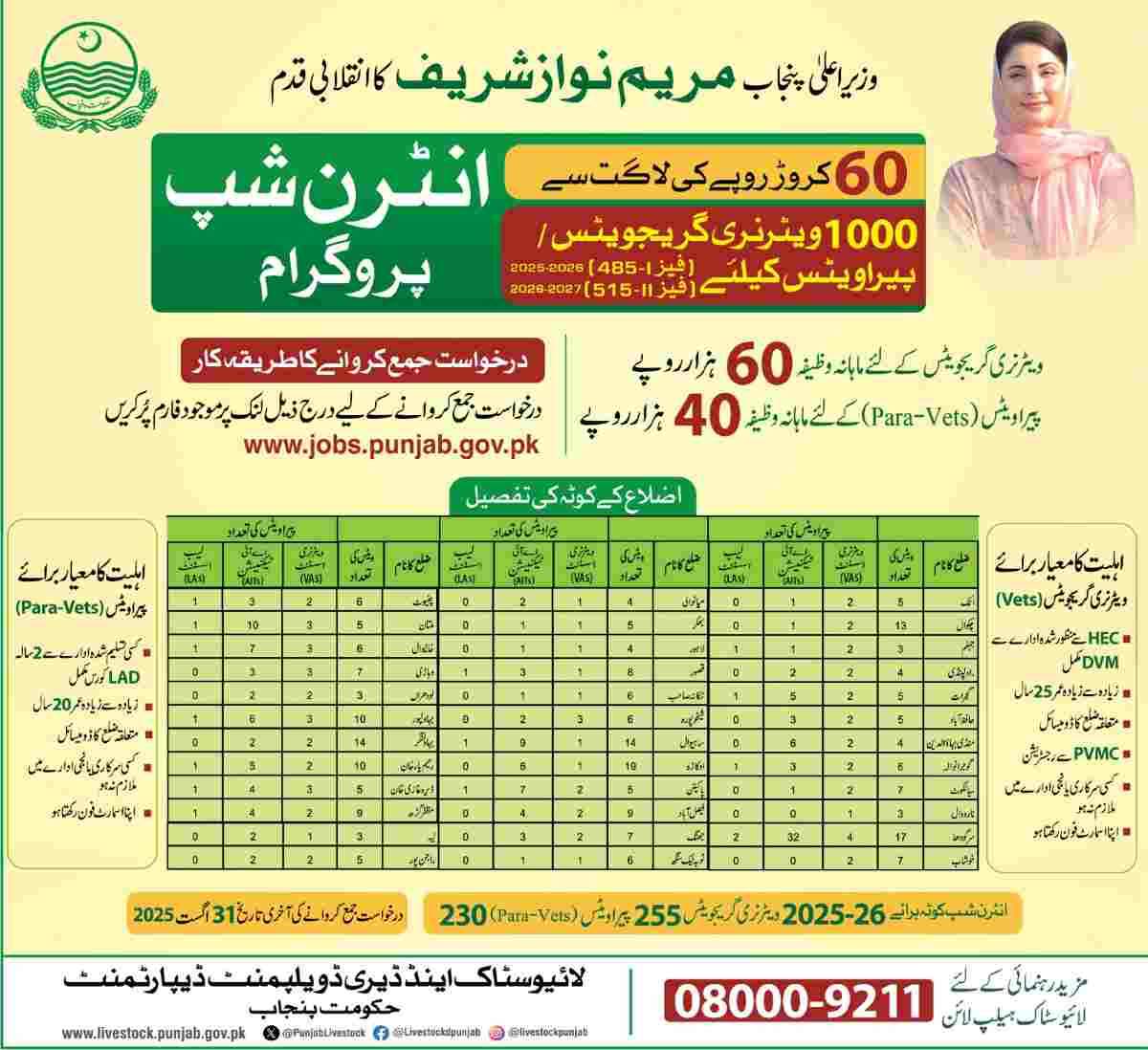
The Agriculture Graduates Internship Program provides 2,000 fresh agriculture graduates with a monthly stipend of Rs. 60,000 for one year of hands-on field training, with Phase 2 currently open for applications. The government has approved increasing the monthly stipend to Rs. 70,000 under the Apna Khet Apna Rozgar integration.
8.1 Who is eligible for Agriculture Graduates Internship Program?
Eligible candidates must have:
- B.Sc (Hons) in Agriculture or B.Sc (Hons) in Agricultural Engineering
- Punjab domicile and valid CNIC
- Graduation completed within the last three years
- Age limit: typically 25 to 30 years depending on program phase
- No current government employment
8.2 What is the age limit for Agriculture Graduates Internship?
The age limit for the Agriculture Graduates Internship Program varies by phase but generally ranges from 25 to 30 years at the time of application. Age relaxation may be granted for candidates from remote districts or those with additional qualifications. Exact age limits are specified in each phase announcement published on the Agriculture Department website.
8.3 How to apply for the Agriculture Graduates Internship?
Internship Application Process
| Step | Action |
|---|---|
| 1 | Visit www.agripunjab.gov.pk |
| 2 | Download internship application form |
| 3 | Complete form with personal and educational details |
| 4 | Attach attested copies of degree, CNIC, and domicile |
| 5 | Submit to designated Agriculture Department office |
| 6 | Await merit list announcement |
8.4 What is the monthly stipend and internship duration?
The internship provides a monthly stipend of Rs. 60,000 for one year. Under the Apna Khet Apna Rozgar program, stipends have been increased to Rs. 70,000 for interns serving in that initiative. The internship duration is 12 months with possibility of extension based on performance and program requirements.
8.5 How to check the internship application status and merit list?
Candidates can check their application status and merit list by:
- Visiting www.agripunjab.gov.pk and navigating to internship section
- Checking SMS notifications sent to registered mobile number
- Calling Agricultural Helpline 0800-17000 for assistance
- Visiting the Agriculture Department office where application was submitted
8.6 What is the Agricultural Helpline number for internship inquiries?
The Agricultural Helpline for internship inquiries is 0800-17000, operational daily from 8:00 am to 8:00 pm. Candidates can call this number for information about application status, merit list release dates, document verification schedules, and internship posting locations.
8.7 Can agriculture engineers apply for the internship program?
Yes, candidates with B.Sc (Hons) in Agricultural Engineering are fully eligible to apply for the internship program. Agricultural engineers are typically assigned to machinery-focused roles including equipment maintenance, mechanization planning, and farm machinery demonstrations. Both agriculture degree holders and agricultural engineers compete through the same merit-based selection process.
8.8 What is the Work with Punjab Government program for interns?
The Work with Punjab Government program is a recent initiative launched to provide internship opportunities to agriculture graduates and other qualified youth. Under this program, interns gain hands-on experience working directly with government departments on agricultural development projects. The program includes the enhanced stipend of Rs. 70,000 and is integrated with the Apna Khet Apna Rozgar scheme.
8.9 Is there a separate internship for agriculture diploma holders?
Currently, the primary internship program is designed for degree holders (B.Sc Hons in Agriculture or Agricultural Engineering). However, agriculture diploma holders may qualify for other government training programs and technical positions. The government has announced plans to expand internship opportunities to diploma holders in future phases.
9. Cross-Cutting Themes: How These Schemes Work Together
The seven agriculture schemes are designed to work synergistically, with the Kisan Card serving as the digital backbone for accessing subsidies under the Green Tractor Scheme, Solarization program, and Livestock Card, while Model Agriculture Malls and Interns provide on-ground support. This integrated approach ensures maximum impact from government investment.
9.1 How do Kisan Card and Green Tractor Scheme complement each other?
Kisan Card holders receive priority consideration in Green Tractor Scheme balloting. The same land verification system through PLRA serves both programs, reducing duplication. Farmers use Kisan Card credit to pay their contribution amount for subsidized tractors, making tractors accessible without upfront cash payment.
9.2 Can a farmer use Kisan Card loan to purchase subsidized solar tube well?
Yes, Kisan Card holders can use their credit limit to pay the farmer contribution portion for solar tube well installation. The solar subsidy covers 75% of system cost, and the remaining 25% farmer payment can be financed through Kisan Card interest-free credit. This integration makes solar conversion accessible to farmers with limited cash reserves.
9.3 How do Model Agriculture Malls connect farmers to other schemes?
Model Agriculture Malls serve as physical registration centers for all seven schemes. Farmers visiting malls receive assistance completing online applications, document verification, and scheme selection guidance. The malls host bank representatives who process Kisan Card applications and loan disbursements, creating a true one-stop solution.
9.4 What role do agriculture interns play in scheme implementation?
Agriculture interns are deployed across the province to assist farmers with scheme registration, document verification, and application processing. Interns conduct field visits to verify land ownership, educate farmers about available schemes, and provide technical advice on scheme selection. The government has approved the inclusion of agriculture interns in the Apna Khet Apna Rozgar program, further integrating youth into agricultural development.
9.5 How does the Apna Khet Apna Rozgar scheme integrate agriculture interns?
Under the Apna Khet Apna Rozgar scheme, agriculture interns receive enhanced stipends of Rs. 70,000 while serving as extension workers. Interns are assigned to specific villages where they assist landless farmers in obtaining state land on nominal rent, help new farmers access Kisan Card credit, and provide ongoing technical support for sustainable farming operations.
9.6 What is the role of PITB in digitizing these agriculture schemes?
The Punjab Information Technology Board (PITB) has developed and maintains all online portals for scheme applications including gts.punjab.gov.pk, livestock.punjab.gov.pk, and the central agripunjab.gov.pk portal. PITB manages the digital balloting system, SMS registration infrastructure, and database integration with PLRA for automated land verification. The technology ensures transparent, efficient, and fraud-resistant scheme delivery.
10. Application Guide: Step-by-Step Process for All Schemes
Farmers can apply for most schemes online through the official Punjab Agriculture Department portal (www.agripunjab.gov.pk) or through dedicated scheme portals, with SMS registration available for Kisan Card and Livestock Card. Understanding the application process is critical for successful scheme access.
10.1 How to apply for CM Punjab all schemes online?
Master Application Process for All Schemes
| Step | Action | Applicable Schemes |
|---|---|---|
| 1 | Visit www.agripunjab.gov.pk | All schemes |
| 2 | Create account with CNIC and mobile number | All schemes |
| 3 | Select desired scheme from dashboard | All schemes |
| 4 | Complete scheme-specific application form | All schemes |
| 5 | Upload required documents | All schemes |
| 6 | Submit and note confirmation number | All schemes |
10.2 What is the common application process for all agriculture schemes?
All schemes require the following common steps: CNIC verification through NADRA, land ownership verification through PLRA, mobile number confirmation through OTP, document upload, and final submission. Once a farmer completes the common registration on agripunjab.gov.pk, they can apply for multiple schemes without re-entering basic information.
10.3 How to register for CM Punjab Scheme portal?
Portal Registration Steps
Step 1: Visit www.agripunjab.gov.pk on computer or mobile browser
Step 2: Click Register New Account button
Step 3: Enter CNIC number, mobile number, and email address
Step 4: Create password and security questions
Step 5: Verify mobile number through OTP sent to registered SIM
Step 6: Complete profile with land ownership details verified through PLRA
Step 7: Account activation and scheme access granted
10.4 What is the document checklist for applying to any scheme?
Universal Document Checklist
| Document | Requirement |
|---|---|
| CNIC | Valid, clear scan or photograph |
| Punjab Domicile | Issued by relevant district authority |
| Land Ownership (Fard) | Verified by PLRA within last 6 months |
| Mobile SIM Registration | Must match CNIC name |
| Photograph | Recent passport-size |
| Bank Account | For subsidy disbursement (where applicable) |
10.5 How to verify land ownership through PLRA for scheme applications?
Land ownership verification is automated through integration between the Agriculture Department portal and Punjab Land Revenue Authority database. Farmers enter their land record number or property identification number, and the system automatically fetches verified ownership details. Farmers with non-computerized land records must visit their local Patwari or Revenue Department office for manual verification before online application.
10.6 What is the helpline number for application assistance?
The central agricultural helpline for all scheme applications is 0800-17000, operational daily 8:00 am to 8:00 pm. For Green Tractor Scheme specific queries, farmers can call 1063. For Livestock Card, call 08000-9211. For Kisan Card SMS issues, send CNIC to 8070 for automated response. Operators provide assistance in Urdu, Punjabi, and English languages.
10.7 Can farmers apply through agriculture facilitation centers?
Yes, farmers without internet access or digital literacy can visit their nearest Agriculture Extension Office, Model Agriculture Mall, or District Agriculture Office for assistance. Facilitation center staff complete online applications on behalf of farmers using government computers. Farmers should bring all required documents for staff-assisted application submission.
10.8 How to track application status for multiple schemes?
Status Tracking Methods by Scheme
| Scheme | Status Check Method |
|---|---|
| Green Tractor | CNIC entry at gts.punjab.gov.pk |
| Kisan Card | SMS PKC to 8070 or portal login |
| Livestock Card | SMS PLC to 8070 or portal login |
| Solarization | Portal login or helpline call |
| Internship | Portal login or helpline call |
11. Eligibility and Documents: Complete Breakdown
General eligibility for all schemes requires Punjab residency, a valid CNIC, verified agricultural land ownership or tenancy, and a mobile number registered in the farmer’s name, with specific requirements varying by scheme. Understanding these requirements prevents application rejection.
11.1 What is the common eligibility criteria for all Maryam Nawaz agriculture schemes?
All schemes require applicants to be permanent residents of Punjab province with valid CNIC and Punjab domicile. Land ownership or legal cultivation rights must be verifiable through PLRA. Mobile phone SIM must be registered in applicant’s name matching CNIC details. Applicants must be actively engaged in farming or agricultural activities.
11.2 What documents are required for Kisan Card registration?
Kisan Card Document Requirements
| Document | Specific Requirement |
|---|---|
| CNIC | Valid, with clear photograph |
| Punjab Domicile | Issued by district authority |
| Land Ownership (Fard) | Minimum 1 acre, PLRA verified |
| Mobile SIM | Registered on applicant’s CNIC |
| Photograph | Recent passport-size |
11.3 What documents are required for Green Tractor Scheme?
Green Tractor Scheme requires CNIC, Punjab domicile, land ownership document showing minimum 5 acres, passport-size photograph, mobile number registered in applicant’s name, and for tenant farmers, a valid lease agreement registered with revenue department. Additional documents may be requested based on district requirements.
11.4 What documents are required for Livestock Card?
Livestock Card requires CNIC, Punjab domicile, proof of minimum 5 to 10 male calves or young stock verified by veterinary officer, mobile number registered in applicant’s name, and photograph. Applicants may also need to provide vaccination records and livestock registration with the Livestock Department.
11.5 What documents are required for Solarization scheme?
Solarization scheme requires CNIC, Punjab domicile, land ownership document verified by PLRA, existing tube well registration or electricity connection bill, mobile number registered in applicant’s name, and photograph. Farmers with diesel tube wells must provide fuel purchase records for verification.
11.6 What documents are required for Agriculture Internship?
Agriculture Internship requires CNIC, Punjab domicile, B.Sc (Hons) Agriculture or Agricultural Engineering degree certificate, transcript or mark sheets, passport-size photograph, mobile number registered in applicant’s name, and experience certificates if any. Candidates must also submit a no-objection certificate if currently employed.
11.7 How to get land ownership verified for scheme applications?
Land ownership verification is conducted through the Punjab Land Revenue Authority database. Farmers can verify their land record online at the PLRA portal or by visiting their local Patwari office. The land record document (Fard) must be issued within the last six months for scheme application validity.
11.8 What is the role of NADRA verification in scheme applications?
NADRA verification ensures that applicant identity documents are authentic and match the information provided in scheme applications. The Agriculture Department portal integrates with NADRA database for real-time CNIC verification including photograph matching, fingerprint verification where required, and mobile SIM ownership confirmation.
12. Frequently Asked Questions (FAQ)
What is the last date to apply for Maryam Nawaz agriculture schemes?
Application deadlines vary by scheme and phase. Farmers should regularly check www.agripunjab.gov.pk for current deadlines. Phase 3 Green Tractor Scheme applications closed January 20, with extensions announced for non-computerized villages.
How much subsidy is available on tractors under Green Tractor Scheme?
Subsidy ranges from Rs. 500,000 for 40-65 HP tractors to Rs. 1,500,000 for high-horsepower tractors in Phase 4.
When will the next phase of Green Tractor Scheme start?
Phase 4 has been approved and is expected to launch soon. The government has announced a target of 30,000 total tractors with 20,000 already delivered.
How to check the Green Tractor Scheme winners list PDF?
Visit gts.punjab.gov.pk and navigate to Results section. District-wise PDF lists are available for download. Winners can also check by entering CNIC number.
What is the Maryam Nawaz 10000 scheme?
This refers to components of the Kisan Card program providing support to thousands of farmers. Specific details available on official portal.
What is the Maryam Nawaz 25000 scheme?
This refers to components of the Green Tractor Scheme involving 30,000 total tractors with 20,000 already delivered and 10,000 remaining for upcoming phases.
What is the Maryam Nawaz 5000 scheme?
This refers to components of the Solarization program targeting 8,000 tube wells for solar conversion.
What is the Apna Khet Apna Rozgar Scheme apply online 2026?
The scheme provides state land on Rs. 1,000 annual rent with Rs. 50,000 per acre financial assistance. Apply through agripunjab
What is the CM Punjab agriculture machinery scheme online registration?
Visit agripunjab.gov.pk for machinery subsidy applications. Registration requires CNIC and land ownership verification.
What is the CM Punjab High-tech farm Mechanization finance program?
A Rs. 30 billion loan program providing access to combine harvesters, high-power tractors, and advanced machinery on easy financing terms.
Disclaimer
This guide provides general information about government agriculture schemes in Punjab. Scheme details including subsidy amounts, eligibility criteria, and deadlines are subject to change by government notification. Farmers should verify current information through official government channels before applying.

Add a Comment