
The CM Punjab Apni Chhat Apna Ghar Scheme 2026 is a flagship Rs. 700 billion housing initiative launched by Punjab Chief Minister Maryam Nawaz Sharif to provide interest-free loans up to Rs. 15 lakh for low-income families to build, repair, or expand their homes. This program aims to construct 100,000 affordable houses across Punjab within four and a half years, marking a significant development in the province’s housing sector.
What you will learn from this guide:
- Complete eligibility criteria and step-by-step online application process for the 15 lakh interest-free loan
- Detailed breakdown of all loan categories including the new Mehfooz Chhat Scheme for roof repairs
- How to check application status, track loan disbursement, and access the ACAG Punjab dashboard
Key Takeaways
- Interest-Free Loan of 15 Lakh: Eligible applicants can receive up to Rs. 15 lakh completely interest-free, repayable in easy monthly installments of Rs. 14,000 over nine years.
- PMT Score Below 60 Required: To qualify, applicants must be registered with the National Socio-Economic Registry (NSER) with a Poverty Means Test (PMT) score of 60 or less.
- Over 200,000 Families Benefited: The Apni Chhat Apna Ghar programme has already helped nearly 200,000 families transition from rented homes to owning their own residences.
- Apply Online at acag.punjab.gov.pk: The official portal for online registration, application status check, and loan tracking is acag.punjab.gov.pk.
- New Mehfooz Chhat Scheme Launched: In response to the Kahna tragedy, the government has introduced Rs. 500,000 loans for roof repair and Rs. 1 million loans for constructing additional floors.
- Read More: Punjab Budget 2026-27: Major Expenditures, Tax Relief, & Budget Highlights
- Read More: Budget 2026-27: Major Expenditures, Tax Relief, & Revenue Target
What Is the CM Punjab Apni Chhat Apna Ghar Scheme 2026 and Why Was It Launched?

Table Of Contents
Apni Chhat Apna Ghar Scheme
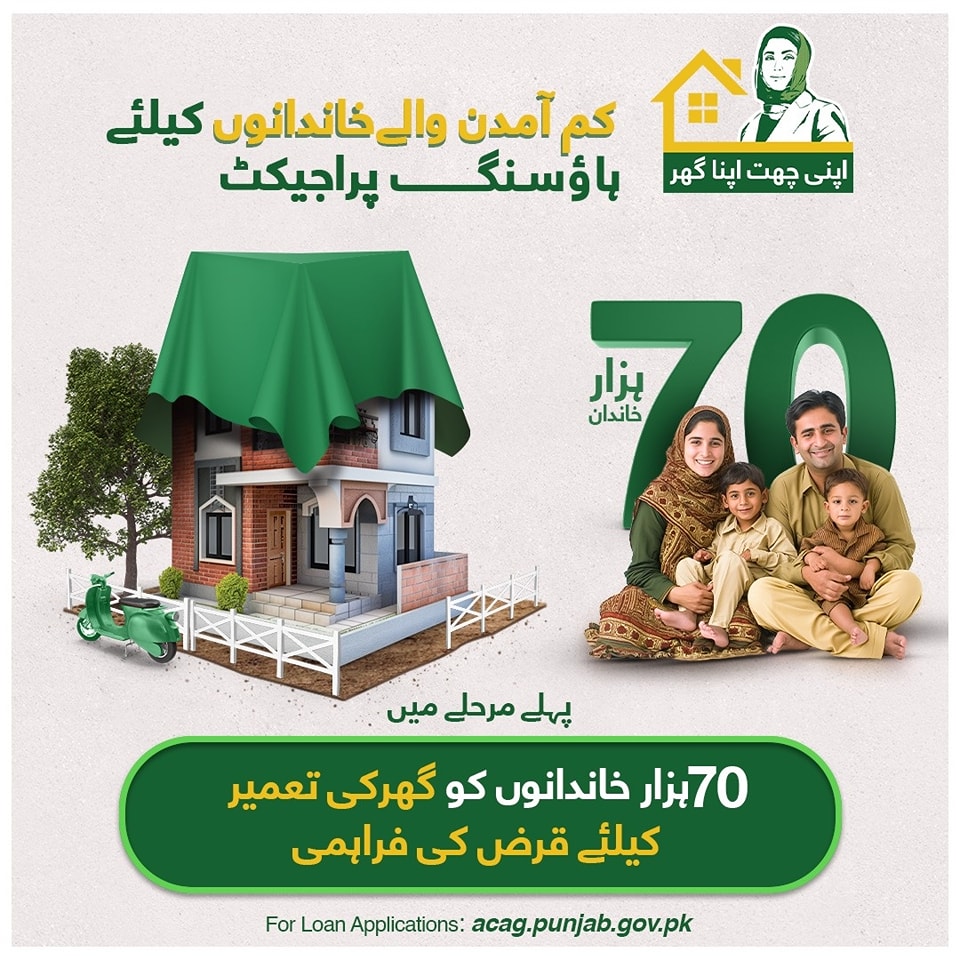
The Apni Chhat Apna Ghar Scheme 2026 is a transformative housing program launched by Punjab Chief Minister Maryam Nawaz Sharif to provide affordable housing solutions to low-income families across Punjab. This Rs. 700 billion project is specifically designed to cater to landowners of small plots, offering loans up to Rs. 15 lakhs with repayments stretched over nine years without any interest.
What is the official name and full form of the Apni Chhat Apna Ghar Scheme?
The official name of the program is the “Apni Chhat Apna Ghar” Scheme, which translates to “My Roof, My Home” in English. It is also commonly referred to as the ACAG program, named after its official portal acag.punjab.gov.pk. The scheme is a flagship initiative of the Punjab government aimed at providing affordable housing to low-income residents across the province.
Who launched the Apni Chhat Apna Ghar Scheme and when?
Punjab Chief Minister Maryam Nawaz Sharif launched the Apni Chhat Apna Ghar Scheme as a flagship housing initiative of the provincial government. The program represents a significant commitment to accessible housing solutions and is part of the government’s broader economic vision. The scheme has been positioned as one of the provincial government’s most important welfare projects.
What is the total budget and financial outlay of the CM Punjab housing scheme?
The Apni Chhat Apna Ghar Scheme has a total budget of Rs. 700 billion. The government has already released substantial funds for the program, with Rs. 224.457 billion disbursed so far. An additional Rs. 217.8 billion has been released for the programme. The government has also earmarked Rs. 71 billion in the budget to finance 150,000 more homes.
What are the primary objectives of the Apni Chhat Apna Ghar Program?
The primary objectives of the ACAG program include:
- Providing affordable housing: Enabling low-income families to own their homes through interest-free loans
- Improving living conditions: Reducing overcrowding and slum dwelling by providing safe housing options
- Enhancing access to basic amenities: Ensuring families have access to water, sanitation, and electricity
- Strengthening social cohesion: Creating stable communities through home ownership
- Generating employment: The construction of 100,000 houses is expected to generate approximately half a million jobs
- Contributing to economic growth: Boosting the construction sector and related industries
How does the Apni Chhat Apna Ghar Scheme 2026 differ from previous housing schemes?
The Apni Chhat Apna Ghar Scheme 2026 differs from previous housing initiatives in several key ways. It offers completely interest-free loans, which is a major departure from earlier programs that carried mark-up rates. The scheme also targets the lowest-income segments by using the PMT score criterion, ensuring that only the most deserving families receive assistance. Additionally, the program includes a component for roof strengthening and floor addition, addressing both new construction and home improvement needs.
How many houses will be constructed under the Apni Chhat Apna Ghar Scheme?
The Apni Chhat Apna Ghar Scheme is designed to deliver 100,000 affordable houses across the province within four and a half years. This target is being achieved through three execution models: beneficiary-led construction, contractor-led construction, and public-private partnership. The scheme has already seen remarkable progress, with over 135,000 families receiving loans and 91,000 houses completed ahead of schedule.
What is the timeline for completing 100,000 houses under this program?
The program has a four-and-a-half-year timeline for completing 100,000 houses. However, the pace of implementation has been rapid. As of the latest updates, the government has already surpassed its target, having completed over 91,000 houses and disbursed loans to more than 135,000 families. The monthly draw system ensures a steady flow of approvals and disbursements, with thousands of new applications processed each month.
What are the expected outcomes and socio-economic benefits of the ACAG program?
The expected outcomes of the Apni Chhat Apna Ghar program are substantial and multi-faceted:
- Improved living conditions for low-income families who move from rented or informal housing to their own homes
- Reduced overcrowding and slum dwelling as families gain access to proper housing
- Enhanced access to basic amenities such as water, sanitation, and electricity
- Increased community safety and security due to stable neighbourhoods
- Positive social impact on target beneficiaries, including improved health and education outcomes
- Strengthened social cohesion and community development
- Creation of approximately half a million jobs directly and indirectly through construction activity
- Economic contribution through increased demand for construction materials and services
How does the Apni Chhat Apna Ghar Scheme contribute to job creation in Punjab?
The construction of 100,000 houses under the Apni Chhat Apna Ghar Scheme is expected to generate approximately half a million jobs. These jobs span across the construction value chain, including masons, carpenters, electricians, plumbers, and labourers, as well as indirect employment in the supply of cement, steel, bricks, and other building materials. The scheme has already stimulated economic activity in the construction sector, providing a boost to local economies across Punjab.
What is the vision of Chief Minister Maryam Nawaz for affordable housing in Punjab?
Chief Minister Maryam Nawaz’s vision for the Apni Chhat Apna Ghar Scheme is to ensure that every low-income family in Punjab has access to a safe and secure home. The initiative is part of a broader agenda to reduce poverty, promote social welfare, and stimulate economic growth through the construction sector. The government aims to expand the scheme to cover more families in the coming years, with a long-term goal of eliminating homelessness and substandard housing in the province.
What Are the Different Loan Categories Under the Apni Chhat Apna Ghar Scheme 2026?
The CM Punjab Apni Chhat Apna Ghar Scheme 2026 offers multiple loan categories to cater to different housing needs, including Rs. 15 lakh for new home construction, Rs. 10 lakh for adding a floor, and Rs. 5 lakh for roof strengthening.
What is the Rs. 15 lakh interest-free loan for new home construction?
The Rs. 15 lakh loan is the flagship product of the Apni Chhat Apna Ghar Scheme. It is designed for families who own a plot of land (up to 5 Marla in urban areas or 10 Marla in rural areas) but lack the funds to build a house. The loan is completely interest-free and is repayable over nine years in monthly installments of Rs. 14,000. This loan covers the full cost of constructing a basic house, including materials and labour.
What is the Rs. 10 lakh loan for constructing an additional floor or room?
For families who already have a house but need to expand, the scheme offers a Rs. 10 lakh loan to construct an additional floor or room. This option is particularly useful for growing families or those who wish to create rental income. The loan carries no interest and is repayable in monthly installments of approximately Rs. 9,333 over nine years.
What is the Apni Chhat Mehfooz Chhat Scheme and the Rs. 5 lakh roof repair loan?
The Apni Chhat Mehfooz Chhat Scheme is a specialised component introduced after the Kahna tragedy, where a roof collapse led to multiple fatalities. Under this scheme, homeowners can avail Rs. 5 lakh for roof strengthening and repair. This loan is also interest-free and comes with a flexible repayment period of up to nine years. The government has made this category particularly accessible, with simplified documentation and faster processing.
How does the Rs. 500,000 roof strengthening loan work under the new initiative?
The Rs. 500,000 roof strengthening loan is disbursed to homeowners whose existing roofs are in a dilapidated condition. The amount can be used to replace or reinforce the roof structure, ensuring safety. The loan is disbursed in installments based on the progress of repair work. Applicants need to provide photographs and a structural assessment report to qualify. The repayment is structured over nine years, with monthly installments of about Rs. 4,630.
What is the monthly installment for the Rs. 15 lakh loan under Apni Chhat Apna Ghar?
The monthly installment for the Rs. 15 lakh loan is Rs. 14,000 per month over a nine-year repayment period. This amount is fixed and does not increase over time, providing financial predictability for the borrower.
What is the monthly installment for the Rs. 10 lakh loan?
The monthly installment for the Rs. 10 lakh loan is approximately Rs. 9,333 per month, calculated over the same nine-year period. This is also interest-free, making it highly affordable for low-income families.
What is the monthly installment for the Rs. 5 lakh Mehfooz Chhat loan?
For the Rs. 5 lakh roof repair loan, the monthly installment is about Rs. 4,630 over nine years. This low monthly payment ensures that even the poorest families can afford to repair their roofs without financial strain.
What is the repayment period for each loan category in the ACAG scheme?
All loan categories under the Apni Chhat Apna Ghar Scheme come with a standard repayment period of nine years. This extended tenure reduces the monthly burden and makes it easier for families to manage their finances. The government has also introduced a grace period of one year before the first repayment is due, allowing families to complete construction before starting payments.
Are there any discounts available for early repayment of the loan?
Yes, the government offers a discount of 10% on the remaining principal amount if the borrower repays the entire loan before the scheduled nine-year period. This incentive encourages early settlement and helps the government recycle funds for other beneficiaries.
What are the interest rates and mark-up charges on Apni Chhat Apna Ghar loans?
The Apni Chhat Apna Ghar Scheme is completely interest-free, and no mark-up charges are applied. This is one of the most attractive features of the program, setting it apart from other housing finance options that typically charge between 8-15% per annum.
Is there a grace period before loan repayments begin?
Yes, the scheme provides a one-year grace period after loan disbursement before the first installment is due. This allows borrowers to complete the construction of their homes without the added pressure of immediate repayments. The grace period applies to all loan categories.
What is the total loanable amount under the ACAG Punjab program?
The total loanable amount depends on the category chosen: Rs. 15 lakh for new construction, Rs. 10 lakh for additional floors, Rs. 5 lakh for roof repair, and Rs. 1 million for constructing an additional floor under the Mehfooz Chhat Scheme. A beneficiary can apply for only one loan category at a time, but may be eligible for other categories in the future.
How are loan amounts disbursed – in installments or lump sum?
Loan amounts are disbursed in three installments: 30% at the start of construction, 40% after completion of the roof, and 30% upon final completion and verification. This phased disbursement ensures that funds are used appropriately and that construction milestones are met. The disbursement is made directly to the beneficiary’s bank account or through partner microfinance institutions.
Who Is Eligible for the CM Punjab Apni Chhat Apna Ghar Scheme 2026?
To be eligible for the Apni Chhat Apna Ghar Scheme 2026, applicants must be permanent Punjab residents, heads of family as per NADRA, own land up to 5 Marla (urban) or 10 Marla (rural), and have a PMT score of 60 or less.
What is the PMT score requirement for Apni Chhat Apna Ghar Scheme eligibility?
The PMT (Poverty Means Test) score is a key eligibility criterion. Applicants must have a PMT score of 60 or less as registered with the National Socio-Economic Registry (NSER). This score reflects the household’s poverty status, with lower scores indicating greater need. The government uses this score to ensure that the most deserving families receive the loan.
What is the National Socio-Economic Registry (NSER) and how does it relate to ACAG?
The NSER is a database of socio-economic information of households across Pakistan, maintained by the Benazir Income Support Programme (BISP). It provides a PMT score for each household based on various indicators such as income, assets, and family size. The Apni Chhat Apna Ghar Scheme relies on NSER data to verify eligibility and target the poorest families. Applicants must be registered in the NSER and have a valid PMT score.
What are the land ownership limits for the Apni Chhat Apna Ghar Scheme?
Applicants must be the sole owner and possessor of a parcel of land measuring up to 5 Marla in urban areas and up to 10 Marla in rural areas. The land must be located anywhere in Punjab, and the applicant must intend to build their house on that land. The ownership should be registered in the applicant’s name as per the revenue records.
Do applicants need to be permanent residents of Punjab?
Yes, applicants must be permanent residents of Punjab as per their CNIC (Computerised National Identity Card). The address on the CNIC must show a Punjab domicile. The scheme is exclusively for residents of Punjab, and applicants from other provinces are not eligible.
What is the head of family requirement as per NADRA records?
The applicant must be the head of his or her nucleus family as per NADRA’s family registration record. This ensures that the loan is granted to the primary breadwinner or decision-maker of the household. If the applicant is not the head, they may need to provide additional documentation to prove their status.
Can a person with a criminal record apply for the Apni Chhat Apna Ghar Scheme?
No, individuals convicted of anti-state, anti-social activities, or heinous crimes are not eligible. The government has a strict vetting process to exclude such individuals from the scheme. Applicants with a clean criminal record are preferred.
What is the bank defaulter policy for ACAG loan eligibility?
Applicants who are loan defaulters of any financial institution or bank are not eligible for the Apni Chhat Apna Ghar Scheme. The scheme requires a good credit history to ensure repayment discipline. If the applicant has any outstanding loan defaults, they are disqualified.
What are the income limits for the Apna Ghar Scheme 2026?
While there is no specific income cap, the PMT score of 60 or less effectively ensures that only low-income households are eligible. The PMT score is a proxy for income and assets, and a score of 60 corresponds to the lowest income quintile. Therefore, the scheme automatically targets the poorest families.
Can government employees apply for the Apni Chhat Apna Ghar Scheme?
Government employees are generally eligible, provided they meet all other criteria, including the PMT score and land ownership. However, they may need to provide additional information about their employment and income. The scheme does not exclude government employees, but they must still qualify based on poverty indicators.
Are widows and disabled persons eligible for the Punjab housing scheme?
Yes, widows and disabled persons are eligible and are given priority in the selection process. The government has a special quota and simplified procedures for these vulnerable groups. They are encouraged to apply and are often processed faster.
Can someone who already owns a house apply for the ACAG loan?
No, the scheme is designed for those who do not own a house. Applicants must be the sole owner of the land but must not own a house elsewhere. The land they own must be the only piece of land they possess, and they should be living in rented or informal housing. Those who already own a house are not eligible.
What is the eligibility criteria for the Apni Zameen Apna Ghar 3 Marla plot scheme?
The Apni Zameen Apna Ghar scheme is a related initiative that provides 3 Marla plots to families who do not even own land. Its eligibility criteria are similar: PMT score of 60 or less, permanent residence in Punjab, and no prior ownership of land. However, this scheme is separate from the Apni Chhat Apna Ghar Scheme, which requires existing land ownership.
How does the Apni Chhat Apna Ghar Scheme verify applicant eligibility?
Eligibility is verified through multiple systems. The PMT score is retrieved from the NSER database using the applicant’s CNIC. Land ownership is verified through revenue department records. The applicant’s NADRA family record is used to confirm head of family status. The bank defaulter check is conducted through credit bureaus. Finally, criminal record checks are performed through the police department.
Who is not eligible for the CM Punjab Apni Chhat Apna Ghar Scheme?
Ineligible individuals include:
- Those with a PMT score above 60
- Non-residents of Punjab
- Individuals who are not heads of their families
- Landowners with more than 5 Marla (urban) or 10 Marla (rural)
- Existing house owners
- Loan defaulters
- Individuals with criminal convictions for serious crimes
- Government employees with high incomes (though they can apply, they are unlikely to meet the PMT score)
How to Apply for the CM Punjab Apni Chhat Apna Ghar Scheme 2026 Online?
To apply for the Apni Chhat Apna Ghar Scheme 2026 online, visit the official portal acag.punjab.gov.pk, register with your CNIC and mobile number, fill the Citizen Registration Form, and submit your application.
What is the official website for Apni Chhat Apna Ghar Scheme online registration?
The official website for online registration is acag.punjab.gov.pk. This portal is the only authorized platform for submitting applications, checking status, and tracking loan disbursements. Applicants are advised to use only this website to avoid scams.
How to register on the ACAG Punjab portal for the Apni Chhat Apna Ghar Scheme?
To register, visit the portal and click on the “Register” button. Enter your CNIC number, mobile number, and create a password. An OTP will be sent to your mobile number for verification. After verification, you can log in and access the application form.
How to fill the Citizen Registration Form for Apni Chhat Apna Ghar online?
The Citizen Registration Form is the main application form. It requires you to provide:
- Personal details (name, CNIC, family members)
- Contact information (address, mobile number, email)
- Land ownership details (plot number, district, tehsil, area)
- Loan category selection
- NSER PMT score (auto-verified)
- Bank account details for loan disbursement
The form is straightforward and includes step-by-step guidance. Make sure to double-check all entries before submission.
What documents are required for Apni Chhat Apna Ghar Scheme online application?
You will need scanned copies of the following documents for uploading:
- CNIC (front and back)
- Punjab domicile certificate
- Land ownership documents (fard, mutation, or registry)
- NSER registration certificate (if available)
- Proof of income (if required)
- Recent utility bill (for address verification)
- Passport-size photograph (optional but recommended)
All documents should be clear and legible. The portal accepts PDF and image files up to 5 MB each.
How to upload documents for ACAG Punjab online application?
After filling the form, you will be directed to the document upload section. Click on each document type and select the file from your device. Ensure the file naming is meaningful (e.g., CNIC_Front.jpg). Once all documents are uploaded, click “Save and Continue”. You can edit or replace documents before final submission.
How to apply for Apni Chhat Apna Ghar Scheme using a mobile phone?
The official portal is mobile-responsive, so you can apply directly from your smartphone. Open the website in your browser, follow the same registration and form-filling process. You can also take photos of your documents and upload them from your phone’s gallery. The process is the same as on a desktop.
What is the Apni Chhat Apna Ghar Scheme apply online login process?
To log in, go to acag.punjab.gov.pk and click “Login”. Enter your registered CNIC and password. If you have forgotten your password, use the “Forgot Password” option to reset it via OTP. Once logged in, you can view your application status, update information, and track loan progress.
How to check Apni Chhat Apna Ghar Scheme application status online?
After logging in, you will see your dashboard. The application status is displayed prominently. Common statuses include “Submitted”, “Under Review”, “Verification Complete”, “Approved”, “Disbursed”, and “Rejected”. Click on the application ID for detailed tracking.
How to check Apna Ghar Apni Chhat application status by CNIC?
If you do not have your login credentials, you can check status by entering your CNIC on the portal’s status check page. Enter your CNIC number without dashes, and the system will display the current status of your application.
How to check ACAG application status through SMS?
The government has also launched an SMS service. Send your CNIC number (without dashes) to 8070 to receive your application status via SMS. This service is free and available to all mobile networks. Standard SMS charges may apply.
What is the ACAG login process and how to access the applicant dashboard?
After successful login, you will be taken to your dashboard. The dashboard shows:
- Your profile information
- Application status
- Loan category and amount
- Disbursement details
- Repayment schedule
- Notifications from the authorities
- Option to edit your profile
The dashboard is user-friendly and provides all necessary information in one place.
How to submit a handwritten application for the Apni Chhat Apna Ghar Scheme?
While the primary mode is online, those who cannot access the internet can submit a handwritten application at their local Deputy Commissioner (DC) office. The application form is available at the DC office, and applicants can fill it in and submit it along with attested copies of required documents. The DC office will then enter the application into the online system.
What is the last date for Apni Chhat Apna Ghar Scheme online registration?
The government has not set a fixed last date for registration, as the scheme is ongoing and will continue until the target of 100,000 houses is achieved, and likely beyond. However, the government periodically announces batches and draws. It is advisable to apply as soon as possible to avoid missing out on earlier disbursement cycles.
Can applicants apply offline for the Apni Chhat Apna Ghar Scheme?
Yes, offline applications are accepted at Deputy Commissioner and Assistant Commissioner offices across Punjab. However, the offline applications are also entered into the online system. It is recommended to apply online for faster processing and transparency.
What is the ACAG complaint portal and how to register a complaint?
The ACAG complaint portal is integrated into the main website. Applicants can file complaints regarding application delays, document issues, loan disbursement problems, or any other grievances. The complaint is assigned a tracking number, and the relevant department is notified. Complaints are typically resolved within 7 working days.
What Is the Step-by-Step Online Registration Process for Apni Chhat Apna Ghar Scheme?
The step-by-step registration process for the Apni Chhat Apna Ghar Scheme involves visiting acag.punjab.gov.pk, creating an account, completing the application form, uploading documents, and submitting the application for review.
What is the first step to register for the Apni Chhat Apna Ghar Scheme?
The first step is to visit the official website acag.punjab.gov.pk. On the homepage, click the “Register” button located at the top right corner. You will be asked to enter your CNIC number and mobile number. After filling in these details, click “Send OTP” to receive a verification code on your mobile.
How to create an account on the ACAG Punjab website?
After OTP verification, you will be prompted to set a password and provide an email address (optional). Complete the registration by confirming your details. Your account is now created with your CNIC as the username. You can then log in using your CNIC and password.
What details are required in the Apni Chhat Apna Ghar application form?
The application form is divided into sections:
- Personal Information: Name, father’s name, CNIC, date of birth, gender, marital status
- Family Information: Number of family members, dependent details
- Contact Information: Current address, mobile number, landline (if any)
- Land Details: Plot size, location (district, tehsil, mouza), ownership proof
- Loan Category: Choose from new construction, additional floor, or roof repair
- Bank Details: Account number and branch for loan disbursement
- NSER Information: PMT score (auto-filled based on CNIC)
How to select the correct loan category during ACAG online application?
The form provides a dropdown menu for loan categories. Choose the one that matches your need:
- For building a new house on your land: Select “New Construction (15 Lakh)”
- For adding a floor/room: Select “Floor Addition (10 Lakh)”
- For roof repair: Select “Roof Repair (5 Lakh)”
- For additional floor under Mehfooz Chhat: Select “Mehfooz Chhat (1 Million)”
Read the descriptions carefully to select the right option.
What property details need to be provided in the Apni Chhat Apna Ghar form?
You must provide:
- Property location (district, tehsil, union council, village/mohallah)
- Property size (in Marla or Kanal)
- Property ownership type (sole ownership, inherited, etc.)
- Property registration number and date
- Survey number and khata number (if available)
- Upload scanned copy of the property deed (fard/mutation)
What financial information is required for the Apni Chhat Apna Ghar Scheme application?
You need to provide your bank account details (account number, bank name, branch code) for loan disbursement. You may also be asked about any existing loans or liabilities to verify your repayment capacity. The PMT score is used as the primary financial indicator, so income details are not separately requested.
How to upload CNIC and property documents on the ACAG portal?
In the document upload section, click on the “Upload” button next to each required document type. Select the file from your device. Ensure the file is in JPG, PNG, or PDF format, and does not exceed 5 MB. After uploading, you can preview the document. If it is not clear, you can delete and re-upload.
What is the OTP verification process for ACAG Punjab registration?
OTP verification is used during registration and also for password recovery. The system sends a 6-digit code to your registered mobile number. You must enter this code within the specified time (usually 5 minutes) to verify your identity. This ensures that the mobile number belongs to the applicant and prevents fraud.
How to submit the final application for Apni Chhat Apna Ghar Scheme?
After completing all sections and uploading documents, review your application thoroughly. Use the “Preview” option to check all details. If everything is correct, click the “Submit” button. You will receive a confirmation message with a unique application tracking number. Save this number for future reference.
What happens after submitting the Apni Chhat Apna Ghar Scheme application?
Once submitted, your application enters the verification queue. The following steps occur:
- Initial Screening: The system checks for completeness and basic eligibility.
- Document Verification: Authorities verify the uploaded documents with original records.
- Site Inspection: In some cases, a physical inspection of the land is conducted.
- Approval: If all checks are passed, the application is approved.
- Loan Disbursement: Funds are released in installments as construction progresses.
How to get the application confirmation and tracking ID for ACAG?
Upon successful submission, a confirmation page appears with your application ID. You will also receive an SMS and email (if provided) with the confirmation. The application ID is used for all future tracking and correspondence.
What is the ACAG Punjab gov pk online apply process for new applicants?
New applicants follow the exact same process. They must first register on the portal, then fill the form, upload documents, and submit. There is no difference for new applicants, except that they will be processed in the next batch of applications.
How to edit or update the Apni Chhat Apna Ghar Scheme application?
If you need to make changes after submission, you can log in to your dashboard and click “Edit Application” (if the status is still “Submitted” or “Under Review”). You can update your personal details, loan category, or upload new documents. Once the application reaches “Verification Complete”, you cannot edit it.
What are the common mistakes to avoid during Apni Chhat Apna Ghar online registration?
Common mistakes include:
- Providing incorrect CNIC or mobile numbers
- Uploading unclear or mismatched documents
- Selecting the wrong loan category
- Not meeting the PMT score requirement (score above 60)
- Not uploading all required documents
- Entering land details incorrectly (wrong size or location)
- Not saving the tracking ID after submission
Double-check all information before final submission to avoid delays.
What Documents Are Required for the Apni Chhat Apna Ghar Scheme 2026?
The documents required for the Apni Chhat Apna Ghar Scheme 2026 include a valid CNIC, Punjab domicile, property ownership documents, proof of income, and NSER registration with PMT score.
What CNIC documents are required for Apni Chhat Apna Ghar Scheme application?
You need to provide a copy of your valid Computerised National Identity Card (CNIC). The CNIC must be current and not expired. You must also provide copies of CNICs of all adult family members, if required. The system will verify your CNIC with NADRA records.
What property ownership documents are needed for the ACAG loan?
The primary property document is the “Fard” or “Mutation” or “Registry” that proves your ownership of the land. The document must show your name as the sole owner and the exact size and location of the plot. It should be issued by the revenue department and be up-to-date.
What is the land ownership proof requirement for the Apni Chhat Apna Ghar Scheme?
The land ownership proof includes:
- Copy of the title deed (fard/malikana)
- Mutation certificate (if the land was inherited)
- Tax payment receipt (property tax or land revenue)
- Map or sketch of the land (if available)
- In case of leased land, a copy of the lease agreement with a validity of at least 10 years
What income proof documents are required for the Punjab housing scheme?
While income proof is not explicitly required due to the PMT score system, the government may ask for additional documents such as:
- Salary slips (if employed)
- Bank statements (for last 6 months)
- Business registration documents (if self-employed)
- Proof of any social welfare payments (e.g., BISP stipend)
What is the NSER registration document and PMT score certificate?
The NSER registration document is a certificate issued by the Benazir Income Support Programme (BISP) confirming your household’s PMT score. You can obtain this certificate from the BISP office or through the NSER helpline. The PMT score is also retrieved online via your CNIC.
What is the domicile certificate requirement for Apni Chhat Apna Ghar Scheme?
A Punjab domicile certificate is mandatory to prove that you are a permanent resident of Punjab. This certificate is issued by the Deputy Commissioner’s office. You must provide a copy of the domicile certificate, which shows your name and the district of residence.
What family registration documents are needed for the ACAG application?
You need to provide a family registration certificate (FRC) from NADRA. This document lists all family members and their relation to the head. It is used to verify the head of family status. The FRC can be obtained online through the NADRA website or by visiting a NADRA office.
Are bank statements required for the Apni Chhat Apna Ghar Scheme loan?
Bank statements are not mandatory but may be requested if you have a bank account. The statements help in establishing your financial history and are used for loan disbursement. You may need to provide the account number and branch details.
What property tax documents are needed for the Apni Chhat Apna Ghar Scheme?
Property tax receipts or land revenue receipts are required to confirm that the land is in your name and that there are no outstanding dues. These documents also help in verifying the location and size of the plot.
How to get a PMT score certificate from NSER for ACAG eligibility?
To obtain your PMT score certificate:
- Visit the nearest BISP office with your CNIC.
- Fill out a request form for a PMT certificate.
- Pay the nominal fee (if any).
- The office will generate the certificate with your household’s PMT score.
- Alternatively, you can check your PMT score online using the NSER portal by entering your CNIC.
What documents are required for the Apni Chhat Mehfooz Chhat Scheme?
For the Mehfooz Chhat Scheme, in addition to the standard documents, you must provide:
- Photographs of the existing roof condition
- A structural assessment report by a certified engineer (if required)
- Proof that the roof is in need of repair
- Any other relevant documentation showing the urgency of repair
What is the document verification process for Apni Chhat Apna Ghar Scheme?
Document verification is done in phases:
- Online Verification: The system automatically checks CNIC and PMT score with NADRA and NSER.
- Manual Verification: Revenue department officials verify land documents.
- Field Verification: In some cases, a site visit is conducted to confirm land existence and ownership.
- Credit Check: The applicant’s credit history is checked through the credit bureau.
Can applicants submit documents at Deputy Commissioner offices for ACAG?
Yes, applicants can submit hard copies of all required documents at their local Deputy Commissioner’s office. The DC office will scan and upload the documents to the online system. This is helpful for those without internet access or scanning facilities.
What Is the ACAG Punjab Dashboard and How to Track Application Status?
The ACAG Punjab dashboard allows applicants to track their Apni Chhat Apna Ghar Scheme application status, view loan disbursement updates, and manage their account online through the official portal.
What is the ACAG dashboard and how to access it?
The ACAG dashboard is a personalized portal accessible after logging in at acag.punjab.gov.pk. It displays all relevant information about your application, including status, loan details, disbursement schedule, and repayment plan. You can access it by logging in with your CNIC and password.
How to log in to the ACAG Punjab dashboard using CNIC and password?
Go to the website and click “Login”. Enter your CNIC number (without dashes) and your password. If you have forgotten your password, use the “Forgot Password” option to reset it via OTP. After successful login, you will be redirected to your dashboard.
How to check Apni Chhat Apna Ghar Scheme application status on the dashboard?
On the dashboard, you will see a section titled “Application Status”. The status will be displayed in a colored box (green for approved, yellow for pending, red for rejected). You can click on “View Details” to see the full status history and any pending actions.
How to check ACAG application status by CNIC online?
If you are not logged in, you can still check status by going to the “Status Check” page on the website. Enter your CNIC and the captcha code, and click “Check”. The system will display your current status. This is useful for applicants who do not have login credentials.
How to check Apna Ghar Apni Chhat application status by SMS?
Send your CNIC number (without dashes) to 8070. You will receive an automated SMS reply with your application status. This service is free and works on all mobile networks. Ensure you have sufficient SMS balance.
What does the ACAG application status – approved, rejected, or under review – mean?
- Submitted: Application has been received but not yet processed.
- Under Review: The application is being checked for eligibility and document verification.
- Verification Complete: All documents verified; awaiting approval.
- Approved: The loan has been sanctioned.
- Disbursed: Funds have been transferred to the beneficiary’s bank account.
- Rejected: The application did not meet eligibility criteria; reason provided.
- Closed: The loan has been fully repaid or terminated.
How to check the Apni Chhat Apna Ghar Scheme winner list?
The government publishes a monthly list of approved beneficiaries (ballot winners) on the official website. You can navigate to the “Beneficiary List” section and search by district or CNIC. The list is also displayed in Deputy Commissioner offices.
How to check the district-wise Apni Chhat Apna Ghar Scheme list?
On the official portal, select your district from the dropdown menu to view all beneficiaries from that district. The list includes names, CNIC numbers, loan amounts, and approval dates. This transparency measure helps applicants verify that the process is fair.
What is the ACAG tracking number and how to use it?
The tracking number is your application ID, which is generated upon submission. You can use this number to track your application without logging in. Enter the tracking number on the status check page to get real-time updates. Keep this number safe for future reference.
How to download the Apni Chhat Apna Ghar Scheme application form?
The application form is available online on the official website. You can download a PDF version from the “Downloads” section. However, the form is primarily filled online, and offline submission requires filling a physical copy available at DC offices.
What is the Apni Chhat Apna Ghar Scheme application status check helpline?
For status inquiries, you can call the helpline at 0800-09100. This toll-free number is available from 9 AM to 5 PM, Monday to Friday. The helpline operators can provide status updates and assist with any issues.
How to check ACAG loan disbursement status on the portal?
In your dashboard, under the “Loan Disbursement” tab, you can see the amount disbursed, the date of disbursement, and the remaining balance. You can also track the installment schedule for repayments. If any disbursement is delayed, you can file a complaint through the portal.
What to do if the ACAG application status shows “PMT Record not found”?
This error indicates that your NSER record is not found. You must visit the nearest BISP office to get your PMT score and have your record updated in the NSER database. After updating, wait for a few days for the record to reflect, and then try again. You can also contact the helpline for assistance.
How Does the Apni Chhat Apna Ghar Scheme Loan Disbursement Process Work?
The loan disbursement process for the Apni Chhat Apna Ghar Scheme involves application verification, approval, and fund release in installments through partner microfinance institutions like NRSP, Akhuwat Foundation, and RCDP.
What is the loan approval process for the CM Punjab Apni Chhat Apna Ghar Scheme?
The approval process follows a structured workflow:
- Initial Screening: The online system checks basic eligibility (PMT score, CNIC verification).
- Document Verification: Revenue department verifies land documents; NADRA verifies identity.
- Field Inspection: A site visit may be conducted to confirm the land and its condition.
- Credit Assessment: Check for any defaults in other financial institutions.
- Approval Committee Review: A committee reviews all applications and approves eligible ones.
- Ballot/Selection: If applications exceed the target, a computerised balloting is conducted.
- Loan Sanction: Approved applicants receive a sanction letter with loan terms.
How are loans disbursed under the Apni Chhat Apna Ghar Scheme?
Loans are disbursed in three tranches:
- First Tranche (30%): Upon verification of land and foundation work.
- Second Tranche (40%): After roof completion (for new construction) or significant repair progress.
- Third Tranche (30%): Upon final completion and inspection.
Each tranche is released after a physical inspection by the concerned authority.
How many loan installments are disbursed under the ACAG program?
As mentioned, three installments are disbursed. The schedule is designed to ensure that funds are used appropriately at each construction stage. Beneficiaries must complete construction within the stipulated time to receive subsequent installments.
What is the role of microfinance institutions in ACAG loan disbursement?
Partner microfinance institutions (MFIs) serve as intermediaries for loan disbursement and recovery. They have field staff who verify construction progress and release installments. MFIs also handle the monthly installment collection and provide loan management services. This partnership leverages MFI networks to reach remote areas efficiently.
Which microfinance banks partner with the Apni Chhat Apna Ghar Scheme?
The key partners include:
- National Rural Support Programme (NRSP)
- Akhuwat Foundation
- Rural Community Development Programme (RCDP)
- Punjab Rural Support Programme (PRSP)
- Other licensed microfinance banks
These institutions are selected based on their outreach and track record in microfinance.
How does the balloting process work for Apni Chhat Apna Ghar Scheme loan selection?
When the number of eligible applications exceeds the available target for a given month, a computerised balloting is conducted. The balloting is transparent and open to public scrutiny. The results are published on the official website and displayed in Deputy Commissioner offices. All eligible applicants have an equal chance of being selected.
What is the monthly draw for selecting Apni Chhat Apna Ghar Scheme recipients?
The government conducts a monthly draw to select beneficiaries from the pool of approved applications. The draw is held at the Punjab Housing and Town Planning Agency headquarters, and representatives from the media and civil society are invited to ensure transparency. Selected applicants are notified via SMS and email.
How long does it take to receive the first loan installment after approval?
After approval, the first installment is usually released within 15 to 30 days. The beneficiary must submit an “Agreement for Loan” and provide their bank account details. Once these formalities are completed, the funds are transferred. Any delay may be due to incomplete documentation or technical issues.
What is the loan disbursement timeline for the Apni Chhat Apna Ghar Scheme?
The entire loan is disbursed over the construction period, which is typically 9-12 months. The first installment is released within one month of approval; the second after the roof is built (around 3-6 months); and the third upon completion (around 9-12 months). The timeline can vary based on construction pace.
How to check the Apni Chhat Apna Ghar Scheme loan disbursement status?
You can check disbursement status on your ACAG dashboard. The dashboard shows the date and amount of each installment disbursed. You can also receive SMS alerts for each disbursement. If the disbursement is delayed, contact the helpline or your partner MFI.
What is the second installment disbursement process for ACAG?
To receive the second installment, you must complete the roof (for new construction) or significant progress (for floor addition). You need to inform the MFI or the verification officer. They will inspect the construction, and upon satisfactory verification, the second tranche is released. The process is similar for the third installment.
How to ensure transparency in the Apni Chhat Apna Ghar Scheme loan process?
Transparency is ensured through:
- Publicly accessible beneficiary lists
- Computerised balloting with third-party oversight
- Open complaint mechanism
- Online tracking of application and disbursement status
- Regular audits by the government and independent bodies
- Citizens can also report irregularities through the helpline.
What is the monthly installment recovery process under the ACAG program?
After the grace period, beneficiaries start paying monthly installments. The recovery is handled by the partner MFI through their collection network. Payments can be made via bank transfer, mobile banking, or at designated collection centers. The MFI sends reminders before each due date, and late payment fees may apply.
How much has been disbursed so far under the Apni Chhat Apna Ghar Scheme?
As of the latest updates, the government has disbursed Rs. 224.457 billion to over 135,000 families. Over 91,000 houses have been completed, and the scheme continues to expand. These figures are regularly updated on the official portal.
What Are the Construction Models and House Specifications Under ACAG?
The Apni Chhat Apna Ghar Program delivers 100,000 affordable houses across Punjab through three execution models, with specific construction standards and quality requirements.
What are the three execution models of the Apni Chhat Apna Ghar Program?
The program operates through three models:
- Beneficiary-Led Construction (Model 1): The beneficiary constructs the house themselves using their own resources and receives the loan in installments. This model is most common and gives flexibility to the owner.
- Contractor-Led Construction (Model 2): The government or the MFI empanels contractors to build the houses. The contractor is paid upon completion of each milestone, and the beneficiary gets a ready-to-move-in house.
- Public-Private Partnership (Model 3): In this model, private developers partner with the government to build housing units on larger scales, often involving apartment buildings. The units are then allocated to beneficiaries.
What are the house construction specifications under the ACAG scheme?
The specifications are designed to be affordable yet durable. The minimum standard includes:
- A single-storey house with at least one room, kitchen, bathroom, and a verandah
- Walls constructed with burnt bricks or concrete blocks
- RCC roof (reinforced cement concrete) for durability
- Cement flooring
- Basic plumbing and electrical fittings
- The total covered area is typically between 25 and 40 square yards.
What is the minimum house size under the Apni Chhat Apna Ghar Scheme?
The minimum size is determined by the loan amount and the cost of construction. For the Rs. 15 lakh loan, the minimum covered area is about 20 to 25 square yards (approx. 180-225 sq. ft.). However, beneficiaries can build larger houses if they have additional funds.
What construction materials are recommended for Apni Chhat Apna Ghar houses?
The government recommends using locally available and sustainable materials such as:
- Burned bricks or concrete hollow blocks
- Cement and sand for mortar
- Steel bars for reinforcement
- Local wood or engineered wood for doors and windows
- Asbestos-free roofing sheets or RCC slabs
- PVC pipes for plumbing
- Quality electrical wiring and switches
What is the role of Punjab Housing and Town Planning Agency in ACAG?
The Punjab Housing and Town Planning Agency (PHTPA) is the executing agency for the Apni Chhat Apna Ghar Scheme. It is responsible for overall program management, including policy formulation, implementation, monitoring, and coordination with other departments. The PHTPA also oversees the disbursement and recovery process.
What is the role of the Housing, Urban Development and Public Health Engineering Department?
The Housing, Urban Development and Public Health Engineering Department (HUD&PHED) is the administrative department for the program. It provides policy guidelines, ensures integration with other urban development schemes, and oversees the PHTPA’s activities. The department also coordinates with other provincial and federal agencies.
How does the Apni Chhat Apna Ghar Scheme ensure quality construction?
Quality is ensured through:
- Standardized construction specifications
- Mandatory inspections at key milestones (foundation, roof, completion)
- Requirement of licensed engineers for larger projects
- Empanelment of quality contractors (for Model 2 and 3)
- Sample testing of construction materials
- Random quality audits
Can beneficiaries choose their own contractors for construction?
Yes, under Model 1 (beneficiary-led), the beneficiary is free to hire any contractor or manage the construction themselves. They have full control over design, material selection, and labour. However, the construction must meet the minimum specifications and pass the milestones.
What are the construction timeline requirements for ACAG beneficiaries?
Beneficiaries are expected to complete construction within 12 to 18 months from the first disbursement. Extensions can be granted in exceptional cases. If construction is delayed beyond 24 months without valid reasons, the loan may be recalled or penalties applied.
How are construction milestones verified for loan disbursement?
Verification is done by the partner MFI or an independent engineer. They conduct site visits and check the progress against the agreed plan. Photographs and reports are submitted to the PHTPA. Once verified, the next installment is released.
What are the safety standards for Apni Chhat Apna Ghar Scheme construction?
Safety standards include:
- Use of earthquake-resistant design (especially in seismic zones)
- Proper foundation depth and footing
- Adequate reinforcement in columns and beams
- Fire-resistant materials for roofing (where possible)
- Safety measures during construction (scaffolding, helmets)
- Compliance with local building bylaws
What Is the Apni Chhat Mehfooz Chhat Scheme 2026?
The Apni Chhat Mehfooz Chhat Scheme 2026 is a specialized component of the Apni Chhat Apna Ghar Program offering interest-free loans of Rs. 500,000 for roof repair and Rs. 1 million for constructing additional floors.
What is the Apni Chhat Mehfooz Chhat Scheme and why was it launched?
The Mehfooz Chhat Scheme was launched in response to the tragic Kahna incident, where a collapsing roof killed several people. The government recognized the urgent need to repair and strengthen vulnerable roofs across Punjab. The scheme provides low-interest loans specifically for roof repair and enhancement, aiming to prevent such tragedies.
What is the Rs. 500,000 loan for roof repair and strengthening?
This loan is intended for homeowners with damaged or weak roofs. The funds can be used to replace the roof, reinforce it, or add a new layer of protection. The loan is interest-free and repayable in monthly installments of Rs. 4,630 over nine years.
What is the Rs. 1 million loan for constructing an additional floor?
For homeowners who want to add a new floor to their existing house, a Rs. 1 million loan is available. This is also interest-free and has a repayment period of nine years, with monthly installments of about Rs. 9,259. This loan helps families expand their living space or generate rental income.
What is the monthly installment for the Rs. 500,000 Mehfooz Chhat loan?
The monthly installment is Rs. 4,630. This amount is fixed for the entire nine-year repayment period. The first installment begins after a one-year grace period.
What is the monthly installment for the Rs. 1 million additional floor loan?
The monthly installment is approximately Rs. 9,259. This is calculated on a flat basis without any markup. The government ensures that this amount is affordable for low-income families.
What is the repayment period for the Mehfooz Chhat Scheme loans?
Both loans are repayable over nine years. The first payment is due one year after loan disbursement. The borrower can repay earlier to avail a 10% discount on the remaining principal.
Who is eligible for the Apni Chhat Mehfooz Chhat Scheme?
The eligibility criteria are similar to the main scheme: permanent Punjab resident, head of family, and PMT score of 60 or less. Additionally, the applicant must own the house and provide evidence that the roof requires repair or that they need to build an additional floor.
What documents are required for the Mehfooz Chhat Scheme application?
In addition to the standard documents (CNIC, domicile, land ownership), the following are required:
- Photographs of the existing roof (for repair)
- A structural assessment report from a qualified engineer
- Proof of ownership of the house
- Reason for seeking the loan (e.g., safety concerns, family expansion)
How to apply for the Apni Chhat Mehfooz Chhat Scheme online?
The application process is the same as the main scheme. During the online application, select the “Mehfooz Chhat” option and choose the appropriate loan amount (500,000 or 1 million). Upload the required documents, and submit the form. You can track your application on the same ACAG dashboard.
What was the Kahna tragedy and how did it lead to the Mehfooz Chhat Scheme?
In Kahna, a town near Lahore, a roof collapsed on a family, resulting in multiple deaths. The incident highlighted the prevalence of weak and unsafe roofs in many low-income homes. The Chief Minister announced the Mehfooz Chhat Scheme as a direct response, providing financial assistance to repair roofs and prevent future tragedies.
How many families have benefited from the Mehfooz Chhat Scheme so far?
Since its launch, thousands of families have availed the Mehfooz Chhat loans. The scheme has been well-received, and the government plans to expand it further. The exact numbers are regularly updated on the official portal.
Can applicants apply for both new construction and roof repair under ACAG?
No, a beneficiary can apply for only one loan category at a time. However, once the loan for new construction is fully repaid, they may be eligible for a Mehfooz Chhat loan in the future. The government may also consider multiple loans for different purposes under exceptional circumstances.
What Is the Progress and Success of the Apni Chhat Apna Ghar Scheme So Far?
The Apni Chhat Apna Ghar Scheme has achieved remarkable success with over Rs. 191 billion disbursed to 135,000+ families, 91,000+ houses completed, and the 100,000-house target met ahead of schedule.
How many families have received loans under the Apni Chhat Apna Ghar Scheme?
Over 135,000 families have received loans as of the latest data. The number continues to grow with each monthly draw. The government aims to reach 200,000 families by the end of the fiscal year.
How much has been disbursed under the ACAG program to date?
The total disbursed amount exceeds Rs. 191 billion, with an additional Rs. 224.457 billion released for future disbursements. The government is committed to ensuring that all eligible applicants receive their loans.
How many houses have been completed under the Apni Chhat Apna Ghar Scheme?
Over 91,000 houses have been completed, and many more are under construction. The completion rate is high due to the phased disbursement model, which ensures timely progress.
How many houses are currently under construction under the ACAG program?
Thousands of houses are under construction across Punjab. The exact number varies monthly, but with the continuous disbursement, the pipeline remains robust. The government is monitoring construction progress closely.
How many applications have been received for the Apni Chhat Apna Ghar Scheme?
The scheme has received over 2 million applications, indicating a huge demand. However, only a fraction can be processed given the budget constraints. The government is working to expand the program to reach more families.
What is the monthly installment recovery amount under the ACAG program?
The recovery rate is over 95%, which is commendable for any microfinance program. The monthly installment recovery helps in recycling funds for new beneficiaries. The government is using this revenue to expand the scheme.
How many families are completing construction daily under the ACAG scheme?
On average, hundreds of families complete construction each day. The pace is accelerating as more beneficiaries receive their final installments. The government aims to complete all 100,000 houses within the stipulated timeline.
What is the World Bank’s involvement in the Apni Chhat Apna Ghar Scheme?
The World Bank has provided technical assistance and financial support to the scheme. The bank has praised the program for its innovative approach and high impact. The partnership has also helped in strengthening the monitoring and evaluation framework.
What are the future targets for the CM Punjab Apni Chhat Apna Ghar Scheme?
The government plans to extend the scheme to cover 200,000 families in the next phase. Additional funds have been allocated in the budget for this expansion. The long-term goal is to eliminate substandard housing in Punjab.
How has the ACAG program contributed to poverty reduction in Punjab?
By providing safe and secure housing, the scheme has improved the quality of life for thousands of families. Home ownership has led to better health outcomes, increased school enrollment, and higher economic productivity. The program has been recognized as a key poverty reduction intervention.
What recognition has the Apni Chhat Apna Ghar Scheme received?
The scheme has received national and international recognition for its design, implementation, and impact. It has been featured in various forums as a best practice for affordable housing. The government has also received awards for transparency and innovation.
How has the ACAG scheme impacted the real estate and construction sector?
The scheme has spurred demand for construction materials and skilled labour. The real estate market has witnessed increased activity, with many beneficiaries investing in their properties. The sector has seen significant growth, contributing to Punjab’s GDP.
How to Contact the Apni Chhat Apna Ghar Scheme Helpline and Support?
For assistance with the Apni Chhat Apna Ghar Scheme, applicants can call the helpline at 0800-09100, visit the official portal acag.punjab.gov.pk, or contact Deputy Commissioner and Assistant Commissioner offices.
What is the Apni Chhat Apna Ghar Scheme helpline number?
The toll-free helpline number is 0800-09100. This number is available from 9 AM to 5 PM, Monday to Friday. You can call for queries related to application status, eligibility, document submission, and loan disbursement.
What are the contact details for the ACAG Punjab support team?
You can also email your queries to the support team at the address provided on the official website. The website has a “Contact Us” section with a form that you can fill out for prompt responses. Additionally, you can reach out via social media channels.
What is the official email address for Apni Chhat Apna Ghar Scheme queries?
The official email address is listed on the website’s contact page. Please check the portal for the current email address. The support team aims to respond within 48 hours.
Where are the Deputy Commissioner offices for ACAG application submission?
Every district in Punjab has a Deputy Commissioner office where you can submit offline applications. The address and contact details of each DC office are available on the ACAG website. You can also visit your local office for assistance.
Where are the Assistant Commissioner offices for Apni Chhat Apna Ghar Scheme?
Assistant Commissioner offices are located in each tehsil. These offices also accept applications and provide information. You can visit the nearest AC office for help with your application.
What is the address of the Punjab Housing and Town Planning Agency?
The head office of the Punjab Housing and Town Planning Agency is located in Lahore. The exact address is mentioned on the ACAG website. You can visit during business hours for urgent matters.
How to visit the ACAG Punjab office in person?
The main office is at 51-Shahra-e-Quaid-e-Azam, Lahore (near Punjab Assembly). Visitors are advised to take an appointment through the helpline before visiting. The office is open from 9 AM to 5 PM, Monday to Friday.
What is the ACAG complaint portal and how to use it?
The complaint portal is integrated into the main website. You can log in and click on “Complaint” to file a new complaint. Describe your issue, attach relevant documents, and submit. You will receive a complaint reference number for tracking.
How to register a complaint about the Apni Chhat Apna Ghar Scheme?
Complaints can be registered online, via the helpline, or by visiting the DC office. You can also send a written complaint to the PHTPA. Ensure you provide your application ID and CNIC for quick resolution.
What is the response time for ACAG complaint resolution?
The government targets a resolution time of 7 working days. However, complex cases may take longer. You can track the status of your complaint on the portal. If not resolved, you can escalate to the PHTPA senior management.
How to get updates on the Apni Chhat Apna Ghar Scheme via social media?
You can follow the official Punjab government social media accounts for updates. The ACAG portal also has a news section where announcements are posted. Subscribe to alerts or join WhatsApp groups for real-time notifications.
What Are the Frequently Asked Questions About the Apni Chhat Apna Ghar Scheme?
1. What is CM Punjab Apni Chhat Apna Ghar Scheme 2026?
It is a housing scheme launched by the Punjab government offering interest-free loans up to Rs. 15 lakh for low-income families to build homes, add floors, or repair roofs.
2. How to apply online for Apni Chhat Apna Ghar Scheme?
Visit acag.punjab.gov.pk, register with your CNIC, fill the form, upload documents, and submit. You can track your application online.
3. What is the last date for Apni Chhat Apna Ghar Scheme registration?
There is no fixed last date; the scheme is ongoing. However, it is advisable to apply early to benefit from early disbursement cycles.
4. How to check Apni Chhat Apna Ghar Scheme application status by CNIC?
Go to the official portal, click on “Status Check”, enter your CNIC, and view your status. Alternatively, send your CNIC to 8070 via SMS.
5. What is the loan amount under Apni Chhat Apna Ghar Scheme 2026?
The loan amounts are Rs. 15 lakh for new construction, Rs. 10 lakh for adding a floor, and Rs. 5 lakh for roof repair.
6. Is the Apni Chhat Apna Ghar Scheme loan interest-free?
Yes, all loans under the scheme are completely interest-free.
7. What is the monthly installment for the 15 lakh loan?
The monthly installment is Rs. 14,000 over nine years.
8. Who is eligible for the Apni Chhat Apna Ghar Scheme?
Punjab residents with a PMT score of 60 or less who own land up to 5 Marla (urban) or 10 Marla (rural) and are heads of family.
9. What is the ACAG Punjab gov pk website?
The official website is acag.punjab.gov.pk.
10. How to check ACAG application status online?
Log in to your dashboard or use the CNIC-based status check on the portal.
11. What is the Apni Chhat Apna Ghar Scheme helpline number?
The toll-free helpline is 0800-09100.
12. How to get the Apni Chhat Apna Ghar Scheme loan disbursed?
After approval, the loan is disbursed in three installments based on construction progress.
13. What documents are required for Apni Chhat Apna Ghar Scheme?
CNIC, domicile, land ownership documents, NSER certificate, and bank account details.
14. What is the PMT score requirement for Apni Chhat Apna Ghar Scheme?
A PMT score of 60 or less is required.
15. How to check Apni Chhat Apna Ghar Scheme winner list?
The beneficiary list is published on the official portal under the “Beneficiary List” section.
16. What is the Apni Chhat Mehfooz Chhat Scheme?
A specialised component offering Rs. 500,000 for roof repair and Rs. 1 million for additional floors.
17. How many houses have been built under the Apni Chhat Apna Ghar Scheme?
Over 91,000 houses have been completed so far.
18. Can I apply for Apni Chhat Apna Ghar Scheme offline?
Yes, you can submit a hardcopy application at your local Deputy Commissioner’s office.
19. What is the ACAG login process?
Visit acag.punjab.gov.pk, click “Login”, enter your CNIC and password, and access your dashboard.
20. How to check Apna Ghar Apni Chhat application status by SMS?
Send your CNIC number to 8070 to receive an SMS with your status.
Disclaimer: This article provides general information about the CM Punjab Apni Chhat Apna Ghar Scheme based on official announcements and publicly available data. Readers are advised to refer to the official portal acag.punjab.gov.pk for the most current and accurate details regarding eligibility, application processes, and loan terms.

Add a Comment