
The property transfer procedure in Pakistan has undergone a complete digital transformation, replacing the old manual Patwari system with mandatory biometric verification, online tax payment, and centralized record management through provincial land record authorities. This updated property transfer procedure in Pakistan eliminates oral transactions and requires every property transfer to be based on a registered instrument under the Registration Act 1908.
What readers will learn from this guide:
- Step-by-step property transfer procedure from initial verification to final mutation
- Complete tax and fee structure including FBR rates for filers and non-filers
- Difference between Registry, Mutation (Intiqal), and Transfer Letter
- How overseas Pakistanis can transfer property without visiting Pakistan
- Legal requirements for inheritance, gift deed, and court-ordered transfers
Key Takeaways
- Property transfer now digital: All land records are computerized and accessible online through provincial portals; no need to visit a Patwari.
- Biometric verification mandatory: Both buyer and seller must complete NADRA-integrated biometric verification at an Arazi Record Center or Sub-Registrar office.
- No oral transactions allowed: As per official directive, mutations based on verbal agreements are banned; only registered instruments are valid.
- Filer status matters significantly: Non-filers pay up to 10.5% advance tax under Section 236K, while filers pay only 1.5% on property purchases up to Rs 50 million.
- Two-step ownership transfer: Registry legalizes the sale, while Mutation (Intiqal) updates government revenue records; both are essential for complete ownership.
- Read More: Maryam Nawaz All Scheme List – (Women Empowerment Initiatives)
- Read More: Maryam Nawaz All Scheme List – (Education Schemes List)
- Read More: Maryam Nawaz All Scheme List – (All Health Programs)
- Read More: Maryam Nawaz All Scheme List – (Information Technology Programs)
Property Transfer Procedure In Pakistan (New Updated)
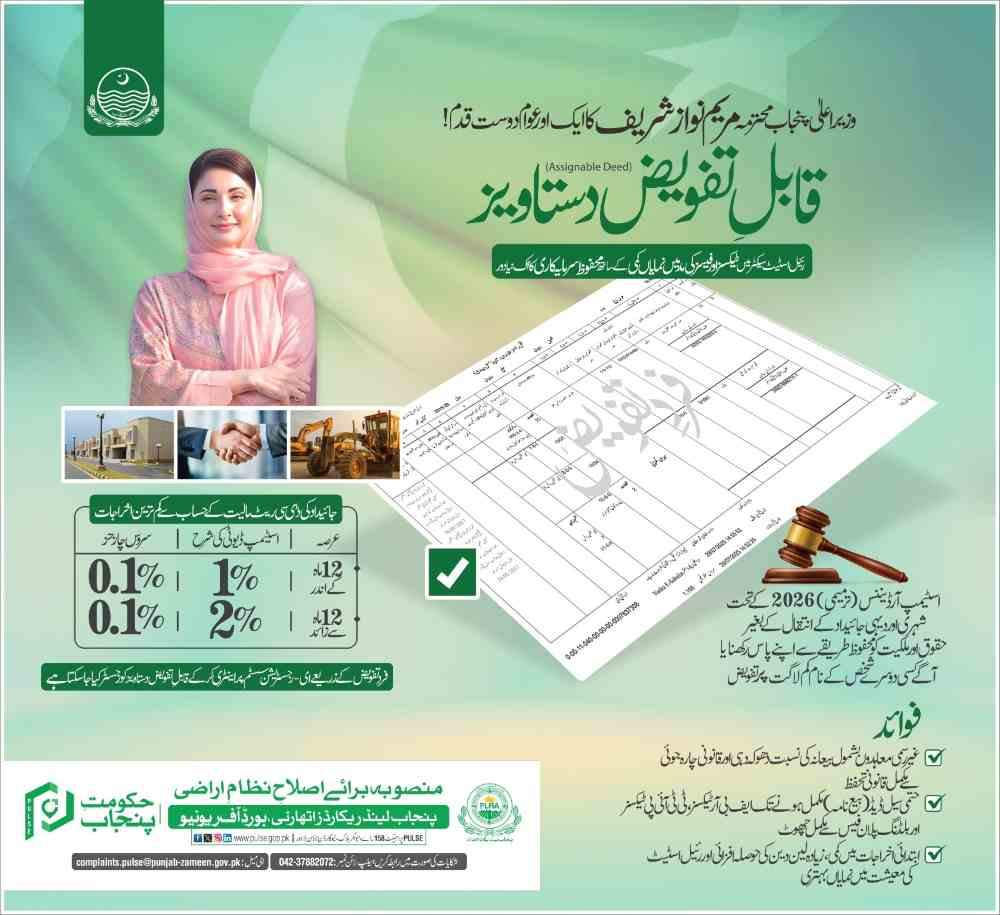
Table Of Contents
Property Transfer Calculator
Muslim Inheritance Calculator (Fara’id with Names)
Professional distribution · Named heirs · PDF report · Infographic chart
Estate & Heirs Details
Heirs Configuration & Names
Full Siblings (optional)
Distribution Summary (Named Heirs)
Enter estate details, heirs’ names and counts, then click “Calculate”
What Is the Complete Property Transfer Procedure in Pakistan for 2026?
The property transfer procedure in Pakistan is a legally mandated process that transfers ownership rights of immovable property from a seller to a buyer through registered documentation, biometric verification, and mutation of government land records. This procedure applies to all types of property transactions including sale, gift, inheritance, exchange, and mortgage across all provinces including Punjab, Sindh, Khyber Pakhtunkhwa, and Balochistan.
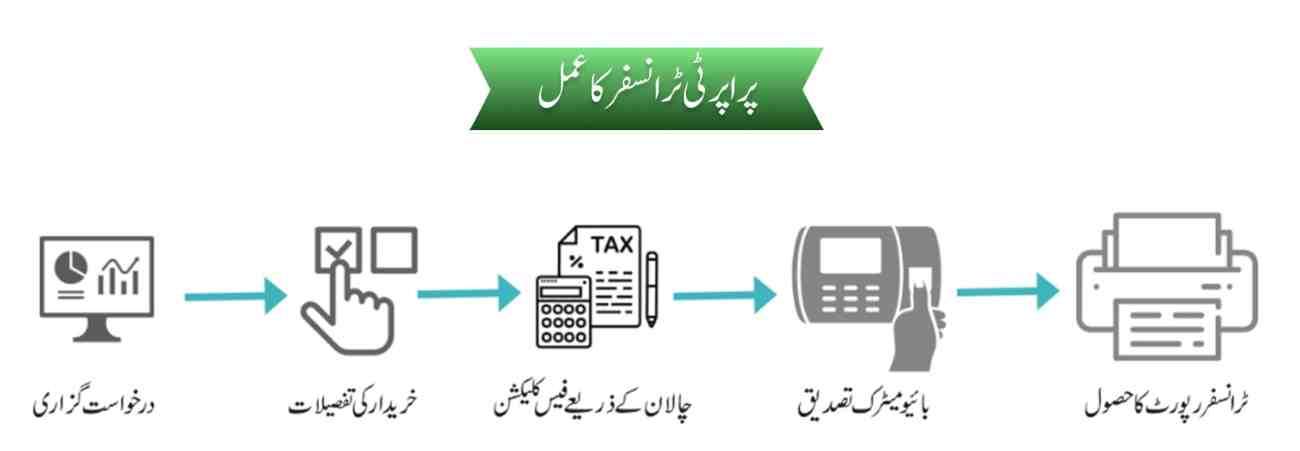
The updated property transfer procedure requires both parties to complete online verification of ownership through the provincial land record authority, payment of stamp duty and registration fees based on DC rates, biometric authentication through NADRA systems, and final mutation entry in the revenue record. The entire process typically takes 15 to 30 days when all documents are complete.
Essential steps in the property transfer procedure:
- Title verification through online Fard-e-Malkiat from the land record portal
- Execution of Bayana agreement on stamp paper
- No Demand Certificate from relevant housing authority
- Drafting and signing of Sale Deed (Baye-Nama)
- Payment of stamp duty, registration fees, and FBR advance tax
- Biometric verification at ARC or Sub-Registrar office
- Registration of the deed with the Sub-Registrar
- Mutation (Intiqal) entry in revenue records
- Issuance of new Fard in buyer‘s name
What Are the Three Main Ways to Transfer Property Ownership in Pakistan?

Property ownership in Pakistan can be transferred through three legally recognized methods, each with distinct documentation requirements and tax implications. The sale and purchase method involves a registered Sale Deed and applies standard stamp duty and capital gains tax. The inheritance method transfers property after death through a Succession Certificate or Wirasatnama, often with reduced tax burden. The gift deed method (Hiba) allows voluntary transfer between living persons, typically with lower tax rates when transferring among immediate family members.
The choice of transfer method significantly affects the overall cost and timeline. Sale transactions require both parties to be physically present for biometric verification. Inheritance transfers can be completed by legal heirs without the original owner‘s presence. Gift deeds between blood relatives enjoy favorable tax treatment under FBR rules.
Comparison of transfer methods:
| Transfer Type | Key Document | Tax Rate | Biometric Required |
|---|---|---|---|
| Sale/Purchase | Registered Sale Deed | Full stamp duty + CGT + Advance Tax | Both parties |
| Inheritance | Succession Certificate | Reduced / Exempt | Legal heirs |
| Gift Deed (Family) | Registered Gift Deed | 1% stamp duty; No withholding tax | Donor + Donee |
| Court Decree | Court Judgment | As per court order | As directed |
What Is the Legal Framework for Property Transfer in Pakistan?
Which Laws Govern Property Transfer in Pakistan?
Property transfer in Pakistan is governed by a comprehensive legal framework consisting of multiple federal and provincial statutes. The Transfer of Property Act 1882 establishes the substantive law governing the transfer of immovable property by act of parties. The Registration Act 1908 mandates compulsory registration of certain documents to give them legal validity. The Stamp Act 1899 prescribes stamp duty rates on instruments of transfer. The Land Revenue Act 1967 governs the mutation process and revenue record maintenance.
Provincial land record authorities, such as the Punjab Land Records Authority (PLRA), operate under their respective acts to digitize land records and streamline property transfer procedures. The Income Tax Ordinance 2001, through Sections 236C and 236K, imposes advance tax on property purchasers and capital gains tax on sellers. The Punjab Land Records Authority Act 2017 specifically empowers PLRA to computerize land records and manage mutation processes digitally.
What Does the Official Directive Say About No Registry, No Transfer?
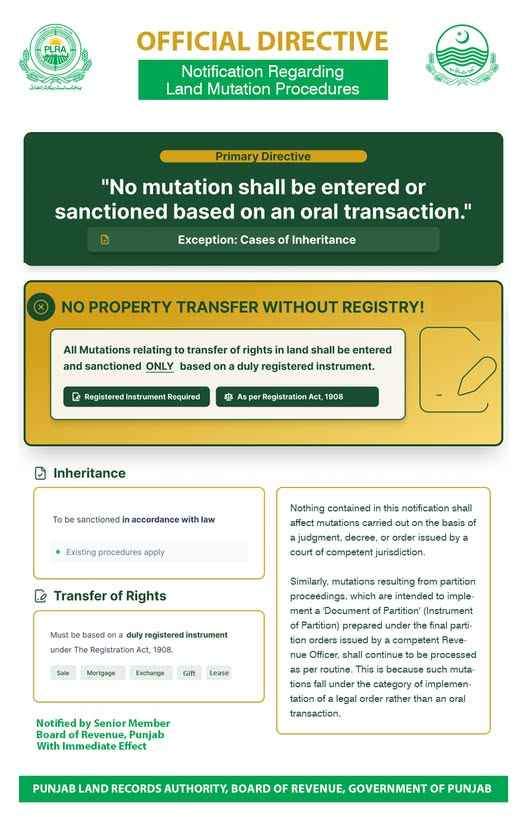
The official directive issued by the Senior Member Board of Revenue, Punjab, explicitly states that “No mutation shall be entered or sanctioned based on an oral transaction.” This directive applies to all forms of land rights transfer including sale, mortgage, exchange, gift, and lease. The only exceptions to this rule are cases of inheritance, mutations resulting from court judgments or decrees, and partitions implementing a Document of Partition prepared under final orders of a competent Revenue Officer.
This directive effectively eliminates the traditional practice of transferring property through verbal agreements or unregistered documents. All mutations must now be based on a duly registered instrument under the Registration Act 1908. The ban on undocumented land transfers takes immediate effect with zero tolerance for violations. Patwaris no longer have authority to sanction mutations based on oral statements.
Is Oral Property Transfer Hawaala Valid in Pakistan?
Oral property transfer, commonly known as Hawaala in local terminology, is no longer valid for any form of land rights transfer in Pakistan. The official notification clearly states that no mutation shall be entered or sanctioned based on an oral transaction in cases of sale, mortgage, exchange, or gift. Inheritance cases remain the sole exception where oral succession may be recognized, but still require documentation for mutation.
Attempting to transfer property through oral agreements exposes both parties to significant legal risks. The buyer cannot obtain a legal title, cannot register the property in their name, cannot secure utility connections, and has no legal recourse if the seller denies the transaction. All property transfers must now be supported by a duly registered instrument, and any mutation officer sanctioning an oral transaction faces disciplinary action.
Read More: Maryam Nawaz All Scheme List – (Law & Order Initiatives)
What Is the Difference Between Registry, Mutation Intiqal, and Transfer Letter?
What Does Registry Mean in Property Terms?
Registry refers to the formal registration of a Sale Deed (Baye-Nama) with the Sub-Registrar appointed under the Registration Act 1908. The registry process legally recognizes the transaction between the buyer and seller and creates a public record of the transfer. A registered deed serves as conclusive evidence of the transaction in a court of law and is compulsory for legalizing any sale or purchase of immovable property.
The registry document contains complete details including the property description, boundaries, Khasra numbers, total consideration amount, names and CNICs of both parties, and signatures of two witnesses. Once registered, the original deed is retained in the Sub-Registrar’s office, and certified copies can be obtained for future reference. Registry establishes the buyer’s legal right to the property but does not automatically update the revenue records.
What Is Mutation Intiqal and Why Is It Necessary?
Mutation, known as Intiqal in Urdu, is the process of updating the government‘s revenue record (Fard-e-Malkiat) to reflect the new owner‘s name after a property transfer. While the registry proves the transaction occurred, the mutation ensures the land revenue department recognizes the buyer as the legal owner for taxation and record purposes. Mutation is essential for establishing ownership in the eyes of the land revenue authorities.
Without mutation, the seller’s name continues to appear in the Fard, creating legal complications for future resale, inheritance, or mortgage. The mutation process involves verifying the registered deed, confirming tax payments, and entering the buyer’s details into the digital land record system. After mutation is sanctioned, a new Fard is issued in the buyer’s name, completing the ownership transfer in government records.
Why mutation is critical:
- Required for paying property tax under the correct owner’s name
- Necessary for obtaining No Demand Certificates from authorities
- Essential for transferring utility connections to the buyer
- Mandatory for legal recognition of ownership in revenue matters
- Prevents disputes about ownership in future transactions
How Does a Housing Society Transfer Letter Differ from a Registry?

A housing society Transfer Letter is an internal document issued by private housing schemes like DHA, LDA, CDA, or other cooperative societies. This letter confirms that the society has updated its internal records to reflect the new owner‘s name. The Transfer Letter is separate from the government Registry and serves a different purpose within the society’s administrative framework.
While the Registry is a legal document recognized by courts and government authorities, the Transfer Letter is only relevant for society-specific matters such as paying maintenance fees, obtaining construction approvals, and receiving utility bills from the society. Both documents are necessary for complete ownership. The buyer must first obtain the Registry from the Sub-Registrar, then submit it to the housing society to obtain the Transfer Letter. Without the Transfer Letter, the society may not recognize the buyer as the legitimate owner for administrative purposes.
What Documents Are Required for Property Transfer in Pakistan?
What Is the Complete Document Checklist for the Buyer and Seller?
The property transfer procedure requires a comprehensive set of documents from both parties to ensure legal validity and prevent fraud. The seller must provide the original title deed or previous registry, a valid CNIC, the latest property tax receipt, and a No Demand Certificate from the relevant housing authority or cantonment board. The buyer must provide CNIC copies, passport-size photographs, and the completed stamp paper for the sale deed.
Two witnesses, unrelated to the transaction, must provide their CNIC copies and be present during the registration process. All documents must be original or certified copies, and any discrepancy can lead to rejection of the transfer application.
Complete document checklist for property transfer:
- Original Sale Deed (Baye-Nama) drafted on stamp paper
- Seller‘s original CNIC with clear copy
- Buyer’s original CNIC with clear copies
- CNIC copies of two witnesses
- Latest Fard-e-Malkiat from land record authority
- Previous registry document or title deed
- No Demand Certificate from housing authority
- Property tax payment receipts for the last 3 years
- Passport-size photographs of buyer and seller (4 each)
- Succession Certificate (for inheritance transfers)
What Is a Fard and How Do You Get It?
A Fard, also known as Fard-e-Malkiat or Jamabandi, is the official land record document that shows current ownership, cultivation details, Khasra numbers, and land area. It serves as the primary proof of ownership in revenue records and is essential for verifying the seller‘s title before proceeding with any property transaction. The Fard contains complete details including the owner’s name, father‘s name, property location, and any existing encumbrances or mortgages.
The Fard can be obtained online through the provincial land record authority portal. For Punjab, visit the PLRA website and enter the owner’s CNIC or the property‘s Khasra number. For Sindh, use the Sindh Land Revenue Act portal. The document is issued with a unique QR code for verification and can be downloaded instantly after paying a nominal fee. Always verify the Fard’s authenticity by scanning the QR code or cross-checking with the physical record at the ARC.
What Is a No Demand Certificate NDC and Why Do You Need It?
A No Demand Certificate (NDC) is a legal document issued by the relevant housing authority, cantonment board, or development authority confirming that the seller has no outstanding dues, taxes, or litigation on the property. The NDC is mandatory for property transfer in organized housing schemes like DHA, LDA, CDA, or any private cooperative housing society. Without a valid NDC, the transfer application is rejected by the society or the Sub-Registrar.
The seller must apply for the NDC by submitting an application along with copies of ownership documents and CNIC at the designated authority‘s office. The authority verifies all outstanding payments including property tax, maintenance fees, electricity charges, and water bills. If any dues exist, the seller must clear them before the NDC is issued. The NDC remains valid for a specific period, typically 30 to 90 days, and the transfer must be completed within this timeframe.
How Do You Verify the Authenticity of a Physical Stamp Paper?
Verifying stamp paper authenticity is crucial to prevent fraud in property transactions. Fake stamp papers are a common method of committing property fraud, and buyers must take proactive steps to verify each stamp paper used in the transaction. The verification process involves checking the unique serial number, vendor details, and watermarks on the stamp paper.
For physical stamp paper verification, contact the relevant stamp vendor or visit the excise and taxation department‘s online portal. Many provinces have introduced e-stamping systems that allow instant verification of stamp papers through QR codes or online portals. Never accept stamp papers that appear tampered, have missing serial numbers, or come from unverified vendors. Always purchase stamp papers from licensed vendors registered with the provincial excise department.
Red flags indicating fake stamp paper:
- Missing or illegible serial numbers
- No watermark or security features
- Different paper quality compared to authentic stamps
- Vendor not registered with excise department
- Price paid significantly below face value
What Is the Step-by-Step Property Transfer Procedure for Sale/Purchase?
Step 1: How Do You Verify Property Ownership Online Before Buying?
Property ownership verification is the first and most critical step before proceeding with any property transaction. The buyer must independently verify the seller‘s legal ownership through the online land record portal of the relevant province. For Punjab, use the PLRA website to download the Fard-e-Malkiat by entering the owner’s CNIC or the property‘s Khasra number. For Sindh, use the Sindh Land Revenue Authority portal.
The verification process should confirm that the seller’s name exactly matches the name in the land records, the property area matches the physical measurements, and there are no existing mortgages, liens, or legal disputes recorded against the property. Cross-reference the online Fard with any physical documents the seller provides. Discrepancies between online records and physical documents indicate potential fraud.
Step 2: What Is a Bayana Token Agreement and How Do You Draft It?
The Bayana agreement, also known as the token agreement or earnest money contract, is a preliminary written agreement between the buyer and seller that fixes the property price and sets a deadline for completing the final sale. The buyer pays a token amount, typically 10 to 25 percent of the total price, as good faith money. The Bayana agreement is drafted on stamp paper of nominal value, usually Rs 100 to Rs 500.
The Bayana document must include the complete property description, total agreed price, token amount paid, deadline for final transfer (typically 30 to 90 days), and consequences for default by either party. If the buyer defaults, the seller keeps the token money. If the seller defaults, they must return double the token amount to the buyer. Both parties and two witnesses must sign the agreement.
Step 3: How Do You Calculate Stamp Duty and Registration Fees in 2026?
Stamp duty and registration fees are calculated as a percentage of the property‘s DC Rate or the transaction value, whichever is higher. In Punjab, stamp duty has been made uniform at 1 percent for both urban and rural areas. Registration fees are typically 1 percent of the property value. Additional charges include Capital Value Tax at 2 percent for urban properties and District Council fee at 1 percent.
The total transfer cost in Punjab ranges from 5 to 7 percent of the DC value, including stamp duty, registration fee, CVT, and other ancillary charges. Female buyers receive a concession of 2 percent on stamp duty in some provinces to encourage female property ownership. Use the online property transfer fee calculator available on provincial land record portals to estimate total costs before proceeding.
Typical fees for property transfer in Punjab:
- Stamp Duty: 1% (uniform rate urban and rural)
- Registration Fee: 1% of property value
- Capital Value Tax: 2% for urban properties
- District Council Fee: 1% (varies by location)
- PLRA Service Charges: fixed fee (approx Rs 1,700)
Step 4: What Is the Role of the Sub-Registrar and Arazi Record Center ARC?
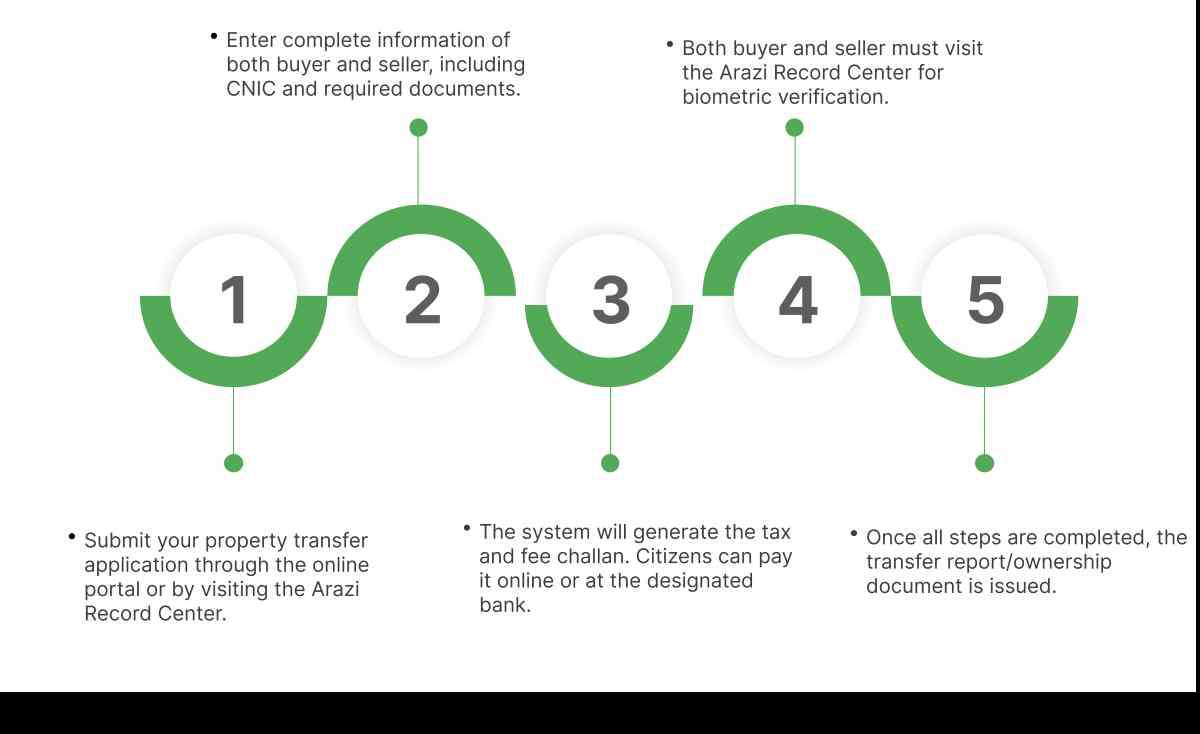
The Sub-Registrar, operating under the Registration Act 1908, is the government authority responsible for registering property deeds in urban areas. The Arazi Record Center (ARC) serves a similar function in rural areas, operating under the provincial land record authority. Both offices verify documents, collect stamp duty and registration fees, capture biometric data, and maintain official records of all registered property transactions.
The buyer and seller must physically appear before the Sub-Registrar or ARC officer on the scheduled date. The officer verifies the identity of both parties, confirms the document details, witnesses the signatures, and officially registers the deed. After registration, the original deed is retained in the office records, and certified copies are provided to both parties.
Step 5: Is Biometric Verification Mandatory for Property Registration?
Yes, biometric verification is mandatory for all property registration transactions in Pakistan. Both the buyer and seller must visit the Arazi Record Center or Sub-Registrar office to complete NADRA-integrated biometric verification. The process involves fingerprint scanning and, increasingly, facial recognition to positively identify both parties and prevent identity theft.
Biometric verification has significantly reduced property fraud by ensuring that the person claiming to be the seller is actually the legal owner. For overseas Pakistanis, biometric verification can be completed at Pakistani embassies and consulates, with the data transmitted digitally to the relevant authority in Pakistan. The NADRA Pak ID mobile app also supports remote biometric verification for certain transactions. Facial recognition has been introduced as an alternative for cases where fingerprint verification fails.
Step 6: How Do You Pay FBR Advance Tax Under Sections 236C and 236K?
FBR advance tax under Section 236K applies to property purchasers, while Section 236C applies to sellers (capital gains tax). The tax rate varies based on the buyer’s filer status and the property value. For properties valued up to Rs 50 million, filers pay 1.5 percent advance tax, late filers pay 4.5 percent, and non-filers pay 10.5 percent. For properties above Rs 50 million, rates increase accordingly.
Payment is made online through the FBR IRIS portal before registration. The buyer must log into their FBR account, select the property tax payment option, enter the property details and DC value, and generate a challan. The challan can be paid through online banking or at designated bank branches. The payment receipt must be submitted to the Sub-Registrar or ARC along with other documents before the deed is registered.
Advance tax rates for property purchase Section 236K:
| Property Value | Filer Rate | Late Filer Rate | Non-Filer Rate |
|---|---|---|---|
| Up to Rs 50 million | 1.5% | 4.5% | 10.5% |
| Above Rs 50 million | 2.5% | 5.5% | 11.5% |
Step 7: What Is the Final Step of Mutation Intiqal at the ARC?
The final step in the property transfer procedure is mutation (Intiqal) entry at the Arazi Record Center or relevant revenue authority. After the registry is completed and all taxes are paid, the revenue officer enters the mutation in the digital land record system. This entry officially transfers the property ownership in government revenue records and updates the Fard-e-Malkiat.
The mutation process includes verifying the registered deed, confirming tax payments, updating the owner’s name in the Jamabandi, and issuing a new Fard. The entire mutation process takes 7 to 15 working days in Punjab through the ARC system. The buyer can track the mutation status online using the tracking number provided at the time of application. Once sanctioned, the new Fard is issued and can be downloaded from the PLRA portal.
How Do You Transfer Inherited Property Wirasat in Pakistan?
What Is the Difference Between a Succession Certificate and a Wirasatnama?
A Succession Certificate is a legal document issued by a Civil Court that establishes the rightful legal heirs of a deceased person and authorizes them to inherit both movable and immovable assets. A Wirasatnama, also known as an Inheritance Certificate, is issued by NADRA for undisputed inheritance cases specifically for land transfer in Punjab and certain other provinces.
The Succession Certificate requires a court petition, publication of notices, and a formal court decree, making it suitable for disputed or complex inheritance cases. The NADRA Wirasatnama is faster and simpler for undisputed cases where all legal heirs agree on the distribution. For property valued above a certain threshold, typically Rs 100,000, the Succession Certificate may be required even for undisputed cases.
How Do You Obtain a Succession Certificate from NADRA or Civil Court?
To obtain a Succession Certificate from NADRA, visit any NADRA mega center with the death certificate of the deceased, CNICs of all legal heirs, and proof of relationship. NADRA has established Succession Facilitation Units at 186 centers nationwide, and legal heirs can complete biometric verification at the nearest center or remotely through the Pak ID Mobile App. Applications can now be submitted at any NADRA center regardless of where the property is located.
For a Civil Court Succession Certificate, file a petition in the Civil Judge’s court of the area where the deceased resided or where the property is located. The court publishes notices to invite any objections, and if none are received, issues the Succession Certificate. This process typically takes 30 to 90 days, compared to 15 to 30 days for NADRA certificate.
What Is the Procedure for Mutation Intiqal of Inherited Land?
After obtaining the Succession Certificate or Wirasatnama, the legal heirs must apply for mutation of the inherited land at the Arazi Record Center. All legal heirs must sign the mutation application, and each heir must complete biometric verification. The revenue officer verifies the Succession Certificate, updates the land record to reflect all heirs as joint owners, and issues a new Fard with all names.
If the heirs wish to partition the inherited land, they must file a separate partition application with the Revenue Officer. The officer measures the land, allocates shares according to the Succession Certificate, and updates the record with individual ownership. The Punjab government has abolished fees on land partition (Wanda) to ease the process for joint family land division.
How Do You Transfer Property When a Legal Heir Refuses to Sign?
When one or more legal heirs refuse to sign the mutation application or contest the inheritance distribution, the matter must be resolved through the civil court. The cooperating heirs should file a civil suit for partition or specific performance in the relevant court. The court hears all parties, reviews evidence of inheritance, and issues a decree determining each heir’s legal share.
Once the court issues a final decree, the heirs present this decree to the Revenue Officer or ARC. The officer is bound to implement the court order and mutate the land according to the decree, even if some heirs refuse to cooperate voluntarily. The mutation is sanctioned based on the court judgment rather than the agreement of all heirs.
What Is the Procedure for a Gift Deed Hiba Transfer?
What Are the Legal Requirements for a Valid Gift Hiba in Pakistan?
A valid gift (Hiba) under Islamic law and Pakistani property law requires three essential conditions: declaration by the donor (giftor), acceptance by the donee (giftee), and delivery of possession. The donor must voluntarily transfer ownership without any consideration or compensation. The donee must accept the gift explicitly or implicitly. Physical or constructive possession of the property must be transferred to the donee.
For immovable property, a written Gift Deed registered with the Sub-Registrar is mandatory. The Gift Deed must state the donor‘s free will, the relationship with the donee, the complete property description, and the transfer of possession. The deed must be signed by the donor, donee, and two witnesses, and must be registered following the same procedure as a Sale Deed.
How Much Is the Tax on a Gift Deed in Pakistan?
Gift transfers among immediate family members receive favorable tax treatment under Pakistani law. No withholding tax under Section 236K is collected on property gifted to close relatives including spouse, parents, children, grandchildren, and siblings. Stamp duty on family gift deeds is significantly reduced, typically 1 percent of the DC rate compared to 3 to 5 percent for commercial sales.
Non-family gifts or gifts made to avoid taxation may attract higher tax rates, up to 2 percent or more of the DC value. The donor should retain evidence of the relationship and the voluntary nature of the gift to avoid tax reassessment. The gift deed registration fee remains the same as for standard property registration.
Can a Gift Deed Be Challenged in Court Later?
A registered Gift Deed can be challenged in a civil court on specific grounds including fraud, coercion, undue influence, mental incapacity of the donor, or lack of delivery of possession. The burden of proof lies with the person challenging the gift deed. If the court finds the gift was obtained through misrepresentation or force, it can declare the gift deed void and restore ownership to the donor or the donor‘s estate.
Gifts made during deathbed illness (marz-ul-maut) are subject to additional scrutiny and may be treated as wills rather than gifts, requiring the consent of all legal heirs. Courts protect the rights of legal heirs and prevent donors from disinheriting rightful heirs through fraudulent gifts.
How Do Overseas Pakistanis Transfer Property Without Visiting Pakistan?
What Is the Legal Requirement for a Power of Attorney PoA for Property?
Overseas Pakistanis can execute a Special Power of Attorney (SPA) authorizing a trusted person in Pakistan to act on their behalf in property transactions. The SPA must specifically authorize the attorney to sell, purchase, transfer, or manage the specified property. General Power of Attorney is not sufficient for property transactions; a Special Power of Attorney limited to the specific property and transaction is required.
The SPA must be notarized in the host country and attested by the Pakistani Consulate or Embassy. The original attested document must be couriered to Pakistan for use in the property transfer process. Digital Power of Attorney services launched by NADRA allow overseas Pakistanis to obtain and submit PoA electronically without visiting the embassy, using the Pak-ID Online Biometric Verification System.
What Is the Procedure for E-Registration and Online Biometric for Overseas Owners?
The e-registration system allows overseas Pakistanis to complete property transactions remotely without a Power of Attorney. Under this system, the overseas seller provides biometric verification at the nearest Pakistani embassy or consulate. The embassy officer verifies the identity, captures fingerprints, and digitally transmits the biometric data to the Sub-Registrar or ARC in Pakistan.
The buyer in Pakistan submits all documents online through the provincial land record portal. The Sub-Registrar reviews the documents, confirms the biometric verification from the embassy, and completes the registration. The registered deed is sent electronically to both parties. Sindh has launched a fully digital property registration system specifically for overseas Pakistanis, integrated with NADRA for biometric and facial verification.
What Documents Need to Be Attested by the Pakistani Consulate?
The Power of Attorney document must be attested by the Pakistani Consulate or Embassy in the country where the overseas Pakistani resides. Additionally, copies of the CNIC or NICOP, passport, and any affidavits related to the property transaction require consular attestation. The original attested documents must be sent to Pakistan for the property transfer process.
For e-registration through the digital system, consular attestation may be replaced by biometric verification performed at the embassy. The embassy officer digitally signs and transmits the verification, eliminating the need for physical document attestation. This digital process significantly reduces processing time and costs for overseas Pakistanis.
What Are the Specific Procedures for Housing Societies DHA LDA CDA?
How Is Property Transfer in DHA Different from Regular Transfer?
Property transfer in Defence Housing Authority (DHA) requires both government registry and DHA‘s internal transfer letter. The seller must first obtain a No Demand Certificate from DHA confirming no outstanding dues. After the government registry is completed, the buyer submits the registered deed along with the NDC to DHA’s Transfer and Record department. DHA verifies the documents and issues a Transfer Letter updating their internal records.
The DHA transfer process includes a transfer fee, typically 1 to 2 percent of the property‘s current value. Both buyer and seller must appear at the DHA office or provide attested authority if overseas. DHA does not recognize unregistered transactions, and the Transfer Letter cannot be issued without the government registry. The entire DHA transfer process takes 7 to 15 working days after receiving the registered deed.
What Is the File vs Allotment Letter Transfer Procedure?
A File is a booking document issued by a housing society when a buyer books a property before possession. An Allotment Letter is issued when the society allots a specific plot or house to the buyer after development. The transfer procedure differs significantly between these two documents.
For File transfer, the buyer simply submits a transfer application to the society with the original file, CNIC copies, and transfer fee. The society updates the name in their booking record. For Allotment Letter transfer, the process requires government registry in addition to society transfer because possession has been delivered. The seller must provide the Allotment Letter, NDC, and possession documents to complete the transfer.
What Are the LDA and CDA Property Transfer Rules?
Lahore Development Authority (LDA) and Capital Development Authority (CDA) require a No Objection Certificate (NOC) for property transfer in their approved housing schemes. The seller must submit an application to the LDA or CDA One Window Cell with attested copies of ownership documents, CNIC, and any building plan approvals. The authority verifies that no building bylaw violations exist and no outstanding dues remain.
The NOC remains valid for one year from the date of issue. If the transfer is not completed within this period, a new NOC must be obtained. The transfer application must be submitted along with the NOC, original ownership documents, and CNIC copies. Both parties must appear for biometric verification at the authority‘s designated office or provide attested Power of Attorney.
How to Calculate Property Transfer Taxes Fees and Stamp Duty?
What Is the DC Rate and FBR Table Value and How Do They Affect Tax?
The DC Rate (District Collector Rate) is the minimum valuation set by the provincial government for property transactions in each area. The FBR Table Value is the valuation set by the Federal Board of Revenue for federal tax purposes. Taxes are calculated on the higher of the actual transaction value, the DC Rate, or the FBR Table Value.
DC rates are typically 15 to 30 percent lower than actual market prices, while FBR table values have been revised upward to close this gap. For federal taxes including advance tax under Sections 236C and 236K, the FBR Table Value is used. For provincial taxes including stamp duty and registration fees, the DC Rate is used. The buyer must pay taxes on the higher applicable value to avoid penalties.
How DC Rate and FBR Value determine taxes:
- Provincial taxes (stamp duty, registration): Use DC Rate
- Federal taxes (advance tax, CGT): Use FBR Table Value
- If transaction value > DC Rate, use transaction value for provincial taxes
- If transaction value > FBR Value, use transaction value for federal taxes
Who Pays the Capital Gains Tax CGT on Property Sale?
Capital Gains Tax (CGT) on property sale is paid by the seller. The tax rate depends on the seller‘s filer status and when the property was acquired. For properties acquired on or after July 1, the holding period has been eliminated, and a flat 15 percent CGT applies for filers regardless of how long the property was held. Non-filers pay double the filer rate, or 30 percent.
For properties acquired before July 1, the previous holding period-based rates continue to apply: properties held for more than 4 years may be exempt or subject to reduced rates. The CGT is calculated on the gain amount (sale price minus purchase price and allowable costs). The tax is filed and paid through the seller‘s annual income tax return or through separate capital gains filing.
What Is the Property Transfer Fee in Punjab vs Sindh vs KPK?
Property transfer fees vary significantly across provinces due to different stamp acts and local taxation policies. In Punjab, the total transfer cost including stamp duty (1%), registration fee (1%), CVT (2%), and district council fee (1%) is approximately 5% of the DC rate. In Sindh, stamp duty ranges from 3 to 5% with an additional 2% CVT, making total costs around 6 to 8%.
Khyber Pakhtunkhwa has reduced property transfer tax from 6% to 3% to encourage real estate activity, though additional local surcharges may apply. Balochistan maintains a 4% transfer fee structure. Buyers should verify the exact rates for the specific property location, as cantonment areas and private housing societies may have additional charges.
Provincial property transfer fee comparison:
| Province | Stamp Duty | Registration Fee | CVT | Total Approx |
|---|---|---|---|---|
| Punjab | 1% | 1% | 2% | 5% |
| Sindh | 3-5% | 1% | 2% | 6-8% |
| KPK | 3% | 1% | 2% | 6% |
| Balochistan | 2% | 1% | 1% | 4% |
How to Use the Property Transfer Fee Calculator Pakistan?
The property transfer fee calculator is an online tool available on provincial land record portals that estimates all costs associated with property transfer. To use the calculator, enter the property type (residential or commercial), the property value or DC Rate, the buyer‘s filer status, and the property’s location. The calculator automatically applies the current stamp duty rate, registration fee, CVT, advance tax under Section 236K, and any other applicable charges.
The calculator provides a breakdown of each fee component, making it easy for buyers to budget for the total transfer cost. Always verify the DC Rate for the specific location before using the calculator, as rates vary by area. The calculator output is an estimate; final charges are determined by the Sub-Registrar or ARC at the time of registration.
How to Check Property Transfer Status Online and Verify Ownership?
How Can I Verify a Property‘s Ownership Online Through PLRA?
Property ownership verification through PLRA is available online through the official portal. Visit the PLRA website and select the “Fard“ or ”Ownership Verification“ service. Enter either the owner‘s CNIC number or the property’s Khasra and Khewat numbers. The system retrieves the current Fard-e-Malkiat showing the registered owner, property area, location details, and any encumbrances.
The online Fard includes a unique QR code that can be scanned to verify authenticity. This digital verification eliminates the need to visit a Patwari or ARC for basic ownership checks. The service is available 24/7 and provides instant results for a nominal fee. Always verify ownership immediately before paying any token amount or signing any agreement.
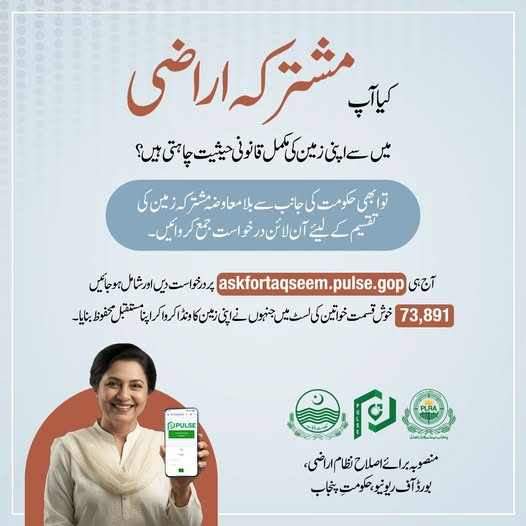
What Is the Ask for Taqseem Portal pulse gop?
The Ask for Taqseem portal pulse gop is a government initiative for filing applications related to land division, partition, and mutation. Citizens can submit online applications for land transfer, track application status, and receive updates digitally. The portal aims to reduce physical visits to revenue offices and improve transparency in land record management.
The system allows users to upload required documents, pay applicable fees online, and receive digital acknowledgments. After processing, the mutation or partition order is issued through the portal and can be downloaded directly. This digital service is part of the broader land reform initiative to modernize revenue record management.
How Do You Check Mutation Intiqal Status Online?
After submitting a mutation application at the ARC or through the online portal, the applicant receives a unique tracking number. Enter this tracking number on the provincial land record authority‘s mutation tracking portal to view the current status. The status may show as “Pending at Patwari,“ ”Pending at Girdawar,“ ”Under Verification,“ ”Sanctioned,“ or ”Rejected.“
The tracking system also shows which revenue officer is processing the application and any remarks or additional requirements. If the mutation is rejected, the reason is displayed, allowing the applicant to address the deficiency and reapply. The entire mutation process from application to sanction typically takes 7 to 15 working days in Punjab through the digital system.
What Are the Consequences of Not Transferring Property Non-Registration?
What Happens If You Only Have a Bayana Agreement but No Registry?
A Bayana agreement alone provides no legal ownership rights to the buyer. Without a registered Sale Deed, the buyer cannot establish legal title to the property in any court or government office. The seller retains full legal ownership and can sell the property to a third party, and the original buyer has no recourse beyond claiming damages for breach of contract.
Utility connections including electricity, gas, and water cannot be transferred to the buyer‘s name without a registered deed. Banks and financial institutions will not accept the property as collateral for loans. The buyer cannot obtain a construction NOC from the housing society. The property remains in the seller’s name for tax purposes, and the buyer may be unable to prove ownership in inheritance or succession matters.
What Is the Penalty for Late Mutation Intiqal in Pakistan?
If the buyer delays mutation beyond 90 days from the date of the registered sale deed, a penalty is imposed at the time of mutation application. The penalty typically ranges from 10 to 20 percent of the registration fee, depending on the delay period and the province‘s rules. The penalty increases for longer delays, and the revenue officer has discretion to impose additional fines.
The buyer also becomes liable for any property tax arrears that accrued during the delay period. The seller remains the recorded owner for tax purposes until mutation is completed, but the buyer may be required to pay back taxes. Delaying mutation also creates legal risks if the seller dies, becomes insolvent, or sells the property again before mutation is completed.
Can You Sell a Property Without Doing Mutation First?
Technically, the recorded owner in the Fard must be the seller in any property transaction. If the current owner purchased the property but never completed mutation, their name is not in the revenue record, and they cannot legally sell the property without first mutating it into their name. The buyer would be purchasing from someone not recognized as the legal owner in government records.
The correct procedure is for the current owner to first complete mutation to transfer the property into their name from the previous owner. After mutation is sanctioned and a new Fard is issued in their name, they can then sell the property to the new buyer following the standard property transfer procedure. Skipping this step exposes both parties to significant legal and financial risks.
How to Resolve Property Transfer Disputes and Fraud?
What Is the Procedure for Challenging a Fraudulent Property Transfer?
Challenging a fraudulent property transfer requires filing both civil and criminal cases. The victim must file a civil suit for “Declaration and Cancellation of Sale Deed” in the Civil Court of the area where the property is located. The suit seeks a court declaration that the fraudulent transfer is void and an order canceling the fake sale deed.
Simultaneously, file a criminal complaint with the Federal Investigation Agency (FIA) Cyber Crime Wing if digital forgery was involved, or with the local police if physical forgery occurred. Provide all evidence including the original ownership documents, CNIC, and any correspondence with the fraudster. The court can issue a stay order preventing further transfer of the property during the legal proceedings.
What Is a Stay Order and How Does It Affect Property Transfer?
A Stay Order is a court directive that temporarily halts any legal proceeding, including property mutation and registration. When a court issues a Stay Order on a property, the Sub-Registrar or ARC cannot register any deed related to that property, and the revenue officer cannot sanction any mutation. The Stay Order remains in effect until the court hears the case and issues a final decision.
Anyone planning to purchase a property must verify that no Stay Order exists against the property. Stay Orders are recorded in the land record and appear in the Fard under encumbrances. Buyers should search court records and obtain a certificate from the relevant court confirming no pending litigation or stay order affects the property.
How Do You Transfer Property When the Original Title Deed Is Lost?
If the original title deed is lost, the owner must take immediate steps to establish their ownership through alternative evidence. File a First Information Report (FIR) at the local police station reporting the loss of the deed. Publish a notice in a newspaper informing the public about the lost deed and inviting any objections. Apply to the Sub-Registrar‘s office for a certified copy of the registered deed if the deed was registered.
If the deed was never registered or certified copies are unavailable, file a civil suit for declaration of ownership. The court hears evidence including witness testimony, tax receipts, utility bills, and other documents proving continuous possession and ownership. After the court issues a declaration, use the court decree in place of the original deed for property transfer.
What Are the Latest FBR and Government Updates?
What Are the New Tax Rates for Non-Filers in Property Transfer?
Non-filers face significantly higher tax rates on property transactions compared to filers. For property purchase under Section 236K, non-filers pay 10.5 percent advance tax on properties up to Rs 50 million, compared to 1.5 percent for filers. For properties above Rs 50 million, non-filers pay 11.5 percent compared to 2.5 percent for filers. For property sales, non-filers pay double the capital gains tax rate, or 30 percent compared to 15 percent for filers.
Overseas Pakistanis holding NICOP or POC can avail filer rates by following a set procedure on the FBR web portal. Late filers who file their tax returns after the deadline fall between filers and non-filers, with rates of 4.5 to 7.5 percent depending on property value. Becoming a filer before any property transaction can save significant tax amounts.
Is There Any Tax Exemption for First-Time Homebuyers?
First-time homebuyers may qualify for reduced advance tax rates under Section 236K. The government has introduced a reduced tax rate of 0.5 to 1 percent advance tax for first-time homebuyers on properties up to a certain value threshold. To claim this exemption, the buyer must provide a declaration that they own no other residential property in their name or in the name of their spouse or dependent children.
The exemption applies only to residential property intended for personal use, not commercial property or investment properties. The buyer must submit an affidavit confirming their first-time buyer status along with the property transfer application. The reduced rate is automatically applied by the FBR portal when the buyer‘s NTN is linked to the first-time buyer declaration.
What Is the Baraq Land Reform System?
The Baraq Land Reform System is a new initiative by the Board of Revenue, Punjab, aimed at automating land records and speeding up mutation processes. The system integrates all land record databases, eliminates manual entries, and provides real-time access to ownership and mutation status. Baraq also introduces assignable conveyance documents, allowing property rights to be transferred through assignable deeds.
Under the Baraq system, citizens can submit mutation applications online, track progress digitally, and receive sanctioned mutations electronically. The system has been launched across multiple districts and is being expanded province-wide. The Baraq reform also includes the introduction of e-stamping and QR code-based verification for all land record documents.
Frequently Asked Questions FAQ
How long does the entire property mutation Intiqal process take?
The mutation process typically takes 7 to 15 working days in Punjab through the Arazi Record Center digital system. In Sindh and other provinces, the process may take 30 to 45 days due to more manual verification steps. Delays occur if documents are incomplete, taxes are unpaid, or the property has existing encumbrances.
Can a foreign national own or buy property in Pakistan?
Yes, foreign nationals can buy residential and commercial property in Pakistan but cannot purchase agricultural land. They must use foreign exchange for the transaction and report it to the State Bank of Pakistan. A valid passport and visa are required, and the property must be registered following the standard property transfer procedure.
What is the role of a Patwari in the modern digital system?
The Patwari no longer maintains physical land records or has authority to sanction mutations. Their role is now limited to assisting with digital entry at the Arazi Record Center and verifying physical possession when required. All land records are accessible online through PLRA and other provincial portals, eliminating the need to visit a Patwari for basic information.
Is biometric verification required for property transfer in private housing societies?
Yes, most registered housing societies including DHA, LDA, and CDA have integrated NADRA biometric verification for their internal transfer letter process. Both buyer and seller must complete biometric verification at the society‘s designated office or through the e-registration system before the Transfer Letter is issued.
How do I check if a housing society is approved by the LDA or CDA?
Visit the LDA or CDA official website and search for the “Approved Housing Schemes” list. Enter the society name to verify its approval status. Never buy property in an unapproved scheme because government registry is impossible, utility connections may be denied, and the property can be demolished for illegal development.
What are the charges for a Transfer Letter in a cooperative housing society?
Transfer letter charges in cooperative housing societies typically range from 1 to 2 percent of the property‘s current DC value, plus a fixed administrative fee of Rs 5,000 to Rs 25,000. The exact charges vary by society and are published in the society’s byelaws. Verify the current transfer fee with the society‘s management before initiating the transfer.

Add a Comment