
When a woman faces harassment, violence, or denial of her legal rights in Punjab, knowing where to turn can mean the difference between suffering in silence and accessing justice. The CM Punjab Women Helpline 1043 serves as that critical lifeline, a toll-free, 24/7 gateway to protection, legal guidance, and rehabilitation services managed by the Punjab Commission on the Status of Women (PCSW).
This guide will walk you through exactly how this helpline works, what services it provides, how to register complaints, and the complete ecosystem of women’s protection services in Punjab, including Dar-ul-Aman shelters, Violence Against Women Centers (VAWCs), and the Punjab Women Protection Authority (PWPA). Whether you are seeking help for yourself or assisting someone in need, this guide ensures you have all the information required to navigate the system effectively and access the support you deserve.
Key Takeaways
- Single Gateway to Justice: The CM Punjab Women Helpline 1043 is your primary entry point for reporting gender-based violence, harassment, discrimination, and seeking legal advice—all free of charge and available 24 hours a day.
- Complete Privacy Guaranteed: Your identity remains confidential when you call 1043, with all-women call agents, female supervisors, and trained counselors ensuring a safe and secure reporting environment.
- Beyond the Phone Call: After reporting, your complaint triggers a structured response involving PCSW legal advisors, referral to PWPA for physical protection, or connection to Dar-ul-Aman shelter homes across all 36 districts of Punjab.
- Multiple Reporting Channels: You can register complaints through the toll-free number 1043, online through the PCSW complaint portal, or by walking into any Women Protection Center or Violence Against Women Center in your district.
- Holistic Support Services: The helpline connects you not just to legal remedies but also to psychosocial counseling, medical assistance, vocational training, and safe shelter—addressing both immediate crisis and long-term rehabilitation needs.
- Read More: Khelta Punjab CM Punjab Pink Games | How To Apply
- Read More: CM Punjab Livestock Card Phase 2 | PLC Card | PLC Punjab gov pk
- Read More: Punjab Livestock Scheme | CM Punjab Livestock Card
CM Punjab Women Helpline | PCSW – Toll-Free Helpline 1043
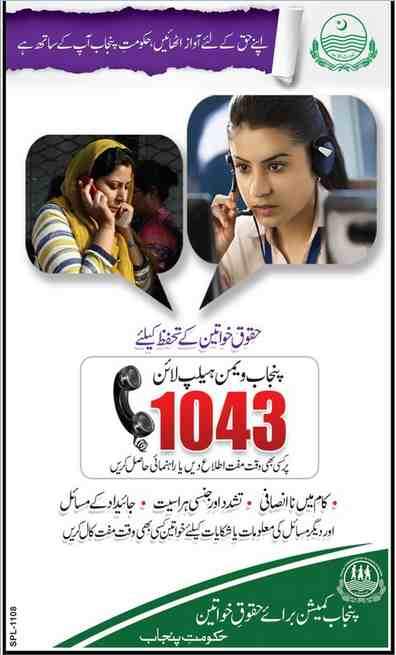
Table Of Contents
What is the CM Punjab Women Helpline 1043 and Who Runs It?
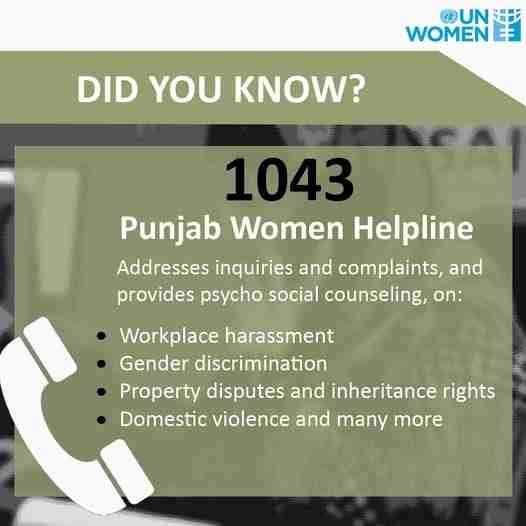
The CM Punjab Women Helpline 1043 is a dedicated toll-free emergency and support line established by the Government of Punjab to provide immediate assistance to women facing harassment, violence, legal disputes, or discrimination. It operates 24 hours a day, 7 days a week, and is completely free to call from any mobile or landline network across Pakistan.
The helpline is managed and supervised by the Punjab Commission on the Status of Women (PCSW) , a statutory body created under the PCSW Act 2014. The Commission functions as an autonomous human rights institution with a mandate to work for women’s empowerment, elimination of all forms of discrimination, and socio-economic development of women in Punjab.
Key facts about PCSW and its authority
- Legal status: Established in March 2014 through an Act of the Punjab Assembly, giving it constitutional backing and powers of a civil court.
- Unique powers: PCSW can summon any government official, demand records and documents from any public institution, and inspect jails, shelter homes, and government facilities.
- Core functions: Research, advocacy, redressal of grievances, monitoring of women’s rights implementation, and policy recommendations to government.
- Current role: The Commission continues to operate with a Chairperson and members appointed by government, working across all 36 districts.
Is 1043 the official government helpline for women in Punjab?
Yes, 1043 is the officially designated government helpline for women in Punjab province. It was launched in August 2014 as a flagship initiative of PCSW to provide citizens with a direct channel to report grievances related to gender discrimination, violence, and inaction by government functionaries.
What does “PCSW” stand for and what is its role in running the 1043 helpline?
PCSW stands for the Punjab Commission on the Status of Women. Its role in managing the 1043 helpline includes:
- Supervision and oversight: Ensuring quality of response and adherence to protocols.
- Staff training: Training all-women call agents, legal advisors, and psychosocial counselors.
- Complaint tracking: Monitoring resolution progress and following up with complainants.
- Data analysis: Using complaint data to identify trends and recommend policy changes.
Read More: CM Punjab 3 Marla Plot Scheme Apply Online | AZAG
What is the difference between PCSW (1043) and PWPA (1737)?

Many citizens confuse the roles of PCSW and PWPA. Here is the clear distinction:
| Feature | PCSW Helpline 1043 | PWPA Helpline 1737 |
|---|---|---|
| Full name | Punjab Commission on the Status of Women | Punjab Women Protection Authority |
| Primary function | Grievance redressal, legal guidance, counseling | Physical protection, police action, shelter management |
| Services offered | Information, complaint registration, referral to authorities | Emergency response, rescue operations, Dar-ul-Aman shelters |
| Legal authority | Civil court powers for summoning officials | Executive authority for enforcement and protection |
| When to call | For advice, reporting discrimination, legal queries | For immediate danger, rescue needs, police assistance |
Is the Punjab Women Helpline really toll-free?
Yes, the 1043 helpline is completely toll-free. You can call from any mobile phone (Jazz, Zong, Telenor, Ufone) or any landline without incurring any charges. The service is funded by the Government of Punjab to ensure that cost is never a barrier to seeking help.
What Are the Exact Helpline Numbers for Women in Punjab? (1043 vs. 1737)
Knowing the correct number to call in different situations can save crucial time. Here are all the essential contact numbers you need to remember.
What is the toll-free number for the CM Punjab Women Helpline?
1043 is the primary toll-free number for the CM Punjab Women Helpline. This number connects you directly to the PCSW helpline center where all-women staff are available 24/7 to assist with complaints, inquiries, and counseling.
What is the Punjab Women Protection Authority (PWPA) Helpline number?
1737 is the dedicated helpline for the Punjab Women Protection Authority. Call this number if:
- You are in immediate physical danger
- You need rescue from an abusive situation
- You require emergency shelter placement
- You want to report violence that requires police intervention
What is the “Maryam Ko Batayein” Helpline 1000 Used for?
The “Maryam Ko Batayein” helpline 1000 is a specialized initiative under the current Chief Minister Maryam Nawaz Sharif, designed for women-specific issues including:
- Reporting harassment and violence
- Seeking guidance on women’s rights
- Accessing government welfare programs
- Filing complaints about government functionaries
How can I contact Dar-ul-Aman (shelter home) in my district?
Dar-ul-Aman shelters are present in every district of Punjab. You can reach them through:
- Calling 1737 for immediate shelter placement assistance
- Contacting the District Women Protection Officer (DWPO) for your district
- Walking into any Women Protection Center or Violence Against Women Center
- Calling 1043 for guidance and referral to the nearest shelter
Is there a WhatsApp number for Dar-ul-Aman or the helpline?
While the main 1043 helpline does not currently offer WhatsApp services, many District Women Protection Officers and Women Protection Centers provide WhatsApp contact for easier communication. The safest approach is to call 1043 first, and the helpline staff will connect you to the appropriate district-level WhatsApp contact if available.
What is the office address of the Punjab Women Protection Authority in Lahore?
The PWPA head office is located at:
Near Filter Hospital, Wahdat Colony, Wahdat Road, Lahore
Phone: 042-99333817
Does the Rozan Counseling Helpline have a different number?
Yes, Rozan is a specialized organization offering psychological counseling and emotional support. Their helpline is:
0304-111-1741
This service operates Monday to Friday from 9:00 AM to 5:00 PM, with counseling available in Urdu and English.
How Do I Use the 1043 Helpline to Register a Complaint?
Understanding the exact process of registering a complaint ensures you can access help efficiently without confusion or delay.
What should I do first when I call 1043?
When you dial 1043, follow these steps for a smooth experience:
- Find a safe space: If possible, call from a location where you can speak freely without fear of being overheard by the perpetrator or hostile family members.
- Be ready to speak: An all-women call agent will answer your call promptly.
- State your need clearly: You can simply say “I want to report a complaint” or “I need help with [your issue].”
- Provide basic information: The agent will ask for your name, location, and a brief description of the problem.
What information is required to register a complaint on 1043?
To ensure your complaint is properly documented and actionable, have the following information ready:
| Information Type | Details Needed | Purpose |
|---|---|---|
| Personal details | Your full name, CNIC number, address, contact number | Identification and follow-up communication |
| Incident details | What happened, when, where, who was involved | Documenting the case accurately |
| Perpetrator information | Name, relationship to you, contact details if known | Taking appropriate action against the offender |
| Evidence available | Any documents, messages, photos, witness names | Strengthening the case for legal action |
| Previous action taken | Whether you approached police, family, or anyone else | Avoiding duplication and understanding context |
What languages are supported by the 1043 call center agents?
The 1043 helpline is designed to be accessible to all women in Punjab, regardless of their language proficiency. Agents are trained to communicate in:
- Urdu: The primary language of communication
- English: Available for those who prefer or need English
- Punjabi: Regional language support for better comfort and understanding
- Other regional languages: Agents try to accommodate other languages through translation support if available
Can I register a complaint online instead of calling?
Yes, PCSW offers an online complaint registration portal for those who prefer digital submission or cannot speak freely on phone. To register online:
- Visit the official PCSW website complaint portal
- Fill in the complaint form with your details and incident description
- Upload any supporting documents or evidence
- Submit the form and note the complaint reference number for tracking
This option is particularly useful for women who:
- Cannot speak freely due to presence of family members
- Prefer written communication
- Want to attach documentary evidence
- Are helping someone else file a complaint
Is there a mobile app for the CM Punjab Women Helpline?
PCSW, in collaboration with the Punjab Safe Cities Authority (PSCA), launched the Women Safety App. Key features of the app include:
- Crisis button: One-tap alert to police with your location
- Unsafe area marking: Tag places where you feel unsafe to warn other women
- Helpline integration: Direct calling to 1043 and other emergency numbers
- Information resources: Access to women’s rights information and legal guidance
What happens after I record a complaint with 1043?
Once your complaint is recorded, a structured process begins:
- Immediate acknowledgment: You receive a complaint reference number for tracking.
- Initial assessment: PCSW staff review your complaint to determine the appropriate response.
- Legal guidance: If you need advice, a legal advisor may contact you.
- Referral to PWPA: For cases requiring physical protection or police action, your complaint is forwarded to PWPA.
- Referral to DWPO: District Women Protection Officers are alerted for local follow-up.
- Feedback mechanism: PCSW contacts you regularly to check on progress and your satisfaction.
- Case closure: The complaint is closed only when you confirm the issue is resolved or you are satisfied with the outcome.
How long does it take for PCSW to take action on a complaint?
Response times vary based on the nature and urgency of your case:
- Emergency situations: Immediate referral to PWPA or police within hours
- Legal advice cases: Legal advisor contacts you within 24-48 hours
- Referral to other departments: Forwarded within 2-3 working days
- Complex cases: May take longer depending on investigation and coordination required
Can I track the status of my complaint on the 1043 helpline?
Yes, you can track your complaint status by:
- Calling 1043 again: Provide your complaint reference number to get an update
- Using the online portal: Log in to check progress if you registered online
- Contacting your DWPO: District Women Protection Officers can update you on local action
What Services Does the 1043 Helpline Provide?
The 1043 helpline is much more than a complaint registration number. It offers a comprehensive range of services addressing various aspects of women’s safety, legal rights, and well-being.
Does the 1043 helpline provide immediate psychological counseling?
Yes, the helpline has trained psychosocial counselors available to provide immediate emotional support and mental health assistance. Services include:
- Crisis counseling: Immediate support for women in distress or trauma
- Referral for long-term therapy: Connecting women with specialized counseling services
- Family mediation support: Guidance for resolving conflicts within families
- Stress management: Techniques and support for coping with abuse-related stress
Can I get legal advice by calling the CM Women Helpline?
Absolutely. PCSW has a team of three in-house legal advisors who specialize in family law, criminal law, and women’s rights. They can advise you on:
- Legal options available in your specific situation
- Procedures for filing cases in court
- Rights regarding marriage, divorce, Khula, and child custody
- Inheritance and property claims
- Workplace harassment complaints under the relevant laws
- How to deal with police refusal to register FIR
How does the helpline assist with marriage-related legal issues?
Marriage-related disputes form a significant portion of helpline calls. The helpline assists with:
| Issue Type | Assistance Provided |
|---|---|
| Forced marriage | Guidance on legal remedies and support for resistance |
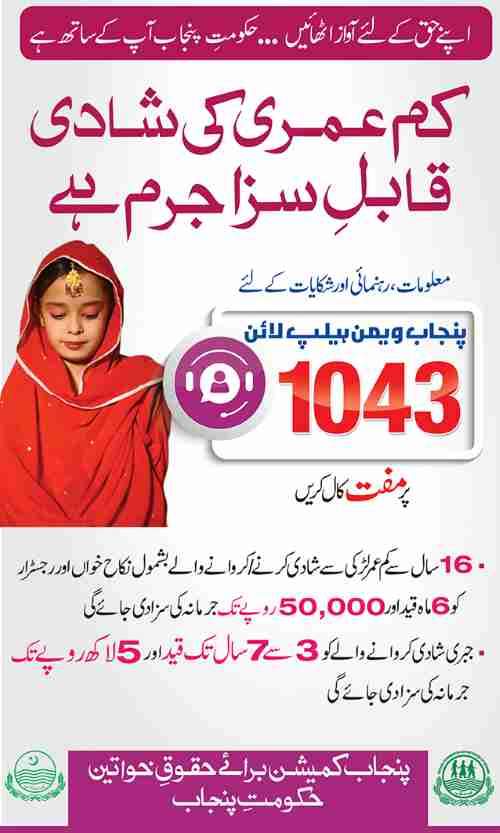
| Child marriage | Reporting under the Child Marriage Restraint Act and new 2026 Ordinance |
| Dowry harassment | Advice on evidence collection and legal action |
| Khula/Divorce | Legal procedure guidance and documentation support |
| Child custody | Information on family court processes and rights |
| Maintenance (Nafqa) | Legal options for claiming financial support from husband |
Does the helpline help with inheritance rights and property disputes for women?
Yes, inheritance rights are a core focus area for PCSW. The helpline provides:
- Legal education: Explaining women’s rights to inherited property under Islamic law and Pakistani civil law
- Guidance on documentation: What papers are needed to claim property
- Mediation support: Attempting to resolve family disputes amicably
- Legal referral: Connecting women with lawyers for court action if family refuses to give share
- Follow-up: Tracking progress and ensuring resolution
How can I report domestic violence (physical, psychological, economic) via 1043?
Domestic violence reporting is one of the primary purposes of the helpline. When you report domestic violence, the helpline:
- Takes detailed complaint: Records nature, frequency, and severity of violence
- Assesses immediate danger: If you are in immediate risk, they refer to PWPA/police
- Provides safety planning: Advice on how to stay safe while seeking help
- Connects to shelter: If you need to leave home, they arrange Dar-ul-Aman placement
- Legal action support: Guidance on filing FIR and getting medical examinations
- Counseling: Emotional support for trauma recovery
Can I call 1043 if I am facing workplace harassment?
Yes, workplace harassment is specifically covered under the helpline’s mandate. The team can:
- Explain your rights under the Protection Against Harassment of Women at the Workplace Act
- Guide you on filing a complaint with your organization’s inquiry committee
- Advise on evidence collection and documentation
- Refer you to the relevant Ombudsperson for legal action
- Provide emotional support during the process
Does the PCSW help with gender discrimination in government jobs or education?
The helpline addresses gender discrimination in various spheres:
- Government jobs: Complaints about violation of women’s quota, biased hiring, or discriminatory policies
- Educational institutions: Issues regarding admission discrimination, harassment, or unfair treatment
- Public services: Discrimination in accessing government services or benefits
- Workplace policies: Unfair policies that disadvantage women employees
Can I report a refusal of FIR by the police to the 1043 helpline?
This is one of the most critical functions of the helpline. If the police refuse to register your FIR:
- Call 1043 immediately
- Provide details of the police station, officer involved, and incident
- PCSW uses its authority to contact senior police officers and ensure FIR registration
- The matter is escalated to the relevant authorities for action against the erring officer
Does the helpline assist with cyber harassment cases?
Yes, cyber harassment is increasingly common, and the helpline provides support by:
- Advising on evidence preservation (screenshots, URLs, messages)
- Guiding on reporting to FIA Cybercrime Wing
- Providing emotional support for victims
- Referring to specialized organizations like Digital Rights Foundation (0800-39393) for technical help
Can I report acid throwing or other violent crimes through the helpline?
Absolutely. For violent crimes like acid throwing, the helpline:
- Immediately alerts PWPA and police for emergency response
- Ensures medical assistance is arranged
- Guides on legal procedures and evidence
- Connects to support networks and rehabilitation services
- Tracks investigation progress
Does 1043 assist with disputes over dowry or forced marriages?
Yes, dowry disputes and forced marriages are common issues reported to the helpline. The team provides:
- Legal information about dowry laws and forced marriage being illegal
- Guidance on evidence collection
- Mediation support where appropriate
- Referral to legal aid for court action
Can I get information about women’s hostels and daycare centers by calling 1043?
Yes, the helpline maintains information about:
- Government and private women’s hostels in various cities
- Daycare centers for working women
- Eligibility criteria and admission procedures
- Contact details and locations
- Subsidized options available through government schemes
What Happens After I Call? (The Role of PWPA, VAWCs, and DWPOs)
Understanding the ecosystem that activates after your call helps you know what to expect and who will contact you.
What is the Punjab Women Protection Authority (PWPA) and how does it help me?
The Punjab Women Protection Authority (PWPA) is a specialized government agency created under the Punjab Women Protection Authority Act 2017. It serves as the executive arm for women’s protection with the following functions:
- Rescue operations: Physically removing women from dangerous situations
- Emergency response: Deploying teams to intervene in violence cases
- Shelter management: Overseeing all Dar-ul-Aman shelters in Punjab
- Police coordination: Ensuring police take appropriate action
- Medical assistance: Arranging medical examinations and treatment
- Legal support: Helping women navigate the legal system
What is a District Women Protection Officer (DWPO) and how do I contact mine?
A District Women Protection Officer (DWPO) is the PWPA’s representative at the district level, responsible for handling women’s protection cases within that district. Each of Punjab’s 36 districts has a designated DWPO.
How to contact your DWPO:
- Call 1043 and ask to be connected to your district’s DWPO
- Visit the Women Protection Center in your district headquarters
- Contact the PWPA helpline 1737 for referral
- Walk into the Dar-ul-Aman or Social Welfare Office in your district
What is a Violence Against Women Center (VAWC)?
A Violence Against Women Center (VAWC) is a one-stop facility that provides comprehensive services to violence survivors under one roof. The first VAWC was established in Multan in March 2017, with more centers planned across Punjab.
Services available at a VAWC:
| Service Type | Purpose |
|---|---|
| Police reporting | Register FIR immediately on-site |
| Medical examination | Forensic evidence collection and treatment |
| Legal counsel | Free legal advice and court representation |
| Psychological support | Counseling and mental health care |
| Shelter referral | Connection to Dar-ul-Aman if needed |
| Prosecution coordination | Follow-up on court cases |
Where are the Violence Against Women Centers (VAWCs) located?
Currently operational VAWCs and Women Protection Centers include:
| District | Center Name | Address | Contact |
|---|---|---|---|
| Multan | Violence Against Women Center | Social Welfare Complex, Matital Road | 061-9220542-3 |
| Lahore | Shaheed Benazir Bhutto Human Rights Center for Women | 148 A Block New Muslim Town | 042-99230058 |
| Rawalpindi | Shaheed Benazir Bhutto Human Rights Center | Social Welfare Complex, Shamsabad | 051-4920482 |
| Bahawalpur | Shaheed Benazir Bhutto Human Rights Center | House 44, Street 3, Yasrab Town | 062-9330095 |
| Faisalabad | Shaheed Benazir Bhutto Human Rights Center | Islam Nagar, Riaz Shahid Chowk | Contact through DWPO |
| Sialkot | Shaheed Benazir Bhutto Human Rights Center | Social Welfare Complex, Aalam Chowk | Contact through DWPO |
What is the difference between a VAWC and a Dar-ul-Aman?
Many women confuse these two facilities. Here is the distinction:
- VAWC (Violence Against Women Center): A crisis intervention center where women go immediately after violence to register FIR, get medical exam, and access legal aid. Stay is temporary (hours to days).
- Dar-ul-Aman (Shelter Home): A residential facility where women can stay for longer periods (weeks to months) for protection, rehabilitation, and skill development until they can reintegrate into society.
Does the PWPA provide emergency shelter or safe houses?
Yes, PWPA manages the network of Dar-ul-Aman shelters across all 36 districts of Punjab. These shelters provide:
- Safe accommodation with 24/7 security and female staff
- Food, clothing, and basic necessities
- Medical care and health services
- Psychological counseling
- Legal aid and court representation
- Vocational training and skill development
- Educational support for children accompanying mothers
What is Dar-ul-Aman (Dar ul eman)?
Dar-ul-Aman translates to “House of Peace” or “House of Safety.” It is a government-run shelter home established under the Social Welfare Department, now managed and monitored by PWPA. These shelters serve as a refuge for women facing:
- Domestic violence and abuse
- Threats to life or honor
- Forced marriage or conversion
- Homelessness or destitution
- Legal battles requiring safe accommodation
- Recovery from trauma and violence
Complete list of Dar-ul-Aman contacts across Punjab districts
| District | Dar-ul-Aman Contact Person | Contact Number |
|---|---|---|
| Lahore | Rabia Usman | 042-99230058 |
| Rawalpindi | Rizwana | 051-4920482 |
| Faisalabad | Kanwal Shehzadi | Contact through DWPO |
| Multan | Muneeza Manzoor Butt | 061-9220542-3 |
| Gujranwala | Shahida Waris | Contact through DWPO |
| Sialkot | Imran Ksana | Contact through DWPO |
| Bahawalpur | Tayyaba Munir | 062-9330095 |
| Sargodha | Sana Rauf | 048-3210025 |
| Jhang | Samra Rubab | 047-9200019 |
| Sheikhupura | Asma Dolat | Contact through DWPO |
| Kasur | Sidra Taj | Contact through DWPO |
| Okara | Rubina Shazadi | Contact through DWPO |
| Vehari | Munazza Kausar | 067-9201355 |
| Sahiwal | Fozia Barkat | 040-4404306 |
| Khushab | Sadia Feroz Malik | 0454-920044 |
| Mianwali | Zubaida Shaheen | 0459-920164 |
| Bhakkar | Naseem Akhtar | 0453-9201214 |
| Layyah | Mahliza | Contact through DWPO |
| Dera Ghazi Khan | Surrayya Majeed Rana | 064-9260042 |
| Rajanpur | Saba Zahra | Contact through DWPO |
| Muzaffargarh | Hina Gondal | 066-9200020 |
| Lodhran | Nazia Sharif | 0608-922173 |
| Khanewal | Fozia Barkat | 065-9200282 |
| Pakpattan | Attia Kashif | Contact through DWPO |
| Bahawalnagar | Zill E Huma | 063-9240269 |
| Rahim Yar Khan | Zobia Mughal | 068-9330086 |
| Jhelum | Sohail Nasir | 0544-230417 |
| Chakwal | Ayesha Khan | Contact through DWPO |
| Attock | Ayesha Kiran | 057-9316241 |
| Nankana Sahib | Iram Baneen | 056-2874299 |
| Mandi Bahauddin | Mehreen Farooq | Contact through DWPO |
| Hafizabad | Nabila Bashir | 0547-920083 |
| Gujrat | Nasreen Chaudhary | Contact through DWPO |
| Narowal | Maham Rashid | 0542-470281 |
| Chiniot | Kousar | Contact through DWPO |
| Toba Tek Singh | Razia Sultana | 046-2516744 |
Privacy, Confidentiality, and Safety Protocols
Trust is essential when seeking help. Here is how the system protects your privacy and safety.
Is my identity kept confidential when I call 1043?
Yes, absolute confidentiality is a core principle of the helpline. PCSW policy ensures:
- Your personal information is not shared with anyone outside the required response system
- Only authorized personnel handling your case have access to your details
- Information is shared with police or PWPA only to the extent necessary for your protection
- You can request anonymity when reporting on behalf of someone else
Are there female operators available at the 1043 helpline?
The 1043 helpline is staffed entirely by women to ensure callers feel comfortable and safe sharing sensitive information. The team includes:
- All-women call agents handling initial calls
- Female supervisors managing operations
- Women legal advisors providing legal counsel
- Female psychosocial counselors offering emotional support
Can I call 1043 if I am in immediate danger?
If you are in immediate danger, call 15 (police emergency) first for the fastest response. However, if you cannot call 15, calling 1043 is still effective because:
- The helpline can immediately alert PWPA and police on your behalf
- They can arrange emergency shelter if you need to leave immediately
- They provide guidance on staying safe until help arrives
If I report a case, will the perpetrator find out it was me?
The system takes precautions to protect complainants from retaliation. However, in legal proceedings, your identity may eventually become known if:
- You file an FIR and pursue court action
- Your testimony is required in court
- The perpetrator is entitled to know the case against them
The helpline staff will explain these implications before you proceed, and you can choose how to proceed based on your safety assessment.
How does the PWPA ensure my safety if I go back home after reconciliation?
PWPA does not simply close cases after reconciliation. Follow-up mechanisms include:
- Regular visits or calls to check on your safety
- Coordination with local police for monitoring
- Warning to perpetrators about consequences of repeat violence
- Option to return to shelter if situation deteriorates
- Documentation of reconciliation agreements for legal evidence
Frequently Asked Questions
Can men call the 1043 helpline for assistance?
Yes, men can call 1043 to seek guidance on behalf of women in their family, report violence they witness, or ask for information about women’s rights and services. However, the primary mandate is to assist women directly.
Can I file a complaint on behalf of someone else?
Absolutely. You can act as a third-party reporter if you know a woman facing violence or discrimination but unable to report herself. The helpline will still register the complaint and take appropriate action.
Is the helpline available in rural areas of Punjab?
Yes, the 1043 helpline is accessible from all districts and rural areas of Punjab. As long as you have mobile or landline connectivity, you can reach the helpline.
What is the difference between 1043 and the 15 police helpline?
1043 is for comprehensive women’s support including legal advice, counseling, complaint registration, and referral to protection services. 15 is the police emergency line for immediate law enforcement response. For ongoing abuse requiring police action, call 15 first, then 1043 for follow-up support.
Does the helpline provide support for acid attack survivors?
Yes, acid attack survivors receive specialized support including:
- Immediate medical assistance coordination
- Legal action guidance
- Long-term rehabilitation support
- Connection to survivor networks and NGOs
Does the PCSW provide any financial assistance?
PCSW itself does not provide direct financial aid, but it can connect you with:
- Government welfare programs (Bait-ul-Maal, Zakat, etc.)
- Vocational training for economic empowerment
- Skills development programs
- Job placement assistance through employment centers
Can I report a property dispute through the 1043 helpline?
Yes, property and inheritance disputes are common complaints. The helpline provides legal guidance on claiming your share and can refer you to legal aid if family refuses to give you your rightful inheritance.
Real Impact: Statistics and Success Stories
The 1043 helpline and associated services have transformed countless lives across Punjab.
How many calls does the 1043 helpline handle?
Since its launch in 2014, the 1043 helpline has handled tens of thousands of calls. Recent data indicates:
- Thousands of calls received monthly
- Domestic violence remains the most common complaint category
- Significant increase in calls about cyber harassment and workplace issues
- High resolution rate with majority of complainants expressing satisfaction
What are the most common reasons women call 1043?
Analysis of helpline data reveals the following breakdown:
| Complaint Category | Approximate Percentage |
|---|---|
| Domestic violence | 35-40% |
| Marriage disputes (Khula, divorce, custody) | 20-25% |
| Property and inheritance | 10-15% |
| Harassment (workplace and general) | 10-12% |
| Police refusal to register FIR | 5-8% |
| Cyber harassment | 3-5% |
| Other (discrimination, services, etc.) | 5-10% |
Has there been an increase in reporting violence over the years?
Reports show a significant increase in calls reporting domestic violence, particularly during crisis periods. This increase reflects growing awareness and trust in the helpline rather than necessarily an increase in actual violence. Women now know there is a number to call and that help is available.
Case Study: How the Multan VAWC has helped thousands of women
The Violence Against Women Center in Multan, established in March 2017, has served as a model for integrated response services. The center brings together police, doctors, lawyers, and counselors under one roof, eliminating the need for traumatized women to run between different offices. Thousands of women have received medical examinations, legal aid, and police assistance at this single location, significantly improving conviction rates and reducing secondary trauma.
Example: How a call to 1737 saved a woman locked in a room in Rawalpindi
In a notable case, a woman was locked in a room by her family for refusing a forced marriage. A neighbor called 1737, and within hours, PWPA teams coordinated with local police to rescue the woman. She was provided medical care, legal counsel, and shelter at Dar-ul-Aman Rawalpindi. Her statement was recorded, legal action was initiated against the family members, and she later received vocational training to become self-sufficient.
Challenges and Limitations of the System
Understanding the challenges helps set realistic expectations and highlights areas needing improvement.
What are the common challenges faced by the Violence Against Women Centers?
Despite their success, VAWCs face several operational hurdles:
- Budget constraints: Limited funding affects staffing, infrastructure, and services
- Staff shortages: Insufficient number of trained personnel to handle caseload
- Political instability: Changes in government can affect continuity and priorities
- Coordination gaps: Delays in inter-departmental cooperation
- Awareness deficits: Many women still unaware of available services
Why do some cases go unresolved or see a relapse?
Several factors contribute to cases remaining unresolved or women returning to abusive situations:
- Social pressure: Family and community pressure to reconcile
- Economic dependency: Lack of financial independence forces women back
- Lengthy court processes: Delays in justice discourage persistence
- Insufficient follow-up: Limited resources for long-term monitoring
- Lack of transitional housing: Women have nowhere to go after shelter stay
What is the “functional clash” between Dar-ul-Aman and VAWCs?
At times, coordination between different institutions can be challenging:
- Jurisdiction confusion: Unclear which agency handles what aspect
- Referral delays: Slow transfer of cases between departments
- Documentation issues: Different record-keeping systems create gaps
- Communication breakdowns: Lack of regular coordination meetings
Is the judiciary fully aware of the Protection of Women Against Violence Act?
While awareness has improved, gaps remain between legislation and implementation. Training programs for judges, police, and prosecutors are ongoing, but consistent application of the law across all districts requires continued effort.
What are the barriers for women in remote districts?
Women in smaller districts face additional challenges:
- Limited facilities: Not all districts have full-fledged VAWCs
- Transport issues: Difficulty reaching district headquarters
- Social stigma: Greater family and community pressure in smaller communities
- Information gaps: Less awareness about available services
- Staff shortages: Fewer trained personnel in remote areas
Additional Support: Other Helplines and Resources
The ecosystem of women’s support extends beyond government helplines. Here are other valuable resources.
What is the Rozan Counseling Helpline?
Rozan is a non-governmental organization offering specialized psychological counseling. Their helpline is:
0304-111-1741
Operating hours: Monday to Friday, 9:00 AM to 5:00 PM
Languages: Urdu and English
Services: Emotional support, counseling, referrals
What is the Digital Rights Foundation Cyber Harassment Helpline?
For online harassment, cyber stalking, and digital violence:
0800-39393
Operating hours: Monday to Friday, 9:00 AM to 5:00 PM
Email: helpdesk@digitalrightsfoundation.pk
Services: Technical support, legal guidance, evidence preservation
What is the Madadgaar Helpline for Women and Children?
Madadgaar provides counseling and legal aid for women and children:
1098
Email: madadgaar@cyber.net.pk
Services: Telephone counseling, legal aid, referral services
Where can I find the nearest Women Help Desk at a police station?
Many police stations across Punjab have established Women Help Desks staffed by female officers. To locate the nearest one:
- Call 1043 for guidance
- Contact your District Women Protection Officer
- Inquire at your local police station
- Use the Punjab Police website or app
What is the role of international partners in supporting these services?
International organizations support women’s protection services through:
- UNFPA Pakistan: Technical support and capacity building
- UNICEF Pakistan: Child protection and awareness programs
- UNDP Pakistan: Institutional strengthening and legal reforms
- British High Commission: Funding for programs like Aawaz II
- UN Women: Research, assessments, and policy guidance
Conclusion: Your Rights and the Path Forward
The CM Punjab Women Helpline 1043 represents a powerful commitment by the Government of Punjab to protect women’s rights, ensure access to justice, and provide comprehensive support to those facing violence, discrimination, or legal challenges. This single toll-free number connects you to a vast network of services—from immediate crisis counseling and legal advice to emergency rescue operations and long-term shelter rehabilitation.
Remember these lifelines:
- Call 1043 for help, guidance, and complaint registration
- Call 1737 for emergency protection and shelter placement
- Call 15 for immediate police response
- Visit your district VAWC or Women Protection Center for in-person support
- Contact your DWPO for local follow-up and assistance
Your rights are protected by law. The Punjab Protection of Women Against Violence Act 2016, the new Child Marriage Restraint Ordinance 2026 raising the marriage age to 18 for women, and the consistent work of PCSW and PWPA ensure that women in Punjab have legal backing when they seek help.
Seeking help is a sign of strength. If you or someone you know is facing violence, harassment, or denial of rights, do not suffer in silence. The system is designed for you, the staff is trained to support you, and the laws are there to protect you. Make the call. Help is waiting.
Frequently Asked Questions
What is the CM Punjab Women Helpline number?
The CM Punjab Women Helpline number is 1043. It is a toll-free helpline available 24/7 across Punjab, managed by the Punjab Commission on the Status of Women (PCSW).
Is the 1043 helpline free to call from a mobile?
Yes, 1043 is completely toll-free from all mobile networks (Jazz, Zong, Telenor, Ufone) and landlines in Pakistan. You will not be charged for calling this number.
What services does the PCSW 1043 helpline provide?
The helpline provides complaint registration for violence and harassment, legal advice from in-house legal advisors, psychosocial counseling, information on women’s rights, referral to police and PWPA, and guidance on accessing Dar-ul-Aman shelters.
How can I report domestic violence in Punjab?
You can report domestic violence by calling 1043, visiting the online PCSW complaint portal, walking into any Women Protection Center, or calling 1737 for immediate police and protection assistance.
Is my identity kept confidential when I call 1043?
Yes, PCSW maintains strict confidentiality. Your personal information is only shared with authorized personnel handling your case and relevant authorities to the extent necessary for your protection.
What is Dar-ul-Aman and how can I contact one?
Dar-ul-Aman is a government shelter home for women in distress. You can access it by calling 1737, contacting your District Women Protection Officer, or getting a referral through the 1043 helpline.
Can I file a complaint on behalf of someone else?
Yes, you can file a third-party complaint if you know a woman who needs help but cannot report herself. The helpline will register the complaint and take appropriate action.
What is the difference between 1043 and 1737 helplines?
1043 is managed by PCSW for complaints, legal advice, and counseling. 1737 is managed by PWPA for emergency response, police action, rescue operations, and shelter placement.

Add a Comment