
The burden of inflation during the holy month often forces families to compromise on quality or quantity, but the Punjab government has stepped in to change that reality. The CM Punjab Ramzan Bazaar initiative, managed by the Punjab Sahulat Bazaars Authority (PSBA), offers essential items at rates significantly below the open market, with the added convenience of free home delivery. This definitive guide will walk you through every aspect of the program, from locating the nearest bazaar and checking daily prices to registering for the Rs. 10,000 Nigehban Card and ordering online, ensuring you maximize your savings this Ramadan.
Key Takeaways
- Free Home Delivery Service: You can order subsidized items online through the Sahulat Bazaar app and get them delivered for free within a 5km radius of a bazaar, with hundreds of thousands of orders already fulfilled.
- Massive Cash Assistance: Eligible families can receive Rs. 10,000 in cash plus a free ration bag by sending their CNIC to 8070 to check their status for the Nigehban Package.
- Guaranteed Lower Prices: All 16 essential commodities are priced below the official DC rates, with a 10kg flour bag fixed at just Rs. 850 and sugar available at Rs. 140 per kg.
- Province-Wide Accessibility: 74 Sahulat Bazaars have been converted into fully operational Ramzan Bazaars across Punjab, with mobile units ensuring no neighborhood is left out.
- Strict Quality Control: A central control room, CCTV monitoring, and on-ground Price Control Magistrates ensure you are not overcharged or sold substandard goods.
- Read More: CM Punjab Bewa Sahara Card Registration | Punjab Portal
- Read More: CM Punjab Rehmat Card (Apply Now) | 25K to 1 Lakh For Widow & orphans
- Read More: PEF Phase 3 School List PDF Download (All Punjab District Wise)
- Read More: Maryam Nawaz 10000 Ramzan Package [Apply Online]
CM Punjab Ramzan Bazar: Free Home Delivery | Order Online
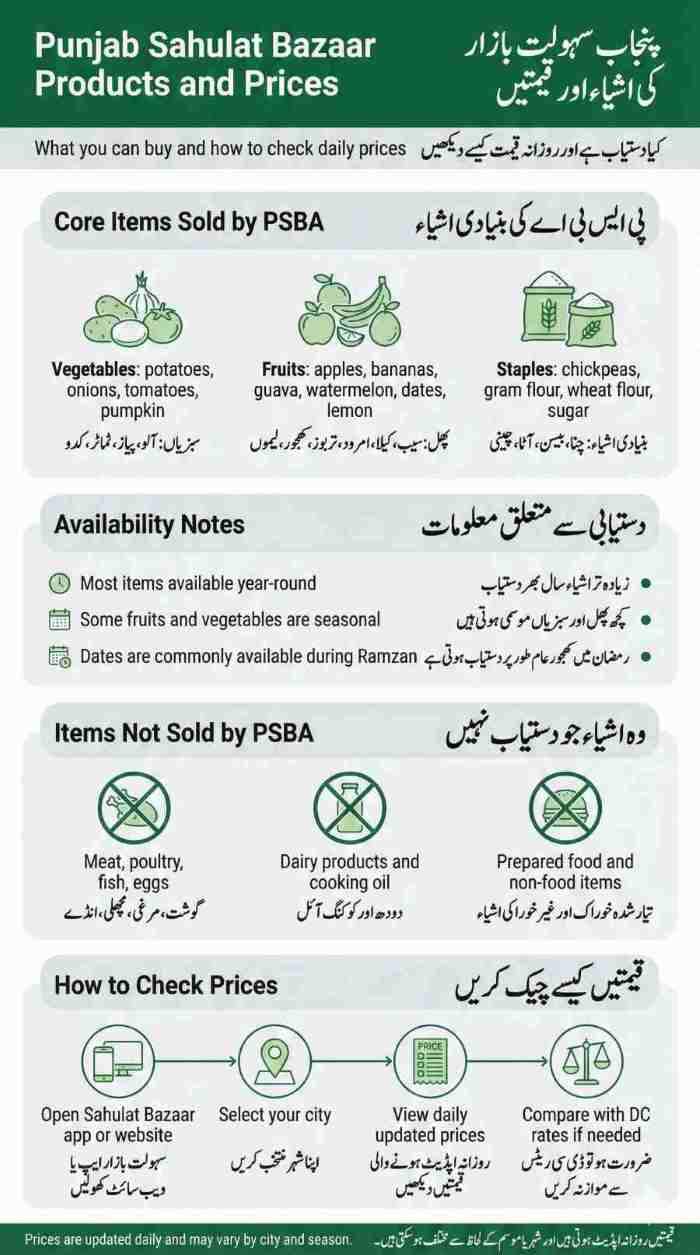
Table Of Contents
What is the CM Punjab Ramzan Bazaar (Sahulat Bazaar) Scheme?

The CM Punjab Ramzan Bazaar is a government-initiated network of markets, officially managed by the Punjab Sahulat Bazaars Authority (PSBA), established across the province to provide essential commodities at highly subsidized rates during Ramadan. This scheme is a direct response to the rising cost of living, designed to transfer the benefit of bulk buying and direct sourcing from producers to the consumer, bypassing exploitative middlemen.
From Sahulat to Ramzan Bazaars: A Seamless Transition
Rather than creating new markets from scratch, the government strategically converted 74 existing, permanent Sahulat Bazaars into fully functional Ramzan Bazaars, which became operative from mid-February. This ensured that the infrastructure, supply chains, and management were immediately ready to serve the public. These are not temporary setups with uncertain supply; they are permanent fixtures with established vendor relationships and logistical frameworks.
The Scale of the Initiative
The program operates on a massive scale, encompassing over 100 dedicated Ramzan bazaars and more than 1,200 “Maryam Ke Mehman” Dastarkhwans (community kitchens) serving free iftar and sehri meals across 152 tehsils in Punjab. The daily footfall at major bazaars often exceeds 6,000 to 7,000 shoppers, a testament to the public’s trust and the scheme’s effectiveness in providing tangible relief.
Who Operates These Bazaars?
The governing body responsible for the seamless operation of these bazaars is the Punjab Sahulat Bazaars Authority (PSBA), managed under the umbrella of the Punjab Model Bazaars Management Company. This authority handles everything from vendor procurement and price fixation to quality control and the digital infrastructure required for the online ordering system.
Read More: Shahbaz Sharif Ramzan Package (Registration PKR 13000)
Where is the Nearest Ramzan Sasta Bazaar in My Area?
The nearest Ramzan Sasta Bazaar can be instantly located using the official Sahulat Bazaar mobile application, by visiting the interactive price dashboard on their website, or by consulting the published list of 74 converted bazaars distributed across major cities. The government has ensured geographical coverage so that a subsidized market is within reasonable distance for most urban and peri-urban populations.
City-Wise Breakdown of Ramzan Bazaar Locations
To help you plan your visit, here is a detailed breakdown of key locations in major cities. These are the primary hubs where you will find the full range of subsidized items.
Ramzan Bazar in Lahore: Key Hubs
Lahore, being the provincial capital, has the highest concentration of bazaars. Key locations include:
- Township: A major hub serving a large residential area.
- Madina Market: Located in Faisal Town, this is a high-traffic bazaar.
- Madar-i-Millat Road: A central location accessible from multiple neighborhoods.
- Nishtar Colony: Serves the densely populated south-eastern part of the city.
- Barki: Covers the outskirts and adjacent communities.
- Shahdara: Serves the northern entry point of the city.
- Mian Plaza, Johar Town: A key location in the rapidly developing Johar Town area.
- Ferozewala: Located on the outskirts, catering to the industrial and residential population there.
- Wahdat Road (Model Bazaar): This is one of the largest and most well-known model bazaars, offering a wide variety of goods under one roof.
Ramzan Bazar in Multan: Central Locations
In Multan, the primary hub is the bazaar located at MDA Road, Shamasabad Colony. This location has historically been a central point for government-subsidized markets and is well-stocked with vegetables, fruits, and staples.
Ramzan Bazar in Rawalpindi: Strategic Setups
Rawalpindi’s setup is particularly robust due to its twin-city status with the capital. Key locations include various bazaars and seven dedicated camp sites established specifically for the distribution and facilitation of the Nigehban Card, ensuring that eligible residents can easily access their cash and rations.
Ramzan Bazar in Other Major Cities
The network extends across Punjab, ensuring no major city is left behind. This includes fully operational bazaars in:
- Faisalabad: Multiple locations serving the textile hub.
- Sahiwal: Bazaars catering to the central Punjab region.
- Bahawalpur: Serving the southern part of the province.
- Sargodha: Including the Shaheen Chowk bazaar.
- Gujranwala: Catering to the industrial city’s needs.
- Dera Ghazi Khan: Ensuring coverage in the south-western district.
- Gujrat: Serving the northern districts.
What is a “Model Bazaar” and How is it Different?
A “Model Bazaar” is a specific type of permanent, large-scale market that falls under the purview of the Punjab Model Bazaars Management Company. While all Model Bazaars function as Sahulat Bazaars during Ramadan, they are distinguished by their permanent infrastructure, higher number of stalls, and often, additional facilities like parking and dedicated areas for different commodity types. The Model Bazaar on Wahdat Road in Lahore is a prime example of this larger, more structured format.
Are There Mobile Ramzan Bazaars?
Yes, recognizing that not every citizen lives within easy reach of a permanent bazaar, the government launched the “Sahulat on the Go” initiative. This deploys 15 mobile units—essentially trucks stocked with essential items—that travel to different neighborhoods on a scheduled basis. These mobile Ramzan bazaars bring the subsidy directly to the doorsteps of communities in less accessible areas, ensuring inclusivity.
CM Sahulat Bazaar Rate List

The post you shared is an advertisement from CM Sahulat Bazaar (under the Punjab government’s Punjab Sahulat Bazaars Authority – PSBA initiative, led by Chief Minister Punjab Maryam Nawaz Sharif). It promotes a special Mehndi Stall (ہندی سٹال or mehndi application service) set up for Eid celebrations.
Key Details
- Event/Focus: “مینہی مینہی عیدیں کی عید کی بازار میں سہولت بازار” – It’s highlighting a festive mehndi (henna) service as part of the Eid bazaar activities in Sahulat Bazaar locations.
- Service Offered: Professional mehndi application (stunning traditional designs applied on hands, as shown in the image of intricate Arabic-style henna being applied with a cone).
- Starting Registration/Booking: Registration for the mehndi stall/service begins now (“مہندی کے سٹال کے لیے رجسٹریشن شروع”).
- Price: Starting from Rs. 5000 Fee.
- Additional Info: It’s marketed as a great opportunity for Eid preparations, especially for women/girls wanting beautiful mehndi for Eid (“عیدالفطر کے لیے مہندی لگوائیں”). The stall aims to provide high-quality, festive mehndi in a bazaar setting at controlled/affordable rates compared to private artists.
- Contact for Booking/Inquiry: Phone number 0327-6609993 (یہ نمبر رجسٹریشن اور تفصیلات کے لیے دیا گیا ہے؛ یہ Punjab Sahulat Bazaars سے منسلک لگتا ہے، جیسا کہ حالیہ ایونٹس میں بھی یہی نمبر استعمال ہوا ہے)۔
Ramzan Bazar Rate List
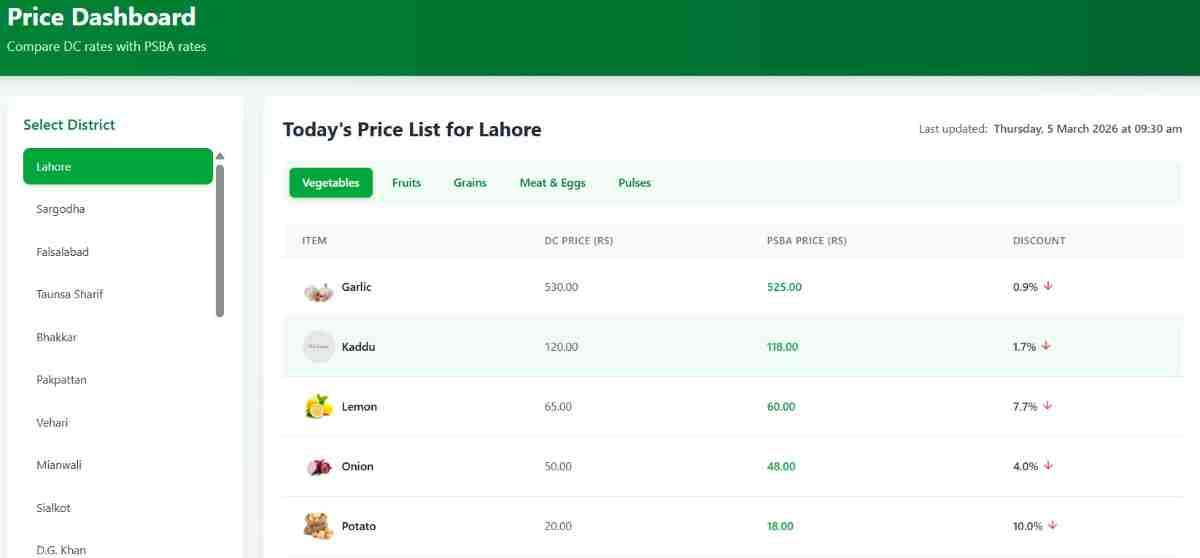
| Category | Item | DC Price (Rs) | PSBA Price (Rs) |
|---|---|---|---|
| Vegetable | Garlic | 530 | 525 |
| Vegetable | Kaddu | 120 | 118 |
| Vegetable | Lemon | 65 | 60 |
| Vegetable | Onion | 50 | 48 |
| Vegetable | Potato | 20 | 18 |
| Vegetable | Tomato | 60 | 58 |
| Fruit | Apple | 420 | 415 |
| Fruit | Banana | 240 | 235 |
| Fruit | Dates | 490 | 480 |
| Fruit | Guava | 145 | 140 |
| Fruit | Melon | 160 | 155 |
| Grain | Atta 10 kg | 905 | 850 |
| Grain | Gram Flour (Besan) | 250 | 245 |
| Grain | Sugar | 155 | 140 |
| Meat & Eggs | Chicken | 490 | 475 |
| Meat & Eggs | Eggs | 200 | 190 |
| Pulse | Gram Pulse | 240 | 235 |
What Are the Official Opening and Closing Hours for Ramzan Bazaars?
The official opening and closing hours for Ramzan Bazaars are designed to accommodate the fasting schedule, with most bazaars operating in two distinct shifts to allow for shopping before Iftar and after Sehri. While exact timings can vary slightly by city and local administration, the standard operational model is consistent across the province.
Morning Shift (Pre-Iftar Preparation)
The first shift typically opens in the late morning, around 10:00 AM to 11:00 AM, and continues until just before Iftar, around 4:00 PM to 5:00 PM. This shift is ideal for purchasing fresh vegetables, fruits, and other items needed for the day’s Iftar meal. It is generally less crowded than the evening rush.
Evening Shift (Post-Iftar to Sehri)
The second shift opens after the Maghrib prayers and Iftar, usually around 7:00 PM to 8:00 PM, and remains operational until late at night, often midnight or 1:00 AM. This timing caters to those who prefer to shop after breaking their fast or those preparing for Sehri. This shift sees the highest footfall.
Are Ramzan Bazaars Open on Fridays and Sundays?
Yes, Ramzan Bazaars are open seven days a week throughout the holy month. The government has mandated daily operations to ensure maximum public access. However, footfall and stock replenishment timings might vary slightly on Sundays, but the bazaars remain fully functional.
Peak Hours and Best Time to Visit
The busiest times are generally the two hours leading up to Iftar and the two hours after Isha prayers. To avoid massive crowds, which can exceed 7,000 visitors daily in major bazaars, it is advisable to visit during the mid-morning hours on weekdays. This ensures a more relaxed shopping experience and better access to stalls.
How to Order Online from Ramzan Bazaar: Free Home Delivery Explained
The Punjab government has revolutionized access to subsidized goods by introducing a free home delivery service for Ramzan Bazaars. You can order online through the Sahulat Bazaar app, and your essential items will be delivered to your doorstep free of charge if you are within a 5-kilometer radius of an operational bazaar.
How Does the Free Home Delivery (5km Radius) Work?
The process is designed to be simple and user-friendly, ensuring that even those less familiar with technology can benefit. Here is a step-by-step breakdown:
Step 1: Accessing the Platform
You need to download the official “Sahulat Bazaar” app from the Google Play Store or Apple App Store. Alternatively, you can access the web version through the official price dashboard website. Ensure the app publisher is “Punjab Model Bazaars Management Company” to avoid fake applications.
Step 2: Selecting Your City and Items
Once you open the app, the first step is to select your city from the dropdown menu. This action filters the available items and prices specific to your location. You can then browse through the PSBA confirmed product list, which includes vegetables, fruits, and staples. The app clearly displays the subsidized price, the unit (e.g., per kg, per dozen), and current availability.
Step 3: Checking Real-Time Availability
Before adding items to your cart, check the availability status. For seasonal items like watermelon (available April–September) or guava, the app will indicate if they are currently in stock in your city. Items that are temporarily out of stock are marked as “Currently unavailable.”
Step 4: Delivery Confirmation and Tracking
After placing your order, the system calculates if your address falls within the 5km free delivery radius. If it does, the delivery charge is automatically waived. You will receive an order confirmation via SMS or in-app notification, and you can track the status of your delivery in real-time.
Is Sahulat Bazaar Online Shopping Available in My Area?
Sahulat Bazaar online shopping is available in areas that fall within the designated 5km radius of any active Ramzan or Sahulat Bazaar. To verify serviceability, simply enter your complete address in the app during checkout. The system will automatically validate your location against the nearest bazaar’s delivery zone and confirm if free home delivery is applicable.
What Items Can I Order Online?
You can order the core 16 essential commodities that form the backbone of the PSBA product list. This includes:
- Vegetables: Potatoes, onions, tomatoes, pumpkin (seasonal peak).
- Fruits: Apples (winter peak), bananas (per dozen), dates (Ramzan demand), lemons.
- Staples: Wheat flour (10kg bag), sugar (1kg), chickpeas (gram), gram flour (besan).
- Other: Garlic (limited summer supply).
Can I Order Meat, Eggs, or Dairy Online?
No, you cannot order meat, poultry, fish, eggs, or dairy products online through the PSBA platform. These items are not part of the PSBA’s confirmed core product list. The authority focuses on dry staples and fresh produce. For meat and dairy, you would need to refer to local market rates or any temporary district-specific announcements.
Ramzan Bazaar Price List: How Much is the Discount?
The primary draw of the Ramzan Bazaar is the significant discount offered on essential items. The prices are fixed at rates 7% to 10% below the officially notified District Collector (DC) rates, making them substantially lower than the prices in the open market.
Open Market vs. Ramzan Bazaar: A Price Comparison
To truly appreciate the savings, it helps to see a direct comparison. The table below illustrates the price difference based on government notifications and market trends.
| Item | Approximate Open Market Price (per kg) | Ramzan Bazaar Subsidized Price (per kg) |
|---|---|---|
| Potatoes | Rs. 50-60 | Rs. 40-45 |
| Tomatoes | Rs. 150-170 | Rs. 120-130 |
| Onions | Rs. 70-80 | Rs. 55-60 |
| Garlic | Rs. 700-800 | Rs. 600-650 |
| Sugar | Rs. 160-170 | Rs. 140-150 |
| Chicken | Rs. 450-480 | Rs. 430-450 |
| Gram Flour (Besan) | Rs. 250-270 | Rs. 220-240 |
What is the Current Subsidized Price of a 10kg Flour Bag at the Bazaar?
The price of a 10kg bag of wheat flour (atta) is one of the most critical indicators of relief. At all Ramzan and Sahulat Bazaars, a 10kg bag of flour is fixed at a highly subsidized rate of Rs. 850. This is significantly lower than the open market rate, which often exceeds Rs. 900 for a comparable quality bag.
Is There a Discount on Sugar and Ghee?
Yes, sugar is available at a subsidized rate of Rs. 140 to Rs. 160 per kg, depending on the specific bazaar and daily notification. Cooking oil and ghee are also discounted, with prices reduced by approximately Rs. 20 to Rs. 25 per pack compared to general store rates.
Pulses (Daal) and Vegetables Discount
All varieties of pulses, including chickpeas (chana), moong, and masoor, are sold at a flat discount of 7-10% below the DC rate. Similarly, all vegetables in the bazaar are priced to ensure this minimum saving, making healthy eating more affordable during the month.
How to Check the Daily Sahulat Bazaar Rate List?
The most accurate and reliable method to check the daily Sahulat Bazaar rate list is by visiting the official Sahulat Bazaar Price Dashboard at sahulatbazar.com.pk/price-dashboard/. This tool provides real-time, city-specific pricing data.
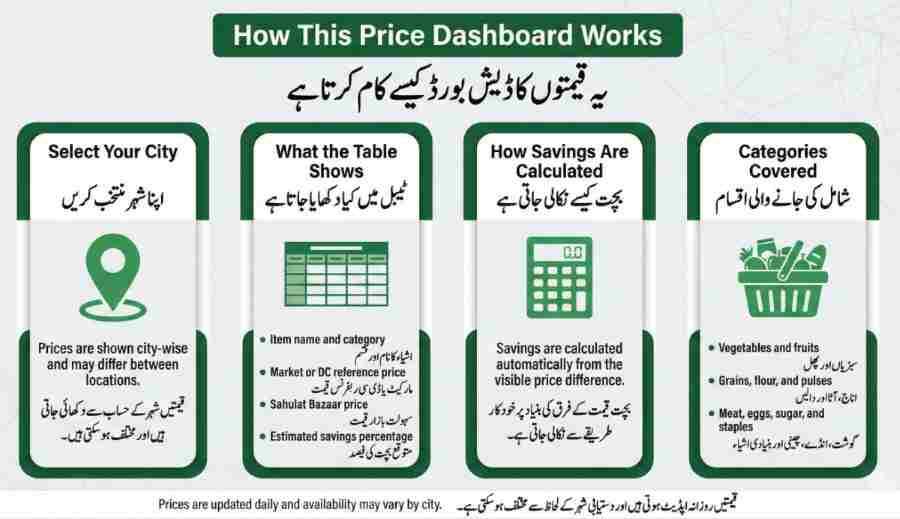
How the Price Dashboard Works
The dashboard is designed for maximum transparency and ease of use. Here is a breakdown of its functionality:
Select Your City
Upon visiting the page, you are greeted with a prominent dropdown menu labeled “Select your city to view daily prices.” You must choose your city—be it Lahore, Multan, Rawalpindi, or any other listed district. This is crucial because prices can and do vary by location due to transport and local supply factors.
What the Table Shows
Once a city is selected, a comprehensive table populates with the following columns:
- Item name and category: Clearly lists the item, such as “Potatoes (Vegetable)” or “Sugar (Staple).”
- Market or DC reference price: Displays the official reference price set by the District Collector or the prevailing wholesale market rate.
- Sahulat Bazaar price: Shows the price at which the item is being sold at the government bazaar.
- Estimated savings percentage: This is an automatically calculated field that shows the percentage you save by shopping at the Sahulat Bazaar compared to the reference price.
Update Frequency
The dashboard is updated daily. A visible “Last Updated” timestamp is displayed on the table, assuring users that the information is current. Price data can change frequently due to supply, demand, weather, or logistics, so checking daily is recommended.
How to Read the “Estimated Savings Percentage”
The savings percentage is calculated based on the difference between the reference price and the Sahulat Bazaar price. For example, if the DC rate for tomatoes is Rs. 150 and the bazaar price is Rs. 135, the savings percentage would be 10%. If the field shows “0.0”, it typically means that the item was not listed for that specific city on that particular day, or the price is exactly matching the reference rate.
Why Do Prices Vary by City?
Prices vary by city because the dashboard publishes rates at the district level. Lahore and Multan, for instance, may have different supply chain dynamics, transportation costs, and local wholesale market conditions. Therefore, some items might appear in one city’s list and not another’s, or prices may differ slightly on the same day.
The Ramzan Nigehban Card: How to Get Rs. 10,000 Cash or Free Ration
The Ramzan Nigehban Card is a cornerstone of the government’s relief efforts, designed as a digital debit card for eligible low-income families. It provides either Rs. 10,000 in direct cash assistance or a free ration bag delivered to your doorstep.
Who is Eligible for the Nigehban Package?
Eligibility is determined through a data-driven process targeting the most vulnerable segments of society. The primary criteria include:
- Residency: Must be a permanent resident of Punjab.
- Income Level: Monthly household income should generally be below Rs. 60,000.
- Utility Bills: Families with low electricity consumption are prioritized.
- Asset Ownership: Households that do not own a car or have not traveled abroad recently are more likely to qualify.
- Automatic Inclusion: Widows, registered Zakat beneficiaries, and existing Benazir Income Support Programme (BISP) beneficiaries are often automatically qualified without needing to apply.
How to Register for the Ramzan Nigehban Card Online?
Registration is a straightforward process, accessible even to those without smartphones.
SMS Method (Fastest and Most Common)
This is the primary method for checking eligibility. Take your mobile phone (the SIM must be registered in your name), open a new text message, type your 13-digit CNIC number without any spaces or dashes, and send it to 8070. You will receive a reply message within seconds informing you of your eligibility status.
Online Portal Method
For those who prefer online verification or need to update their information, you can visit the official Punjab Social and Economic Registry (PSER) portal at pser.punjab.gov.pk. Here, you can register or update your family’s socioeconomic details, which feeds into the eligibility database.
How to Check Eligibility and Status via 8070?
After sending your CNIC to 8070, the reply message will clearly state your status:
- “Eligible (Mubarak ho)”: This confirms you are qualified for the package. You will then receive further instructions on when and where to collect your card or cash.
- “Verification in Process”: Your data is being cross-checked with government databases. You should wait for a final confirmation message.
- “Not Eligible”: Your profile does not meet the current criteria. This could be due to income level, asset ownership, or data mismatches.
Why Was My Application Rejected?
Common reasons for rejection include:
- SIM Ownership Mismatch: The mobile number you used to send the SMS is not registered in your name in NADRA’s records.
- High Utility Bills: Your recent electricity bills exceed the threshold set for the program.
- Outdated NADRA Records: Your marital status, family composition, or address is not updated in NADRA’s database, leading to verification failures.
How Will I Receive the Rs. 10,000?
If you are declared eligible, the Rs. 10,000 cash assistance is disbursed through multiple convenient channels. You can withdraw the amount from any ATM using your Nigehban Card, visit a designated branch of the Bank of Punjab, or go to any of the thousands of branchless banking agents across the province. The withdrawal process often uses thumb verification for added security and accessibility.
What is Inside the Free Ration Bag?
In addition to or sometimes in lieu of cash, eligible families receive a substantial ration bag. The standard contents of this bag are designed to cover the basic needs of a family for a significant period:
- 10 kg of high-quality Wheat Flour (Atta)
- 2 kg of Sugar
- 2 kg of Ghee or Cooking Oil
- 2 kg of premium Rice
- 1 kg of Chickpeas (Chana)
What Essential Items Are Included in the Ramzan Relief Package?
The Ramzan Relief Package is comprehensive, covering a wide range of items necessary for daily cooking and consumption. The items are divided into two main categories: the general bazaar items and the special Nigehban ration hamper.
The PSBA Confirmed Product List
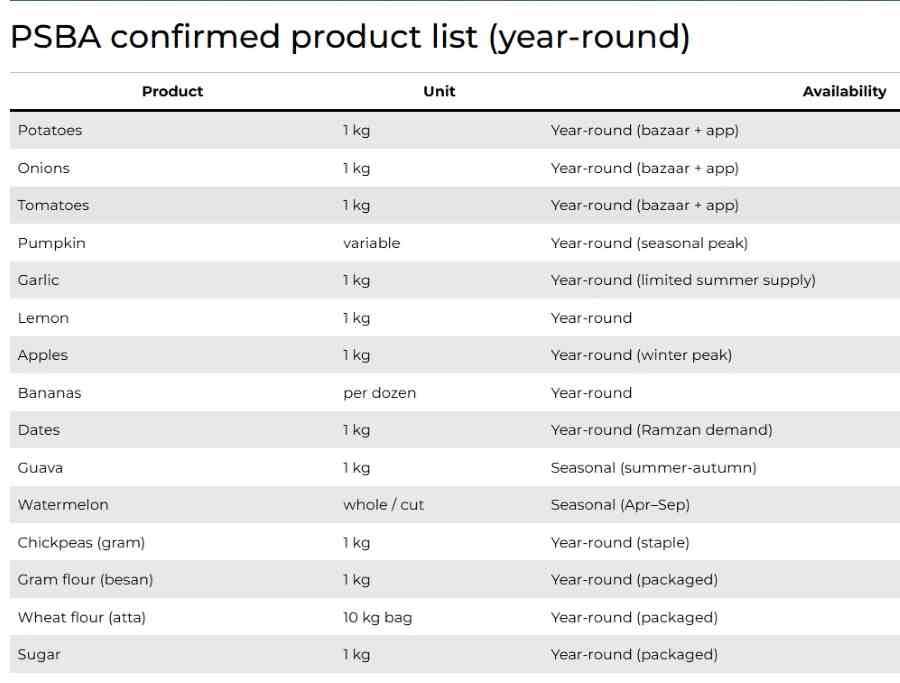
The following table outlines the core products you can consistently expect to find at any PSBA-run Ramzan Bazaar. This list is the foundation of the relief package.
| Product | Unit |
|---|---|
| Potatoes | 1 kg |
| Onions | 1 kg |
| Tomatoes | 1 kg |
| Pumpkin | variable |
| Garlic | 1 kg |
| Lemon | 1 kg |
| Apples | 1 kg |
| Bananas | per dozen |
| Dates | 1 kg |
| Guava | 1 kg |
| Watermelon | whole / cut |
| Chickpeas (gram) | 1 kg |
| Gram flour (besan) | 1 kg |
| Wheat flour (atta) | 10 kg bag |
| Sugar | 1 kg |
Seasonal Items to Look For
While most items are available year-round, some have peak seasons. Apples are at their best and most abundant during the winter months. Dates see a massive surge in demand and availability specifically during Ramzan. Watermelon is a seasonal favorite available from April to September, providing refreshment during the warmer months.
Items NOT Sold at PSBA
It is equally important to know what you will not find at these bazaars. The PSBA’s core roster explicitly excludes certain categories to maintain focus on staple and fresh produce.
- Meat, Poultry, and Fish: These protein items are not sold.
- Eggs and Dairy: Milk, yogurt, cheese, and eggs are not part of the core list.
- Cooking Oil (in some contexts): While ghee is often available, cooking oil is not always confirmed in the 16-item roster.
- Non-Food Items: Prepared foods, bakery items, cosmetics, and general non-food goods are not sold.
How is the Quality and Price Monitored at These Bazaars?
The Punjab government has implemented a multi-layered monitoring system to ensure that the quality of goods is maintained and that no vendor dares to overcharge customers. This system combines high-tech surveillance with on-ground enforcement.
The Centralized Control Room
A state-of-the-art central control room has been established where officials monitor activities across all bazaars in real-time. This room is equipped with live feeds from over 1,400 CCTV cameras installed at various bazaars. In a notable display of commitment, the Chief Minister herself has visited this room and made live, on-air calls to citizens to personally inquire about prices and quality, sending a strong message of accountability.
Role of Price Control Magistrates and Para Force
On the ground, Price Control Magistrates are present at every major Ramzan Bazaar. They are empowered to hear complaints on the spot and take immediate action. Additionally, the “Para Force” (auxiliary police) is deployed to ensure that government rates are being implemented not just in the bazaars but across all open markets in the city.
Strict Enforcement Actions
The enforcement is not just for show. In the first few days of Ramzan alone, authorities in cities like Rawalpindi conducted extensive raids, resulting in the sealing of hundreds of shops and the arrest of individuals for profiteering. This visible crackdown acts as a powerful deterrent.
Punjab Food Authority’s Role
The Punjab Food Authority (PFA) plays a critical role, especially concerning the “Maryam Ke Mehman” Dastarkhwans. PFA teams regularly inspect the community kitchens to ensure the food being prepared and served is hygienic, fresh, and safe for consumption, protecting public health.
What is the Maryam Ke Mehman Initiative (Dastarkhwan)?
“Maryam Ke Mehman” is a flagship initiative that extends relief beyond groceries to providing free, cooked meals. It is a network of Ramzan Dastarkhwans (community kitchens) established across Punjab, serving thousands of iftar and sehri meals daily, often in collaboration with philanthropists and local organizations.
Locations of Dastarkhwans
These Dastarkhwans are strategically located to serve the maximum number of people. You will primarily find them at major public places, including the entrances of large hospitals (like Services Hospital in Lahore) and in busy public squares in cities like Rawalpindi. There are over a dozen such locations ensuring that no one has to break their fast hungry.
Practical Information for Shoppers
To make your experience at the Ramzan Bazaar smooth and beneficial, here is some practical information you should know.
Do I Need a Special Card to Get Discounts?
- For the General Public at Bazaars: No card is needed. The subsidized prices at the bazaars are available to every citizen. You can walk in, pick your items, and pay the displayed rate.
- For the Nigehban Package: Yes, you need the Nigehban Card or at least the SMS confirmation of your eligibility to receive the Rs. 10,000 cash or the free ration bag.
Is There a Limit on How Much Sugar or Flour One Person Can Buy?
The PSBA has not published any official, fixed per-customer quantity limits. However, during peak demand periods or in times of short supply, the bazaar administration may impose informal stock limits on a per-person basis to ensure fair distribution and prevent hoarding by a single individual.
Is There a Separate Line for Women and Senior Citizens?
Recognizing the need for a dignified shopping experience, the authorities are actively reviewing and implementing setups for “Senior Citizen Camps” and dedicated queues. This initiative aims to facilitate vulnerable shoppers, allowing them to purchase essentials without having to stand in long, crowded lines.
Is Parking Free at Major Sasta Bazaars?
Generally, parking is available and often free at major bazaars, especially those with dedicated grounds like the Model Bazaar on Wahdat Road. However, for bazaars set up in temporary locations or along busy roads, parking might be limited. It is always advisable to check the specific location for any nominal parking fees.
Where and How to File a Complaint?
If you encounter overcharging, poor quality goods, or are asked for a bribe to process your Nigehban Card, you have multiple channels to file a complaint and seek immediate redressal.
PSBA Official Helpline
For issues directly related to bazaar operations, pricing, or vendor behavior, you can call the PSBA official helpline at +92-42-99001000. This line connects you to the central complaint cell.
Nigehban Package Helpline
For specific issues regarding the Nigehban Card, such as non-receipt of cash, eligibility disputes, or complaints about the distribution process, you can call the dedicated helpline at 0800-02345. Alternatively, you can send the details of your complaint via SMS to the same shortcode 8070 used for eligibility checks.
Can I Complain About Overcharging at a Private Store?
Yes, absolutely. The district administration’s price control mechanism extends to all private retailers. If you find a private store charging more than the official rates, you can report the profiteering to the nearest Price Control Magistrate or call the relevant district helpline for action.
Ramzan Bazaars vs. Other Options
Understanding how the Ramzan Bazaar stacks up against other shopping options helps you make an informed decision about where to spend your money.
Sahulat Bazaar vs. Utility Stores
A key distinction exists between government-run Utility Stores and the Sahulat Bazaars. At Utility Stores, there is often a condition that to buy highly subsidized flour, you must purchase other items. In contrast, at Ramzan Bazaars run by the Punjab government, there is no such condition. You can buy only the flour, or only the sugar, without being forced to buy anything else. Furthermore, the check and balance system for weight and quality is often cited as being more stringent at the bazaars.
Are Private Stores Like Imtiaz or Alfatah Offering Deals?
Yes, many large supermarket chains cooperate with the government during Ramzan. Over 100 such stores are directed to display official rate counters and offer some discounts. However, for the deepest discounts on staples like flour, sugar, and ghee, the government Ramzan Bazaars remain the most economical choice.
Transition to Eid: When Do Ramzan Bazaars Become Eid Bazaars?
As the month of Ramadan progresses, the focus of these markets begins to shift slightly to accommodate the needs of Eid-ul-Fitr. In the last ten days of Ramadan, many Sasta Bazaars begin a gradual transition, adding stalls and sections dedicated to Eid shopping.
Can I Find Eid Clothes at Ramzan Bazaars?
Yes, later in the month, you will notice that alongside the food items, stalls selling clothes, shoes, bangles, and other accessories start appearing. This transforms the bazaar into a one-stop shop where you can buy your ration and also pick up new items for your family to celebrate Eid, all under one roof.
Frequently Asked Questions (FAQs)
Is the 8070 code still working to check my eligibility?
Yes, the 8070 shortcode is currently active and is the primary method for citizens to check their eligibility for the Ramzan Nigehban Package. You should send your CNIC number to this code to receive an immediate status update.
Does PSBA limit how much of an item I can buy?
The PSBA has not published any official per-customer purchase limits for its items. However, during periods of very high demand, bazaar management may implement temporary, informal limits to ensure that stock lasts for all shoppers. It is always best to check with the specific stall if you are buying in bulk.
Are all items available in every city every day?
The core 16-item roster is standard across all PSBA bazaars. However, availability can vary by city due to local supply chains and seasonal factors. For instance, fresh guava or watermelon may be listed in one city but not another on a given day. Always check your city’s daily list on the price dashboard before heading out.
How does PSBA keep prices so low without relying on subsidies?
While the government does provide some subsidy, the PSBA’s primary method of keeping prices low is through direct sourcing. They procure items directly from farmers and producers, effectively removing layers of middlemen who typically inflate prices in the open market.
If my online delivery arrives with the wrong item, what should I do?
If your order from the Sahulat Bazaar app arrives and an item is wrong or damaged, you have the right to refuse that specific item at the time of delivery. It is strongly recommended to take a clear photograph of the incorrect or damaged item and then immediately call the PSBA helpline to report the issue and seek a resolution.
Can I use the Nigehban Card at any private supermarket?
No, the Nigehban Card is specifically designed for use at designated government distribution points, Bank of Punjab branches, and approved branchless banking agents. It cannot be used as a regular debit card at private supermarkets like Imtiaz or Alfatah.
Are widows automatically eligible for the Nigehban Package?
Yes, widows who are already registered in government databases, such as those receiving Zakat or who are part of the BISP program, are typically automatically included in the eligibility list for the Nigehban Package without needing to submit a separate application.

Add a Comment