
Are you unsure whether your newly purchased or imported phone will work on Pakistani networks tomorrow? The difference between a fully functional smartphone and an expensive paperweight often comes down to one thing: checking the PTA mobile tax list and ensuring your device is compliant. With the Federal Board of Revenue (FBR) issuing new valuation rulings that have significantly changed how taxes are calculated on used phones, understanding the PTA mobile tax list is more critical than ever.
This definitive guide will walk you through the complete PTA mobile tax list, show you how to check your tax online by IMEI, explain the 60-day rule, and reveal legal ways to save money on your registration.
Key Takeaways
- January Tax Cuts Confirmed: The FBR’s new Valuation Ruling has drastically reduced customs values on used iPhones, Samsung flagships, and Google Pixels, making registration more affordable than in previous months.
- Passport vs. CNIC Difference: Registering your phone using your passport almost always results in lower taxes compared to using your CNIC, a critical saving tip for overseas Pakistanis.
- 120-Day Free Window: Overseas Pakistanis and foreign visitors can legally use their phones tax-free for 120 days per visit, but must register permanently if staying longer.
- IMEI is Your Key: Your phone’s 15-digit IMEI number is the only code needed to check its status via SMS (8484) or the official DIRBS portal.
- Beware of Scams: PTA and FBR will never ask for your OTP, PIN, or biometric information over the phone. Such calls are always fraudulent.
- Read More: PTA Tax Check Online | PTA Tax Check By IMEI
- Read More: PTA Mobile Registration Online Check | PTA Approved Check [DVS PTA]
- Read More: PTA IMEI Check App | Device Verification System – PTA
What Exactly is the PTA Mobile Tax and How is it Calculated?
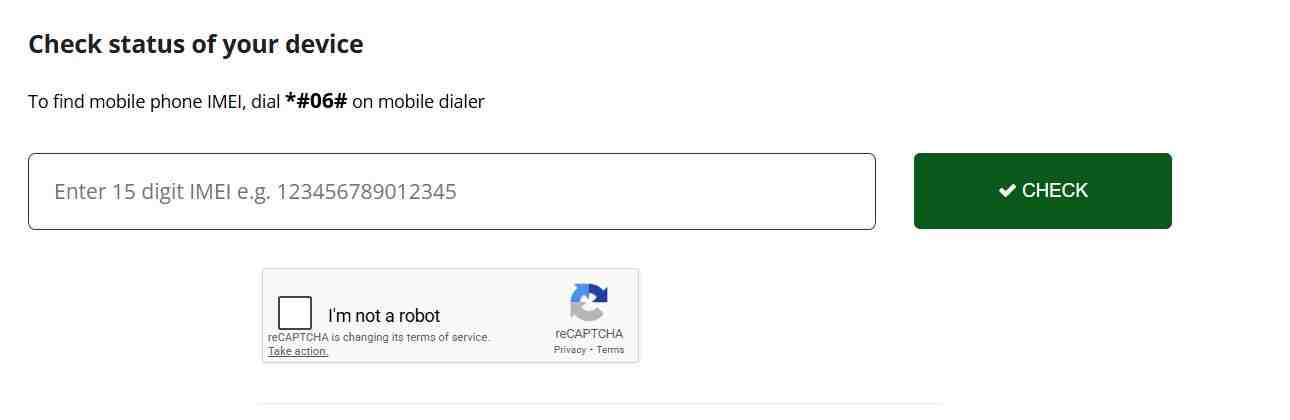
Table Of Contents
What is the difference between PTA tax, Customs Duty, and FBR levies on mobile phones?
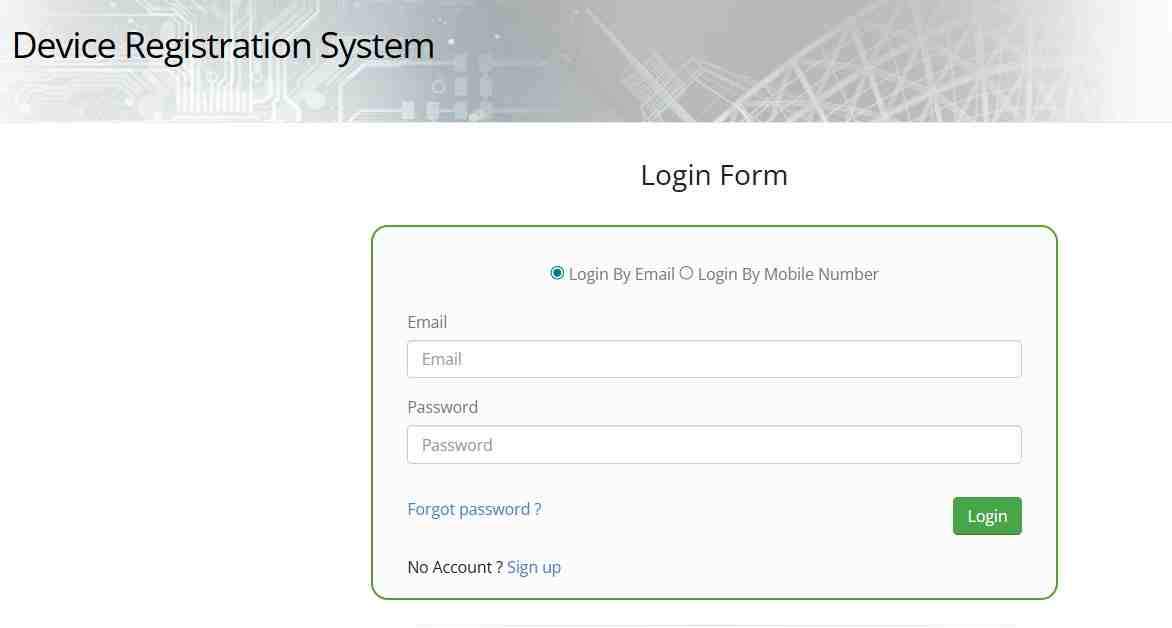
The term “PTA tax” is a common misnomer. The Pakistan Telecommunication Authority (PTA) does not collect taxes; it provides the technical platform called DIRBS (Device Identification, Registration and Blocking System) to enforce compliance. The actual taxes and duties are levied and collected by the Federal Board of Revenue (FBR). When you consult a PTA mobile tax list, you are looking at a combination of four distinct government levies.
- Customs Duty: This is charged on the importation of goods. The rate varies based on the phone’s value and whether it is new or used.
- Regulatory Duty: An additional duty imposed to regulate imports and protect local industry.
- Sales Tax: A fixed percentage (generally 17% to 18%) applied to the value of the goods plus the customs duty.
- Income Tax (Withholding): A small percentage withheld at the time of import or registration, applicable to certain categories of importers.
The PTA’s role begins after the tax is paid. They update their DIRBS database, which communicates with all cellular mobile operators (Jazz, Telenor, Zong, Ufone) to allow the phone to connect to local networks. Therefore, when you see a “PTA mobile tax list,” it is essentially a consolidated tax liability calculated by the FBR and enforced by the PTA.
How does the government determine the value of a used phone for tax calculation?
The valuation of used phones is a dynamic process managed by the Directorate General of Customs Valuation. They regularly issue Valuation Rulings that set the minimum assessable values for hundreds of mobile phone models. These rulings are based on international market prices, trends in the Dubai and Chinese markets, and feedback from local importers.
The most significant update occurred in January, when the government slashed the customs values on hundreds of used phone models. This was done to curb smuggling and encourage legal imports. For example, a used iPhone 15 Pro Max that was previously valued at $900 for tax purposes might now be valued at $700. This directly lowers the total tax payable. The system uses the Cost, Insurance, and Freight (CIF) value, meaning the price of the phone, plus the cost of insurance and freight to bring it to Pakistan, forms the base for tax calculation.
What are the official PTA tax slabs based on a phone’s USD value?
For devices that are not specifically listed in the latest valuation rulings, or for very new models, the FBR applies a standardized slab system based on the phone’s value in US dollars. These slabs provide a baseline for calculating the combined customs duty and sales tax.
The table below outlines the general tax structure applied to mobile phones based on their CIF value:
| Phone Value (USD) | Customs Duty (Approx.) | Sales Tax | Total Estimated Tax (PKR) |
|---|---|---|---|
| Up to $30 | Low/Flat Rate | Exempt/Minimal | Around Rs. 430 |
| $31 to $100 | Fixed Rate | 17% | Around Rs. 3,200 |
| $101 to $200 | Fixed Rate | 17% | Around Rs. 9,580 |
| $201 to $350 | Fixed Rate + 17% | 17% | Rs. 12,200 + 17% of Value |
| $351 to $500 | Higher Fixed Rate | 17% | Variable, often Rs. 30,000+ |
| Above $500 | Highest Bracket | 17% | Subject to individual calculation |
It is crucial to understand that these are simplified estimates. The final amount can vary based on the exact model, its age, and the specific HS Code (Harmonized System Code) assigned to it by customs.
Why are PTA taxes so high compared to the phone’s actual price?
This is one of the most frequent questions asked by Pakistani consumers. The perception of “high” taxes stems from comparing the tax on a grey market or personally imported phone to the price of a phone that is officially assembled or marketed in Pakistan. The government’s strategy is multi-pronged.
- Discouraging Smuggling: High taxes on individual imports make officially assembled phones or those brought in by commercial importers more competitive. This starves the grey market of demand.
- Protecting Local Industry: Pakistan has a growing mobile phone assembly industry. Brands like Vivo, Infinix, and Samsung have local assembly plants. Taxing imports heavily makes locally assembled phones more attractive to price-sensitive buyers.
- Revenue Generation: The telecom sector is a significant source of revenue. Taxes on high-value smartphones, often used by higher-income segments, are seen as a progressive way to generate funds for national development.
- Closing the Digital Divide: Revenue generated is theoretically reinvested into telecom infrastructure, expanding network coverage to rural areas.
The high tax is therefore not an arbitrary decision but a calculated policy tool to achieve multiple economic objectives.
The Complete PTA Mobile Tax List: Brand-Wise Breakdown
What is the current PTA tax on iPhone 16 Pro Max and other iPhone models in Pakistan?
Apple iPhones are consistently among the most searched devices on the PTA mobile tax list due to their high value. The tax is calculated based on the device’s storage capacity and condition (new or used). Following the January valuation updates, used iPhones saw a noticeable reduction in their tax liability.
Here is a breakdown of the estimated tax for popular iPhone models, reflecting the latest used phone valuations. These figures are for devices registered using a CNIC.
- iPhone 16 Series Tax List:
- iPhone 16 Pro Max (512GB): Estimated tax ranging from Rs. 180,000 to Rs. 210,000 depending on the exact condition and market value assessment.
- iPhone 16 Pro (256GB): Estimated tax between Rs. 150,000 and Rs. 170,000.
- iPhone 16 Plus (128GB): Estimated tax around Rs. 130,000 to Rs. 145,000.
- iPhone 16 (128GB): Estimated tax in the range of Rs. 115,000 to Rs. 130,000.
- iPhone 15 Series Tax List:
- The iPhone 15 series remains popular. The tax is now lower due to depreciation.
- iPhone 15 Pro Max (256GB): Estimated tax Rs. 110,000 to Rs. 130,000.
- iPhone 15 Pro (128GB): Estimated tax Rs. 95,000 to Rs. 110,000.
- iPhone 15 Plus (128GB): Estimated tax Rs. 85,000 to Rs. 95,000.
- iPhone 15 (128GB): Estimated tax Rs. 75,000 to Rs. 85,000.
- iPhone 14 Series Tax List:
- iPhone 14 Pro Max (128GB): Estimated tax Rs. 80,000 to Rs. 95,000.
- iPhone 14 Pro (128GB): Estimated tax Rs. 70,000 to Rs. 80,000.
- iPhone 14 (128GB): Estimated tax Rs. 55,000 to Rs. 65,000.
- iPhone 13 Series Tax List:
- The iPhone 13 is often considered a value-for-money flagship. Its tax is more accessible.
- iPhone 13 Pro Max (128GB): Estimated tax Rs. 60,000 to Rs. 70,000.
- iPhone 13 Pro (128GB): Estimated tax Rs. 50,000 to Rs. 60,000.
- iPhone 13 (128GB): Estimated tax Rs. 40,000 to Rs. 48,000.
- iPhone 12 and 11 Series Tax List:
- iPhone 12 (64GB): Estimated tax Rs. 30,000 to Rs. 38,000.
- iPhone 11 (64GB): Estimated tax Rs. 20,000 to Rs. 28,000.
- Older iPhone Models (iPhone X, XS, 8, 7, SE) Tax List:
- These models often fall into lower tax brackets. For example, an iPhone 7 Plus may have a tax liability of Rs. 10,000 to Rs. 15,000, while an iPhone SE (2020) might be around Rs. 18,000 to Rs. 25,000, depending on its condition and valuation.
What is the PTA tax list for Samsung phones after the January price drop?
Samsung phones, particularly the S and Note series, also benefit from the revised customs values. The tax is highly dependent on the model year. The January update specifically targeted high-end used models to align their value with market depreciation.
- Samsung S24 & S23 Ultra Tax List:
- Samsung S24 Ultra (512GB): Estimated tax Rs. 140,000 to Rs. 165,000.
- Samsung S24 Plus (256GB): Estimated tax Rs. 110,000 to Rs. 125,000.
- Samsung S23 Ultra (512GB): Estimated tax Rs. 90,000 to Rs. 105,000.
- Samsung S23 Plus (256GB): Estimated tax Rs. 75,000 to Rs. 85,000.
- Samsung S22, S21, and S20 Series Tax List:
- Samsung S22 Ultra (256GB): Estimated tax Rs. 65,000 to Rs. 78,000.
- Samsung S21 Ultra (256GB): Estimated tax Rs. 50,000 to Rs. 60,000.
- Samsung S20 Ultra (128GB): Estimated tax Rs. 35,000 to Rs. 45,000.
- Samsung Note Series Tax List (Note 20, Note 10, Note 9) :
- Samsung Note 20 Ultra (256GB): Estimated tax Rs. 55,000 to Rs. 68,000.
- Samsung Note 10 Plus (256GB): Estimated tax Rs. 30,000 to Rs. 40,000.
- Samsung Note 9 (128GB): Estimated tax Rs. 18,000 to Rs. 25,000.
- Samsung A-Series and Mid-Range Android Tax List:
- Samsung A55 (8GB/256GB): Estimated tax Rs. 25,000 to Rs. 32,000.
- Samsung A35 (8GB/128GB): Estimated tax Rs. 18,000 to Rs. 24,000.
- Samsung A15 (4G/8GB/128GB): Estimated tax Rs. 8,000 to Rs. 12,000.
- Samsung A05 (4GB/64GB): Estimated tax Rs. 4,500 to Rs. 7,000 (falls into lower slabs).
What is the PTA tax for Google Pixel 8 Pro and other Pixel models?

Google Pixel phones have gained immense popularity in Pakistan, primarily through the used phone market from the US and Dubai. The new valuation ruling acknowledged this popularity and set more realistic values for these devices.
- Google Pixel 9 Series Tax List (Pro XL, Pro, Regular) :
- Pixel 9 Pro XL (256GB): Estimated tax Rs. 130,000 to Rs. 150,000.
- Pixel 9 Pro (128GB): Estimated tax Rs. 110,000 to Rs. 125,000.
- Pixel 9 (128GB): Estimated tax Rs. 95,000 to Rs. 110,000.
- Google Pixel 8, 8 Pro, and 8a Tax List:
- Pixel 8 Pro (128GB): Estimated tax Rs. 75,000 to Rs. 88,000.
- Pixel 8 (128GB): Estimated tax Rs. 60,000 to Rs. 72,000.
- Pixel 8a (128GB): Estimated tax Rs. 45,000 to Rs. 55,000.
- Google Pixel 7, 7 Pro, 6, 6a, and Older Models Tax List:
- Pixel 7 Pro (128GB): Estimated tax Rs. 48,000 to Rs. 58,000.
- Pixel 7 (128GB): Estimated tax Rs. 38,000 to Rs. 45,000.
- Pixel 6 Pro (128GB): Estimated tax Rs. 30,000 to Rs. 38,000.
- Pixel 6a (128GB): Estimated tax Rs. 20,000 to Rs. 26,000.
Is there a list of PTA tax rates for OnePlus, Vivo, Oppo, and other brands?
For brands like OnePlus, Vivo, and Oppo, the tax is generally calculated based on their value slab. High-end OnePlus models compete with Samsung flagships and attract similar taxes. Mid-range Vivo and Oppo phones, many of which are assembled locally, have much lower tax liabilities.
- OnePlus:
- OnePlus 12 (16GB/512GB): Estimated tax Rs. 90,000 to Rs. 110,000.
- OnePlus 11 (16GB/256GB): Estimated tax Rs. 60,000 to Rs. 72,000.
- OnePlus Nord Series: Estimated tax ranges from Rs. 15,000 to Rs. 30,000 depending on the model.
- Vivo:
- Vivo X100 Pro (16GB/512GB): Estimated tax Rs. 70,000 to Rs. 85,000.
- Vivo V30 Series: Estimated tax Rs. 25,000 to Rs. 40,000. (Locally assembled models may have a different tax structure if purchased new from the market).
- Vivo Y Series (Budget): Estimated tax Rs. 3,500 to Rs. 10,000.
- Oppo:
- Oppo Find N3 (Fold): Estimated tax Rs. 140,000 to Rs. 170,000.
- Oppo Reno 11 Series: Estimated tax Rs. 28,000 to Rs. 42,000.
- Oppo A Series: Estimated tax Rs. 4,000 to Rs. 12,000.
- Motorola, Tecno, Infinix:
- Motorola Edge Series: Rs. 25,000 to Rs. 45,000.
- Tecno Camon Series: Rs. 8,000 to Rs. 18,000.
- Infinix Note Series: Rs. 6,000 to Rs. 15,000.
How much is the tax on a low-end Android phone worth under $100?
Phones valued under $100 fall into the most favorable tax brackets. This encourages the legal import of affordable smartphones, ensuring that even budget-conscious consumers can have compliant devices. The tax on such phones is a fixed amount rather than a percentage.
A phone with a CIF value between $31 and $100 typically incurs a total tax of around Rs. 3,200. This includes customs duty and sales tax. Phones valued under $30, often basic feature phones or very entry-level smartphones, are taxed nominally, around Rs. 430. This structure ensures that the cost of compliance does not exceed the price of the device itself, a key factor in promoting digital inclusion.
Step-by-Step Guide: How to Check PTA Mobile Tax Online by IMEI
How can I check my mobile tax status by IMEI number?
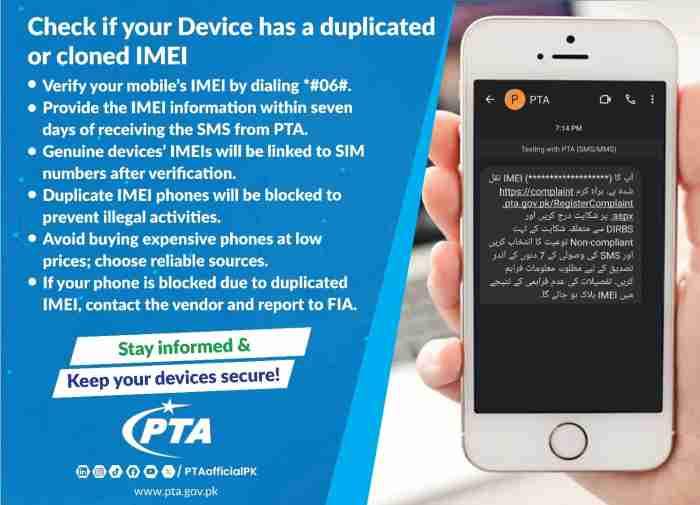
Your phone’s IMEI (International Mobile Equipment Identity) number is its unique fingerprint. It is a 15-digit code that identifies the device to the network. Checking your PTA tax status is impossible without it. There are three official methods to check the status, each offering a different level of detail.
How to check PTA tax online via the official DIRBS portal?
The DIRBS (Device Identification, Registration and Blocking System) portal is the most comprehensive tool for checking your phone’s status. It provides detailed information, including the exact tax amount due, the device’s approval status, and its specifications.
Step-by-Step Process:
- Open your web browser and go to the official DIRBS website: dirbs.pta.gov.pk.
- On the homepage, you will see a field asking for your IMEI number. Enter the 15-digit IMEI you obtained by dialing *#06#.
- Complete the simple CAPTCHA verification to prove you are not a robot.
- Click the “Check” or “Submit” button.
- The system will display a comprehensive report. This report will tell you:
- Approval Status: Whether the device is “Approved,” “Non-Compliant,” or “Blocked.”
- Device Information: Brand, model, and color of the phone.
- Tax Status: If the phone is non-compliant, the portal will show the exact amount of tax payable in Pakistani Rupees.
- Deadline: The date by which the tax must be paid to avoid blocking.
This online method is the best for getting a definitive answer, especially if you are about to buy a used phone and want to verify the seller’s claims.
How to check PTA tax by sending an SMS to 8484?
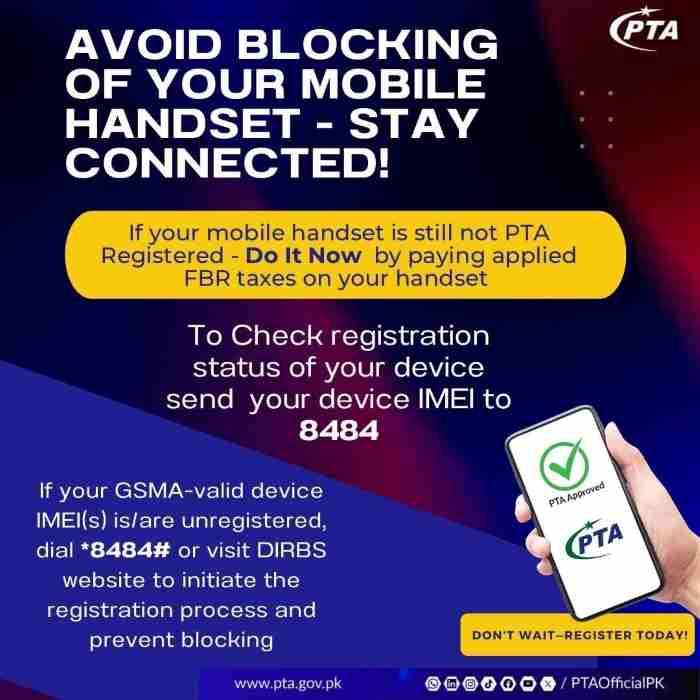
For a quick, offline check, the SMS service to 8484 is the most convenient. It does not require an internet connection and provides an immediate response.
How to Use the SMS Service:
- Open the messaging app on your phone.
- Create a new message.
- Type your 15-digit IMEI number in the message body. Do not add any other text, spaces, or hyphens.
- Send this message to 8484.
- Within a few seconds, you will receive a reply. The possible responses are:
- “Your mobile is PTA Approved”: The device is compliant and can be used freely.
- “Your mobile is Non-Compliant”: The device requires tax payment. The response may include a link or instructions to check the exact amount online.
- “Your mobile is Blocked”: The device has been permanently blocked from all Pakistani networks and cannot be registered.
- “Invalid IMEI”: The number you entered is not a valid IMEI. Double-check and try again.
What is the DVS PTA app and how does it help in checking mobile tax?
The Device Verification System (DVS) app is a mobile application developed by PTA, available for both Android and iOS devices. It offers the same functionality as the web portal but in a user-friendly app format. You can scan the IMEI barcode on the phone box or manually enter the number.
The app is particularly useful for mobile phone retailers and frequent buyers who need to verify multiple devices quickly. It provides the same detailed information as the website, including tax amounts and compliance status.
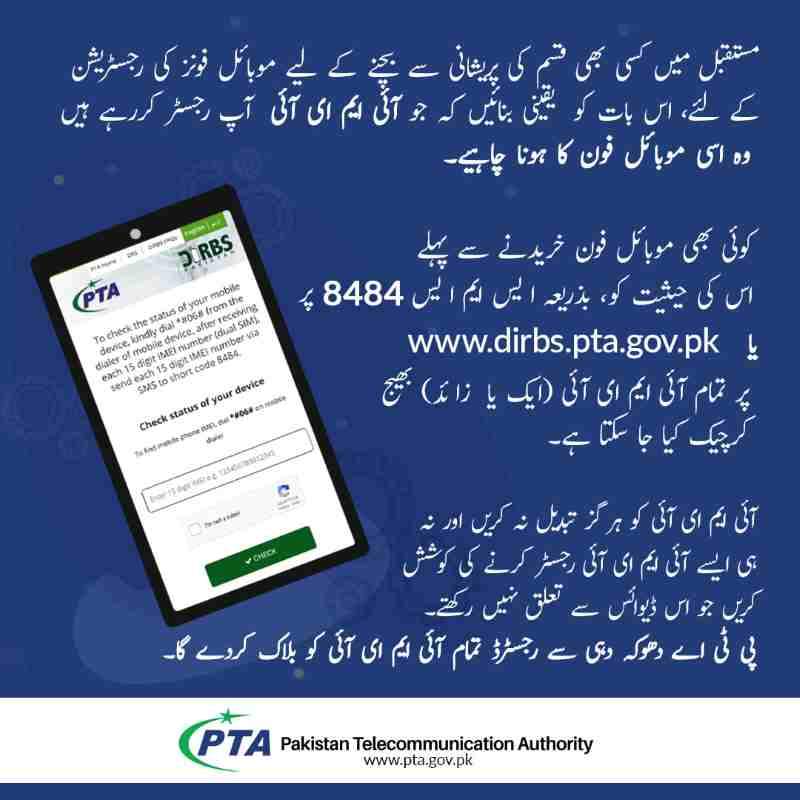
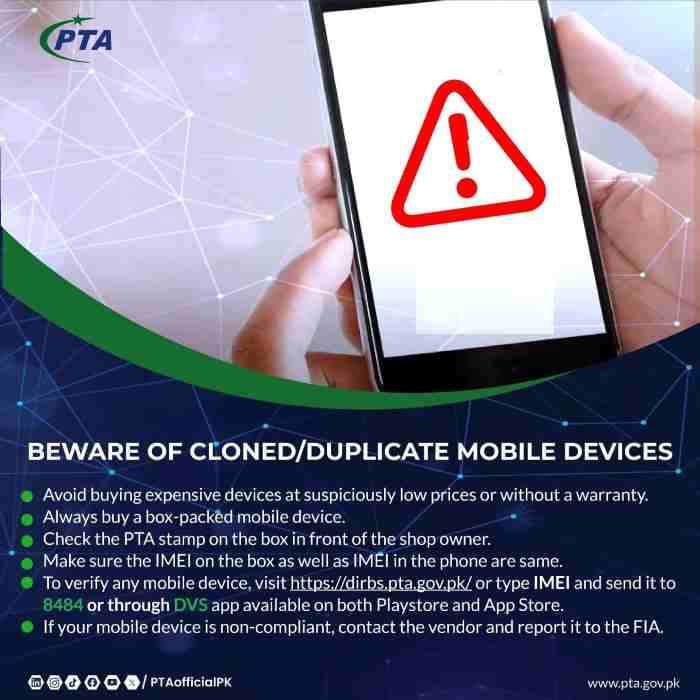
How to check if a mobile is PTA approved before buying a used phone?
This is a non-negotiable step in the used phone buying process. Never rely on the seller’s word alone. Follow this checklist at the time of purchase:
- Physically Check the IMEI: On the phone you intend to buy, dial *#06#. The 15-digit IMEI will appear on the screen. Write it down.
- Verify the Box: Check if the IMEI on the phone’s box matches the one on the screen. Mismatched IMEIs are a huge red flag.
- Do a Live Check: Using your own phone or the seller’s phone with your permission, send the IMEI via SMS to 8484. Or, use the DIRBS website on your mobile data.
- See the Result: Ensure the response clearly states “Approved.” If it says “Non-Compliant,” you can use this information to negotiate a lower price, as you will have to pay the tax later. If it says “Blocked,” walk away immediately.
The 60-Day Rule and Registration Process Explained
Can I use my phone for 60 days in Pakistan without paying tax?
Yes, absolutely. Pakistani law provides a grace period of 60 days for personally used and imported mobile phones. This rule applies to:
- Overseas Pakistanis returning home for a visit.
- Foreign tourists entering Pakistan.
- Residents who have purchased a phone from abroad and are bringing it in personally.
The 60-day clock starts ticking from the day the phone is activated on a Pakistani mobile network, or from the date of entry into the country as recorded by immigration authorities. During these 60 days, you can use your SIM card normally. This window is designed to give you time to decide whether to keep the phone permanently or take it back out of the country.
What happens if I don’t pay the PTA tax within 60 days?
If the 60-day period expires without the phone being registered and the tax paid, the consequences are immediate and severe. The DIRBS system automatically updates, and a blocking order is sent to all mobile network operators.
The phone’s IMEI is added to a master blacklist. Once on this list, the phone will lose all connectivity. You will be unable to make or receive calls, send text messages, or use mobile data. The phone essentially becomes a Wi-Fi-only device, rendering its primary function useless while on the go. This block is permanent until the tax is paid. Even after paying the tax, it can take a few hours for the system to reverse the block and restore service.
How to register a mobile phone with PTA online?
Registering your phone is a straightforward, two-part process involving the FBR for payment and the PTA for activation. You can complete the entire process from your home.
Step 1: Verify IMEI Status.
First, confirm that your phone is actually non-compliant and needs registration. Use the DIRBS portal or SMS to 8484. If it shows “Non-Compliant,” proceed to Step 2.
Step 2: Generate a Payment Slip ID (PSID) on the FBR DIRBS portal.
Visit the FBR’s dedicated DIRBS web portal (usually linked from the PTA DIRBS site). You will need to enter your IMEI again and select your user type (e.g., Overseas Pakistani, Resident using CNIC, Foreigner using Passport). The system will calculate the exact tax amount and generate a unique 24-digit Payment Slip ID (PSID). This PSID is valid for a limited time, usually 7 to 15 days.
Step 3: Pay the tax via various methods.
Take your generated PSID and use it to pay the tax. You can pay through:
- ATM: Visit any 1LINK ATM and use the “Bill Payments” or “Government Transactions” option.
- Mobile Banking: Log in to your bank’s app (e.g., HBL, UBL, Alfalah) or mobile wallets like JazzCash or Easypaisa. Navigate to “Payments” and select “PSID Payment” or “Government Tax.”
- Over-the-Counter: Visit any branch of partner banks (like National Bank of Pakistan) and submit the PSID along with the cash.
Step 4: Confirmation and signal restoration timeline.
Once the payment is successful, the FBR system automatically notifies the PTA’s DIRBS system. Your phone’s status is updated from “Non-Compliant” to “Approved.” Signal restoration typically happens within a few minutes to a maximum of 24 hours. If service is not restored after 24 hours, you may need to restart your phone or contact your mobile network operator’s helpline.
How can I generate a PSID for mobile tax payment?
Generating a PSID is a critical step that requires accuracy. You must ensure you select the correct user type. Selecting “Passport” when you are a resident using a CNIC can lead to payment rejection or incorrect tax calculation. The portal will ask for your personal information (CNIC/Passport number, name, address) and the phone’s details. After verification, it presents the tax amount and the PSID. Save this PSID and note the expiry date.
How long does it take for signal to restore after paying PTA tax?
The system is largely automated. The FBR confirms the payment to the State Bank, which then confirms it to the PTA. This digital chain is usually completed within 2 to 6 hours. In some cases, especially during weekends or public holidays, it might take up to 24 hours. If your phone remains blocked after 24 hours and you have the payment receipt, you should contact your mobile operator’s customer support. They can manually refresh your IMEI status in their system.
How to pay PTA tax via mobile banking apps like JazzCash or Easypaisa?
Digital payments are the fastest way to settle your PTA tax. Here is how to do it on a typical mobile banking app:
- Log in to your JazzCash or Easypaisa app.
- Look for the “Payments” or “Bill Payment” section.
- Find and select the option labeled “PSID Payment,” “Government Tax,” or “FBR Tax.”
- Enter your 24-digit PSID number carefully. The app should auto-fetch the amount due.
- Verify that the amount displayed matches your expected tax.
- Confirm the payment using your MPIN or biometric verification.
- You will receive a confirmation SMS and a digital receipt. Keep this receipt as proof of payment.
Passport vs. CNIC: Who Pays What?
Is there a difference between PTA tax on Passport vs. CNIC?
Yes, and the difference can be substantial. The tax regime distinguishes between a permanent resident (CNIC holder) and a temporary visitor or non-resident (Passport holder).
- CNIC Registration: This is for Pakistani citizens who are permanently residing in the country. The tax rates applied to CNIC are generally the standard, higher rates designed for permanent use and ownership.
- Passport Registration: This option is for foreigners and overseas Pakistanis who do not have a valid CNIC. The tax rates for passport-based registration are often significantly lower. This is because it acknowledges that the person and the phone may not stay in Pakistan indefinitely.
For example, the tax on a high-end iPhone might be Rs. 150,000 on a CNIC, but only Rs. 80,000 to Rs. 100,000 on a passport. This is a legal and official difference, not a loophole.
Is the 120-day tax-free facility still available for overseas Pakistanis?
The facility for overseas Pakistanis remains in place, though the duration has been updated. Currently, overseas Pakistanis can bring one personal mobile phone into the country and use it tax-free for 120 days per visit. This is an extension of the general 60-day rule, acknowledging that overseas Pakistanis often stay for longer periods. To avail this, you must enter through a legal port of entry and, if asked by customs, declare the phone. The 120-day period is tracked from your entry date.
Is there any PTA tax exemption for overseas Pakistanis?
Yes, a full tax exemption exists, but it is strictly defined. An overseas Pakistani can bring one used personal mobile phone into Pakistan without paying any tax, provided they can prove:
- They have stayed abroad for more than a certain period (typically 6 months or more).
- The phone is for their personal use and not for sale.
- They register the phone under their passport using their one-time exemption facility per year.
This exemption is typically claimed at the airport upon arrival by going through the red channel and presenting the phone to the customs officials. It is always advisable to carry the purchase receipt of the phone as proof of ownership and age.
Can I register my phone for free if I am a student returning from abroad?
Students returning to Pakistan after their studies are treated as overseas Pakistanis for the purpose of this exemption. If you have been living abroad as a student and are returning permanently or for a long visit, you qualify for the 120-day tax-free window. To claim the full tax exemption (i.e., not having to pay at all), you must use your one-time exemption facility. The key is to have your valid student visa and passport ready to present to customs if required.
How many phones can one person register on a single CNIC?
The DIRBS system is designed to prevent commercial smuggling under the guise of personal use. While there is no publicly advertised fixed number, the system has internal checks and triggers. Registering one or two phones per year on a CNIC is generally considered normal personal use. However, if a single CNIC is used to register three, four, or more high-value phones within a short period, the system will flag the account for audit. The FBR may then request proof of how the phones were acquired and proof of tax payment, potentially leading to penalties if commercial activity is suspected.
Legal Ways to Save Money on PTA Tax
How much is the PTA tax on used phones imported from Dubai?
The tax on a used phone from Dubai is calculated based on its current used value, as per the latest FBR valuation ruling, not the original price paid in Dubai. This is a critical point. For example, if you bought a used iPhone 15 in Dubai for $800, but the FBR’s updated ruling values that specific model at $600, the tax will be calculated on the $600 value. This recent policy change has made importing used phones from Dubai more attractive, as the tax is now based on depreciated values.
Is it cheaper to pay PTA tax at the airport?
The tax amount itself is identical whether you pay at the airport or online through a PSID. The FBR system calculates the tax based on the device and your status, and this amount is fixed. However, paying at the airport offers the advantage of immediate clearance.
You hand over the phone, pay the tax at the customs desk, and receive a stamp on your passport or a receipt. This eliminates any waiting period or the need to generate a PSID later. For overseas Pakistanis claiming an exemption, going through the airport process is mandatory to get the exemption officially recorded.
What is the difference in tax for a new phone vs. a used/refurbished phone?
The difference is substantial and is the core reason for the January policy update. A new phone, imported as a Completely Built Unit (CBU), is taxed on its full commercial invoice value. This includes the manufacturer’s price, freight, insurance, and a profit margin, attracting the highest duties.
A used or refurbished phone, imported by an individual, is now taxed on its depreciated value as determined by the FBR’s valuation tables. These tables reflect the phone’s age and condition. For a flagship phone that is one year old, the used value might be 20% to 30% lower than the new price, leading to a proportionally lower tax bill.
What are the legal hacks to reduce the PTA mobile tax?
Reducing your tax liability is about understanding and using the rules to your advantage. These are all legal methods approved by the FBR and PTA.
- Use Passport Registration: If you are an overseas Pakistani, always register using your passport. The tax rates for temporary residents are lower than those for permanent residents with CNICs.
- Avail the Overseas Pakistani Exemption: If you have been abroad for a long time, use your one-time exemption per year to bring a phone in completely tax-free. This is the single biggest saving.
- Utilize the 120-Day Window: If your stay is less than 120 days, do not pay the tax. Simply use the phone and take it back with you when you leave. The 120-day window is a legal right, not a loophole.
- Buy Locally Assembled Phones: Phones assembled in Pakistan (like many Vivo, Infinix, and Samsung A-series models) have a completely different tax structure. The taxes are already included in the retail price and are far lower than import duties, making these phones much cheaper to buy and own.
- Challenge an Over-Valuation: If you have the original proof of purchase for a used phone that shows you paid significantly less than the FBR’s assessed value, you can file a grievance with the customs authorities. You can provide your invoice and request a re-assessment based on the actual price paid.
- Buy Older Flagship Models: The tax on a one or two-year-old flagship (like an iPhone 14 or S23 Ultra) is often half or even less than the tax on the latest model, while still offering 90% of the performance and features.
Can I gift a phone to someone in Pakistan without paying tax?
Gifting a phone does not exempt it from tax. The recipient is still liable for the full tax if the phone is not PTA approved. The only exception is if the gifter is an overseas Pakistani using their one-time exemption facility on behalf of the recipient.
For example, an overseas Pakistani can bring a phone, declare it as a gift for a family member, and go through the customs channel to have the tax waived under their personal exemption. Once the phone is gifted, the family member can use it freely. If the phone is simply mailed or brought in without being declared under an exemption, the recipient will have to pay the full tax to register it on their CNIC.
Troubleshooting and Important Notices
Why did my PTA tax amount increase after the deadline?
If you check the tax on a non-compliant phone after the 60-day deadline, you may notice the amount has increased. This is not a penalty in the traditional sense, but rather the system may apply the current, undepreciated value of the phone.
The initial 60-day window often assumes the phone is being assessed as a “used personal import.” Once that window lapses without action, the system may reclassify the phone, potentially applying a different tax rate or adding late payment surcharges as per FBR rules. It is always financially better to pay within the grace period.
What are the current PTA taxes on tablets and iPads with SIM slots?
Yes, the PTA mobile tax list and all associated rules apply to any device that has a cellular radio and can accept a SIM card. This includes iPads (Pro, Air, Mini with cellular), Android tablets, and even cellular smartwatches. The tax is calculated based on the device’s value, just like a phone. A high-end iPad Pro with 5G capability can attract a tax bill running into tens of thousands of rupees. Wi-Fi only tablets are not subject to PTA registration as they cannot connect to mobile networks.
How to protect your SIM from being blocked while abroad?
For overseas Pakistanis who want to keep their Pakistani SIM active while living abroad, there is a specific procedure. Simply keeping the SIM in a phone abroad is not enough; the network operators have policies for long-term inactivity or roaming abuse. You must inform your mobile operator (Jazz, Telenor, etc.) of your intention to keep the SIM active while overseas. You may need to use the SIM for incoming calls/SMS periodically or subscribe to a specific international package offered by the operator. Failure to do so can result in the SIM being blocked, even if the phone itself is PTA approved.
Beware of Scams: How to avoid fraudsters impersonating PTA and FBR?
A new wave of scams has emerged where fraudsters call individuals, claiming to be from the PTA or FBR. They use spoofed numbers and official-sounding language to create panic. They may claim your SIM will be blocked immediately unless you verify your identity by sharing an OTP, your CNIC number, or performing a biometric verification over the phone.
This is always a scam. PTA and FBR never request OTPs, PINs, or biometric verification via phone call. They never ask for payments to be made to personal bank accounts. If you receive such a call, hang up immediately. You can report the number to your mobile operator and the FIA’s cyber crime wing. Official communication regarding taxes and registration is always through the official DIRBS portal or written notices.
What is the difference between PTA Approved, Non-Compliant, and Blocked status?
Understanding these three statuses is fundamental.
- PTA Approved: The device has been registered and all applicable taxes have been paid. It can be used on any Pakistani network without any restrictions.
- Non-Compliant: The device has been detected on the network but has not been registered, and the taxes have not been paid. It is currently within or past its grace period. It requires immediate action (tax payment) to avoid being blocked.
- Blocked: The device’s IMEI has been added to the master blacklist. It cannot connect to any mobile network in Pakistan for calls, SMS, or data. The only way to unblock it is to pay the outstanding tax plus any applicable penalties. In some cases of confirmed theft, devices may be permanently blocked without the option for reinstatement.
Frequently Asked Questions (FAQs)
What is the PTA tax on iPhone 13 in 2026?
The estimated tax on a used iPhone 13 (128GB) ranges from Rs. 40,000 to Rs. 48,000, depending on its condition and exact model, based on current used phone valuations.
How to calculate PTA tax for Samsung S24 Ultra?
You cannot calculate it manually with 100% accuracy. The best method is to use the official DIRBS portal. Enter the IMEI number of the specific S24 Ultra, and the system will display the exact tax due based on its model, storage, and current FBR valuation.
Is there a PTA tax calculator app?
There is no single official “calculator” app, but the official DVS (Device Verification System) app by PTA serves the same purpose. You can enter an IMEI, and it will show the tax amount for non-compliant devices.
Can I pay PTA tax in installments?
No. The PTA mobile tax is a one-time payment. You must pay the full amount via a single PSID transaction. There is no facility for paying in installments through any bank or government channel.
What is the PTA tax on a phone worth $500?
For a phone valued at $500, it falls into the “Above $500” bracket. The tax is not a simple percentage. It includes a significant fixed customs duty plus 17% sales tax. The total estimated tax would likely be in the range of Rs. 70,000 to Rs. 90,000 or more, depending on the specific model.
Are PTA taxes reduced in the latest budget?
Yes, the latest significant reduction came through a new Valuation Ruling issued in January, which lowered the assessable values for hundreds of used phone models, effectively reducing the tax for many consumers.
Does PTA tax apply to smartwatches with SIM slots?
Yes, any device with an IMEI number that can connect to a cellular network falls under the PTA regulations. This includes cellular smartwatches from Apple, Samsung, and other brands.
Where can I find the official FBR mobile tax calculator?
The most official and accurate tool is the “Check Compliance” feature on the DIRBS website (dirbs.pta.gov.pk) or the FBR’s DIRBS payment portal. These systems use live FBR valuation data to provide the exact tax amount for a specific IMEI.
Conclusion: Final Checklist for PTA Mobile Tax Compliance
Navigating the PTA mobile tax list and registration process is manageable when you break it down. Before you buy a phone or travel with one, run through this five-step checklist to ensure you stay connected.
- Check Before You Buy: Always verify the IMEI on the DIRBS portal or via SMS to 8484 before purchasing a used phone. Do not rely on verbal assurances.
- Know Your Status: Determine if you are a resident (CNIC) or a visitor/overseas Pakistani (Passport). This single factor has the biggest impact on your final tax amount.
- Use the Grace Period Wisely: If you are visiting, mark your calendar for the 120-day deadline. If you are a resident, set a reminder for 55 days to ensure you pay the tax well before the 60-day block.
- Generate and Pay PSID Promptly: Use the official FBR portal to generate your PSID and pay immediately through a secure channel like mobile banking. Keep a screenshot of the receipt.
- Stay Alert for Scams: Remember, no government official will ever call you to ask for an OTP or biometric verification. Report any such calls immediately.
By following this guide, you can ensure your device remains compliant, your connection stays active, and you pay exactly what is required—no more, no less.
Disclaimer: The tax figures provided in this guide are estimates based on the latest available valuation rulings and general tax slabs. Actual tax liabilities can vary based on the specific device model, its condition, and the user’s status (CNIC/Passport). Always verify the exact amount using the official DIRBS portal before making any payment.
Frequently Asked Questions (FAQs)
What is the PTA tax on iPhone 14 Pro Max in Pakistan?
The estimated tax for a used iPhone 14 Pro Max (128GB) is currently in the range of Rs. 80,000 to Rs. 95,000, reflecting its depreciation since launch.
How to check PTA tax by IMEI online for free?
Visit dirbs.pta.gov.pk, enter your 15-digit IMEI, and complete the CAPTCHA. The check is completely free and provides the most detailed status report.
Is there a PTA tax exemption for students?
There is no specific “student” exemption category. However, students returning from abroad are treated as overseas Pakistanis and can avail the 120-day tax-free window or the one-time full exemption if they meet the criteria.
What happens if I buy a PTA blocked phone?
You will own a device that cannot make calls or use mobile data in Pakistan. It will function as a Wi-Fi-only device. It can be unblocked only if the previous owner’s dues are paid, which is often difficult to arrange.
How much is the tax on a phone worth $300?
A phone valued at $300 falls into the $200-$350 slab. The tax would be the fixed amount of Rs. 12,200 plus 17% sales tax on the value, totaling approximately Rs. 60,000 to Rs. 70,000.
Can I use a phone on 2G/3G only without paying tax?
No. Once a phone is declared non-compliant and the deadline passes, it is blocked from all generations of network connectivity (2G, 3G, 4G, 5G). There is no partial service for unregistered phones.
How many days does PTA take to approve after payment?
Approval is typically automatic and takes between a few minutes to 24 hours. The network operators update their databases in batches, which can cause the slight delay.
What is the PTA tax on OnePlus 11?
The estimated tax for a used OnePlus 11 (16GB/256GB) is in the range of Rs. 60,000 to Rs. 72,000.
Can I transfer PTA approval to another person?
PTA approval is tied to the device’s IMEI, not the person. Once a phone is approved, it is approved for life, regardless of who uses it. You do not need to “transfer” anything when selling an approved phone.
What is the new PTA tax policy for 2026?
The most significant policy update is the revised customs valuation on used phones, which has reduced the tax burden on popular flagship models from brands like Apple, Samsung, and Google.

Add a Comment