
The PEF Quality Assurance Test (QAT) 2026 is the annual standardized assessment conducted by the Punjab Education Foundation (PEF) to evaluate the quality of education in all partner schools, with results directly determining the continuation of school funding and partnership status.
In this comprehensive guide, you will learn:
- Exact test dates, schedule, and the major shift to PEC-conducted exams
- Class-wise syllabus, paper pattern, and subject weightage
- Passing criteria for students and schools, plus consequences for failure
- How to register, download model papers, and check results online
Key Takeaways
- Centralized PEC Conduct: The Punjab Examination Commission (PEC) now oversees QAT administration, moving written exams to nearby government schools to standardize testing procedures.
- 40% Individual Passing Threshold: Each student must secure a minimum of 40% marks in every subject to pass, with schools needing 50% to 75% of students meeting this benchmark to qualify.
- Three-Strike Funding Penalty: Schools face a warning on first failure, a 50% funding cut on the second consecutive failure, and complete partnership termination on the third.
- Center-Based Written Exams: Written tests are held in government schools within a 5km radius, accommodating 200-250 students per center, while oral exams remain at partner campuses.
- Read More: PEF Phase 3 School List PDF Download (All Punjab District Wise)
- Read More: PEF Phase 3 Online Apply | School List, Last Date to Apply
- Read More: Kisan Card – Payment Update April (Kisan Card Bill Payment)
PEF Quality Assurance Test (QAT) (Syllabus & Test Date)

Table Of Contents
What is the PEF Quality Assurance Test (QAT) 2026 and Why Does It Matter?
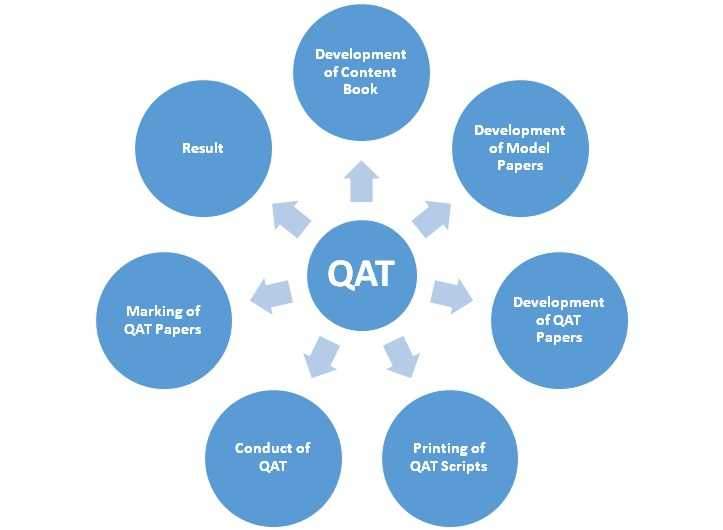
The PEF Quality Assurance Test (QAT) is the exclusive responsibility of the Academic Development Unit (ADU), established in 2005 to plan and conduct this annual assessment for all PEF partner schools. The QAT measures the quantifiable impact of PEF schemes and determines learning outcomes across the foundation’s public-private partnership network.
Why QAT matters for partner schools:
- Funding Eligibility: Monthly per-student funding (Rs650 for nursery to class II; Rs750 for classes III-V; Rs800 for middle; Rs1,000-Rs1,100 for high school) depends entirely on QAT performance.
- Partnership Continuation: Schools that fail QAT risk losing their partnership status, which directly impacts their ability to operate under the PEF model.
- Quality Benchmarking: The test ensures all partner schools follow the Punjab Textbook Board curriculum and maintain minimum educational standards.
The ADU consists of dedicated teams of Subject Specialists for English, Mathematics, Urdu, Physics, Chemistry, Biology, and Computer Science who continuously develop question banks and assessment items based on Bloom’s Taxonomy. These teams ensure that every QAT paper aligns with prescribed PTB content while testing students across different cognitive levels.
Types of QAT conducted:
- Regular QAT: Annual assessment for existing partner schools under FAS, EVS, and NSP programs.
- Baseline QAT: Conducted for all PSSP Schools once they are first licensed to partners.
- Preliminary QAT: Mandatory for new applicant schools seeking FAS partnership.
What is the Official Test Date for the PEF QAT 2026?
When will the PEF QAT 2026 be conducted across Punjab?
The PEF QAT 2026 examination is scheduled to take place on September 23 across all partner schools in Punjab. This single-day, province-wide administration represents a significant shift from previous phased cluster-based testing, with the date now fixed on the academic calendar to ensure uniform preparation timelines for all partner institutions.
Key schedule details:
- Test Date: September 23
- Test Timing: Morning shift, typically from 09:00 AM to 11:00 AM
- Participating Grades: Students from grade two to grade five
- Sampling Percentage: 50% of enrolled students from each partner school
Will the PEF QAT 2026 be conducted in the morning or evening shift?
The PEF QAT 2026 is uniformly conducted in the morning shift only, with examinations running from 09:00 AM to 11:00 AM. This morning-only schedule applies to all tested classes across all partner schools, with students required to report to their designated test centers at least 30 minutes before the start time. However, partner schools operating under the EVS (Evening Shift) program have been notified of adjusted second-shift timing for Friday examinations, accommodating their unique operational hours while maintaining assessment integrity.
Is the PEF QAT 2026 schedule affected by the PEC takeover announcement?
Yes, the PEC takeover has fundamentally transformed QAT scheduling and administration. The Punjab Examination Commission (PEC) now conducts all Quality Assurance Tests for PEF partner schools, marking a major shift from the previous ADU-only model. Written examinations are now center-based at nearby government schools rather than at partner school campuses, with each center accommodating a maximum of 200 to 250 students. Oral examinations for nursery, preparatory, and grades 1 and 2 continue to be conducted at the respective PEF partner schools. Test centers are established within a five-kilometer radius of PEF partner schools, and specific criteria have been set for the selection and duties of test administrators and the center superintendent.
How can I download the PEF QAT 2026 date sheet for the Lahore cluster?

The PEF QAT 2026 date sheet for the Lahore cluster and all other Punjab districts is available for download from the official PEF website. Schools should navigate to the “Latest Announcements” or “QAT” section and locate circulars related to the regular QAT session. Specific circulars, including “Circular for PEF Partners regarding regular QAT 2025-26” dated February 19, provide cluster-wise test dates and instructions. Schools can also access cluster-specific schedules through the PEF Student Information System (SIS) portal using their registered school credentials.
Can a school request a change in the QAT 2026 test date?
PEF does not accommodate individual school requests for test date changes once the QAT calendar is finalized. The QAT conduct plan for each PEF program starts with the finalization of the calendar at the beginning of the financial year, and preparation begins in October each year. In exceptional circumstances involving natural disasters or government-declared emergencies, the foundation may reschedule examinations for entire clusters. Schools facing genuine hardship should submit a formal written request to the Director of ADU, though no guarantee of date change is provided under standard policy.
What is the Complete Syllabus for the PEF QAT 2026?

What is the syllabus for the PEF QAT 2026 for Class 3?
The PEF QAT 2026 syllabus for Class 3 is based on the Punjab Textbook Board (PTB) curriculum and covers content taught up to December 31. The assessment includes five core subjects: English, Urdu, Mathematics, Science, and General Knowledge. The Science syllabus covers basic life sciences, physical science concepts, and environmental awareness aligned with PTB standards. The ADU prepares and regulates a syllabus or content book from which all QAT papers are developed, designed class-wise and topic-wise based on PTB prescribed contents to guide partner schools about standardized assessment parameters.
Which classes are included in the PEF Quality Assurance Test 2026?
The PEF QAT 2026 specifically targets students from grade two to grade five. For regular QAT, the ADU finalizes the number of classes to be tested based on program requirements. Student participation is random, with 50% of enrolled students in tested classes selected through the Student Information System (SIS) data. For certain programs like FAS, the selection percentage may vary based on program-specific requirements. The foundation has instructed that 50% of the total students in each partner school will participate in the test, allowing for better assessment of overall educational quality.
Does the PEF QAT 2026 include Science for primary classes?
Yes, the PEF QAT 2026 includes Science as a mandatory subject for primary classes. The Science paper assesses students on PTB curriculum content including general science concepts, environmental studies, and basic physical and life sciences. For primary classes, Science is assessed alongside English, Urdu, Mathematics, and General Knowledge. The weightage of Science in the overall assessment varies by class level, with ADU subject specialists developing question banks based on PTB content and Bloom’s Taxonomy.
What is the syllabus for the PEF QAT 2026 for middle and secondary classes?
For the current QAT cycle focused on grades two through five, the syllabus covers foundational concepts in core subjects. The assessment includes Urdu, English, and Mathematics as the primary tested subjects. The purpose of selecting these subjects is to measure basic academic skills: Urdu assesses reading, comprehension, and writing abilities; English checks understanding of language, vocabulary, and grammar; Mathematics evaluates arithmetic skills, logical reasoning, and problem-solving abilities. By focusing on these core subjects, the foundation ensures that students have a strong foundation in language and numeracy.
Is the Punjab Textbook Board (PTB) syllabus used for the QAT 2026?
Yes, the Punjab Textbook Board (PTB) syllabus serves as the exclusive curriculum foundation for the PEF QAT 2026. All question banks, model papers, and content books developed by the ADU are strictly aligned with PTB-prescribed contents. The ADU’s teams of subject specialists continuously develop new resources and assessment items based on PTB standards.
Is the General Knowledge paper part of the PEF QAT 2026?
Yes, General Knowledge is included as a mandatory subject for primary classes in the PEF QAT 2026. The General Knowledge paper covers topics including Islamic studies, Pakistan studies, current affairs, and basic civic awareness, all aligned with PTB curriculum standards. For middle and secondary classes, General Knowledge is not assessed as a separate paper but is integrated into other subject assessments where relevant.
What is the deadline for syllabus completion for the 2026 QAT?
PEF requires all partner schools to complete the prescribed PTB syllabus for tested classes by December 31. The QAT syllabus is typically covered up to this cutoff date, meaning content taught after December 31 is not included in the QAT assessment. Schools are advised to pace their academic calendars accordingly to ensure all tested content is covered before the winter break.
How Can Schools Register Students for the PEF QAT 2026?
How can schools register their students for the QAT 2026?
School registration for the PEF QAT 2026 is an automated process based on enrollment data maintained in the PEF Student Information System (SIS). Schools are required to ensure their SIS data is accurate and up to date as the ADU collects student enrollment data from all programs two months prior to the conduct of QAT. No separate registration application is required for regular QAT, as students are selected randomly from SIS data. For preliminary QAT (for new applicant schools), registration is managed through the formal FAS partnership application process.
How many students from each class are tested in the QAT?
The number of students tested from each class varies by program and class size. For the upcoming QAT, the foundation has instructed that 50% of the total students in each partner school will participate in the test. This approach allows the foundation to better assess the overall educational quality of each school while making the process manageable. For FAS programs, specific percentages may apply based on the total enrollment of the partner school.
Can private students appear in the PEF Quality Assurance Test?
No, the PEF Quality Assurance Test is exclusively for students enrolled in PEF partner schools. Private students not affiliated with any PEF partner school cannot appear in the QAT. The test is designed specifically to assess the quality of education being delivered through PEF’s public-private partnership model and to determine funding eligibility for partner schools.
What is the Paper Pattern and Marking Scheme for the PEF QAT 2026?
Is the PEF QAT 2026 objective or subjective?
The PEF QAT 2026 uses a hybrid format combining both objective and subjective components. Papers are typically composed of multiple-choice questions (MCQs) for objective assessment and subjective questions including short answer questions, problem-solving exercises, and descriptive responses. The exact ratio may vary by subject and class level, with the ADU preparing subject-wise multiple templates of QAT papers for each class to ensure secrecy and credibility of assessment.
What is the weightage of MCQs in the PEF QAT 2026?
Multiple-choice questions carry a significant weightage in the PEF QAT 2026 examination. The MCQs section is designed to assess students’ conceptual understanding, factual knowledge, and application of basic principles across all subjects. The remaining portion comprises subjective questions that evaluate analytical skills, problem-solving abilities, and written expression. The ADU subject specialists develop question banks for each class and subject based on Bloom’s Taxonomy, ensuring appropriate distribution of cognitive difficulty levels.
Are there any changes in the PEF QAT 2026 paper pattern?
Significant changes to the QAT paper pattern have been implemented following the PEC takeover. Under the new arrangement, written QAT examinations are center-based at nearby government schools rather than at partner school campuses. Oral examinations for early grades (nursery, prep, grades 1 and 2) are still conducted at partner schools. Schools should consult the official model papers released by the ADU to understand the most current paper pattern and marking scheme.
Are bilingual papers provided for the PEF QAT 2026?
Yes, the PEF QAT 2026 papers are typically bilingual, provided in both Urdu and English versions to accommodate students from diverse linguistic backgrounds. The bilingual format ensures that language proficiency does not become a barrier to demonstrating subject knowledge. Question papers are clearly labeled with language versions, and students can choose to answer in either language based on their comfort level.
Are there any negative markings in the PEF QAT 2026?
There is no negative marking in the PEF QAT 2026 for incorrect answers on the objective section. Students are encouraged to attempt all questions as there is no penalty for wrong responses. Only correct answers contribute to the total score, and unanswered questions receive zero marks without additional deduction.
What are the Passing Criteria for Students and Schools in the PEF QAT 2026?
What is the passing percentage for students in the PEF QAT 2026?
Each student appearing in the PEF QAT 2026 must secure a minimum of 40% marks in each subject to pass the examination. This 40% threshold applies uniformly across all subjects and all tested classes. The goal of setting this benchmark is not only to assess student performance but also to encourage better preparation among students. Schools are urged to guide students carefully and provide extra support where needed to help them succeed.
How many marks are required for a school to pass the PEF QAT?
The school-level passing criteria vary by program under the PEF. The passing criteria for regular QAT are as follows:
- FAS (Foundation Assisted Schools): 75% of tested students must secure 40% average marks.
- EVS (Education Voucher Scheme): 50% of tested students must secure 40% average marks.
- NSP (Non-Formal Schools Program): 50% of tested students must secure 40% average marks.
For preliminary QAT (new applicant schools), the criteria are:
- FAS: 66.67% of students must secure 35% marks in English and 40% average marks in Urdu and Mathematics.
What happens if a school fails the PEF QAT 2026?
Schools that fail to meet the qualifying criteria face severe consequences that escalate with repeated failures. The three-strike policy is strictly enforced:
- First failure: The school receives a formal warning and must submit a school improvement plan.
- Second consecutive failure: 50% of monthly student funding is withheld from the school.
- Third consecutive failure: The partnership agreement is terminated and school registration is cancelled, making way for institutions that can deliver quality education.
The foundation has warned that partner schools may face fines if their students perform poorly. This strict measure has been introduced to ensure that schools do not compromise on the quality of education.
How does the PEF QAT 2026 affect school funding?
QAT performance directly determines school funding under PEF’s financial assistance model. Schools meeting or exceeding qualifying criteria receive full monthly per-student funding amounts:
- Rs650 per student for nursery to class II
- Rs750 for classes III, IV, and V
- Rs800 for middle school students
- Rs1,000 to Rs1,100 for high school students depending on program type
Schools failing QAT face proportional funding cuts and ultimately termination of financial support. The foundation now links monthly funding to digital student verification, requiring partner schools to submit accurate online student records every month to prevent duplicate entries and ensure equal distribution of funds.
How to Prepare for the PEF QAT 2026: Model Papers, Past Papers, and Study Resources
Where can I find solved past papers for the PEF QAT?
The ADU ensures the availability of past years’ QAT papers on the PEF website for the guidance of partner schools. Schools can access solved past papers and model papers from the official portal by navigating to the QAT section. The purpose of making past papers available is to assist partner schools in preparing students according to the standardized pattern and marking scheme. These test papers have been displayed as model papers to practice and offer only the pattern and types of questions which may be asked in actual tests.
How can I download the PEF QAT 2026 model papers?
PEF QAT 2026 model papers can be downloaded from the official PEF website. The ADU subject specialists prepare model papers for all classes and upload them to the website so that all schools may access them and prepare students accordingly. Available model papers include those for regular QATs, preliminary QATs, EVS evening classes, and PSSP QATs. These model papers help students practice and perform better on the actual QAT.
Where can I find the PEF QAT 2026 solved past papers with answers PDF?
Solved past papers with answers PDF are available for download from educational resource websites and the official PEF portal. Schools are advised to use these resources alongside official ADU materials to provide comprehensive exam preparation for students.
What is the PEF content book for primary and how can it help in QAT preparation?
The PEF content book is a helping tool designed for class-wise syllabus-related guidance to facilitate partner schools. It is designed class-wise and topic-wise based on the contents prescribed under the Punjab Text Book Board, enabling partner schools to understand the standardized parameters through which their students will be assessed. The content book serves as the primary reference from which all QAT papers are developed, making it essential for school preparation.
What are the best preparation strategies for teachers and students?
Effective QAT preparation requires a systematic approach. Schools should focus on the following strategies:
- Complete syllabus coverage: Finish the PTB syllabus by the December 31 deadline to ensure all tested content is taught.
- Regular model paper practice: Familiarize students with the paper pattern and marking scheme using official model papers.
- Mock tests under timed conditions: Conduct practice exams that simulate actual test conditions to build student confidence.
- Analysis of past papers: Identify common question types and frequently tested topics from previous years.
- Targeted remedial support: Focus on weak subject areas identified through diagnostic assessments.
- 40% benchmark awareness: Ensure students understand the minimum passing requirement for each subject.
- Parent-teacher collaboration: Engage parents in supporting student preparation at home.
The foundation has outlined several key goals for partner schools through this initiative: improving the quality of teaching, focusing on teacher training, providing complete preparation according to the curriculum, and instilling self-confidence and a passion for learning in children.
How to Check PEF QAT 2026 Results and Understand the Rechecking Process
When will the PEF QAT 2026 results be announced?
The PEF QAT 2026 results are expected to be announced on June 10. After necessary verification of results and approval from the Competent Authority, the result is announced on PEF’s official website and communicated to partner schools through respective programs. The ADU displays QAT results subject-wise and class-wise so that schools may analyze their weak areas and focus on improvements for subsequent assessments.
How can I check the PEF QAT 2026 result online?
The PEF QAT 2026 result can be checked online by following these steps:
- Visit the official PEF website.
- Click on “QAT Result 2026” or navigate to “Latest Announcements.”
- Select your program type (FAS, EVS, NSP).
- Download the PDF for your district or school.
- Use CTRL+F to search your school name or code within the document.
The detailed result includes subject-wise student performance data, percentage of students passed per school, school-wise and district-wise ranking, and performance under FAS, EVS, and NSP schemes. The merit list helps identify top-performing partner schools, schools eligible for incentives, and at-risk institutions that may lose partnerships if performance drops again.
What is the rechecking process for the PEF QAT 2026?
The purpose of rechecking is to give all partner schools a fair chance to get their results reviewed. The rechecking process follows these guidelines:
- Application window: Interested schools may apply within 20 days after result issuance.
- Application method: Submit a formal application addressed to the Director or HoD of ADU.
- Rechecking fee: Rs. 10,000 as per existing PEF policy.
- Late rechecking: An additional 10 days beyond the initial 20-day window may be granted subject to collection of double fee of Rs. 20,000 as late rechecking fee with approval of the Managing Director and Chairman.
What documents are required for students on the QAT 2026 test day?
Students appearing in the PEF QAT 2026 are required to bring their official school ID card or a verified student registration document from the SIS. Schools must maintain attendance records of selected students, and the PEF requires 100% attendance of selected students on the test day. For center-based assessments under the PEC arrangement, students may also need to carry hall tickets or admit cards issued by the examination commission.
Frequently Asked Questions (FAQs)
Q1: What is the official date for the PEF QAT 2026?
The PEF QAT 2026 will be conducted on September 23 across all partner schools in Punjab.
Q2: Which classes are included in the PEF Quality Assurance Test 2026?
Students from grade two to grade five are included, with 50% of enrolled students from each partner school being assessed.
Q3: What is the passing percentage for students in the PEF QAT 2026?
Each student must secure a minimum of 40% marks in each subject to pass the examination.
Q4: Is the PEF QAT 2026 syllabus based on the full academic year?
No, the syllabus is based on content covered up to December 31, not the full academic year.
Q5: How does the PEF QAT 2026 affect school funding?
Schools that fail QAT face a warning on first failure, a 50% funding cut on second consecutive failure, and complete partnership termination on the third failure.
Q6: Will the PEF QAT 2026 be conducted in the morning or evening shift?
The test is uniformly conducted in the morning shift from 09:00 AM to 11:00 AM, with adjusted timing for EVS programs on Fridays.
Q7: Are bilingual papers provided for the PEF QAT 2026?
Yes, papers are provided in both Urdu and English versions to accommodate students from diverse linguistic backgrounds.
Q8: What is the role of the ADU in the PEF QAT 2026?
The ADU plans and conducts QAT, develops question banks based on Bloom’s Taxonomy, prepares model papers, and ensures quality assessment.
Q9: Can a school request a change in the QAT 2026 test date?
No, individual school requests for date changes are not accommodated once the QAT calendar is finalized.
Q10: Where can I find solved past papers for the PEF QAT?
Solved past papers are available on the official PEF website and educational resource portals.

Add a Comment