
Are you tired of soaring electricity bills and relentless load shedding that disrupt your daily life in Khyber Pakhtunkhwa? The KPK Solar Scheme 2026 is a flagship Rs20 billion provincial initiative designed to provide 130,000 deserving households with free or heavily subsidized solar energy systems, offering a permanent escape from the grid’s uncertainty. This definitive guide covers everything from real-time eligibility criteria and step-by-step online application processes to checking your Qurandazi results and understanding the technical specifications of your future solar kit, ensuring you have all the information needed to benefit from this transformative program.
Key Takeaways
- Tiered Eligibility System: The scheme is strictly divided into two tiers: households consuming up to 100 units monthly qualify for a completely free 2kW system, while those using up to 200 units can get a system at a 50% subsidized cost with easy installments.
- Massive Scale & Reach: A total of 250,000 households are targeted—130,000 across the province and an additional 120,000 specifically in the merged districts (Ex-FATA), with a separate Rs13 billion budget.
- Transparent Selection Process: Beneficiaries are chosen through an electronic balloting system (Qurandazi) to ensure fairness, with priority given to widows, persons with disabilities, transgender individuals, and BISP-registered families.
- Active Distribution Phase: While the main online registration portal is currently closed for new applications, the scheme is in its active distribution phase for 2026. Selected beneficiaries must check their status online immediately.
- No Registration Fee: There is absolutely no fee to apply or register for the scheme. Be aware of fraudulent agents asking for money; the application and balloting process is completely free.
- Read More: How to Apply for KPK Ramzan Package (CNIC Check via SMS)
- Read More: KPK Ramzan Package Registration (12500 by CM KPK)
- Read More: Solar System Scheme Khyber Pakhtunkhwa Online Apply
KPK Solar Scheme: How to Apply Online (Application Form)
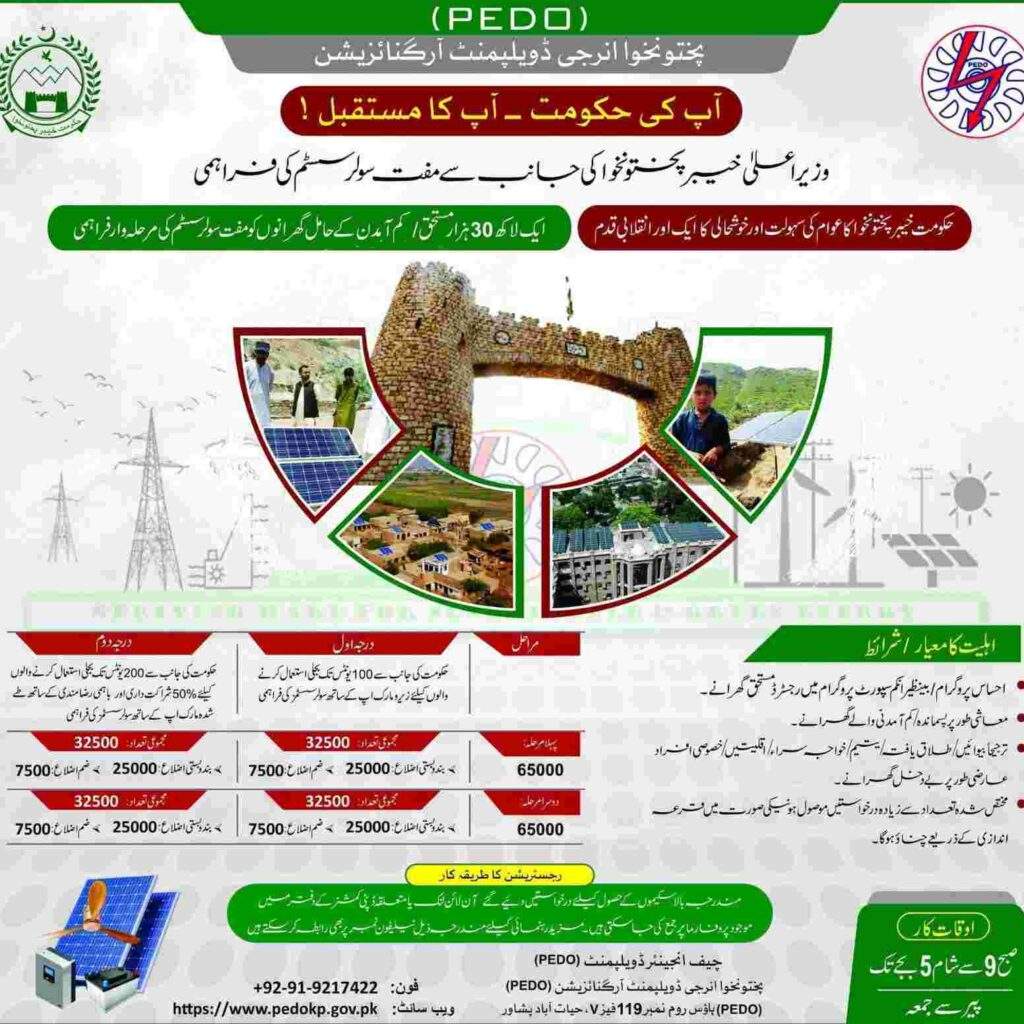
Table Of Contents
What is the KPK Solar Scheme and Why Was It Launched?
The KPK Solar Scheme, officially titled the “Solarisation of Houses project,” represents the provincial government’s most ambitious response to the dual crises of escalating electricity costs and unreliable power supply. It is a strategic shift towards renewable energy aimed at providing long-term relief to the province’s most vulnerable residents.
What is the official name of the KPK solar panel scheme?
Officially, it is known as the Solarisation of Houses project, but it is commonly referred to by the public as the KPK Free Solar Scheme, the KPK Solar Panel Scheme, or the KPK Solar Scheme 2026.
Who launched the KPK Solar Scheme and when?
The scheme was initially conceptualized and launched under the leadership of former Chief Minister Ali Amin Gandapur in late 2024. The project is now being actively implemented and overseen by the current Chief Minister, Sohail Afridi, who in March 2026, chaired high-level meetings to expedite the distribution of solar units to deserving families, emphasizing that the project remains a top priority for his administration.
What is the total budget for the KPK Solar Scheme 2026?
The financial commitment is substantial and reflects the government’s dedication to this cause. For the main scheme covering 130,000 households across the province, the government has allocated over Rs20 billion. In addition, a separate fund of Rs13 billion has been earmarked specifically for the solarisation of 120,000 homes in the merged tribal districts.
What are the primary objectives of the free solar panel scheme by the government of KPK?
The core objectives are multi-faceted, targeting social welfare, economic relief, and environmental sustainability.
- Energy Relief: To provide a sustainable and uninterrupted power supply, freeing households from the burden of load shedding.
- Financial Relief: To drastically reduce or eliminate monthly electricity bills for low-income families, allowing them to allocate resources to other essential needs.
- Social Equity: To prioritize the most vulnerable segments of society, ensuring that widows, orphans, disabled persons, and the poorest households receive direct support.
- Environmental Sustainability: To promote clean, green energy, reduce the province’s carbon footprint, and decrease dependence on fossil fuels.
What is the role of PEDO (Pakhtunkhwa Energy Development Organization) in this scheme?
PEDO is the primary technical arm of the government for this project. Their responsibilities are critical for ensuring quality and long-term functionality:
- Technical Assistance: They provide expert oversight for the installation process.
- Quality Assurance: PEDO conducts system validation and rigorous quality checks on all equipment and installations to ensure they meet government standards.
- Vendor Coordination: They work in tandem with approved vendors to ensure timely delivery and proper setup of the solar systems.
Who is managing the financial aspects and vendor selection for the solar scheme?
The Bank of Khyber (BoK) has been entrusted with the financial management of the scheme.
- Vendor Approval: The Bank of Khyber is responsible for selecting and empaneling the private vendors who will supply and install the solar systems.
- Financial Discipline: They monitor all financial transactions, particularly the collection of monthly installments from beneficiaries who opt for the subsidized, refundable payment plans, ensuring complete transparency.
How many households will benefit from the KPK Solar Scheme in total?
In total, the provincial government aims to benefit 250,000 households through its combined solarisation efforts. This includes 130,000 families under the main provincial scheme and an additional 120,000 families in the merged districts under a separate, dedicated project.
Is the KPK solar scheme available in Peshawar and Mardan only?
No, the scheme is not limited to major cities. It is a province-wide initiative. While the main scheme covers all districts of Khyber Pakhtunkhwa in proportion to their population, the government has launched a parallel, massive project specifically for the merged districts, ensuring that remote areas are not left behind.
Are the merged districts (Ex-FATA) included in this solarization project?
Yes, they are a central focus of the government’s plan. A dedicated project under the Accelerated Implementation Programme (AIP) has been designed for the merged districts. This initiative will provide solar systems to 120,000 deserving households in areas that have historically faced severe energy shortages and infrastructure challenges.
The districts covered under this specific merged districts scheme include:
- Bajaur
- Khyber
- Kurram
- Orakzai
- Mohmand
- North Waziristan
- South Waziristan
Who Is Eligible for the KPK Solar Scheme 2026?
Eligibility for the KPK Solar Scheme is defined by clear, objective criteria designed to ensure that the benefits reach the intended low-income and vulnerable households. Understanding these requirements is the first and most crucial step for any applicant.
What are the basic residency and nationality requirements?
The primary requirement is citizenship and permanent residency. The applicant must be a citizen of Pakistan and a permanent resident of Khyber Pakhtunkhwa. This is verifiable through a valid Computerized National Identity Card (CNIC) with a local address in the province.
How is electricity consumption used to determine eligibility (Tier 1 vs. Tier 2)?
The scheme uses the average monthly electricity consumption as the primary metric to place applicants into one of two distinct tiers. This data is verified through recent electricity bills provided at the time of application.
What are the two tiers of the KPK Solar Scheme 2026?
The program is bifurcated into two main categories to cater to different levels of need and energy usage.
Who gets the free solar system under the KPK scheme (Tier 1)?
Tier 1 is designed for the most financially constrained households with minimal energy needs.
- Consumption Limit: Households with an average monthly electricity consumption of up to 100 units.
- Benefit: These families are eligible to receive the complete 2kW solar system completely free of cost. This includes solar panels, inverter, battery, and essential accessories like fans and lights.
Who qualifies for the 50% subsidized solar system (Tier 2)?
Tier 2 is aimed at lower-middle-class families who consume slightly more power but still struggle with high bills.
- Consumption Limit: Households with an average monthly electricity consumption between 101 and 200 units.
- Benefit: These families can acquire the solar system at a 50% subsidized cost. The remaining amount can be paid in easy, interest-free monthly installments, making it accessible without a large upfront payment.
Do I need to be registered with BISP or Ehsaas to apply?
While not mandatory for all, registration with the Benazir Income Support Programme (BISP) or the Ehsaas Programme significantly strengthens an application. These programs have already verified the low-income status of households, making them a primary pool for selecting beneficiaries. Official government briefings state that preference is given to households already registered in these social welfare databases.
Can I apply if I don’t have a BISP or Ehsaas card?
Yes, you can still apply if you meet the other criteria (residency, low consumption, low income). However, you will be competing for a spot in the general quota. The government has clearly stated that priority will be given to those already registered with BISP/Ehsaas, along with other vulnerable groups.
Who gets priority in the selection process for the KPK solar scheme?
The scheme is designed with a strong social welfare focus. Beyond the consumption-based tiers, priority in the electronic balloting is explicitly given to specific segments of society.
Are widows, orphans, and transgender individuals given preference?
Yes, absolutely. The government has mandated that special preference be given to these groups to ensure social protection. The official priority list includes:
- Widows
- Orphans
- Transgender individuals
- Persons with disabilities
- Households affected by natural disasters
- Temporarily Displaced Persons (TDPs)
Can government employees apply for the solar scheme?
Eligibility for government employees is generally determined by their income level and electricity consumption. If a government employee is a low-income worker (e.g., a junior staff member) whose monthly consumption falls under the 200-unit cap, they may be eligible. However, the scheme’s primary focus is on the most economically disadvantaged, so higher-income government employees are unlikely to be prioritized.
Can tenants apply for the KPK solar project, or only homeowners?
Tenants are eligible to apply, but they must provide additional documentation to prove they have the legal right to install the system on the property. The primary requirement is a No Objection Certificate (NOC) from the property owner (landlord), explicitly allowing the installation. A copy of the landlord’s CNIC is also typically required alongside the tenant’s application.
What if I don’t own the house but have a rent agreement?
A valid rent agreement can serve as proof of your residence and right to occupy the property. However, the application process will still likely require the landlord’s NOC and CNIC copy, as the solar system is a fixed installation on their building. This ensures legal clarity and avoids disputes later.
Can residents of merged districts (Bajaur, Khyber, Kurram, etc.) apply?
Yes. In fact, a massive, parallel scheme has been launched specifically for these areas. Residents of Bajaur, Khyber, Kurram, Orakzai, Mohmand, North Waziristan, and South Waziristan are not just eligible; they are the primary focus of a Rs13 billion, 120,000-household project aimed at addressing the unique energy challenges of the merged districts.
Is the solar scheme available for shops and small businesses?
Currently, the scheme is strictly for residential users. Officials have confirmed that commercial users, including shops and businesses, are not eligible under this phase of the project. The focus remains on providing domestic relief.
Are agricultural tube wells included in this solarization project?
While the primary household scheme focuses on homes, the broader solarisation vision of the KP government does include agricultural aspects. Separate initiatives and plans are being discussed for the solarisation of tube wells, but they are not part of the main 130,000-household scheme being distributed in 2026.
What disqualifies an applicant from the KPK solar panel scheme?
There are several clear disqualifying factors:
- Electricity Defaulters: Applicants with outstanding dues on their electricity bills are disqualified.
- Non-Residents: Individuals whose CNIC does not show a permanent address in Khyber Pakhtunkhwa.
- High Consumption: Households consuming more than 200 units per month are not eligible for this specific scheme.
- False Information: Providing incorrect or forged documents during the application process leads to immediate disqualification and potential legal action.
- Previous Beneficiaries: Those who have already benefited from a similar government solar scheme may be disqualified.
How to Apply Online for the KPK Solar Scheme 2026: A Step-by-Step Guide
This section outlines the standard application procedure based on the scheme’s design. It is crucial to read the status update first.
Is the KPK solar scheme online registration still open in 2026?
As of March 2026, the primary online registration portal for the main phase of the KPK Solar Scheme is closed. The government has successfully completed the data collection and application phase. The scheme is now in its distribution and verification phase, having already received over 2.5 million applications and conducted the first rounds of electronic balloting (Qurandazi) to select 32,500 families for the first phase of distribution.
However, it is important to stay informed because:
- Future phases are expected to open later in 2026 or 2027.
- The separate scheme for merged districts may have its own application windows.
What is the official website for the KPK solar registration?
When registration is active, the official portal is managed by PEDO. The primary domain to remember is: http://freesolar.pedokp.gov.pk:83 . This is also the primary site for checking results.
What is the step-by-step process for the KPK solar scheme online apply method?
For future reference, when the portal reopens, here is the standard procedure you will follow:
How do I create an account on the PEDO solar portal for the first time?
- Step 1: Visit the official PEDO solar portal at the address mentioned above.
- Step 2: Look for the “Register” or “Sign Up” option. You will be required to enter your 13-digit CNIC number (without dashes) to create a unique user ID.
- Step 3: Provide a valid active mobile phone number. This will be used for all future communication, including confirmation messages and selection alerts.
- Step 4: Create a secure password and complete the registration process. You may receive a verification code via SMS to confirm your mobile number.
What information is required to fill out the KPK solar scheme application form online?
Once logged in, you will need to fill out the application form accurately. The form will request:
- Personal Details: Full name, father’s/husband’s name, and CNIC number.
- Contact Information: Mailing address, mobile number, and alternate phone number.
- Residential Details: Permanent address in KPK, type of residence (owned/rented).
- Electricity Details: Your 14-digit electricity bill reference number and your average monthly consumption (based on recent bills).
- Social Welfare Information: Your BISP or Ehsaas program registration number, if applicable.
- Declaration: A formal declaration that the information provided is true and correct.
Is there an SMS registration method for the solar scheme in KPK?
In some previous phases, the government experimented with SMS-based registration. For instance, users could send their CNIC and bill reference number to a shortcode like 8800. However, for the main 2026 cycle, the online portal has been the primary and most reliable method of application. It is advisable to rely on the official website for future applications.
What is the shortcode for SMS registration in KPK?
While 8800 has been associated with various government schemes in the past, there is no confirmation that it is active for the KPK Solar Scheme 2026. To avoid scams, always verify such shortcodes from official government announcements or the PEDO website before sending any information.
How can I apply offline for the solar panel scheme?
For citizens without internet access, an offline mechanism exists.
- Step 1: Visit the office of the Deputy Commissioner (DC) in your respective district.
- Step 2: Request the official application proforma for the solar panel scheme.
- Step 3: Fill out the form manually with accurate information.
- Step 4: Attach attested copies of all required documents (CNIC, bills, etc.).
- Step 5: Submit the completed form to the designated official at the DC’s office and obtain a receipt or acknowledgment of submission.
Can I download the KPK solar scheme application form PDF?
Yes, when the scheme is open for applications, the official PDF version of the application form is typically made available for download on the PEDO solar portal (freesolar.pedokp.gov.pk:83). This allows applicants to review the required fields and gather their documents before filling out the online form or visiting the DC office.
Where can I get the KPK solar scheme application form in Urdu?
While the primary mode of application is online or via proforma at DC offices (often in English/Urdu mixed), you can find informational guides and sample forms in Urdu on various informative websites. The official government portal may also provide instructions in Urdu to ensure wider accessibility.
What Documents Are Required for the KPK Solar Project?
Having the correct documentation ready before you start the application process is essential for a smooth and successful registration. Here is a complete checklist.
What is the complete list of documents for the KPK solar scheme?
Applicants must prepare a file with the following documents:
- CNIC: A clear copy of the applicant’s Computerized National Identity Card (both sides).
- Electricity Bills: Copies of the last 3 to 6 months’ electricity bills to verify consumption and the connection’s ownership.
- Proof of Residence: A domicile certificate or any official document verifying permanent residence in Khyber Pakhtunkhwa.
- Proof of Income (Optional but Recommended): An income certificate or salary slips to help establish low-income status.
- Property Documents: Proof of ownership (for homeowners) or a rental agreement/NOC from the landlord (for tenants).
- Photographs: 2-4 recent passport-sized photographs.
- BISP/Ehsaas Card: A copy of the card or registration number if applicable, as this provides priority status.
Is a copy of my CNIC mandatory for the application?
Yes, the CNIC is the single most important document. It serves as your primary identifier and is used to verify your residency, check for duplicates, and is the key field for searching results on the portal. The number must be entered without dashes during online checks.
How many recent electricity bills are needed to verify my consumption?
To establish a consistent consumption pattern, you are generally required to submit copies of your electricity bills for the last three to six months. This helps the authorities verify that your average consumption falls within the eligible Tier 1 (up to 100 units) or Tier 2 (up to 200 units) categories.
What proof of residence or domicile is acceptable?
A domicile certificate issued by the relevant district authority in Khyber Pakhtunkhwa is the strongest proof of permanent residency. In lieu of that, a utility bill (gas/water) or a voter registration slip showing your address in KPK may also be accepted.
Do I need to provide proof of income for the solar panel scheme?
While not strictly mandatory for everyone, providing proof of income, such as a low-income certificate from a union council, salary slips from employment, or being registered with BISP, can significantly improve your chances of being prioritized. It helps establish your status as a “deserving” or low-income household.
What documents are required if I am a tenant applying for the solar scheme?
Tenants face an additional layer of documentation. You will need:
- Your own CNIC and proof of residence.
- A valid rental agreement proving your tenancy.
- A No Objection Certificate (NOC) from the landlord, explicitly permitting you to apply and have the solar system installed on their property.
- A copy of the landlord’s CNIC for verification purposes.
What property documents are needed for homeowners?
Homeowners need to provide proof of ownership. This can be:
- A copy of the property registry or title deed (Fard).
- A sale deed or allotment letter from a housing society.
- Any other legal document that establishes your ownership of the house where the system will be installed.
Is a passport-size photograph required for the application form?
Yes, recent passport-sized photographs (usually 2-4 copies) are a standard requirement for the application form. They are used for official records and verification purposes.
Do I need to provide my BISP or Ehsaas registration number?
If you are registered with the Benazir Income Support Programme or the Ehsaas Programme, providing your registration number or a copy of your card is highly recommended. As per official statements, this automatically places you in a priority category for selection.
What Are the Details of the Solar Kit Provided Under the KPK Scheme?
Beneficiaries are not just receiving solar panels; they are getting a complete, functional system designed to power their essential home appliances. Here are the technical specifications and components.
What is the size of the solar system provided under the KPK solar scheme?
The standard system being deployed under the scheme is a 2kW solar system. This capacity is specifically chosen as it is sufficient to cover the basic electricity needs of an average low-income household, running lights, fans, and charging mobile devices, thereby eliminating their electricity bills.
What are the complete specifications of the KPK solar scheme solar kit?
The government has ensured that the kit is comprehensive and includes everything needed for a standalone, off-grid solar solution.
What components are included in the 2kW solar system?
A complete kit consists of four main components:
- Solar Panels: High-efficiency photovoltaic (PV) modules that capture sunlight and convert it into direct current (DC) electricity.
- Inverter: This device converts the DC electricity from the panels into alternating current (AC), which is what standard household appliances like fans and lights use.
- Battery Bank: Deep-cycle batteries store the excess electricity generated during the day for use at night or during cloudy weather, ensuring 24/7 power availability.
- Balance of System: This includes mounting structures, wiring, junction boxes, safety switches, and connectors required for a safe and functional installation.
What is the wattage and type of the solar panels provided?
While specific brand details may vary depending on the vendors selected by the Bank of Khyber, the system is designed to meet a total capacity of 2kW. This typically involves the installation of multiple panels (e.g., 5-6 panels of 330-400 watts each). The panels are required to meet high-efficiency standards set by PEDO to ensure maximum power generation.
Does the KPK solar scheme include batteries?
Yes, absolutely. The official scheme documentation confirms that the solar kit includes battery storage. This is a critical component, as it ensures that households have power during the night and during load shedding hours, providing true energy independence.
What is the capacity of the battery provided?
The exact battery capacity (measured in Ampere-hours, Ah) is designed to work in harmony with the 2kW system. The goal is to provide enough backup storage to power essential lights and fans for several hours after sunset, typically through the night. The specific capacity will be determined by the approved vendors but will be sufficient for the system’s intended purpose.
Does the solar kit include an inverter?
Yes, an inverter is a standard and essential component of the solar kit. It ensures the electricity generated is usable for standard home appliances. The inverter provided will be of suitable capacity (likely above 2kW) to handle the load of the connected fans and lights.
What appliances (fans, lights) are included with the free solar system?
To provide immediate relief, the basic free solar kit (Tier 1) typically includes energy-efficient DC fans and LED lights. This ensures that from day one of installation, the household can enjoy lighting and air circulation without relying on the grid. The exact number of fans and lights may vary but is designed to cover the essential rooms of a typical home.
Can I upgrade the solar system provided by the government?
The government provides a standardized 2kW system. If a beneficiary wishes to have a larger system or add more appliances later, they would typically need to do so at their own expense, with the help of a private solar company. However, tampering with the government-installed system may void warranties.
Does the KP solar scheme cover the installation costs?
Yes, the installation costs are fully covered within the scheme’s budget. Whether the beneficiary is in the free Tier 1 or the subsidized Tier 2, the cost of shipping the equipment and the professional installation by the approved vendor is included. The beneficiary does not have to pay any extra amount for installation.
What is the market value of the 2kW solar system provided?
The market value of a comparable 2kW solar system, including panels, inverter, and batteries, can range significantly. However, official documents for the merged districts scheme estimate the cost of each complete kit to be between Rs 255,000 and Rs 300,000. This highlights the substantial financial benefit being passed on to the beneficiaries.
How Are Beneficiaries Selected? (The Qurandazi Process Explained)
With millions of applicants for a limited number of systems, a transparent and fair selection process is critical. The government employs an electronic balloting system.
What is the selection process for the KPK solar scheme?
Due to the overwhelming response, with over 2.5 million applications received, the government cannot serve everyone at once. Therefore, a lottery-based selection process is used to choose beneficiaries from the pool of eligible applicants.
How does the electronic balloting (Qurandazi) for the solar scheme work?
The process is known as electronic balloting or Qurandazi.
- Data Compilation: All verified, eligible applications are entered into a central, secure database.
- Computerized Random Draw: A computer program is used to randomly draw a pre-determined number of applications from the database. For the first phase, 32,500 families were selected through this method.
- Transparency Measures: The process is typically conducted in the presence of government officials, independent observers, and sometimes media representatives to ensure there is no human interference or bias. This system guarantees that every eligible applicant has an equal chance of being selected, regardless of their connections or influence.
How many families were selected in the first phase of the Qurandazi?
The government successfully conducted the first phase of the electronic balloting and selected 32,500 families to receive the free solar units. This marks the kick-off of the distribution phase.
When will the balloting for the KP solar scheme take place?
For the main scheme, the first round of balloting has already taken place, with results announced in early 2026. Future balloting rounds for the remaining beneficiaries (the next batch of 32,500, etc.) are expected to occur as the project implementation progresses through the year.
Is the selection process really fair and transparent?
The government has emphasized that the Qurandazi system is designed to be merit-based and tamper-proof. By using a randomized electronic draw, it eliminates the possibility of nepotism or favoritism. Furthermore, priority is systemically built-in before the draw, as applicants from vulnerable groups (widows, disabled, BISP-registered) are flagged and given extra weight in the selection algorithm, ensuring social justice without compromising fairness.
How does the government verify the information provided in applications?
Selection in the Qurandazi is not the final step. After the balloting, a physical verification team (often comprising officials from PEDO, the local administration, and the vendor) visits the selected applicant’s home. They verify:
- The applicant’s identity and residence.
- The authenticity of the provided documents.
- The suitability of the roof for solar panel installation (sunlight exposure, structural integrity).
Only after this physical verification is successful is the installation scheduled.
What happens after I am selected in the ballot?
If your name appears in the Qurandazi list, you will likely receive an official notification via SMS on your registered mobile number. The next steps are:
- Confirm Your Details: Ensure your CNIC and address are correct in the system.
- Prepare for Verification: A government team will contact you to schedule a visit for physical verification.
- System Installation: Once verification is cleared, the approved vendor will contact you to install the solar system.
- Acknowledgement: You may need to sign an acknowledgement of receipt and a declaration of satisfaction with the installation.
How to Check the KPK Solar Scheme Qurandazi Results 2026
This is the most critical action item for anyone who has already applied. Here are the methods to find out if you are a beneficiary.
How can I check my KPK solar scheme application status online?
The primary method is through the official PEDO solar portal. The website is designed to be user-friendly and accessible from any smartphone or computer with an internet connection.
How to check KPK solar scheme results by CNIC?
Follow these simple steps:
- Step 1: Open your web browser and go to the official results portal:
http://freesolar.pedokp.gov.pk:83. - Step 2: On the homepage, you will find a search bar or a tab labeled “Check Status,” “Qurandazi Results,” or “Find Your Name.”
- Step 3: Enter your 13-digit CNIC number without any dashes (e.g., 1234512345671).
- Step 4: Click the “Search” or “Submit” button.
- Step 5: Your status will be displayed on the screen. If you are selected, your name, father’s name, district, and other registration details will appear. If not, a message indicating “Not Selected” or “In Process” will be shown.
What is the official website to check the KPK solar scheme list?
The sole official and authoritative website for checking the beneficiary list and results is the PEDO portal: http://freesolar.pedokp.gov.pk:83 . Always rely on this domain to avoid fake websites or scams.
Where can I download the KPK solar scheme list PDF?
On the same official website (freesolar.pedokp.gov.pk:83), there is usually a download section. You can find a button or link that says “Download Winner List PDF” or “Download Complete Beneficiary List.” Clicking this will download a PDF file containing the names and CNIC numbers of all selected beneficiaries for a particular phase. You can then use the “Find” (Ctrl+F) function to search for your own CNIC number within the document.
How can I check my name in the Solar Scheme Qurandazi list?
You can use either of the two methods above:
- Direct Online Search: Enter your CNIC on the portal for an instant result.
- PDF Search: Download the master beneficiary list PDF and use the search function (Ctrl+F) to find your CNIC.
What should I do if the website is not loading my result?
If the official website is down or slow due to high traffic, try these steps:
- Refresh and Retry: Wait a few minutes and refresh the page. Try again during off-peak hours (early morning or late night).
- Clear Cache: Clear your browser’s cache and cookies.
- Try Another Browser: Switch to a different browser (e.g., from Chrome to Firefox).
- Offline Method: Visit your nearest Benazir Income Support Programme (BISP) office or the Deputy Commissioner’s office with a copy of your CNIC. The staff there can assist you in checking the official list.
Can I check the KPK solar scheme list at the Benazir Income Support Programme office?
Yes, for beneficiaries who face difficulties with online checking, the government has facilitated offline verification. You can visit your nearest BISP office or the Deputy Commissioner’s office in your district. Provide your CNIC to the designated official, and they can verify your selection status from the official records.
What is the helpline number for the KPK solar scheme?
For official inquiries, complaints, or assistance, you can contact the Pakhtunkhwa Energy Development Organization (PEDO):
- Official Contact Number: +92-91-9217422
- Office Address: PEDO Headquarters, Phase 5, Hayatabad, Peshawar, KPK.
- Office Timing: 9:00 AM to 5:00 PM (Monday to Friday).
How can I verify if my name is on the balloting list through SMS?
As of the latest updates for the 2026 distribution phase, the primary method for checking results is the online portal and in-person verification at government offices. While SMS services have been used in the past for other schemes, there is no active, official SMS shortcode confirmed for result checking for this specific scheme. Relying on the official website is the safest bet.
What Happens After Selection? The Installation Process and Costs
Being selected is just the beginning. Here is what you need to know about the final steps to getting your solar system up and running, including the costs involved for those in the subsidized category.
How will I be notified if I am selected for the solar scheme?
If your name appears in the Qurandazi list, you should receive an official confirmation message via SMS on the mobile number you provided during registration. This message will likely contain further instructions on the next steps. Additionally, the beneficiary lists published online serve as the official notification.
What is the physical verification process?
This is a mandatory step before any installation can occur. A verification team, which may include a representative from the local district administration, PEDO, and the empaneled vendor, will visit your home. They will:
- Verify Documents: Cross-check your original CNIC and other documents with the application data.
- Inspect the Site: Assess your roof’s suitability. They will check for:
- Adequate, unobstructed sunlight (minimal shading from trees or nearby buildings).
- Structural soundness of the roof to hold the solar panel mounting structure.
- A suitable location for installing the inverter and battery bank inside the home.
- Obtain Sign-off: Upon successful verification, they will complete a report, and you may be asked to sign it, clearing the way for installation.
How much does the subsidized solar system cost under the KPK scheme?
For beneficiaries in Tier 2 (the 65,000 families eligible for subsidized systems), the government pays 50% of the cost. The beneficiary is responsible for the remaining 50%. This amount is not a lump sum; it is converted into an easy monthly installment plan to make it affordable.
What is the cost of the solar system under the refundable installment plan?
For the separate scheme in the merged districts, a refundable installment option is available. In this model, the government covers the upfront cost, and the beneficiary repays it in monthly installments. For a system valued between Rs 255,000 and Rs 300,000, the beneficiary pays approximately Rs 8,300 per month for 36 months.
Is the solar system free for everyone in the merged districts?
No, the merged districts scheme offers two clear choices to provide flexibility:
- Non-Refundable Option: The most vulnerable households, as identified by the government (e.g., poorest of the poor, widows, disabled), will receive the system completely free. This is a grant.
- Refundable Installment Option: Other eligible households can opt to receive the system by paying for it in affordable, long-term installments (approx. Rs 8,300/month for 3 years). This is not a subsidy but a zero-markup financing plan.
What is the monthly installment for the 50% subsidized solar system?
For the main provincial scheme’s Tier 2 (50% subsidy), the exact monthly installment amount will depend on the final cost of the system determined by the Bank of Khyber’s vendor agreements and the payment period offered. The government has promised “easy installment options” to ensure families are not overburdened.
How long is the warranty for the solar panels and inverters?
The government, through PEDO and the Bank of Khyber, mandates that all equipment provided by approved vendors must meet quality standards and carry a warranty. Typically, solar panels carry a performance warranty of 25 years and a product warranty of 10-12 years. Inverters and batteries usually come with warranties ranging from 2 to 5 years. The specific warranty terms will be provided to the beneficiary at the time of installation.
Who installs the solar system at my home?
The installation will not be done by government employees directly. The Bank of Khyber is responsible for selecting and empaneling a list of approved, qualified private solar vendors. Once a beneficiary is verified, the Bank of Khyber assigns one of these approved vendors to carry out the installation at the designated home.
What is the role of the Bank of Khyber after selection?
The Bank of Khyber’s role is central to the execution of the scheme.
- Vendor Management: They manage the panel of approved vendors, ensuring they are qualified and adhere to the project’s standards.
- Work Order Issuance: They issue work orders to vendors for installations in specific areas or for specific beneficiaries.
- Payment Processing: They manage the financial flow, paying the vendors for completed installations and, in the case of the refundable schemes, collecting the monthly installments from beneficiaries.
What happens after installation? Is there a maintenance plan?
Upon successful installation, the vendor is expected to provide a basic orientation to the household on how to use and maintain the system (e.g., keeping panels clean, checking battery water levels if applicable). The warranty provides a channel for reporting technical faults. For any major issues, the beneficiary should contact the vendor or the PEDO helpline for guidance.
Frequently Asked Questions (FAQs)
Is there a registration fee for the KPK solar scheme?
No, there is absolutely no registration or application fee. The application process is completely free. Beware of anyone asking for money to register you or guarantee your selection.
What happens if I provide incorrect information in my application?
Providing false information or forged documents is a serious offense. It will lead to immediate and permanent disqualification from the scheme. In some cases, legal action or fines may also be pursued.
What is the last date to apply for the KPK solar panel scheme?
The main application window is currently closed. The last date for the previous phase has passed. For future phases, official announcements will be made through newspapers and the PEDO website, clearly stating the new deadline.
When will the next phase of registrations open?
According to some sources, the next phase of registrations is expected to open around July 2026, though this is tentative and subject to official confirmation from the government.
Who is the current chairman of PEDO?
While the head of PEDO can be a government-appointed position, for the latest information on the current office holder, it is best to check the official PEDO website or recent government notifications.
How do I get a solar panel scheme check status update if I lost my application number?
You do not need your application number. The system is primarily based on your CNIC. You can check your status on the official portal simply by entering your 13-digit CNIC number.
Can I apply for the free solar panel registration online in Pakistan from another province?
No, this scheme is strictly for permanent residents of Khyber Pakhtunkhwa, verifiable through a CNIC with a KPK address. Other provinces like Punjab and Sindh have their own separate solar schemes.
Is the 8800 Solar Scheme online registration related to the KPK scheme?
The 8800 shortcode has been used for various federal and provincial programs. While it might have been used for information or previous schemes, the dedicated portal for the KPK Solar Scheme 2026 is the primary and most reliable method. It is always safest to use the official PEDO website.
Who should I contact if I face technical issues with the solar kit after installation?
First, refer to the warranty documents provided by the installer. You should contact the vendor company whose details are on the paperwork. If the issue is not resolved, you can escalate it by calling the PEDO helpline at +92-91-9217422 for assistance.
What is the CM Solar Panel Scheme official website?
The official website for the Chief Minister’s Solar Panel Scheme (KPK) is the PEDO portal: http://freesolar.pedokp.gov.pk:83 .
Conclusion
The KPK Solar Scheme 2026 stands as a transformative initiative, poised to bring energy independence and financial relief to a quarter of a million households across the province and its merged districts. By understanding the tiered eligibility, preparing the required documents in advance, and knowing how to navigate the official portal for future applications and current result checking, you position yourself to take full advantage of this government program. For those already selected, immediate action to verify your status is crucial. For others, staying vigilant for announcements about the next registration phase is key. This is a monumental step towards a brighter, more sustainable, and economically secure future for the people of Khyber Pakhtunkhwa.

Add a Comment