
The Free Medicines Program at your Doorstep, launched by Chief Minister Punjab Maryam Nawaz Sharif, delivers a two-month supply of prescription drugs for Hepatitis, Tuberculosis (TB), and Cardiac diseases directly to patients’ homes across all 36 districts of Punjab.
In this definitive guide, you will learn:
- The exact eligibility criteria for heart, TB, and Hepatitis patients
- A step-by-step registration process via Sahulat Markaz and HMIS
- How the two-month automatic delivery cycle works with TCS riders
- The role of drug testing labs in ensuring medicine quality
- Latest 2026 updates including TB elimination targets and air ambulance plans
Key Takeaways
- Doorstep Delivery for Chronic Diseases: The program specifically targets bedridden, elderly, and chronically ill patients suffering from Hepatitis, Tuberculosis, and Cardiac conditions, eliminating hospital visits for medicine refills.
- Two-Month Automatic Supply: Eligible patients receive a two-month stock of prescribed medicines at once, with automatic re-delivery following a regular check-up through the Hospital Management Information System (HMIS).
- Massive Scale & Budget Impact: With 17.8 million registered patients and PKR 9.15 billion dispensed, the program has delivered medicines worth PKR 39.47 million for Hepatitis and TB patients alone.
- Quality Control via Drug Testing Lab: All medicines are tested at the newly established Drug Testing Lab in the Primary & Secondary Healthcare department, including chromatography and drug release testing.
- Read More: Community Health Inspector (By Maryam Nawaz) | 50K Salary- Apply Online
- Read More: Maryam Nawaz Insulin Program | Free Insulin Scheme (By Insulin Card)
- Read More: CM Punjab Climate Internship Program (PKR 60K Apply Online)
CM Punjab Maryam Nawaz Free Medicines Program- At Your Doorstep
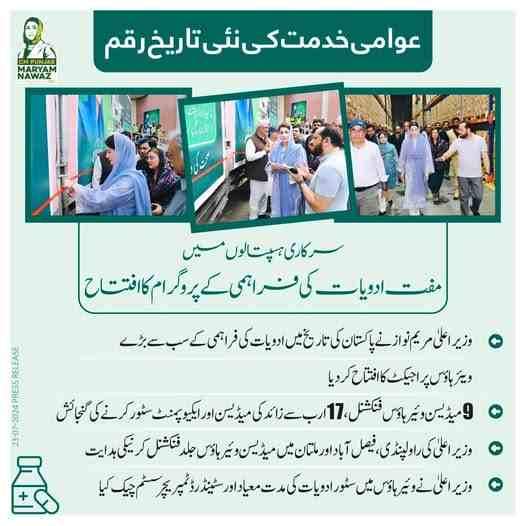
Table Of Contents
What is the CM Punjab Free Medicines at your Doorstep Program?
The CM Punjab Free Medicines at your Doorstep Program is a universal health access initiative that replaces hospital queues with automated home delivery for chronic disease patients across Punjab. It is a revival and expansion of a project first introduced between 2013 and 2018, which was unfortunately abolished by the previous government.
How does the Free Medicines Program differ from previous government schemes?
The 2009-2018 origin under Shahbaz Sharif
The foundation of free medicine distribution in Punjab was laid in 2009 when the Shahbaz Sharif government launched free medicine distribution in all government hospitals. By 2016, the program was expanded to include ICUs, emergency wards, and OPDs. The Punjab Hepatitis Control Program was also expanded, providing free medicines to over 150,000 patients. An annual budget of over PKR 20 billion was allocated for free medicines in government hospitals, benefiting millions of patients, particularly in rural Punjab.
Why the previous government abolished the delivery project in 2018
Following the change in government after the 2018 elections, the public welfare project was unfortunately abolished. While ministers continued receiving their salaries, the poor man was deprived of getting medicines with the closure of this project. The abolition forced patients to return to long queues at government hospitals, reversing years of progress in healthcare accessibility.
The 2024 revival and expansion by Maryam Nawaz
Chief Minister Maryam Nawaz Sharif revived the project within just 08 weeks of assuming office. She formally restarted the registration process for TB and Hepatitis patients by inaugurating a Sahulat Markaz in the Primary & Secondary Healthcare department. The scope of this project was extended to all cities of Punjab, not just Lahore.
Key differences: From OPD pickup to TCS rider delivery
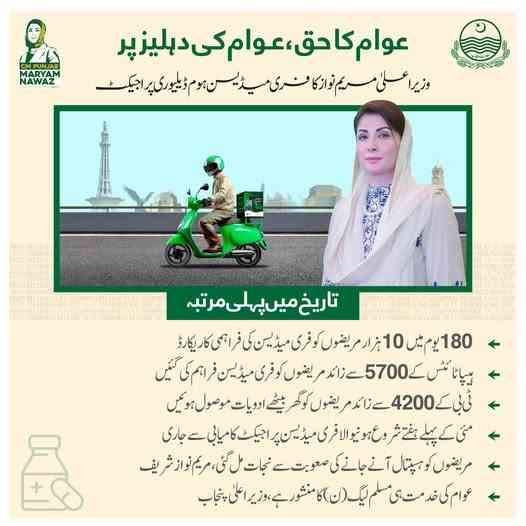
Unlike previous iterations where patients had to visit hospital OPDs for medicine pickup, the revived program delivers medicines directly to doorsteps using private courier partners such as TCS riders. The Chief Minister personally demonstrated this by visiting patients in narrow streets of Katchi Abadis alongside TCS riders.
What are the official objectives of the Free Medicine delivery Project?
Reducing hospital overcrowding for refill visits
By delivering medicines to homes, the program significantly reduces the burden on government hospitals. Patients no longer need to take time off work, spend money on travel, or wait in long queues just to collect their monthly medicine refills.
Eliminating TB from Punjab via doorstep therapy
A cornerstone of the program is the elimination of Tuberculosis from Punjab. With doorstep delivery of TB medicines, patients can complete their full DOTS (Directly Observed Therapy, Short-course) treatment without interruption. Special drug-resistant TB (DR-TB) centres are being established across the province for patients unresponsive to standard treatment.
Financial protection for bedridden and elderly patients
The program is specifically designed for the elderly, bedridden, and chronically ill who find it difficult to visit hospitals. By bringing medicines to their homes, the government ensures that no patient is deprived of treatment due to physical limitations or financial constraints.
How does the Hospital Management Information System (HMIS) power this program?
Role of HMIS in automatic second and third month deliveries
For cardiac patients, the first month’s medicine is prescribed via the Hospital Management Information System (HMIS) during a physical visit to any public cardiac hospital. For the second and third months, medicines are delivered automatically to the patient’s doorstep without requiring another hospital visit.
Integration with Sahulat Markaz for Hepatitis and TB registration
For TB and Hepatitis patients, registration is conducted through Sahulat Markaz located at Primary & Secondary Healthcare departments. This streamlined process ensures that patients are entered into the HMIS database for automatic delivery scheduling.
Read More: Honhaar Jawan Program (Free IT Courses, Laptops, & Solar Panels)
Who is eligible to receive free medicines at home in Punjab?
Eligibility is restricted to residents of Punjab diagnosed with Hepatitis, Tuberculosis (TB), or Cardiac diseases, with priority given to elderly, bedridden, and chronically ill patients. The program serves permanent residents of Punjab as per NADRA records.
What are the specific medical conditions covered under the Maryam Nawaz Free Medicine Program?
Cardiac diseases list: From angina to post-PCI medication
Heart patients receive comprehensive cardiac medication including antiplatelets, beta-blockers, ACE inhibitors, and statins. The program covers patients with angina, post-PCI (stent) patients, and those with heart failure.
Hepatitis types covered: B and C medications
Patients suffering from Hepatitis B and C receive their full course of antiviral medications. Under the Hepatitis Control Program, 6,806 patients have already benefited from free home delivery of medicines.
Tuberculosis: Full DOTs regimen delivered at home
TB patients receive their complete DOTs regimen at home, ensuring treatment compliance. A total of 7,673 patients have benefited from the TB Control Program, with special centres being established for drug-resistant TB.
Are surgical items also provided for free under this scheme?
No, surgical items are not provided under this scheme. The program is strictly limited to prescription medicines for the three specified chronic conditions: Hepatitis, Tuberculosis, and Cardiac diseases.
Do heart patients get free medicines at home in Punjab?
Heart patients are the largest beneficiary group of this program. A total of 585,000 patients across Punjab have been registered for home delivery of cardiac medicines. The Punjab government has also unveiled the Chief Minister’s Adult Cardiac Surgery Program, offering free treatment facilities worth over PKR 3 billion annually to patients suffering from heart diseases.
List of cardiac medicines included
The program covers essential cardiac medications including antiplatelet agents like Aspirin and Clopidogrel, statins for cholesterol management, beta-blockers for blood pressure control, and ACE inhibitors for heart failure patients.
The Punjab Institute of Cardiology free medicine referral pathway
Cardiac patients can receive their initial prescription from the Punjab Institute of Cardiology or any public cardiac hospital. Once registered in HMIS, the automatic delivery system takes over for subsequent months.
How do TB patients apply for the doorstep medicine program?
TB patients can register through Sahulat Markaz located at Primary & Secondary Healthcare departments. Lady health workers are also actively engaged in household-level case detection, identifying TB patients who may benefit from the doorstep delivery program.
Can Hepatitis patients receive free medication through this scheme?
Yes, Hepatitis patients are fully covered under this scheme. The Hepatitis Control Program has already delivered medicines worth millions of rupees to patients across Punjab, with major districts including Lahore, Multan, Sheikhupura, Gujranwala, and Faisalabad showing the highest number of beneficiaries.
Can cancer patients apply for free doorstep medicine delivery?
Cancer patients are not directly covered under this specific doorstep delivery program. However, the Punjab government is establishing the first official state-of-the-art cancer hospital in Lahore where patients will receive free cancer treatment. The government has allocated PKR 5 billion for cancer treatment machines and access.
Is the program available in all cities of Punjab or just Lahore?
The program has been expanded across all districts of Punjab. Major districts with the highest number of beneficiaries include Lahore (3,439), Multan (1,058), Sheikhupura (892), Gujranwala (774), and Faisalabad (589). The program aims to reach approximately 200,000 patients across the province.
Rural reach: How field hospitals and Clinic On Wheel support remote areas
Thirty-two field hospitals have been functionalized to provide treatment facilities to people belonging to rural areas. The “Clinic on Wheels” project delivers medical services directly to patients living in remote and underserved communities, distributing free medicines for up to two months to patients in need.
Do I need to visit a government hospital for the first prescription?
Yes, the first prescription must be obtained from a government hospital. For cardiac patients, the first month’s medicine is prescribed via HMIS during a physical visit to any public cardiac hospital. For TB and Hepatitis patients, initial registration and prescription occur at Sahulat Markaz.
First prescription mandatory at any public cardiac hospital
Patients cannot register with the program using prescriptions from private hospitals or clinics. The first consultation must occur at a public healthcare facility to ensure proper diagnosis and entry into the government healthcare system.
Exception: TB and Hepatitis registration directly via Sahulat Markaz
TB and Hepatitis patients do not need to visit a cardiac hospital. They can directly visit any Sahulat Markaz at Primary & Secondary Healthcare departments for registration and initial prescription.
How can I register for the Punjab doorstep medicine delivery?
Registration is disease-specific: Cardiac patients enroll via HMIS during a hospital visit; TB and Hepatitis patients register at any Primary & Secondary Healthcare department’s Sahulat Markaz. The registration process is designed to be simple and accessible to all Punjab residents.
How to register online for the Free Medicines Program?
While the program primarily relies on in-person registration for the first visit, patients can check their eligibility and status online. The HMIS database maintains digital records of all registered patients, and delivery tracking is available online.
Using the CM Punjab Complaint Cell WhatsApp number for registration help
Patients can contact the CM Punjab Complaint Cell via WhatsApp for assistance with registration queries and delivery issues. The government has established multiple communication channels to ensure no patient is left behind.
What is the role of the Sahulat Markaz in registration?
The Sahulat Markaz serves as the primary registration point for TB and Hepatitis patients. Located at Primary & Secondary Healthcare departments across Punjab, these centres handle all paperwork, verify patient information, and initiate the medicine delivery schedule.
Documents needed at Sahulat Markaz
Patients must bring their valid CNIC, medical reports confirming their diagnosis, and any previous prescriptions from government healthcare facilities.
Which documents are required for registration in this program?
Valid CNIC mandate and address verification process
A valid Computerized National Identity Card (CNIC) is mandatory for registration. The government uses NADRA records to verify patient identity and address. The address verification is crucial for the delivery rider to locate the patient’s home.
Prescription from a government hospital doctor
The prescription must come from a doctor employed at a Punjab government hospital. Private prescriptions are not accepted for registration under this program.
Can private hospital prescriptions be used to get free medicines at home?
No, private hospital prescriptions cannot be used. This policy ensures that patients receive proper diagnosis and care within the government healthcare system before accessing free medicine delivery.
Can elderly patients register via a phone call?
Yes, the program accommodates elderly and bedridden patients who cannot physically visit registration centres. Family members can call the helpline to arrange for a field worker to visit the patient’s home and complete the registration process.
Helpline number for voice registration
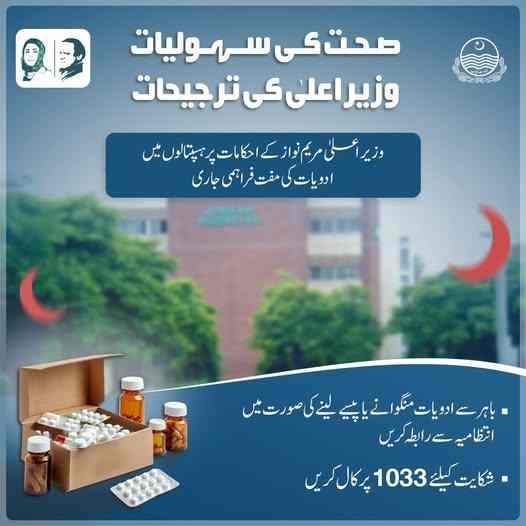
Patients can call the designated helpline numbers for registration assistance. The government has also established toll-free numbers for complaints regarding medicine unavailability at hospital pharmacies.
Home visit by field worker for bedridden patients
For patients who are completely bedridden and unable to visit any healthcare facility, the program dispatches field workers to their homes to complete registration and deliver the first medicine supply.
Is there a helpline number for the CM Punjab Free Medicine Program?
Yes, multiple helpline channels exist. Patients can send their CNIC number to 8500 to check eligibility for health programs. For medicine delivery complaints, the government has established toll-free numbers prominently displayed at all health facilities.
Is there an online portal to check eligibility for the program?
Patients can check their eligibility through the HMIS online portal using their CNIC number. The system provides instant confirmation of registration status and upcoming delivery dates.
How does the free medicine doorstep delivery process work?
After registration, patients receive a two-month medicine stock delivered by private courier partners like TCS riders, followed by automatic re-delivery after a scheduled check-up. The process is designed to be seamless and patient-friendly.
Who delivers the medicines to the patients’ homes?
TCS riders and their training for medicine handling
The government collaborates with private sector services, including TCS riders, to ensure timely delivery. These riders are trained in proper medicine handling and delivery protocols. Medicines are securely packed before distribution to maintain quality during transit.
The symbolic visit of CM Maryam Nawaz with a TCS rider
To inaugurate the project, Chief Minister Maryam Nawaz Sharif personally delivered medicines to patients. She reached the house of cardiac patient Rasoolan Bibi by passing through narrow streets of service quarters at Shaman Katchi Abadi. She also visited Munawar Malik at Shadman Katchi Abadi, presenting medicines alongside a TCS rider, demonstrating her hands-on leadership approach.
How many months of medicine are provided in one delivery?
The two-month stock rule for chronic diseases
Eligible patients receive a two-month stock of their prescribed medicines at once. This reduces the frequency of deliveries and ensures patients have an uninterrupted supply of essential medications.
Why three months for cardiac patients?
Cardiac patients receive a slightly different schedule. The first month’s medicine is prescribed during a physical hospital visit. For the second and third months, medicines are delivered automatically to the patient’s doorstep, eliminating the need for two additional hospital visits.
How do I track my medicine delivery status?
Live tracking via courier service
Patients can track their medicine delivery using the courier service’s tracking system. Once medicines are dispatched, patients receive a tracking number to monitor delivery progress.
SMS notification system for delivery day
The program sends SMS notifications to registered patients on the day of delivery, allowing them to be available to receive their medicines.
What happens if the medicine delivery is delayed?
Standard operating procedures for delays
In case of delivery delays, patients can contact the helpline number. The government has established protocols to investigate and resolve delivery issues promptly.
Escalation to CM Punjab Complaint Cell
If standard resolution channels fail, patients can escalate their complaint to the CM Punjab Complaint Cell via WhatsApp or phone call for immediate action.
How often will the delivery rider visit my home?
Every two months for TB and Hepatitis
TB and Hepatitis patients receive deliveries every two months following their regular check-up schedule. After the initial two-month cycle, medicines are delivered again following a check-up.
Monthly for first three months for cardiac patients
Cardiac patients receive monthly deliveries for the first three months, with the first month requiring a physical hospital visit and months two and three being automatic doorstep deliveries.
Can I change my delivery address after registration?
Process for address update via helpline
Patients can request an address change by calling the helpline and providing their registered CNIC number and new address details. Verification of the new address may be required.
Verification challenges for address change
The government conducts address verification before approving address changes to prevent fraud and ensure medicines reach the correct patient.
What should I do if the medicine I need is out of stock?
Substitution policy (generic vs. brand)
If a prescribed brand is temporarily unavailable, the program provides generic equivalents of the same medication, ensuring patients never miss their doses.
Reporting stockouts to the Drug Testing Lab
Patients can report medicine stockouts through the helpline. The government’s Drug Testing Lab monitors supply chain issues and works to resolve stockouts promptly.
Is the medicine delivery service completely free of cost?
Yes, the delivery service is 100% free for all registered patients, including the courier charge and the medicines themselves, with no hidden taxes or fees. The Punjab government bears the entire cost of both the medicines and their delivery.
Are there any hidden charges for rural delivery?
No. Whether a patient lives in a major city like Lahore or a remote village, the delivery service remains completely free. The government has ensured uniform service across all 36 districts of Punjab.
How does the government pay TCS for delivery?
The government contracts private courier services through formal agreements, reimbursing them for each successful delivery. The cost is covered by the annual healthcare budget allocation.
What is the total financial outlay of the Free Medicines Program?
PKR 39.47 million delivered for Hepatitis and TB alone
Medicines worth PKR 39,470,894 have been delivered to Hepatitis and TB patients. A total of 14,479 beneficiaries have received free home delivery of medicines under the Hepatitis and TB Control Programs combined.
PKR 9.15 billion dispensed to cardiac patients
Since the program’s launch, medicines worth PKR 9.15 billion have been dispensed to 17 million cardiac patients. Total registered patients with the program stand at 17.8 million with 34.9 million total visits.
How does the government ensure medicine quality in the Free Medicines Program?
All medicines are tested at the newly established Drug Testing Lab in the Primary & Secondary Healthcare department, including chromatography and drug release labs. Quality control is a non-negotiable priority for the Punjab government.
Are the medicines provided by the Punjab government of high quality?
Drug testing protocols: Chromatography and Hepatitis reference lab
The Chief Minister inspected the Drug Testing Lab being established to check medicine quality. She visited the chromatography section, drug release lab, drug sample receiving area, and hepatitis reference/public health lab. These advanced testing facilities ensure that every batch of medicine meets pharmaceutical standards before reaching patients.
CM Maryam Nawaz’s inspection of the drug release lab
During her visit to the Drug Testing Lab, CM Maryam Nawaz personally inspected the drug release lab where medicines are tested before being cleared for distribution. She also reviewed the medicine packing and delivery process.
How does the government verify the patient’s address?
Address verification is conducted using NADRA records during the registration process. For patients in Katchi Abadis and informal settlements, field workers may conduct physical verification to ensure accurate delivery routing.
What is the role of the Hepatitis reference/public health lab?
The Hepatitis reference lab serves as a specialized testing facility for Hepatitis medications, ensuring that antiviral drugs meet quality standards before being delivered to patients across Punjab.
What is the historical background of free medicine delivery in Punjab?
The concept originated in 2009 under Shahbaz Sharif, was expanded by 2016, then abolished by the previous government in 2018, and finally revived by Maryam Nawaz in 2024. Understanding this history provides context for the current program’s importance.
Free medicine distribution in government hospitals (2009-2016)
In 2009, the Shahbaz Sharif government launched free medicine distribution in all government hospitals in Punjab. This was a pioneering initiative that set the foundation for healthcare accessibility in the province.
The 2016 expansion to ICUs and emergency wards
By 2016, free medicines were expanded to ICUs, emergency wards, and OPDs. The Punjab Hepatitis Control Program was expanded with free medicines for over 150,000 patients. Over PKR 20 billion was allocated annually for free medicines in government hospitals.
Why was the project closed in 2018?
The project was unfortunately abolished by the incoming government after the 2018 elections. The closure deprived poor patients of essential medicines and forced them back into hospital queues.
The 2024 revival: From 8 weeks to all Punjab
Maryam Nawaz Sharif launched the revival of this public welfare project within just 08 weeks of assuming office. The scope was immediately extended to all cities of Punjab, with the aim of serving 200,000 patients.
What are the 2026 updates and future roadmap for the program?
As part of ongoing efforts, the program continues to expand. TB elimination remains a top priority, with doorstep delivery of TB medicines being a cornerstone of the province’s strategy. Special drug-resistant TB centres are being established across the province.
TB elimination focus by 2026
Chief Minister Maryam Nawaz reaffirmed that doorstep delivery of TB medicines is a cornerstone of the province’s strategy to eradicate the disease. Free diagnostics and PCR tests are ensured at public hospitals with the DOTS strategy guaranteeing cost-free treatment at district and tehsil level. Lady health workers are actively engaged in household-level case detection.
Air ambulance project launch timeline
The Chief Minister announced that an air ambulance project will be launched for poor patients in coming weeks. This project will provide rapid medical transport for critically ill patients from remote areas to specialized hospitals.
Clinic On Wheel project for rural Punjab
The “Clinic on Wheels” project delivers medical services directly to patients living in remote and underserved communities. Mobile clinics and field hospitals operate throughout the province, providing consultations, maternal and child health services, vaccinations, and chronic disease management.
The first state-of-the-art cancer hospital in Lahore
The Punjab government is establishing the first official state-of-the-art cancer hospital in Lahore where patients will be provided free cancer treatment. The Chief Minister has directed the Health Minister to functionalize the cancer hospital’s outdoor wing.
What are the challenges and solutions in the Free Medicines Program?
The main challenges include delivery delays in remote areas, stockouts of specialized cardiac drugs, and patient address verification errors. The government has implemented systematic solutions to address each of these issues.
How does the program handle delivery delays in Katchi Abadis?
The Shaman Katchi Abadi and Shadman Katchi Abadi case studies
During the launch, CM Maryam Nawaz personally navigated the narrow streets of Shaman Katchi Abadi to reach patient Rasoolan Bibi. The government uses this experience to train delivery riders on navigating informal settlements and hard-to-reach areas.
What happens if a patient moves without updating address?
If a patient moves without updating their address, deliveries will be sent to the old address. Patients are strongly advised to update their address information immediately through the helpline to avoid delivery disruptions.
How are medicine stockouts reported and resolved?
The government has established a committee to finalize a revised medicines list and create a foolproof mechanism to ensure uninterrupted supply of essential drugs. Any lapse in delivery to patients is considered “unacceptable” by the Chief Minister.
How does the Free Medicines Program compare to other health schemes?
Unlike the Sasta Ramazan or Nigehban packages which focus on food, this program is Punjab’s first chronic disease-specific, recurring home delivery model. It complements other healthcare initiatives rather than competing with them.
Free Medicines Program vs. Sehat Sahulat Card
The Sehat Sahulat Card provides cashless inpatient treatment up to PKR 1 million per family for hospitalization and surgeries. The Free Medicines Program focuses specifically on outpatient medicine delivery for chronic diseases, filling a gap that the Sehat Card does not address.
Is this program part of the “Sasta Ramazan” or “Nigehban” package?
No, this is a separate vertical health program. The Sasta Ramazan and Nigehban packages focus on food subsidies and essential grocery items, while the Free Medicines Program is dedicated solely to healthcare delivery.
Comparison with federal TB programs
The provincial program works alongside federal TB initiatives, with the Punjab government taking primary responsibility for doorstep delivery within the province. The DOTS strategy is implemented at district and tehsil headquarters hospitals with support from lady health workers.
Frequently Asked Questions
How do I apply for free medical treatment in Punjab?
Visit any public cardiac hospital for heart conditions or any Sahulat Markaz for TB and Hepatitis. Bring your valid CNIC and medical reports. The hospital or Sahulat Markaz will register you in HMIS and initiate the medicine delivery schedule.
What is the CM Punjab contact number for complaints?
Send your CNIC number to 8500 to check health program eligibility. For medicine delivery complaints, toll-free numbers are displayed at all government health facilities. The CM Punjab Complaint Cell is also available via WhatsApp.
Is free medicine available in Lahore only?
No, the program is available in all 36 districts of Punjab. Major beneficiary districts include Lahore, Multan, Sheikhupura, Gujranwala, and Faisalabad, with rural areas served through field hospitals and the Clinic on Wheels project.
What is the Free Medicine CM Punjab Helpline Number?
Patients can check eligibility by sending their CNIC to 8500. For specific helpline numbers, contact your nearest government hospital or Sahulat Markaz for the most current contact information.
Can I get free medicine from government without a CNIC?
No, a valid CNIC is mandatory for registration. The government uses NADRA records to verify patient identity and address before approving medicine delivery.
What is the role of FM Sehat Zindagi in this program?
FM Sehat Zindagi is a health awareness platform. The Chief Minister recorded a podcast on FM Sehat Zindagi during the program launch to spread awareness about the free medicine delivery initiative.
Where can I listen to CM Maryam Nawaz’s podcast on this scheme?
The podcast is available on the FM Sehat Zindagi platform. The Chief Minister visited FM Sehat Zindagi and got her podcast recorded to educate citizens about the program.
How many beneficiaries under Hepatitis Control Program so far?
Under the Hepatitis Control Program, 6,806 patients have received free home delivery of medicines. Major districts with the highest number of beneficiaries include Lahore, Multan, and Sheikhupura.
How many TB patients received doorstep delivery?
A total of 7,673 patients have benefited from the TB Control Program through free home delivery of medicines. This number continues to grow as the program expands across all districts.
What is the worth of medicines delivered so far?
Medicines worth PKR 9.15 billion have been dispensed to cardiac patients. For Hepatitis and TB patients specifically, medicines worth PKR 39,470,894 have been delivered. The total registered patient base is 17.8 million with 34.9 million total visits.

Add a Comment