
The countdown has begun for Punjab’s most generous paid internship opportunity, and if you are a graduate passionate about environmental governance, you need to act before March 29. The CM Punjab Climate Internship Program, officially launched by Chief Minister Maryam Nawaz Sharif, offers a monthly stipend of PKR 60,000 to young graduates who want to transition from academic theory to hands-on climate action. This definitive guide will walk you through every single detail from eligibility and required documents to the step-by-step online application process, selection merit, intern responsibilities, and what happens after you get selected, ensuring you have all the information to successfully apply and become a Climate Warrior for a Green Punjab.
Key Takeaways
- Application Deadline is Non-Negotiable: The online application portal closes on March 29, 2026. Late submissions are not accepted, so complete your registration well before the cutoff date.
- PKR 60,000 Stipend is Guaranteed: Selected interns receive a fixed monthly stipend of PKR 60,000 for the entire three-month duration, paid directly via bank transfer.
- Fifty Percent Seats Reserved for Women: The program mandates a 50% quota for female candidates, ensuring balanced gender participation in climate leadership.
- Multidisciplinary Eligibility Broadens Access: You do not need an environmental science degree to apply. Seats are allocated for Business, IT, Social Sciences, Arts, and Humanities graduates.
- UNESCO-Backed Certification Adds Global Value: Interns receive an official Government of Punjab certificate, with the potential for co-certification from UNESCO or alignment with UNFCCC learning frameworks.
- Read More: Honhaar Jawan Program (Free IT Courses, Laptops, & Solar Panels)
- Read More: CM Punjab Internship Program Apply Online (Get PKR 70K)
- Read More: Punjab Socio-Economic Registry (PSER) | Punjab Portal For Schemes
CM Punjab Maryam Nawaz Climate Internship Program (PKR 60K Apply Online)
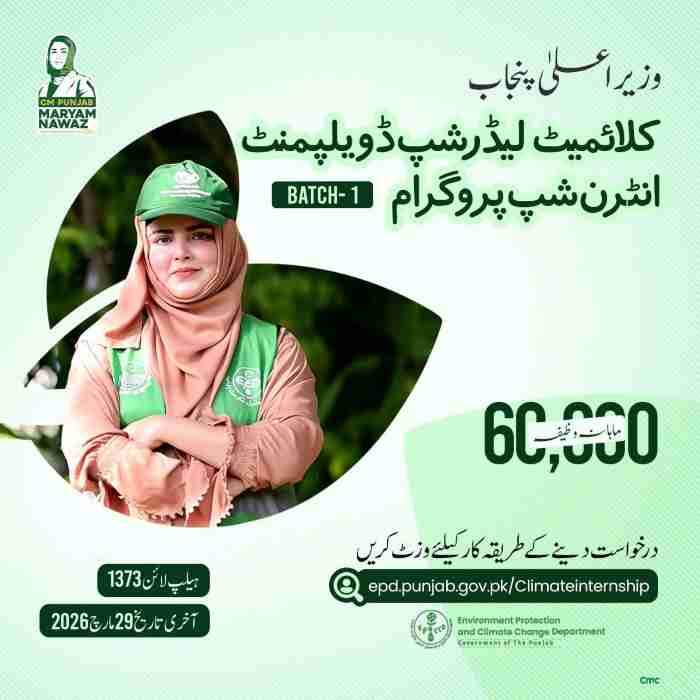
Table Of Contents
What Exactly is the CM Punjab Climate Leadership Development Internship Program?

The CM Punjab Climate Leadership Development Internship Program is a paid, merit-based initiative by the Government of Punjab designed to train fresh graduates in environmental governance, climate action, and sustainable development through direct field experience and structured learning.
Why did the Punjab Government launch the CM Punjab Climate Internship Program?
The government launched this program to address the urgent need for climate-literate professionals who can translate policy into on-ground action. Punjab faces severe environmental challenges, including smog, water scarcity, and waste management issues. By engaging youth, the program builds a workforce capable of tackling these problems at the district level.
What is the primary vision and mission behind the CM Punjab Climate Program?
Vision: To inspire and mobilize youth to build a Climate Resilient Punjab.
Mission: To train young professionals through a paid, merit-based platform that combines field deployment, structured learning via a Learning Management System, and practical assignments across all districts of Punjab.
How does this program aim to build a “Climate Resilient Punjab”?

The program builds resilience by:
- Decentralizing Action: Posting interns in their home districts to address local environmental issues.
- Creating Behavior Change: Training interns to become “Climate Champions” who lead community awareness campaigns.
- Data-Driven Interventions: Having interns collect environmental data and work on capstone projects tied to district-level problems.
Who is the founder and patron-in-chief of the CM Punjab Climate Leadership Development Internship Program?
Chief Minister Maryam Nawaz Sharif is the founder and patron-in-chief. She officially announced the program through a Facebook message, emphasizing that every young individual can play a meaningful role in environmental protection.
What is the role of the Environment Protection & Climate Change Department (EPCCD) in this internship?
The EPCCD is the implementing body. It oversees the entire process, from application processing and merit list generation to field deployment and certification. Interns work under the supervision of the Environmental Protection Agency (EPA), which operates under the EPCCD.
How does the CM Punjab Climate Internship Program align with global climate goals (UNFCCC)?
The program’s curriculum is aligned with the United Nations Framework Convention on Climate Change (UNFCCC) learning objectives. Interns gain exposure to international climate policies, sustainability frameworks, and reporting mechanisms, making the learning experience globally relevant.
What is the “Climate Warriors” or “Climate Champions” initiative mentioned in the program?
“Climate Warriors” is the title given to selected interns. They are expected to lead the fight against climate change in their communities by:
- Conducting environmental awareness sessions.
- Participating in tree plantation drives.
- Promoting the Punjab Green School Certification Program in local educational institutions.
How is the CM Punjab Climate Internship different from a regular government job?

This is a fixed-term training program, not a permanent job. It focuses on skill development rather than employment. However, it provides verified government experience, which significantly boosts employability for future roles in the public or private sector.
What are the core strategic objectives of this climate leadership initiative?
- Province-wide reach through district-wise merit lists.
- Multidisciplinary recruitment across Sciences, Business, IT, and Humanities.
- Competency standards via strict academic thresholds.
- Real-world impact through capstone projects and school adoption programs.
- Alumni network formation for continued climate engagement.
How does the program ensure province-wide scale and district representation?
The program uses an automated merit system that generates separate merit lists for each district and gender. This ensures that candidates from less-developed districts have an equal opportunity to be selected, preventing urban-centric dominance.
What is the significance of Phase II of the CM Punjab Climate Internship Program?
Phase II represents the current application cycle, building on the success of the pilot phase. It incorporates refined eligibility criteria, a higher stipend, and enhanced partnerships with organizations like UNESCO for certification.
How does this program contribute to the Punjab Green School Certification Program?
Interns are tasked with adopting schools in their districts. They guide these schools through the certification process, which involves implementing eco-friendly practices, waste management systems, and green clubs.
What is the long-term vision for the Climate Leadership Alumni Network?
The alumni network aims to create a sustained community of climate professionals. It facilitates:
- Mentorship for future intern batches.
- Knowledge sharing and collaboration on environmental projects.
- Continued access to government and sector opportunities.
Is the CM Punjab Climate Internship Program only for environmentalists, or is it multidisciplinary?
It is deliberately multidisciplinary. While 60% of seats are reserved for Environmental Sciences and Engineering, 20% are for Business, IT, and GIS, and another 20% for Social Sciences, Arts, and Humanities. This diversity ensures that climate action benefits from varied perspectives, including policy, communication, and data analysis.
What is the Monthly Stipend and Duration of the CM Punjab Climate Internship Program?
The CM Punjab Climate Internship Program offers a fixed monthly stipend of PKR 60,000 for a duration of three months, making it one of the highest-paying internship programs in the country.
What is the exact monthly stipend for the CM Punjab Climate Internship?
The exact monthly stipend is PKR 60,000. This amount is consistent for all selected interns, regardless of their academic discipline or district of posting.
Is the PKR 60,000 stipend paid on time every month?
Yes, the stipend is disbursed monthly via direct bank transfer to the intern’s registered bank account. The process is managed by the Finance Department to ensure timely payments, provided the intern meets attendance and performance requirements.
How long does the CM Punjab Climate Internship Program last?
The program duration is three months. This compact timeline is designed to provide intensive, focused training and project completion without requiring a long-term commitment from fresh graduates.
Are there different batches, and how many interns per batch?
Yes, the program operates in batches. Each batch onboards 250 interns simultaneously. This batch size allows for manageable supervision while maintaining province-wide coverage.
What is the total stipend an intern can expect to earn over the full term?
Over the full three-month term, an intern earns a total of PKR 180,000 (PKR 60,000 x 3 months). This provides significant financial support, allowing graduates to focus entirely on their learning and field assignments.
Is the stipend for the CM Punjab Climate Internship taxable?
As a government stipend for a training program, it is generally not subject to income tax. However, interns should consult with a tax advisor or check the official notification for any specific withholding tax regulations applicable to government stipends.
How is the stipend disbursed to the selected candidates?
Stipend disbursement follows a structured process:
- Bank Account Submission: Interns must provide valid bank account details (IBAN) during onboarding.
- Monthly Verification: Attendance and performance are verified by the supervising officer.
- Automated Transfer: The finance wing processes the payment, and the amount is credited to the intern’s account by the end of each month.
Who is Eligible to Apply for the CM Punjab Climate Internship Program? (Detailed Eligibility Criteria)
Eligibility for the CM Punjab Climate Internship Program is defined by strict academic, age, and domicile requirements. Meeting all criteria is mandatory for your application to be considered.
What is the required educational qualification?
Candidates must hold a minimum Bachelor’s degree, which constitutes 16 years of education. This includes degrees like B.A., B.Sc., B.Com, BBA, BS (Hons), or equivalent, from a university recognized by the Higher Education Commission (HEC).
Which academic disciplines are eligible for the CM Punjab Climate Internship Program?
The program is divided into three major discipline clusters with specific seat allocations:
- Environmental Sciences & Engineering (60% of seats):
- Environmental Science
- Environmental Engineering
- Civil Engineering
- Chemical Engineering
- Agricultural Engineering
- Forestry
- Geology
- Hydrology
- Botany
- Zoology
- Chemistry
- Physics
- Biotechnology
- Biochemistry
- Business, Computer Sciences & GIS (20% of seats):
- Business Administration (BBA)
- Computer Science (CS)
- Information Technology (IT)
- Software Engineering
- Data Science
- Geographic Information Systems (GIS)
- Accounting & Finance
- Management Sciences
- Social Sciences, Arts, & Humanities (20% of seats):
- Economics
- Public Policy
- Sociology
- Political Science
- Mass Communication / Journalism
- Law (LLB)
- International Relations
- History
- Public Health
- Geography
- Archaeology
What is the minimum required CGPA or percentage?
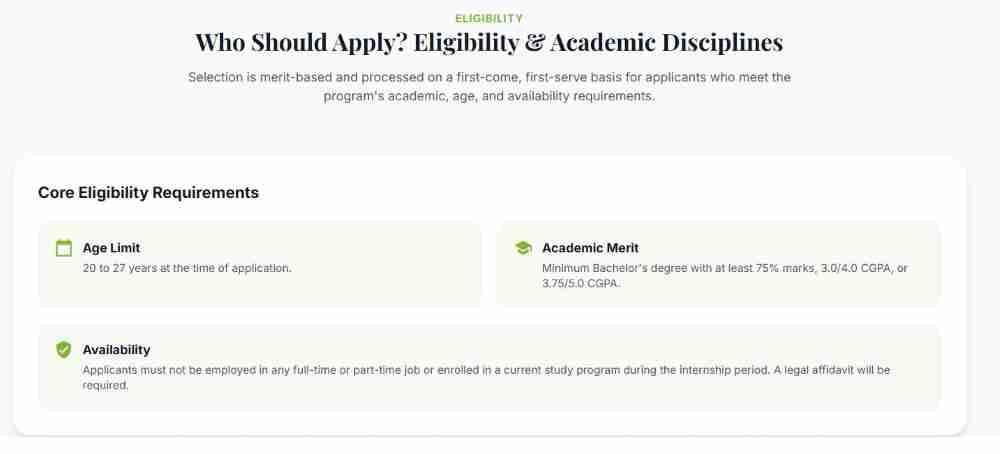
To ensure academic competency, applicants must meet one of the following thresholds in their Bachelor’s degree:
- Minimum 75% marks in the annual system.
- Minimum CGPA of 3.0 on a 4.0 scale.
- Minimum CGPA of 3.75 on a 5.0 scale.
Is there an age limit for the CM Punjab Climate Internship?
Yes, there is a strict age limit. Applicants must be between 20 and 27 years of age at the time of application. This ensures the program targets young graduates at the start of their careers.
Do I need a domicile of Punjab to apply?
Yes, a Punjab domicile is mandatory. The program is funded by the Government of Punjab and is intended for residents of the province. You will be required to upload a scanned copy of your domicile certificate.
Is the CM Punjab Climate Internship Program for both males and females?
Absolutely. The program is open to both males and females. To promote gender equality and women’s leadership in climate action, 50% of all seats are specifically reserved for female candidates.
What is the female quota or reserved seat percentage for women?
The program guarantees a 50% quota for women. This means that in every district and across all discipline clusters, half the available slots are allocated to female applicants, calculated on merit within their category.
Can students currently enrolled in a degree program apply?
No. Applicants must have completed their degree and must not be currently enrolled in any other study program. The internship requires full-time commitment, so concurrent enrollment is strictly prohibited. A legal affidavit confirming this will be required.
Can I apply if I am already employed in a private or government firm?
No. Applicants must not be employed in any full-time or part-time job during the internship period. The program requires your undivided attention. You will need to submit an affidavit declaring your unemployment status.
What is the requirement regarding “Availability” or employment status?
You must be fully available for the three-month duration. This means you cannot:
- Hold any other job.
- Enroll in any academic program.
- Engage in any other full-time commitment that would interfere with your field assignments and LMS participation.
Is there a quota for disabled candidates or special persons in this internship?
While the core documentation emphasizes gender quotas, the program aligns with Punjab government policies on disability inclusion. Special persons who meet the eligibility criteria are encouraged to apply, and accommodations may be provided during the selection and internship phases.
What are the requirements for “Fresh Graduates” under this program?
The term “fresh graduate” implies that candidates should have completed their degree recently, although no specific cutoff year is mentioned beyond the age limit. The focus is on graduates who are not yet established in their careers and can benefit from this entry-level training.
Can applicants with a degree in Arts or Humanities apply?
Yes. Disciplines like History, Archaeology, Sociology, Mass Communication, and Law are explicitly listed under the Social Sciences, Arts, and Humanities category, which holds 20% of the total seats.
What if my degree is in a field not listed, like Law or Archaeology?
As shown in the comprehensive list above, Law (LLB) and Archaeology are indeed eligible fields. If your specific major is not listed but falls under a broader eligible category (e.g., a specialized social science), it is advisable to check the official portal’s dropdown list or contact the helpline for clarification.
What Documents are Required for the CM Punjab Climate Internship Online Application?
Having your documents scanned and ready before you start the online application is crucial for a smooth submission process.
What is the complete checklist of documents?
- Educational Documents:
- Attested copy of Bachelor’s degree / transcript.
- Detailed marks sheets of all semesters/years.
- Identity Documents:
- Scanned copy of Computerized National Identity Card (CNIC) (both sides).
- Recent passport-sized photograph (with white background).
- Residency Documents:
- Scanned copy of Punjab Domicile Certificate.
- Declarations:
- Legal affidavit on stamp paper (format may be provided on the portal) declaring non-employment and non-enrollment in another program.
How do I get an attested copy of my educational degrees and transcripts?
You can get your documents attested by a:
- Gazetted Officer (e.g., Assistant Commissioner, Tehsildar).
- Head of your Educational Institution (e.g., Registrar, Principal, Dean).
- Notary Public.
What are the specifications for the scanned copy of my CNIC?
- Format: JPEG or PNG.
- Size: Typically under 1MB per file.
- Quality: Clearly legible, with no glare or cropped edges. Both sides of the CNIC should be scanned into a single image or uploaded as two separate files as per portal instructions.
Is a domicile certificate mandatory?
Yes, it is absolutely mandatory. Applications without a valid Punjab domicile will be rejected automatically during the verification stage.
Do I need to provide passport-sized photographs?
Yes, you will need to upload a recent passport-sized photograph. Ensure it meets the standard requirements:
- White or light blue background.
- Front-facing, with a neutral expression.
- High resolution, with your face clearly visible.
What is a legal affidavit, and is it required?
An affidavit is a sworn statement made on judicial stamp paper. It is required to legally declare that you are not currently employed and not enrolled in any other educational program. The exact wording may be provided on the official website when you download the application form or checklist.
How do I obtain and upload my experience certificates (if any)?
While experience is not mandatory, if you have relevant volunteer or internship experience, you can upload attested copies of your certificates. This can strengthen your profile, although selection is primarily merit-based on academics.
How Do I Apply Online for the CM Punjab Climate Internship Program? (Step-by-Step Guide)
Applying online is a straightforward process if you follow these steps carefully. The entire process is managed through the official portals.
What is the official website for the CM Punjab Climate Internship apply online?
There are two official portals you can use:
- Primary Portal:
epd.punjab.gov.pk/climateinternship - Secondary Portal:
climateinternship.pk
How do I register on the CM Punjab Climate Internship Portal using my CNIC?
- Visit the official portal (epd.punjab.gov.pk/climateinternship).
- Click on “New Registration” or “Sign Up.”
- Enter your CNIC number (without dashes) as your username/ID.
- Create a strong password.
- Provide a valid mobile number and email address.
- You will receive an OTP (One-Time Passcode) on your mobile. Enter it to verify your account.
- Complete the registration process and log in.
What is the step-by-step process to fill the online application form?
- Login: Access your dashboard using your CNIC and password.
- Personal Information: Fill in your name, father’s name, date of birth, gender, marital status, and religion exactly as they appear on your CNIC.
- Contact Information: Provide your postal address, mobile number, and alternative contact number.
- Academic Information: Enter your educational details, including:
- Degree title (e.g., BS Environmental Science).
- University/Board name.
- Year of passing.
- Total marks / CGPA obtained.
- Upload scanned copies of your transcripts/degrees.
- Domicile Information: Select your district, tehsil, and upload your domicile certificate.
- Declaration: Read the declarations carefully and check the box to confirm your eligibility and the accuracy of the information provided.
How do I upload the required documents?
- Click on the “Upload Documents” section in your dashboard.
- Upload each document in the specified format (PDF/JPEG) and size.
- Ensure the file names are simple (e.g., “CNIC_Front,” “Degree_Transcript”) to avoid upload errors.
- Double-check that the uploaded documents are clearly visible before final submission.
What is the CM Punjab Climate Internship Program login process?
Go to the official portal and click on “Login” or “Sign In.” Enter your CNIC as the username and the password you created during registration. If you forget your password, use the “Forgot Password” option to reset it via your registered mobile number or email.
How do I review my application before final submission?
Before hitting the “Submit” button, carefully review:
- Spelling: Ensure your name matches your CNIC.
- Numbers: Verify your CNIC, mobile number, and email are correct.
- Documents: Confirm all required documents are uploaded and are legible.
- Eligibility: Re-check that you meet all age, academic, and domicile criteria.
Is there an application fee?
No. There is absolutely no application fee for the CM Punjab Climate Internship Program. If anyone asks you for money to process your application, it is a scam. Report such instances to the helpline.
How can I edit my application after submission?
Once you click “Submit,” your application is locked for editing in most cases. If you discover a critical error, you must immediately contact the official helpline (1373) or send an email from your registered address explaining the issue. Do not create a second registration.
Can I save my application as a draft and complete it later?
Yes, the portal typically allows you to save your application as a draft. You can log in and out multiple times to complete different sections. However, ensure you finally submit it before the deadline.
What is the helpline number for application assistance?
The official helpline number provided for the program is 1373. You can call this number for technical support and queries related to the application process.
What is the Last Date to Apply for the CM Punjab Climate Internship Program (Phase II)?
The application deadline for Phase II of the CM Punjab Climate Internship Program is fixed and critical.
What is the deadline to apply for Phase II of the internship?
The last date to submit your online application is March 29, 2026.
Is the March 29, 2026 deadline final and strict?
Yes, the deadline is final and strict. The online portal will automatically cease to accept new applications or submissions after 11:59 PM on March 29. The government has not indicated any extension for Phase II.
What happens if I miss the deadline?
If you miss the March 29 deadline, you will not be able to apply for Phase II. You will have to wait for the announcement of Phase III or subsequent batches, assuming the program continues. It is highly recommended to apply well before the cutoff date to avoid last-minute technical glitches.
What is the Selection Process and Merit List for the CM Punjab Climate Internship?
The selection process is designed to be transparent, automated, and merit-based, ensuring equal opportunity for candidates across Punjab.
How is the merit calculated for the selection?
Merit is calculated primarily based on academic performance. The system assigns weightage to your final percentage or CGPA in your Bachelor’s degree. Candidates are then ranked within their district and gender category. The “first-come, first-serve” principle may apply only after the initial merit list is exhausted, but the primary driver is academic score.
What is the role of academic merit in selection?
Academic merit is the sole criteria for initial shortlisting. Your marks or CGPA determine your position on the merit list. Candidates with higher academic scores in their respective disciplines and districts are selected first.
Is there an entry test for the CM Punjab Climate Internship?
No, there is no entry test. The selection is based entirely on the scrutiny of academic documents and the automated merit calculation.
Is there an interview?
Generally, there is no interview mentioned for the initial selection. Shortlisted candidates may be called for document verification only. However, in case of any discrepancies, a brief interview or interaction might be conducted for clarification.
How are district-wise and gender-wise merit lists generated?
The online system automatically segregates applicants by:
- District of Domicile: All applicants from a specific district (e.g., Multan) are grouped together.
- Gender: Within each district group, male and female applicants are separated.
- Merit Rank: Within each gender-district group, applicants are ranked by their academic scores (percentage/CGPA).
- Selection: The top candidates from each list are selected until the district’s quota is filled, ensuring 50% female representation.
How will I be notified if I am shortlisted?
Shortlisted candidates will be notified via:
- SMS: A text message sent to the mobile number registered on the portal.
- Email: An official email sent to the address provided in the application.
- Portal Dashboard: The status of your application will be updated on your login dashboard. You should check it regularly.
Where can I find the official merit list?
The official merit lists will be published on the same portals where you applied: epd.punjab.gov.pk/climateinternship and climateinternship.pk. They will be available for download in PDF format, organized by district.
How can I check my application status online?
Log in to your account on the portal. Your dashboard will display the current status of your application, such as:
- Submitted: Your application is received.
- Under Verification: Your documents are being checked.
- Shortlisted: You have been provisionally selected.
- Approved/Rejected: Final status after document verification.
How many total interns are selected in each batch?
Each batch onboards a total of 250 interns. This number is divided across all districts of Punjab based on population and other factors.
What are the seat-shifting rules?
If seats remain unfilled in a particular district or gender category after the initial merit list, they may be shifted to another district or category to ensure the total 250 slots are filled. This is done transparently as per program rules.
How does the automated merit-based system ensure transparency?
Automation removes human bias. The system:
- Calculates merit uniformly for all applicants.
- Generates lists without manual intervention.
- Provides an audit trail.
- Publishes results publicly, allowing anyone to verify the selection.
What are the Job Responsibilities of a CM Punjab Climate Intern?
The role of a Climate Intern is dynamic, blending fieldwork, digital learning, and community engagement.
What does a “Climate Warrior” actually do on a daily basis?
A Climate Warrior’s daily tasks are varied and impactful:
- Morning: Visit a designated field site (e.g., a school, a waste management site, an industrial area) for environmental monitoring or awareness sessions.
- Afternoon: Attend structured learning modules on the Learning Management System (LMS).
- Evening: Document findings, prepare reports, and engage with the community on social media or through local meetings.
What kind of field deployment can interns expect?
Interns are deployed in their home districts and work on:
- Environmental sample collection (water, soil, air).
- Assisting in pollution control inspections.
- Conducting surveys for environmental impact assessments.
- Implementing the Punjab Green School Certification Program in local schools.
What is the role of the Learning Management System?
The LMS is the digital backbone of the program. It is used for:
- Structured Learning: Accessing course materials on climate change, environmental law, and policy.
- Daily Attendance: Marking daily login and participation.
- Assignments: Submitting weekly tasks and quizzes.
- Progress Tracking: Monitoring the intern’s learning journey by supervisors.
What is the final capstone project?
The capstone project is a practical assignment that interns complete by the end of the program. It involves:
- Identifying a specific environmental problem in their district.
- Proposing a solution or intervention.
- Implementing a small-scale project (e.g., a plantation drive, a waste segregation campaign).
- Submitting a final report with findings and recommendations.
Will interns be involved in environmental data analysis?
Yes, interns will be trained to collect and analyze basic environmental data. This could include:
- Analyzing water quality parameters.
- Compiling data on tree cover.
- Monitoring air quality trends in their locality.
- Preparing data visualizations for reports.
Do interns have to conduct community awareness campaigns?
Absolutely. Community engagement is a core responsibility. Interns will:
- Organize seminars and walks on climate issues.
- Educate citizens on waste management and anti-smog measures.
- Distribute informational material in public places.
- Use social media to spread awareness about environmental best practices.
Will interns be posted in their home districts?
Yes, a key feature of the program is posting interns in their home districts. This leverages their local knowledge, reduces relocation costs, and ensures they work on issues relevant to their own communities.
What is the “Adopt a School” initiative?
Under this initiative, each intern is responsible for “adopting” a government school in their district. Their task is to:
- Conduct environmental education sessions for students.
- Help the school establish a garden or greenery.
- Guide the school towards achieving the “Punjab Green School Certification.”
What are the social media engagement responsibilities?
Interns act as digital ambassadors for the program. They are expected to:
- Share their experiences and learnings on platforms like Facebook, Twitter, and Instagram.
- Use official hashtags like #ClimateWarrior and #GreenPunjab.
- Create engaging content (photos, short videos) to promote environmental awareness.
- Counter misinformation about environmental issues online.
Do interns have to prepare reports for the Environmental Protection Agency?
Yes, reporting is a key part of the job. Interns prepare:
- Weekly activity reports for their supervising officer.
- Data collection reports based on field visits.
- A comprehensive final report on their capstone project.
What is the role of working with officers of the Punjab Environmental Protection Agency?
Interns work under the direct supervision and mentorship of EPA officers. This provides:
- On-ground training from experienced professionals.
- Insight into how regulatory bodies function.
- Networking opportunities within the government sector.
What are the Learning and Certification Benefits of the Internship?
The program offers substantial professional and academic returns that extend far beyond the monthly stipend.
Will I get a certificate after completing the internship?
Yes, upon successfully completing the three-month program, including all LMS requirements, field assignments, and the capstone project, you will be awarded an official internship certificate from the Government of Punjab.
Is the internship certificate officially recognized?
Yes, it is an official certificate issued by the Environment Protection & Climate Change Department, Government of Punjab. It carries the weight of government recognition and is a valuable addition to your professional portfolio.
What is the role of UNESCO and UNFCCC in providing certification?
The program has collaborations in place to offer enhanced certification.
- UNESCO Certification: Some interns may receive a certificate co-signed or backed by UNESCO, adding significant international prestige to their accomplishment.
- UNFCCC-Aligned Learning: The curriculum is aligned with the learning objectives of the United Nations Framework Convention on Climate Change (UNFCCC), meaning your training meets global standards for climate knowledge.
How does the Learning Management System work for daily participation?
The LMS tracks your daily participation. You are expected to log in, complete assigned modules, and submit quizzes. This digital record is used to verify your attendance and engagement, which is a prerequisite for receiving your final certificate.
Will I gain practical experience in environmental governance?
Yes, the program is designed specifically for this. You will move from classroom theory to practical work by:
- Understanding how environmental laws are implemented.
- Participating in policy-relevant data collection.
- Seeing how government departments function at the district level.
What are the learning outcomes regarding international climate policies?
By the end of the internship, you will have a foundational understanding of:
- The Paris Agreement and Nationally Determined Contributions (NDCs).
- The role of UNFCCC in global climate governance.
- International best practices for sustainability and climate resilience.
Does the CM Punjab Climate Internship Lead to a Permanent Government Job?
This is a common question, and the answer requires a clear understanding of the program’s nature.
Are these internships a gateway to permanent employment?
The primary purpose of this internship is skill development and capacity building, not direct employment. It is not a guarantee of a permanent government job. It is a training program designed to prepare you for the job market.
What is the difference between this internship and a regular government job?
A regular government job involves a permanent position with a salary, pension, and benefits. This internship is a fixed-term (three months), paid training opportunity. It provides experience and a certificate, but you do not become a permanent government employee upon completion.
Can I use this internship experience to apply for other government posts?
Absolutely. The experience you gain, the skills you learn, and the official government certificate will strengthen your CV significantly. When you apply for future government jobs (e.g., in EPA, PCS, or other departments), this internship will be counted as valuable professional experience and will give you a competitive edge over other candidates.
Is this internship considered government service experience?
Yes, it is considered verified professional experience within a government department. It is not “government service” in the pensionable sense, but it is a credible and verifiable work experience that you can list on your resume.
What Happens After Selection? (Onboarding, Training, and Stipend Disbursement)
Once you are selected, a structured onboarding process begins to integrate you into the program.
What is the orientation process for new interns?
Selected interns are invited to a central or divisional orientation session. During this session, you will:
- Receive a formal welcome from EPCCD officials.
- Learn about the program’s rules, expectations, and code of conduct.
- Get detailed training on how to use the Learning Management System (LMS).
- Receive your initial field assignment and supervisor details.
How are interns assigned to their districts and field offices?
Interns are assigned to their district of domicile. Within the district, they are placed at the office of the Assistant Director, EPA, or at a specific field office/laboratory based on the department’s needs and the intern’s academic background.
What is the schedule for stipend disbursement?
The stipend is typically disbursed at the end of each month, after the verification of attendance and performance for that month. Payments are made through direct bank transfer to the account details provided during onboarding.
How is the intern’s attendance verified?
Attendance is verified through a combination of methods:
- Digital: Daily login to the LMS.
- Physical: Sign-in register at the assigned field office.
- Supervisor Verification: The officer in charge confirms your presence and fieldwork completion.
What are the performance requirements to remain in the program?
To successfully complete the program and receive the certificate, you must:
- Maintain a minimum attendance percentage (usually 80% or higher).
- Actively participate in and complete all LMS modules and quizzes.
- Successfully execute and submit your final capstone project.
- Adhere to the code of conduct and follow supervisor instructions.
Important Dates and Deadlines You Cannot Miss (Timeline)
| Event | Date |
|---|---|
| Application Start Date | Early March 2026 |
| Last Date to Apply (Phase II) | March 29, 2026 |
| Merit List Publication | To be announced (shortly after deadline) |
| Document Verification of Shortlisted Candidates | To be announced |
| Onboarding & Orientation of Batch-1 | To be announced |
| Internship Start Date (Batch-1) | To be announced |
| Internship End Date (Batch-1) | Approx. 3 months after start date |
Frequently Asked Questions (FAQs)
1. Can I re-apply if I was rejected in Phase I?
Yes, if you were rejected in Phase I, you can re-apply for Phase II provided you still meet all the eligibility criteria (age, academic, etc.) and were not debarred for any disciplinary reason.
2. Do I need to take an entry test?
No, there is no entry test. Selection is purely merit-based on your academic record (percentage/CGPA).
3. Will I be posted in my home district?
Yes, a key feature of the program is that interns are posted in their home district of domicile to work on local environmental issues.
4. Is there an age relaxation for any category?
The program notification specifies a strict age limit of 20-27 years. Any relaxation, if applicable (e.g., for disabled persons or minorities), would be explicitly mentioned in the official advertisement. Currently, no general relaxation is announced.
5. What is the minimum CGPA for eligibility?
You need a minimum of 3.0 CGPA on a 4.0 scale, or 3.75 CGPA on a 5.0 scale, or 75% marks in your Bachelor’s degree.
6. Is the internship only in Lahore or across Punjab?
The internship is across Punjab. Interns are placed in their respective home districts, ensuring that environmental work happens in every corner of the province, not just the capital.
7. How do I become a “Climate Champion”?
All selected interns are designated as “Climate Warriors.” By actively participating, showing leadership in your community, and excelling in your projects, you can embody the title of a Climate Champion.

Add a Comment