
Every year, Pakistani farmers lose billions of rupees to pest attacks, weed competition, and fungal diseases. Without effective crop protection, cotton yields drop by 40%, wheat harvests shrink, and rice quality deteriorates. The top 10 pesticides companies in Pakistan provide the chemical defense systems that protect over 22 million hectares of farmland. This guide delivers the latest ranking, company profiles, crop-specific recommendations, and practical insights for farmers, dealers, and agribusiness professionals.
What this comprehensive guide covers:
- Ranked list of the 10 most influential pesticide companies in Pakistan
- Market share analysis between local formulators and multinational corporations
- Which company leads for cotton, wheat, rice, and mango crops
- Distribution network size and reach across Punjab, Sindh, KPK, and Balochistan
- Emerging biopesticide and eco-friendly product trends
- Regulatory challenges and future market projections
Key Takeaways
- Local Manufacturers Rising: Four locally owned companies now rank among the top 10, with Suncrop Group holding the number one position by manufacturing volume.
- Crop-Specific Leadership: No single company dominates all crops. Syngenta excels in cotton, Bayer in wheat, and Jaffer Agro in rice protection.
- Distribution Determines Reach: Companies with the largest franchise networks—Suncrop’s 450+ centers and FMC’s 2,000+ dealers—serve remote farming communities most effectively.
- Counterfeit Crisis: The Competition Commission of Pakistan reports widespread fake pesticides, making brand trust and source verification critical for farmers.
- Biopesticide Growth: Auriga Group leads the shift toward eco-friendly solutions, with the biorational segment growing faster than conventional chemicals.
- Price Sensitivity Wins: Local companies offer comparable efficacy at 20-30% lower cost, capturing price-conscious smallholder farmers.
- Read More: Single Super Phosphate (SSP) – 50 Kg Price In Pakistan
- Read More: DAP Price In Pakistan (DAP 50KG) – FFC, Sona, Engro DAP
- Read More: Canola Seed Price In Pakistan (2Kg, 5Kg, 40Kg) – All Variants
- Read More: Pumpkin Seed Price In Pakistan (Per Kg) – Uses & Benefits
Top 10 Pesticides Companies In Pakistan – (No. 1 To 10)
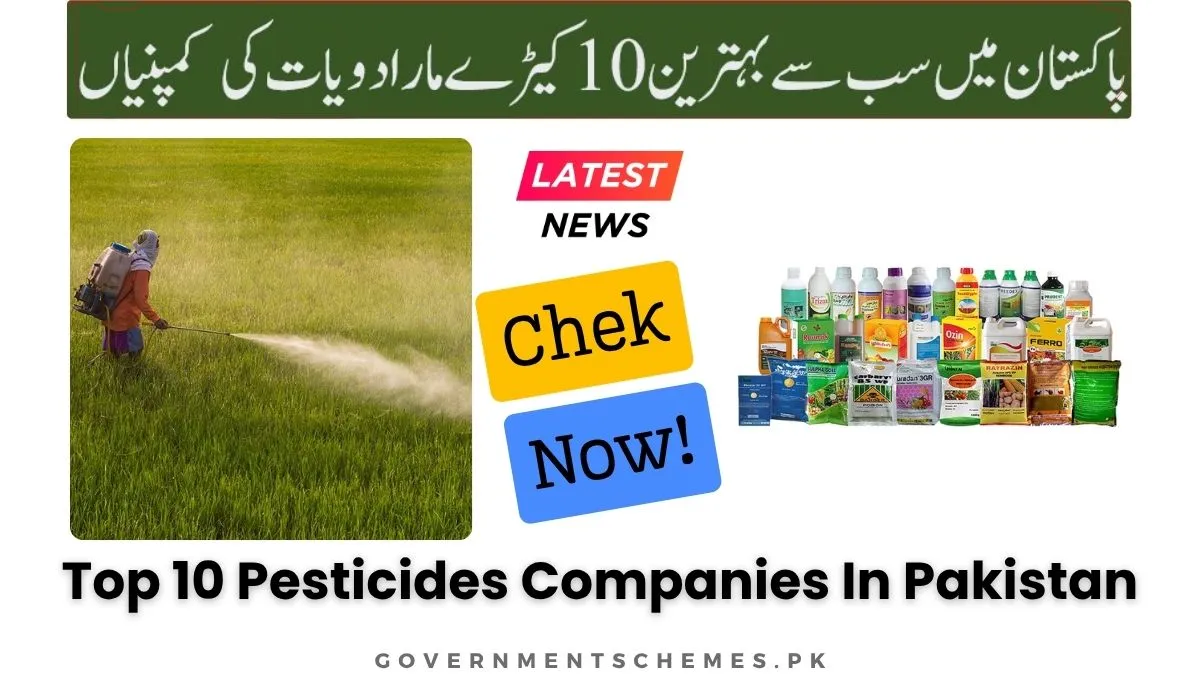
Table Of Contents
1. Understanding the Pesticide Market in Pakistan
The pesticide industry in Pakistan serves one of the world’s largest agrarian economies. Agriculture contributes nearly 24% to the national GDP and employs 42% of the labor force. Pest pressure has intensified due to climate shifts, monoculture practices, and pest resistance development.
Key market characteristics:
- Total market size: Estimated at $251 million annually
- Insecticides dominate: 54% of total pesticide consumption
- Herbicides are fastest-growing: 3.6% projected annual growth
- Complete dependence on imported active ingredients
- Over 500 registered pesticide formulations
- More than 200 active companies operating in the sector
Why pesticide use is essential:
Cotton suffers from bollworm complex, jassids, and whitefly. Wheat faces rust diseases and broadleaf weeds. Rice battles stem borers and leaf folder. Without crop protection, national food security would collapse.
Major challenges facing the industry:
- Widespread counterfeit and adulterated products
- Weak enforcement of the Agricultural Pesticides Ordinance 1971
- Lengthy registration process (2-3 years per molecule)
- Lack of provincial laboratory testing capacity
- Farmer illiteracy about correct application methods
This context sets the stage for understanding why the top 10 pesticides companies in Pakistan matter so much to millions of farming families.
2. The Complete Ranking: Top 10 Pesticides Companies in Pakistan
The following ranking reflects market presence, product portfolio breadth, distribution reach, and farmer recognition as of the current period.
The definitive list:
- Suncrop Group (Ali Akbar Group) – Largest local manufacturer and formulator
- Syngenta Pakistan – Global R&D leader with strong cotton portfolio
- Bayer Pakistan – Crop science giant with wheat herbicide dominance
- FMC United (Pvt) Ltd – Largest field force in the industry
- Lucky Core Industries (LCI) – Publicly traded diversified chemical company
- Evyol Group – Fast-growing local group with solution-based approach
- Jaffer Agro Services – Specialist in fungicides and rice protection
- Auriga Group – Pioneer in bio-pesticides and micro-fertilizers
- Four Brothers Group – Extensive franchise network across Punjab and Sindh
- Tara Group Pakistan – Largest liquid pesticide production capacity
How the ranking was determined:
- Annual turnover and sales volume
- Number of registered products
- Geographic distribution coverage
- Farmer recognition and brand trust surveys
- Investment in R&D and quality control
- Regulatory compliance record
Read More: Bitter Gourd Karela – Price, Uses, & Benefits
2.1 What makes a company qualify for the top 10?
To enter the top tier, a company must demonstrate:
- Minimum 5% market share in at least two major crop segments
- ISO-certified manufacturing facilities
- Active presence in Punjab, Sindh, and at least one other province
- Portfolio covering insecticides, herbicides, and fungicides
- Field force of trained agronomists
- Registered products with the Pesticides Registration Division
2.2 How has the ranking changed in recent years?
The most significant shift is the rise of local groups. Five years ago, multinationals held six of the top seven positions. Today, local companies occupy four of the top five spots by manufacturing volume. Suncrop overtook Syngenta for the number one position. Evyol and Tara Group entered the top 10, displacing older multinationals that scaled back operations.
Drivers of local company growth:
- Lower pricing due to local formulation
- Faster response to farmer needs
- Extensive rural distribution networks
- Government preference for local manufacturing
- Reduced foreign exchange costs
3. Company-by-Company Deep Dive
Each of the top 10 pesticides companies in Pakistan brings unique strengths, product specialties, and geographic strongholds. This section provides actionable intelligence for farmers and dealers.
3.1 Suncrop Group (Ali Akbar Group)
Is Suncrop Group the largest local pesticide manufacturer?
Yes, Suncrop Group holds the title as the largest local manufacturer and formulator of agrochemicals in Pakistan. The company operates from its head office in Multan, the cotton belt heartland.
Core business structure:
Suncrop functions as a conglomerate of multiple companies involved in:
- Pesticide formulation (EC, WP, SC, WG, OD formulations)
- Fertilizer production (40,000 tons per year capacity)
- Seed processing and distribution
- Farmer advisory services
Flagship product categories:
- Insecticides for cotton bollworm and whitefly
- Herbicides for wheat and rice weeds
- Fungicides for sugarcane red rot and mango anthracnose
- Plant growth regulators
Distribution strength:
The company operates the “Apna Zarai Markaz” franchise model with over 450 centers and 1,000+ dealers. This network covers all major tehsils in Punjab and extends into Sindh and KPK.
Why farmers trust Suncrop:
- Decades of local market presence
- Competitive pricing (20-30% below multinational equivalents)
- Availability in remote villages
- Urdu-language product literature and training
3.2 Syngenta Pakistan
How does Syngenta Pakistan compare to Bayer in market share?
Syngenta and Bayer compete closely for the second position. Syngenta traditionally leads in cotton and rice insecticides, while Bayer holds an edge in wheat herbicides. Market share fluctuates by season and crop cycle.
Global-local integration:
Syngenta benefits from the global R&D pipeline of Syngenta AG (now part of Sinochem). New molecules reach Pakistan within 2-3 years of global launch, faster than local competitors.
Strategic partnership impact:
The collaboration with Engro Fertilizers bundles pesticide recommendations with fertilizer advice. Engro’s 1,500+ dealer network amplifies Syngenta’s reach without direct investment.
Top-selling products:
- Insecticides for bollworm control in cotton
- Fungicides for rice blast disease
- Herbicides for broadleaf weeds in wheat
Field force strength:
Syngenta maintains over 300 field agronomists who conduct farmer meetings, demonstration plots, and spray service supervision.
3.3 Bayer Pakistan
What innovative solutions does Bayer Pakistan offer?
Bayer Pakistan focuses on integrated crop solutions rather than standalone pesticides. The “seed-to-harvest” approach combines:
- High-yielding seed varieties
- Crop protection products
- Digital farming tools
- Financial access partnerships
Smallholder farmer support:
Bayer has partnered with financial institutions to provide credit-linked input packages. Small farmers can purchase crop protection products on deferred payment, repaid after harvest.
Wheat herbicide leadership:
Bayer’s selective herbicides for wheat are the most recognized in the category. Products control broadleaf weeds like wild radish and bathu without damaging the wheat crop.
Digital extension services:
The company offers mobile-based advisory services in Urdu and local dialects. Farmers receive pest alerts, weather forecasts, and spray recommendations via SMS and WhatsApp.
3.4 FMC United (Pvt) Ltd
What makes FMC United unique in the Pakistani market?
FMC United operates the largest field force among all pesticide companies in Pakistan. Over 600 field staff and 200+ agronomists provide direct farmer service.
Key brands and products:
FMC’s portfolio includes Talastar, Fastmix, Affinity, Coragen, Ferterra, Winsta, Benevia, Katalst, Padan, Hoopoe, and Advantage. These cover insecticides, herbicides, and fungicides.
Farmer outreach programs:
- One-on-one farm advisory services
- Soil and water testing at no cost
- Supervised application demonstrations
- Pest detection and identification training
- Digital helpline (Dastak) for farmer queries
Quality certifications:
FMC’s Lahore plant is the first in the industry to obtain ISO 9001 (quality management) and ISO 17025 (laboratory competence) certifications. The facility formulates both liquid and granular products.
3.5 Lucky Core Industries (LCI)
Does Lucky Core Industries truly rank among the top 10?
Yes, through its Agri Sciences division. LCI is a publicly traded company on the Pakistan Stock Exchange (symbol: LCI) with diversified businesses including soda ash, polyester, animal health, and pharmaceuticals.
History and evolution:
LCI started as Khewra Soda Ash Company in 1953, became ICI Pakistan in 1966, and was rebranded as Lucky Core Industries after acquisition by the Yunus Brothers Group. The agrochemical business has operated for over five decades.
Agri Sciences portfolio:
- Insecticides for cotton, rice, and vegetables
- Herbicides for wheat and maize
- Fungicides for fruit and vegetable crops
- Specialty plant nutrients
Financial transparency:
As a listed company, LCI publishes annual reports with segment-wise financial performance. The Agri Sciences division contributes significant revenue, though exact figures vary by year.
3.6 Evyol Group
How has Evyol Group grown so quickly?
Evyol was founded in 2004 and has expanded through a “group of companies” structure. Five member companies serve different market segments under one brand umbrella.
Group structure:
- Kanzo Ag – flagship crop protection company
- AgPharma – pharmaceutical and veterinary products
- Kanzo Quality Seeds – hybrid and certified seeds
- Combagro – fertilizer and nutrients
- Eco Pest Solution – urban pest management
Customer-driven philosophy:
Evyol differentiates itself by solving farmer problems rather than pushing products. The solution-based approach has gained traction among progressive farmers seeking integrated pest management.
Flagship product:
Granox insecticide combines Chlorantraniliprole and Monomehypo for effective control of rice stem borer and other lepidopteran pests. Defeater 20WP fungicide serves all crops and fruit plants.
Urban expansion:
Evyol has entered the home-care market with healthy living concepts, diversifying beyond agriculture.
3.7 Jaffer Agro Services
What is Jaffer Agro’s specialty?
Jaffer Agro focuses on fungicides and herbicides, sourcing active ingredients from Germany, Japan, India, and China. The company believes fungicides are essential for efficient food production.
Consultancy services:
Beyond product sales, Jaffer Agro provides:
- Farm advisory and consultancy
- Output optimization guidance
- Yield improvement strategies
- Pest and disease identification
Geographic presence:
A wide network of offices and warehouses across Pakistan ensures farmers can access products at their doorstep.
Key product examples:
- Pendimethalin – pre-emergence herbicide for cotton and other crops
- Butachlor – pre- or early post-emergence treatment for rice
Years of experience:
The Jaffer Group has been involved in agriculture for decades, building deep relationships with farming communities.
3.8 Auriga Group
What makes Auriga Group a pioneer?
Auriga Group pioneered bio-fertilizers, micro-fertilizers, and bio-pesticides in Pakistan. The company designed its own bio-fertilizer plant, demonstrating indigenous engineering capability.
Subsidiary companies:
- Auriga Chemical Enterprises – distribution network
- Sayban International – franchise network for one-stop agri inputs
- Auriga Seeds Corporation – R&D for high-yielding hybrids
Biological solutions focus:
Auriga has worked on sustainable biological solutions for agriculture, reducing dependence on chemical inputs. This aligns with global trends toward integrated pest management.
Growth trajectory:
Auriga is recognized as one of the fastest-growing companies among both multinationals and national players. The trusted dealer network covers the entire country.
Seed R&D:
Using an indigenous pool of genetics, Auriga Seeds Corporation develops high-yielding hybrids adapted to local growing conditions.
3.9 Four Brothers Group
Where does Four Brothers Group have the strongest presence?
The company has deep roots in Sindh and Punjab. Activities began with distribution in the late 1970s, and Four Brothers Industries was established in July 2002 to complement distribution with manufacturing.
Tarzan Markaz franchise model:
Four Brothers operates Pakistan’s largest franchise network called “Tarzan Markaz,” offering all agricultural inputs under one roof. This includes pesticides, seeds, fertilizers, and advisory services.
Crop focus areas:
- Major field crops: cotton, rice, corn, wheat
- Oilseeds: sunflower and canola
- Small-acre crops: vegetables, ornamentals, fodders
Farmer engagement:
The group conducts daily farmer meetings to communicate timely recommendations and solutions for farming problems. The biological AG platform supports sustainable practices.
Dealer network reach:
Hundreds of successful pesticides dealers work through the Four Brothers biological platform across Punjab and Sindh.
3.10 Tara Group Pakistan
Which company leads in liquid pesticide production?
Tara Group Pakistan holds the largest liquid pesticide production capacity in the country. After large-scale expansion, their agrochemical plants became capacity-wise the biggest agrochemical unit in Pakistan.
Production capabilities:
- Chemical formulation plant: 10 million bottles aggregate capacity
- Powder and granule filling: 5 million units capacity
- State-of-the-art quality control labs
- R&D laboratories accredited under ISO/IEC 17025:2017 and ISO 9001:2015
Product portfolio breadth:
Tara Group produces 198 branded and registered products, including:
- Pesticides (insecticides, herbicides, fungicides)
- Micro and macro fertilizers
- Hi-tech seeds of international standards
Research infrastructure:
The group established its own research and demonstration farms in four different ecological zones of Pakistan. Advanced breeding programs develop hybrids and GMO technology.
Leadership:
Dr. Khalid Hameed, Chairman/CEO, is an eminent agriculture scientist and visionary leader. Under his leadership, Tara Group has received more than 50 national and 9 international excellence awards.
Seed processing:
A seed processing plant in Multan complements the pesticide and fertilizer operations, offering complete crop solutions.
4. Local Versus Multinational: Comparative Analysis
The battle between local and multinational companies shapes pricing, innovation, and farmer access.
Advantages of local companies:
- Lower prices (20-30% cheaper for equivalent efficacy)
- Faster registration of generic molecules
- Extensive rural distribution networks
- Culturally attuned marketing and advisory
- No foreign exchange risk on finished goods
Advantages of multinationals:
- Patented molecules with novel modes of action
- Rigorous R&D and field testing
- Global quality standards
- Technical training and digital tools
- Brand trust and recall
Market share reality:
Local companies now hold approximately 40-45% of the total market by volume, up from 25% five years ago. By value, multinationals still lead due to premium pricing.
Which is better for small farmers?
Price-sensitive farmers often prefer local brands for affordable pest control. Large-scale farmers growing export-oriented crops may choose multinational products for residue compliance and proven efficacy.
5. Crop-Specific Company Leadership
Different companies excel for different crops. This section provides crop-by-crop recommendations.
5.1 Best companies for cotton protection
Cotton faces bollworm complex (American, pink, and spotted bollworms), jassids, whitefly, and mealybug.
Leading companies for cotton:
- Syngenta Pakistan – broad portfolio of bollworm insecticides
- FMC United – Talastar and Fastmix for sucking pests
- Four Brothers Group – strong cotton focus since inception
- Suncrop Group – affordable generics for small farmers
5.2 Best companies for wheat herbicides
Wheat competes with broadleaf weeds (wild radish, bathu, itsit) and grassy weeds (crabgrass, wild oats).
Leading companies for wheat:
- Bayer Pakistan – dominant in selective broadleaf herbicides
- FMC United – portfolio of post-emergence options
- Suncrop Group – cost-effective generic herbicides
5.3 Best companies for rice protection
Rice suffers from stem borer, leaf folder, and blast disease.
Leading companies for rice:
- Jaffer Agro Services – Butachlor for early weed control
- FMC United – Coragen for stem borer
- Evyol Group – Granox for borer complex
5.4 Best companies for mango orchards
Mango faces hopper, mealybug, and anthracnose.
Leading companies for mango:
- Multiple top companies offer fungicides for anthracnose
- Bayer and Syngenta have specific mango pest solutions
- Local companies provide cost-effective generics
6. Distribution Networks: Who Reaches Farmers Best?
A pesticide company’s effectiveness depends on product availability at the village level.
Largest distribution networks:
- Suncrop Group – 450+ Apna Zarai Markaz franchises, 1,000+ dealers
- FMC United – 2,000+ channel partners nationwide
- Four Brothers Group – Tarzan Markaz network across Punjab and Sindh
- Evyol Group – rapidly expanding dealer network
Reach by province:
- Punjab: All top 10 companies have strong coverage
- Sindh: Four Brothers, FMC, and Suncrop lead
- KPK: FMC and Suncrop have dedicated warehouses
- Balochistan: Limited coverage, mostly through regional dealers
Franchise model innovation:
Apna Zarai Markaz (Suncrop) and Tarzan Markaz (Four Brothers) offer one-stop shops for all agricultural inputs. Farmers buy pesticides, seeds, fertilizers, and get advisory services in one location.
7. The Rise of Biopesticides and Eco-Friendly Solutions
Environmental awareness and pest resistance are driving demand for biological solutions.
Which companies lead in biopesticides?
Auriga Group is the undisputed pioneer, with its own bio-fertilizer plant and range of bio-pesticides. Four Brothers Group offers biological solutions through its AG platform.
What are biopesticides?
Biopesticides are derived from natural sources:
- Botanical extracts (neem, garlic, chili)
- Microbial agents (Bacillus thuringiensis, Trichoderma)
- Biochemicals (pheromones, plant growth regulators)
Advantages of biopesticides:
- Safe for beneficial insects (bees, predators)
- No chemical residues on harvest
- Lower risk of pest resistance
- Compatible with organic farming
Market growth:
The biorational pesticides segment is growing faster than conventional chemicals. Farmers increasingly seek eco-friendly options, especially for fruits, vegetables, and export-oriented crops.
Regulatory support:
The legalization of biopesticide registration has encouraged more companies to enter this segment. The process is simpler than for chemical pesticides.
8. Regulatory Framework and Quality Assurance
Understanding the rules helps farmers identify genuine products and avoid counterfeits.
Primary regulations:
- Agricultural Pesticides Ordinance, 1971
- Agricultural Pesticides Rules, 1973
- Pesticides Registration Division oversight
Registration process:
Companies must submit:
- Chemical composition and formulation details
- Toxicity studies (acute, chronic, environmental)
- Efficacy trials in Pakistani conditions
- Label and packaging specifications
Quality control:
Registered products must display:
- Registration number (e.g., Reg. No. XXX)
- Active ingredient concentration
- Batch number and manufacturing date
- Expiry date
- Safety warnings and first aid instructions
Counterfeit pesticide problem:
The Competition Commission of Pakistan has highlighted widespread fake products. Counterfeit pesticides often contain no active ingredient or harmful adulterants. Farmers should buy only from authorized dealers and check registration numbers.
Provincial challenges:
Lack of provincial laboratory capacity means most quality testing happens in federal labs. This creates delays and enforcement gaps.
9. Market Trends and Future Outlook
The pesticide market in Pakistan is evolving rapidly.
Projected growth:
- Market size expected to reach $289 million by 2030
- Compound annual growth rate of 2.86%
- Herbicides segment growing fastest at 3.63% CAGR
Drivers of growth:
- Increasing pest pressure due to climate change
- Growing food demand from rising population
- Adoption of high-yielding varieties that require protection
- Expansion of cash crops (cotton, rice, sugarcane)
Challenges to watch:
- Complete dependence on imported active ingredients (supply chain vulnerability)
- Currency devaluation raising input costs
- Farmer liquidity issues affecting seasonal purchases
- Resistance development reducing chemical efficacy
Opportunity for local manufacturing:
No company in Pakistan manufactures technical-grade active ingredients. This represents a significant opportunity for backward integration. If local production starts, prices could drop dramatically.
Digital transformation:
Companies are adopting digital tools:
- SMS and WhatsApp advisory services
- Drone-based spray applications (trial stage)
- Soil and pest monitoring apps
- Online dealer ordering systems
10. Practical Resources for Farmers
Farmers need accessible, actionable information.
How to get a PDF list of top 10 pesticides companies:
Save or print this article as a PDF. Agricultural extension offices and dealer networks also provide printed lists.
Urdu-language resources:
Most top companies produce Urdu product literature. Ask field staff for pamphlets and training materials in Urdu.
Verifying product registration:
Request the registration certificate from the dealer. Check the registration number against the official list available at the Pesticides Registration Division office.
Job opportunities:
Pesticide companies regularly hire:
- Agronomists and field sales representatives
- Quality control chemists
- R&D scientists
- Supply chain and warehouse managers
- Digital marketing and farmer outreach coordinators
Check company career pages and job portals for openings.
Getting technical support:
Call company helplines (e.g., FMC’s Dastak). Visit local franchise centers (Apna Zarai Markaz, Tarzan Markaz). Attend farmer meetings announced by field staff.
Frequently Asked Questions (FAQs)
Which pesticide company offers the most affordable products for small farmers?
Suncrop Group and other local manufacturers offer the most competitive pricing, typically 20-30% below multinational equivalents. Their generics provide comparable efficacy for common pests.
How can I identify counterfeit pesticides?
Check for intact seals, registration numbers, batch codes, and manufacturing dates. Genuine products have clear printing and no spelling errors. Buy only from authorized dealers.
What is the best time to apply pesticides?
Early morning or late afternoon when temperatures are lower. Avoid windy conditions and follow label instructions for pre-harvest intervals.
Are biopesticides as effective as chemical pesticides?
Biopesticides work well for preventive applications and low-to-moderate pest pressure. For severe infestations, chemical pesticides may be needed. Many farmers integrate both.
Which company has the best distribution in remote areas?
Suncrop Group’s Apna Zarai Markaz network reaches the most remote tehsils. Four Brothers Group’s Tarzan Markaz also has wide rural coverage.
How do I report a fake pesticide product?
File a complaint with the local agricultural extension officer or the Pesticides Registration Division. Provide batch numbers and purchase receipts.
What should I do if a pesticide doesn’t work?
Contact the company’s field agronomist. Possible reasons include resistance development, incorrect application, expired product, or misidentified pest. Never reapply without diagnosis.
Can I mix different pesticides together?
Only mix products recommended by the manufacturer or agronomist. Incompatible mixtures can reduce efficacy or damage crops. Always perform a jar test first.
Disclaimer
The information provided here is for general educational purposes. Always read and follow pesticide label instructions. Consult qualified agricultural experts for specific crop and pest situations.

Add a Comment