
Every passing month forces Punjab’s farmers to confront a harsh reality: diesel prices climb without warning, and electricity bills arrive with figures that erase entire profit margins. The burden of powering irrigation has pushed countless cultivators to the edge, making the difference between a successful harvest and a season of loss. The Punjab Solar Tubewell Scheme emerges as the direct answer to this crisis, offering a permanent escape from fuel dependency through a government-backed transition to solar energy. This comprehensive guide walks you through every aspect of the scheme: who qualifies, how to apply online at the official portal, the exact subsidy amounts you can claim, the transparent balloting process, and the steps that follow selection.
Key Takeaways
- Eighty Percent Subsidy Confirmed: The Punjab government covers 80% of the total cost for approved solar tubewell systems, leaving farmers responsible for only the remaining 20% share.
- One Acre Minimum Land: Applicants must own at least one acre of agricultural land within Punjab and possess a valid CNIC to meet the baseline eligibility threshold.
- Online Portal Only: Registration happens exclusively through the official website cmstp.punjab.gov.pk; no agent or middleman can process your application.
- Eight Thousand Units Available: The first phase targets the conversion of 8,000 tubewells across all districts, with quotas allocated to ensure fair geographic distribution.
- Kissan Card Integration: Active Nawaz Sharif Kissan Card holders receive priority consideration, and the card can cover the farmer’s 20% share of installation costs.
- Read More: Clinic On Wheels: Free Medicines & Ambulance By CM Punjab
- Read More: Prime Minister Ramzan Package | 9999 Official Portal (For PKR 13K)
- Read More: How To Apply For CM Punjab Ramzan Nigehban Card (Get 10000)
- Read More: How To Get Rs10,000 Through Nigehban Ramzan Package
CM Punjab Solar Tubewell Scheme Online Apply

Table Of Contents
What is the Punjab Solar Tubewell Scheme and How Does It Work?
The Punjab Solar Tubewell Scheme is a government-funded initiative officially named the Chief Minister Punjab Solarization for Agricultural Tubewells Programme, designed to convert existing diesel and electric tubewells to solar-powered systems with substantial financial subsidies. This program represents one of the largest direct investments in agricultural renewable energy in Pakistan’s history, carrying a total allocation of Rs. 9 billion to fund the transition. The scheme directly targets the single largest recurring expense for farmers—irrigation energy costs—and replaces it with a free, inexhaustible power source: sunlight.
What is the new scheme of CM Punjab for farmers?
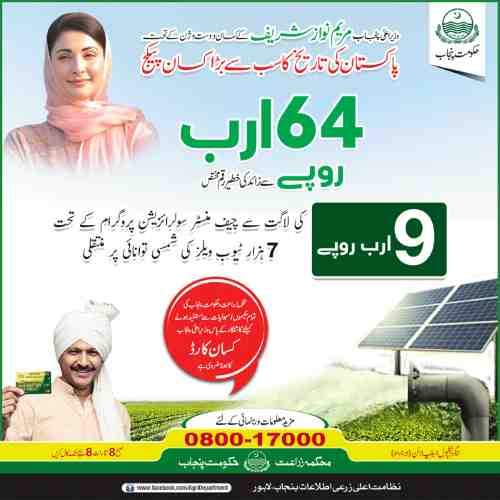
Chief Minister Maryam Nawaz Sharif launched this flagship program to fulfill a core promise made to the farming community: deliver affordable electricity and prosperous agriculture, encapsulated in the slogan “Sasti Bijli, Khushhaal Kissan.” The program represents a fundamental shift in how the government approaches agricultural support, moving from temporary relief (like bill subsidies) to permanent infrastructure investment. Unlike previous initiatives that offered partial assistance on fuel or electricity bills, this scheme provides a capital asset that continues delivering savings year after year. The scheme operates on a simple principle: remove the energy cost burden entirely, and farmers will reinvest those savings into their land, families, and future harvests.
What are the key objectives of this solar scheme?
Reducing the financial burden of energy costs on farmers stands as the primary objective, acknowledging that irrigation pumping consumes the largest share of operational expenses in crop production. A farmer running a diesel tubewell spends approximately Rs. 3,000 per acre per season on fuel alone, while electric tubewell owners face ever-increasing tariff rates and surprise bills.
Promoting sustainable agriculture and climate resilience forms the second critical pillar, as solar irrigation produces zero carbon emissions and reduces the agricultural sector’s dependence on imported fossil fuels. Pakistan ranks among the countries most vulnerable to climate change, and agriculture bears the brunt of extreme weather patterns.
Decreasing reliance on fossil fuels and reducing carbon emissions aligns with Pakistan’s international commitments under the Paris Agreement and its nationally determined contributions to combat global warming. Every diesel tubewell converted to solar eliminates approximately 6 to 8 tons of carbon dioxide emissions annually.
How does the subsidy work under the Solar Tubewell Scheme?
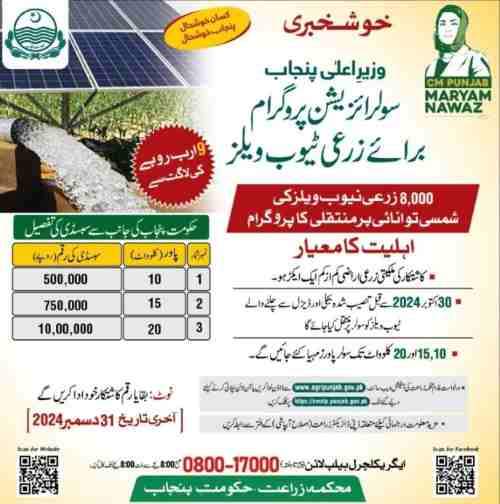
The government provides a fixed subsidy based on system capacity, covering 80% of the total cost, while the farmer pays the remaining 20% share directly to the approved vendor upon installation. This structure ensures that farmers retain ownership and responsibility for their contribution, preventing the mindset of a “free gift” that might lead to neglect or misuse. The 80% figure represents the highest subsidy level offered in any provincial agricultural program currently active, surpassing even the Green Tractor scheme’s concession rates. The government deposits its share directly with the vendor after verification, meaning farmers never handle the subsidy amount—they simply pay their portion and receive a fully installed, operational system.
What is the exact subsidy amount for 10kW, 15kW, and 20kW systems?
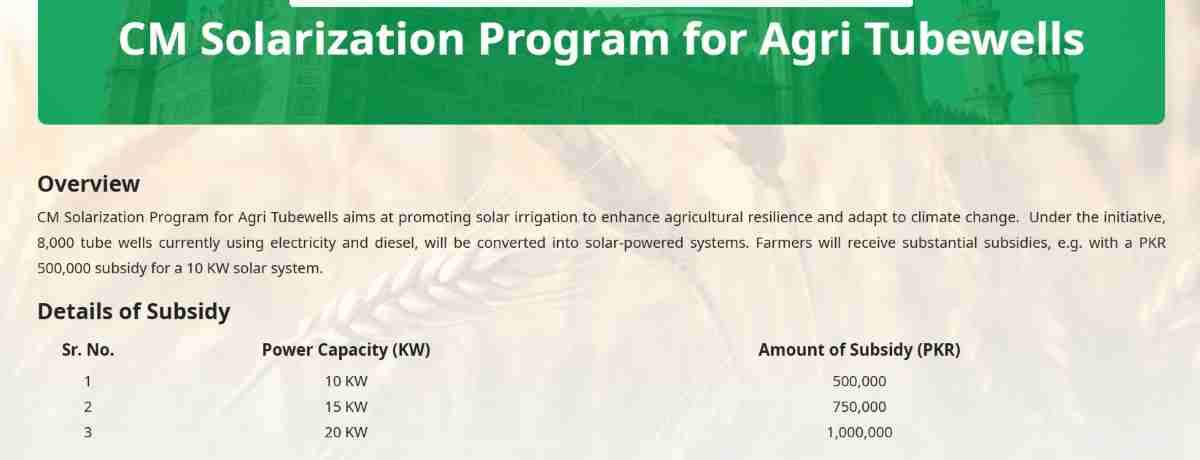
Subsidy for 10 kW System: PKR 500,000 covers systems suitable for smaller landholdings or shallower water tables, typically powering pumps in the 7.5 to 10 horsepower range. This configuration works well for farmers owning five to twelve acres with moderate irrigation needs.
Subsidy for 15 kW System: PKR 750,00 applies to medium-capacity systems that handle deeper wells or larger acreage, supporting pumps up to 15 horsepower. Farmers with twelve to twenty-five acres find this size adequate for most crop cycles.
Subsidy for 20 kW System: PKR 1,000,000 (PKR 10 Lakh) funds the largest eligible systems, designed for extensive landholdings, very deep water tables, or farmers running multiple irrigation channels simultaneously. This top-tier subsidy reflects the government’s commitment to supporting farmers of all scales, from smallholders to large commercial operators.
What is the total cost and farmer’s share after subsidy?
The total system cost varies depending on the brand of panels, the quality of the inverter, the type of pump (surface or submersible), and the complexity of installation. However, the 80% government contribution means the farmer’s out-of-pocket expense remains predictable and manageable. For a 10kW system where the government provides PKR 500,000, the farmer typically pays approximately PKR 100,000 to PKR 125,000, representing the 20% share of a total PKR 600,000 to PKR 625,000 installation. A 15kW system costing roughly PKR 900,000 total requires the farmer to contribute about PKR 150,000 alongside the government’s PKR 750,000. The 20kW option, with a total cost near PKR 1.2 million, leaves the farmer responsible for approximately PKR 200,000 after the government’s PKR 1,000,000 subsidy. Cost-Benefit Analysis reveals why this one-time payment makes overwhelming financial sense: a farmer currently spending PKR 400,000 annually on diesel recovers their entire investment within three to six months, after which every rupee previously spent on fuel becomes pure profit.
What is the official website and portal for the Punjab Solar Tubewell Scheme?
The official portal for online registration is cmstp.punjab.gov.pk, a dedicated domain created specifically for this program to ensure security, prevent fraud, and provide a single source of truth for applicants. This website handles the entire application lifecycle: registration, document upload, status tracking, and final selection notifications. The Punjab government designed the portal with simplicity in mind, recognizing that many farmers access the internet through smartphones with limited technical experience. The interface uses clear Urdu and English instructions, minimal jargon, and step-by-step guidance.
- cmstp.punjab.gov.pk is the exclusive application portal where farmers submit their forms and track progress.
- www.agripunjab.gov.pk serves as the information hub where farmers can download the application form in PDF format for preview, read detailed policy documents, and access departmental contact information.
Is the application form available for download?
Yes, the Punjab Agriculture Department provides the complete application form as a downloadable PDF file on its official website, allowing farmers to review all required fields and prepare their documents before starting the online submission. This practice prevents the frustration of beginning an online application only to realize critical documents are missing or information is incomplete. Farmers can download the form, gather the necessary paperwork, fill in their details offline, and then transfer the information to the online portal with confidence.
Who is Eligible for the Punjab Solar Tubewell Scheme? (Complete Criteria)
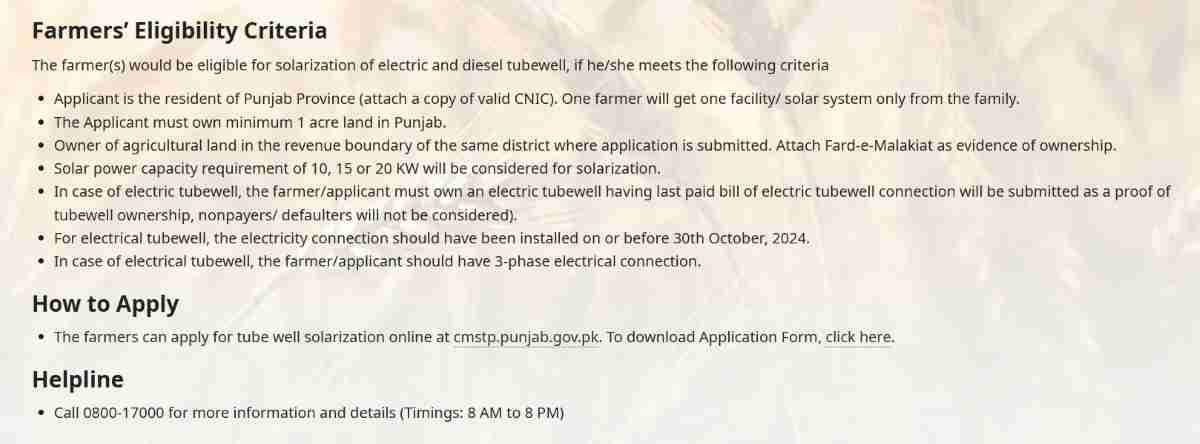
A farmer qualifies for the Punjab Solar Tubewell Scheme if they meet four fundamental requirements: permanent residency in Punjab, ownership of at least one acre of agricultural land, possession of a valid Computerized National Identity Card, and an operational tubewell (either diesel or electric) ready for solar conversion. These criteria establish the baseline for eligibility, but the selection process applies additional filters to ensure fairness and compliance with program objectives.
Who is eligible for the free solar scheme in Punjab?
Eligibility for the solar scheme extends to any individual who farms in Punjab, regardless of whether they own the land outright or hold it through legal tenancy arrangements, provided they can document their relationship to the land and the tubewell. The scheme deliberately avoids restricting benefits to large landowners, recognizing that small farmers face the greatest proportional burden from energy costs. A farmer with two acres spending Rs. 6,000 per acre on diesel feels the pain far more acutely than a large operator with economies of scale. The eligibility criteria therefore aim for inclusivity while maintaining safeguards against fraud and multiple claims from the same family.
What is the minimum land ownership required to apply for the solar tubewell scheme?
The applicant must own a minimum of 1 acre of agricultural land in Punjab, as verified by the official land record known as Fard-e-Malakiat or the jamabandi. This one-acre threshold deliberately includes the smallest operational farmers while excluding urban residents who might own tiny plots without genuine farming activity. Can farmers with less than 1 acre of land apply? No, the one-acre requirement stands as a strict, non-negotiable floor. Is there a maximum land limit, such as 12.5 acres, for small farmers to be prioritized? While the official notification sets one acre as the minimum, program administrators have indicated that farmers owning between 2 and 12.5 acres receive priority weighting during the balloting process, reflecting the scheme’s focus on supporting small to medium agricultural operations that lack the capital to self-finance solar conversions.
Can tenants or renters apply, or is it only for landowners?
Yes, tenants can absolutely apply, but they must provide a valid 11-month lease agreement and a verification stamp from the Patwari confirming their tenancy status and the specific land they cultivate. This provision recognizes that a massive portion of Punjab’s agricultural output comes from tenant farmers who invest their labor and capital in land they do not own. What documentation do tenants need (e.g., lease agreement, Patwari stamp)? Tenants must assemble:
- A notarized copy of their lease agreement clearly stating the land’s location and duration of tenancy.
- A verification certificate from the Patwari (revenue officer) confirming the tenant actively cultivates the specified land.
- An affidavit declaring that the landowner has not applied for the same scheme using the same land.
- Proof of the tubewell’s existence and operational status, typically through photographs and bills.
Can more than one person from the same family apply for a solar system? No. The policy explicitly states that only one farmer will get one facility/solar system from the family, meaning a single household cannot receive multiple installations even if they own separate land parcels in different family members’ names. This rule prevents concentrated benefits and ensures wider distribution across the farming community.
Must the applicant reside in the same district where the agricultural land is located?
Yes, the applicant must be the owner of agricultural land within the revenue boundary of the same district where the application is submitted, ensuring that local agriculture departments can conduct physical verification without cross-district coordination complications. A farmer owning land in Sheikhupura but residing in Lahore must apply through Sheikhupura’s district quota and facilitate verification visits to the actual farm location.
What are the specific requirements for electric and diesel tubewells?
In case of electric tubewell, what documents are needed? Electric tubewell owners must submit:
- Proof of ownership via the last paid electricity bill showing the connection reference number and applicant’s name.
- A history sheet from the relevant DISCO (LESCO, GEPCO, MEPCO, or FESCO) confirming no outstanding dues.
- A photograph of the electric meter and pump house clearly showing the installation.
- The original installation certificate or work order from the electricity provider.
Non-payers or defaulters are strictly not considered under any circumstances. Farmers with unpaid bills must clear all dues before applying, and even a single disputed charge can trigger automatic rejection.
Is there a deadline for when my electric tubewell must have been installed? Yes, the electricity connection must have been installed on or before 30th October 2024, as verified by the utility company’s records. This cut-off prevents farmers from hastily installing connections after scheme announcement merely to qualify.
Do I need a 3-phase electrical connection for an electric tubewell to qualify? Yes, the farmer must have a 3-phase electrical connection, as single-phase lines lack the capacity to support the motor sizes eligible for solar conversion. Three-phase power indicates a serious agricultural installation rather than a domestic line repurposed for occasional irrigation.
Can I convert a diesel-powered tubewell to solar under this scheme? Yes, diesel tubewells are fully eligible and, in many ways, represent the scheme’s primary target because diesel costs exceed even the most expensive electricity tariffs. Diesel pump owners face the highest per-acre energy costs and stand to gain the most from conversion.
What is the maximum water table depth allowed for eligibility? The system performs optimally when the water table does not exceed approximately 60 to 80 feet, though specific depths depend on the pump’s horsepower and the aquifer’s recharge rate. Applications from areas designated as “Red Zones” with very deep water tables may face rejection or deprioritization because solar pumps cannot economically lift water from extreme depths.
Is the Kissan Card mandatory for the Solar Tubewell Scheme?
Yes, being an active Nawaz Sharif Kissan Card holder is a primary requirement for the subsidy grant, as the Kissan Card database provides a pre-verified pool of genuine farmers with documented landholdings and clean credit histories. The Kissan Card program registered millions of Punjab farmers, collecting biometric data, land records, and banking information that eliminates the need for fresh verification. Can I use my Kissan Card to pay for the farmer’s share of the installation? Yes, the Kissan Card can be used to cover the 20% farmer’s share, either through direct debit or by accessing the interest-free loan facility attached to the card for agricultural inputs.
How to Apply Online for the CM Punjab Solar Tubewell Scheme?
Applying online requires access to the internet, a working mobile phone registered in your name, and scanned copies of all required documents saved in JPEG or PDF format. The entire process takes approximately twenty to thirty minutes for a prepared applicant but can stretch much longer if documents are missing or unclear. The system saves progress, so starting and completing later is possible.
How can I apply online for the CM Punjab Solar Tubewell Scheme?
Eligible farmers can apply online by visiting the official portal cmstp.punjab.gov.pk and completing the registration form in five structured steps. The portal operates 24/7 throughout the application window, though traffic surges near deadlines may slow response times. Farmers should avoid waiting until the final day, as technical glitches or high server load could prevent submission.
Step-by-Step Guide to CM Punjab Solar Tubewell Scheme Online Apply:
- Portal Access: Open your preferred browser and navigate to cmstp.punjab.gov.pk. Look for the green lock icon in the address bar confirming a secure connection—never enter personal information on unsecured sites.
- Registration: Click “New Registration” and enter your CNIC number without dashes, your mobile number (registered in your name with the mobile network), and create a strong password. The system sends a verification code via SMS to confirm your mobile.
- Form Filling: Log in with your CNIC and password, then complete the application form with personal details (name, father’s name, address), land information (khewat number, khasra number, total acreage), and tubewell specifications (type, horsepower, depth).
- Document Upload: Upload scanned copies of all required documents. Ensure each file is clear, legible, and within the size limits specified on the portal (typically 1-2 MB per file). Blurry or cropped documents cause verification delays or rejection.
- Submission and Tracking: Review every field for accuracy, check the declaration box confirming the information’s truthfulness, and submit. The system generates a unique tracking ID. Save this number and note it down—you will need it for all future correspondence and status checks.
What documents must be uploaded during the online application process?
You must upload clear, legible copies of specific documents in the formats and sizes specified on the portal. Incomplete or unclear uploads rank among the top reasons for application rejection, so take care with this step.
- CNIC (front and back) validated against NADRA records through an automated check.
- Fard-e-Malakiat or jamabandi (land record) issued within the last six months, showing the applicant as owner.
- Last paid electricity bill (for electric tubewell owners) showing the connection reference number and no arrears.
- Tubewell site photo showing the pump, the bore, and the surrounding field to prove operational status.
- Kissan Card details including the card number and a copy of the card front.
- Bank account details (first page of the bank book or a cancelled cheque) for any potential disbursements or verification.
What is the last date to apply for the current phase?
While the initial application window carried a deadline of January 31st, the government extended the date to allow more farmers to benefit from the scheme following overwhelming public response and technical requests for more time. Applicants must check the official portal for the current closing date, as extension announcements appear on the homepage and through SMS alerts to registered users. Is there a Phase 2 of the Solar Tubewell Scheme? Yes, planning is already underway for subsequent phases targeting an additional 15,000 to 18,000 tubewells, with funding mechanisms and district allocations under discussion based on Phase 1 data.
Are there any registration fees when applying online?
No, there is absolutely no application or registration fee to apply for the scheme. Any person or entity demanding payment to process an application, guarantee selection, or expedite verification is engaging in fraud. Farmers should report such attempts to the helpline immediately.
Is a physical visit to the Agriculture Department office required for registration?
Not for the application itself. The process is entirely online, but a physical verification of the land and tubewell will be conducted by a government team after application submission. This verification involves an actual visit to your farm by an agriculture officer or designated inspector who will:
- Confirm the tubewell’s existence and operational status.
- Verify GPS coordinates match the land record.
- Take fresh photographs with timestamps.
- Interview the applicant or farm manager to confirm genuine farming activity.
Technical Specifications: Solar System Size, Panels, and Costs
Understanding the technical aspects of your future solar system helps set realistic expectations and ensures you select the correct capacity for your needs. The scheme funds complete systems, not just panels, meaning every component from the mounting structure to the pump motor meets approved specifications.
What are the available solar power capacities (e.g., 10 kW, 15 kW, 20 kW)?
The scheme offers solarization for systems requiring 10kW, 15kW, or 20kW of power capacity, corresponding to pump motor sizes ranging from approximately 7.5 horsepower to 20 horsepower. How to determine the right HP for your tubewell involves matching the motor size to three factors: the depth of your water table, the diameter of your bore, and the acreage you irrigate. A shallow well (under 40 feet) may run efficiently on a 10kW system with a 10HP motor, while a deep well approaching 80 feet likely requires 20kW to achieve adequate flow rates.
How many solar panels are typically required for a standard tubewell pump?
Estimating the number of panels depends on the wattage of individual panels and the total system size. Modern panels range from 540 watts to 600 watts each. A 10kW system therefore requires approximately 18 to 20 panels. A 15kW system needs 28 to 30 panels. A 20kW installation uses 35 to 40 panels. These panels connect in series and parallel configurations to achieve the voltage and current required by the pump motor. The physical space required for mounting ranges from 300 square feet for the smallest system to over 700 square feet for the largest, so farmers must have sufficient unshaded land near the tubewell for installation.
Can the solar system also power other farm equipment or just the tubewell?
Strictly no. The subsidy is specifically for agricultural pumping only. Using it for residential purposes, running other farm machinery, or feeding excess power into the grid for compensation can lead to cancellation of the grant and potential legal action. The system design includes controls that limit operation to the tubewell motor, preventing diversion of power to other loads.
What is the warranty on the solar panels, inverter, and pump?
Approved vendors provide a 25-year performance warranty on solar panels guaranteeing that output will not fall below 80% of rated capacity even after two and a half decades of use. The inverter, which converts DC power from panels to AC power for the pump, carries a warranty of 5 to 10 years depending on the brand and model. The submersible pump and motor typically come with a 2 to 5 year warranty covering defects in materials and workmanship.
What are the typical annual maintenance costs for these solar tubewells?
Annual maintenance is relatively low, ranging from PKR 6,000 to 10,000 for professional panel cleaning, wiring checks, inverter diagnostics, and pump inspections. This cost represents a tiny fraction of the annual diesel or electricity expenses saved. Most maintenance is simple: keeping panels free of dust and bird droppings (which can reduce output by 15-20%), ensuring no vegetation shades the array, and checking connections for corrosion or loosening.
Post-Application: Selection, Balloting, and Installation
Submitting the application marks the beginning of a multi-stage process involving verification, scoring, balloting, and finally installation. Understanding these stages reduces anxiety and helps farmers plan their upcoming crop cycles accordingly.
How are successful applicants chosen for the Punjab Solar Tubewell Scheme?
If applications exceed the district quota—which happened in every district within days of the portal opening—successful applicants are chosen through a transparent computerized balloting (Qurandazi) process. The system first filters applications for eligibility, removing those with incomplete documents or mismatched records. It then assigns each eligible application a unique ballot number. A computerized random number generator selects winners, with the process observed by district administration, agriculture department officials, and farmer representatives. The entire procedure is recorded and results published immediately.
What is the district-wise quota for the solar tubewells?
The government has allocated a fixed number of tubewells for each division and district to ensure fair distribution and prevent wealthier, more organized districts from capturing all benefits. The quota reflects each district’s agricultural land area, number of existing tubewells, and proportion of diesel versus electric installations. Gujranwala Division received the highest allocation at 1,918 tubewells, reflecting its intense agricultural activity and high concentration of irrigation needs.
District Wise Quota Breakdown (Selected Divisions):
| Division/District | Diesel Tubewells | Electric Tubewells | Total |
|---|---|---|---|
| Bahawalpur Division | 588 | 588 | 1,176 |
| Bahawalpur | 85 | 85 | 170 |
| Bahawalnagar | 197 | 197 | 394 |
| R.Y. Khan | 306 | 306 | 612 |
| D.G. Khan Division | 445 | 445 | 890 |
| Faisalabad Division | 577 | 577 | 1,154 |
| Gujranwala Division | 959 | 959 | 1,918 |
| Lahore Division | 460 | 460 | 920 |
| Multan Division | 278 | 278 | 556 |
| Rawalpindi Division | 63 | 63 | 126 |
| Sahiwal Division | 285 | 285 | 570 |
| Sargodha Division | 345 | 345 | 690 |
How can I check my application status or see if my name is on the balloting list?
You can check the CM Punjab solar tubewell scheme list online by entering your CNIC number on the official portal cmstp.punjab.gov.pk and navigating to the “Check Status” section. The system displays your current stage: Application Received, Under Verification, Verification Complete, Ballot Pending, Selected, or Rejected. Will I receive an SMS alert? Yes, successful applicants receive automated SMS notifications at every major stage change, including selection confirmation and vendor assignment.
What happens to my selection if physical verification of my land or tubewell fails?
Your selection will be immediately canceled if the physical inspection by the government team reveals discrepancies, a non-functional bore, or evidence that the application contained false information. The system then moves to the next candidate on the waiting list created during balloting.
Who is responsible for installing the solar system once I am selected?
A government-approved vendor is responsible for installing the complete system—panels, inverter, pump, wiring, and mounting structure—after the farmer pays their 20% share of the cost directly to the vendor. The agriculture department maintains a panel of pre-qualified companies that meet technical and financial standards. Farmers cannot choose their own vendor; the system assigns one based on geographic proximity and workload balance.
Troubleshooting: Rejections, Defaulters, and Common Problems
Even eligible farmers face rejection if they overlook critical details or misunderstand requirements. Knowing the common pitfalls helps you avoid them.
What happens if I am an electricity bill defaulter?
Defaulters are strictly ineligible. You must clear all outstanding dues, obtain a clearance certificate from your electricity provider, and only then apply. The system automatically checks default status through a link with DISCO databases, and any outstanding amount—no matter how small or disputed—triggers immediate rejection.
Why was my application for the solar tubewell scheme rejected?
Common reasons for rejection include:
- Fard-e-Malakiat not matching CNIC due to name inconsistencies, missing father’s name, or old land records not updated.
- Outstanding electricity bills on the connection or any other connection associated with the applicant’s CNIC.
- Unstable or dry bore discovered during physical verification, meaning the well cannot sustain pumping.
- Applying from a district where you don’t own land despite owning land elsewhere.
- Blurry or incomplete documents uploaded that prevent verification.
- Duplicate applications from the same family using different land parcels.
What is the “Net Metering” crisis, and does it affect this scheme?
The shift from Net Metering to Net Billing in Pakistan, implemented through updated regulations, affects grid-connected solar systems by reducing the rate paid for exported power. This scheme, however, is for off-grid solar tubewells operating independently of the distribution company network. Farmers remain completely unaffected by grid export tariff changes because their systems connect only to the pump, not to the grid.
Can I apply if my tubewell is in a “Red Zone” with a deep water table?
The scheme prefers areas with suitable groundwater levels. Applications from “Red Zones” where the water table exceeds 100 feet may be deprioritized because standard solar pumps cannot lift water from such depths efficiently, leading to system failure and farmer disappointment. If your area is designated a Red Zone, consult your local agriculture office before applying.
Frequently Asked Questions (FAQ) – Punjab Solar Tubewell Scheme
Can I apply for the solar scheme if I own land but the tubewell is in my father’s name?
Yes, but you must either transfer the tubewell connection to your name and provide proof of transfer, or submit an affidavit from your father along with his CNIC and a no-objection certificate allowing you to apply using his tubewell.
What is the helpline number for the CM Punjab Solar Scheme?
Call 0800-17000 for information, assistance, and complaint registration. Helpline hours are 8 AM to 8 PM, seven days a week. Operators speak Urdu, English, and Punjabi.
How can I download the Punjab solar tubewell scheme PDF?
Visit www.agripunjab.gov.pk, navigate to the “Programs” or “Downloads” section, and select the Solar Tubewell Scheme application form or policy document for PDF download.
Is the 80% subsidy a loan or a grant?
It is a non-refundable government grant, not a loan. You do not repay the 80% contribution. Your only financial obligation is the 20% farmer share paid at installation.
If I already have a solar system, can I get a subsidy for another?
No. The policy explicitly limits one facility per farmer family. If you already received a subsidized system under this or any similar government program, you cannot apply again using different land.
Does the scheme cover the cost of the submersible pump?
Yes, the subsidy covers the complete system including solar panels, inverter, mounting structure, wiring, and the pump (surface or submersible as required).
Can widows or female farmers apply?
Absolutely. Female farmers who own land and meet all other eligibility criteria are encouraged to apply. The scheme includes provisions to support women in agriculture.
What happens if the vendor’s installation is faulty?
You must immediately report any issues to the helpline 0800-17000 and your district agriculture officer. Vendors are contractually obligated to rectify faults during the warranty period.
Will my electricity connection be removed after solar installation?
For electric tubewell conversions, you may retain the connection for backup if you wish, but using grid power defeats the purpose. Some farmers keep the connection as a contingency but disconnect internally to avoid phantom bills.
How long does the entire process take from application to installation?
Successful applicants typically receive their systems within 60 to 90 days of the balloting date, subject to vendor availability, weather conditions, and timely payment of the farmer’s share.

Add a Comment