
A single dialysis session costs between PKR 3,000 to PKR 6,000, and most kidney patients require two to three sessions every week—a financial burden that pushes thousands of families into poverty each year. The CM Punjab Dialysis Card, launched by Chief Minister Maryam Nawaz Sharif, eliminates this cost barrier completely by providing free, cashless dialysis treatment to registered kidney patients across Punjab. This comprehensive guide explains everything you need to know about the program: who qualifies, how to apply, which hospitals participate, what benefits you receive, and how this initiative compares to other health schemes.
Key Takeaways
- Rs. 1 Million Annual Coverage: Each registered patient receives total coverage of PKR 1,000,000 per year, split between dialysis sessions and allied treatments.
- Free Lifesaving Treatment: The card covers dialysis sessions, AV Fistula surgeries, lab tests, and essential medicines at no cost to patients.
- Simple Registration Process: Apply by visiting any major government hospital with your CNIC and medical reports—no complicated paperwork required.
- Expanding Hospital Network: Over 215+ public and private hospitals across all 36 districts of Punjab accept the card, with more joining monthly.
- Cashless Healthcare Experience: Patients receive treatment without any upfront payment; hospitals bill the Punjab Health Initiative Management Company directly.
- Read More: Maryam Nawaz Insulin Program | Free Insulin Scheme (By Insulin Card)
- Read More: CM Punjab Climate Internship Program (PKR 60K Apply Online)
- Read More: Honhaar Jawan Program (Free IT Courses, Laptops, & Solar Panels)
CM Punjab Free Dialysis Scheme | CM Punjab Dialysis Card

Table Of Contents
What Is the CM Punjab Dialysis Card and Why Was It Launched?
The CM Punjab Dialysis Card is a government-issued digital health card that provides completely free dialysis treatment to kidney patients across Punjab. This initiative transforms healthcare access for thousands of families who previously could not afford the recurring costs of dialysis.
What Is the CM Punjab Dialysis Card?

The card functions as a cashless healthcare entitlement for patients diagnosed with chronic kidney disease. Registered patients present their card at any empaneled hospital and receive dialysis sessions, laboratory tests, and essential medicines without paying anything. The Punjab Health Initiative Management Company manages the program, ensuring transparency and seamless service delivery.
Why Did the Punjab Government Launch This Specific Dialysis Program?
The government launched this program in response to a public health crisis. Chronic kidney disease ranks as the 12th leading cause of death in Pakistan, with over 22 million people suffering from kidney-related diseases. Dialysis costs consume entire household incomes, forcing families to choose between treatment and basic necessities. Chief Minister Maryam Nawaz Sharif prioritized this initiative to ensure that no citizen dies due to inability to pay for dialysis.
How Is This Different From Previous Healthcare Initiatives?
Previous healthcare schemes offered limited coverage or required complex insurance processes. The CM Punjab Dialysis Card provides dedicated, specialized coverage specifically for kidney patients. The Rs. 1 million annual limit far exceeds previous allocations, and the split between dialysis funds and allied treatment funds ensures comprehensive care rather than just session coverage.
Who Founded and Patronizes the Free Dialysis Scheme?
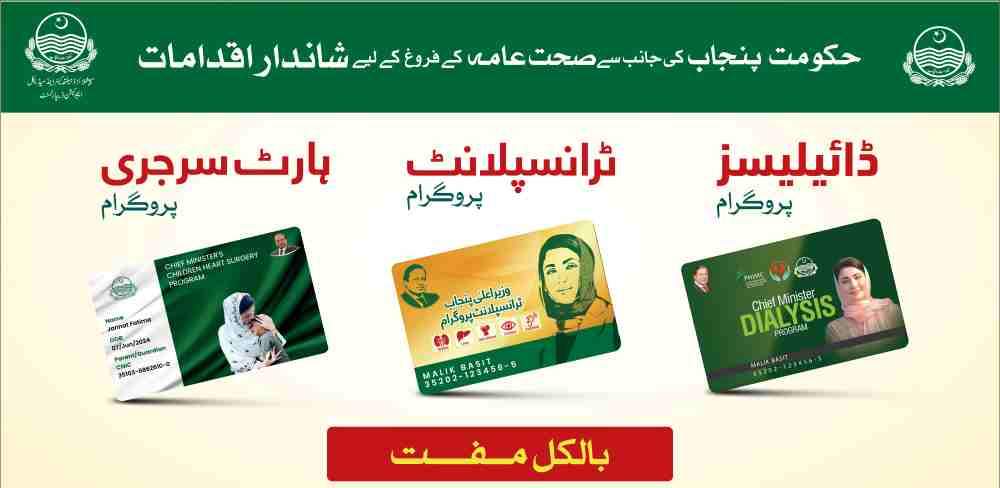
Chief Minister Maryam Nawaz Sharif personally champions this program. She issued clear directives that dialysis must continue regardless of fund availability and mandated strict infection control protocols following concerns about patient safety at certain centers.
What Is the Role of PHIMC in Managing This Card?
The Punjab Health Initiative Management Company serves as the implementing partner. PHIMC manages the hospital network, processes registrations, monitors treatment quality, ensures transparent fund utilization, and maintains digital records for every patient across the province.
What Is the Total Financial Coverage and What Does It Include?
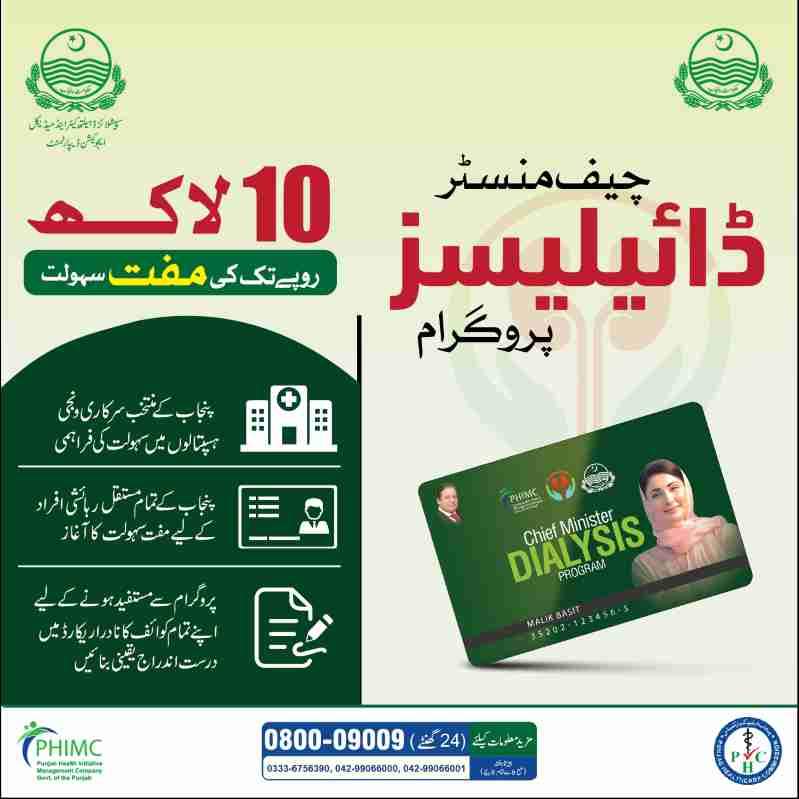
The financial package under this card is designed to cover all aspects of dialysis care, not just the sessions themselves.
How Much Financial Coverage Does the Dialysis Card Provide Annually?
Each registered patient receives total coverage of PKR 1,000,000 per year. This amount refreshes annually for patients who continue to require dialysis, ensuring uninterrupted lifelong care.
Is the Coverage Amount Broken Down Into Specific Categories?
Yes, the allocation follows a specific structure:
- PKR 850,000 for Dialysis Sessions: This portion covers the cost of actual dialysis procedures, including machine usage, consumables, and staff services.
- PKR 150,000 for Allied Treatments: This fund covers supporting medical needs essential for effective dialysis.
Does the Card Cover the Cost of Lab Tests and Medicines?
Yes, absolutely. The allied treatment allocation specifically includes:
- Monthly blood tests to monitor kidney function
- Complete blood count and electrolyte panels
- Hepatitis B and C screening
- Essential injectable medicines including erythropoietin and heparin
- Oral medications prescribed in connection with dialysis
Does the Card Cover Kidney Transplant Expenses?
The card does not cover kidney transplant surgery itself. However, the allied treatment fund covers AV Fistula creation—the vascular access surgery required before dialysis can begin—which is also a necessary step for patients awaiting transplant. For transplant surgery, patients should explore the separate Chief Minister Punjab Transplant Programme launched in 2025.
Are Diagnostic Tests for Kidney Disease Free Under This Initiative?
Yes, all diagnostic tests directly related to dialysis treatment are covered. These include pre-dialysis assessments, monthly monitoring tests, and any urgent tests required due to complications.
Does the Card Cover Complications Arising During Treatment?
Yes. If a patient experiences complications during a dialysis session at an empaneled hospital, the management of those acute complications is covered under the program. This includes emergency interventions, additional medications, and extended monitoring when medically necessary.
CM Punjab Transplant Program Hospital List
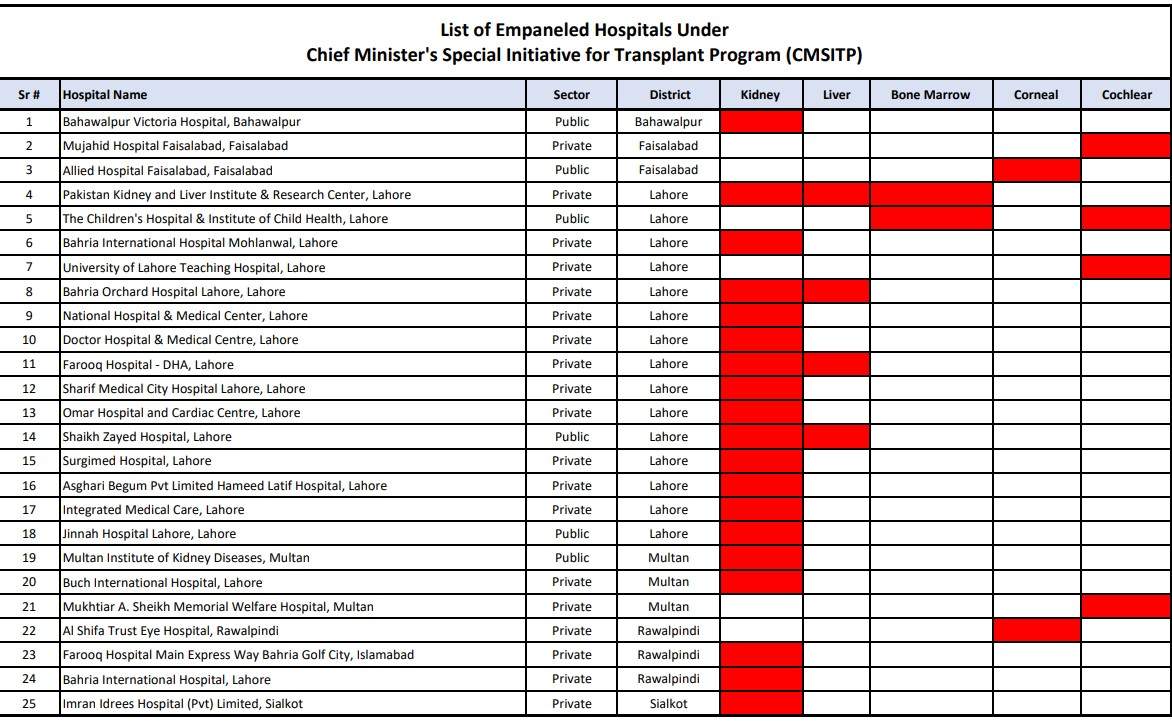
| Hospital Name | Sector | District | Kidney | Liver | Bone Marrow | Corneal | Cochlear |
|---|---|---|---|---|---|---|---|
| Bahawalpur Victoria Hospital | Public | Bahawalpur | Yes | No | No | No | No |
| Mujahid Hospital Faisalabad | Private | Faisalabad | No | No | No | Yes | Yes |
| Allied Hospital Faisalabad | Public | Faisalabad | No | No | Yes | No | No |
| Pakistan Kidney and Liver Institute & Research Center | Private | Lahore | Yes | Yes | Yes | No | No |
| The Children’s Hospital & Institute of Child Health | Public | Lahore | No | No | Yes | Yes | Yes |
| Bahria International Hospital Mohlanwal | Private | Lahore | Yes | No | No | No | No |
| University of Lahore Teaching Hospital | Private | Lahore | No | No | No | Yes | Yes |
| Bahria Orchard Hospital Lahore | Private | Lahore | Yes | Yes | No | No | No |
| National Hospital & Medical Center | Private | Lahore | Yes | No | No | No | No |
| Doctor Hospital & Medical Centre | Private | Lahore | Yes | No | No | No | No |
| Farooq Hospital – DHA | Private | Lahore | Yes | Yes | No | No | No |
| Sharif Medical City Hospital Lahore | Private | Lahore | Yes | No | No | No | No |
| Omar Hospital and Cardiac Centre | Private | Lahore | Yes | No | No | No | No |
| Shaikh Zayed Hospital | Public | Lahore | Yes | Yes | No | No | No |
| Surgimed Hospital | Private | Lahore | Yes | No | No | No | No |
| Asghari Begum Pvt Limited Hameed Latif Hospital | Private | Lahore | Yes | No | No | No | No |
| Integrated Medical Care | Private | Lahore | Yes | No | No | No | No |
| Jinnah Hospital Lahore | Public | Lahore | Yes | No | No | No | No |
| Multan Institute of Kidney Diseases | Public | Multan | Yes | No | No | No | No |
| Buch International Hospital | Private | Multan | Yes | No | No | No | Yes |
| Mukhtiar A. Sheikh Memorial Welfare Hospital | Private | Multan | No | No | No | Yes | Yes |
| Al Shifa Trust Eye Hospital | Private | Rawalpindi | No | No | No | Yes | No |
| Farooq Hospital Main Express Way Bahria Golf City | Private | Rawalpindi | Yes | No | No | No | No |
| Bahria International Hospital | Private | Rawalpindi | Yes | No | No | No | No |
| Imran Idrees Hospital (Pvt) Limited | Private | Sialkot | Yes | No | No | No | No |
Public / Government Hospitals Empaneled Under CM Punjab Transplant Program
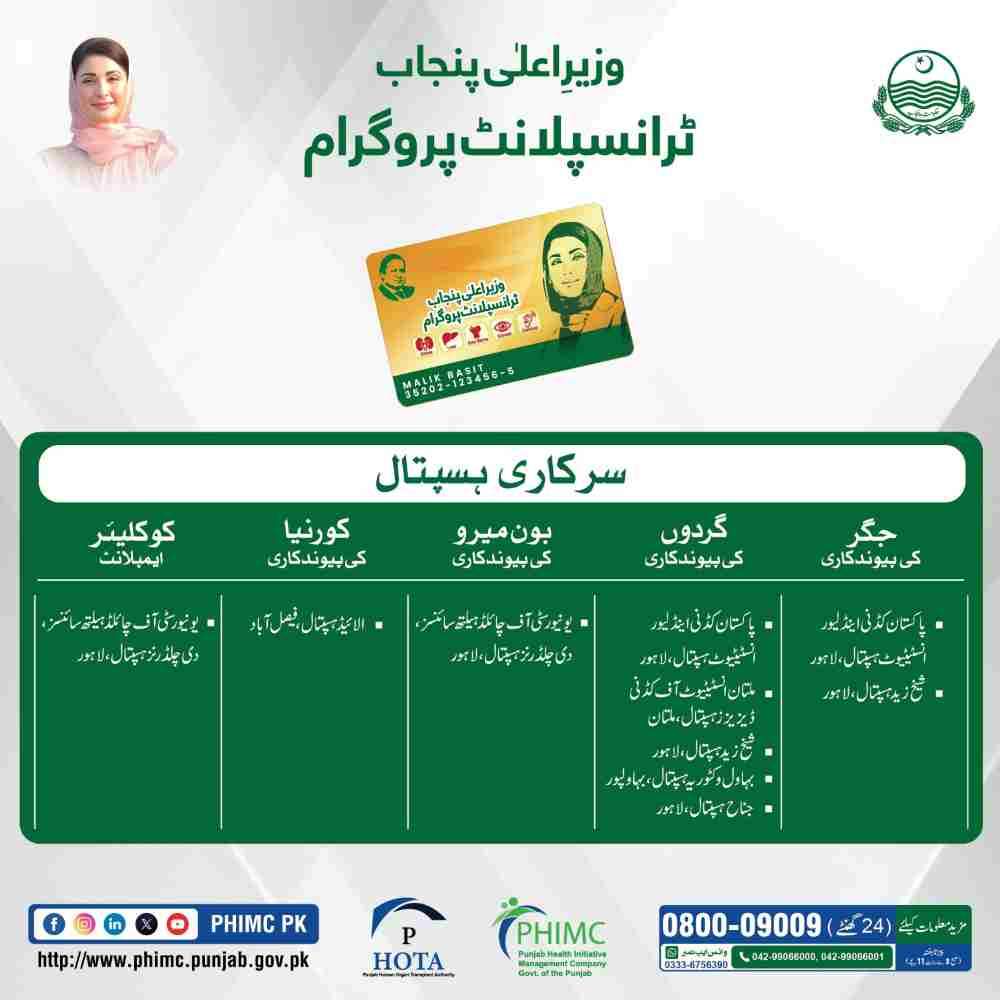
| Hospital Name | District | Kidney | Liver | Bone Marrow | Corneal | Cochlear |
|---|---|---|---|---|---|---|
| Bahawalpur Victoria Hospital, Bahawalpur | Bahawalpur | Yes | No | No | No | No |
| Allied Hospital Faisalabad | Faisalabad | No | No | Yes | No | No |
| The Children’s Hospital & Institute of Child Health, Lahore | Lahore | No | No | Yes | Yes | Yes |
| Shaikh Zayed Hospital, Lahore | Lahore | Yes | Yes | No | No | No |
| Jinnah Hospital Lahore | Lahore | Yes | No | No | No | No |
| Multan Institute of Kidney Diseases | Multan | Yes | No | No | No | No |
Total Public Hospitals: 6 Key Observation: Public hospitals tend to focus more on kidney, bone marrow, corneal, and cochlear procedures, with strong pediatric and specialized institute presence (e.g., Children’s Hospital Lahore and Shaikh Zayed).
Private Hospitals Empaneled Under CM Punjab Transplant Program
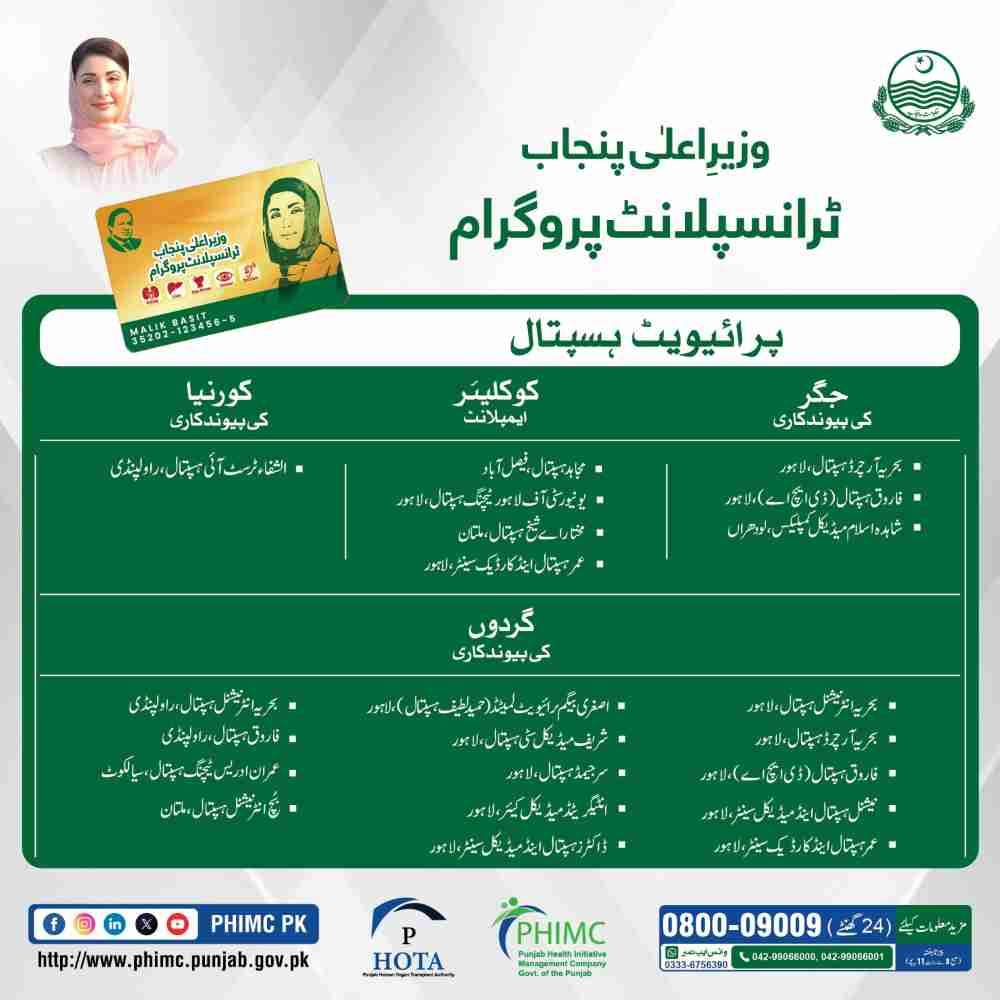
| Hospital Name | District | Kidney | Liver | Bone Marrow | Corneal | Cochlear |
|---|---|---|---|---|---|---|
| Mujahid Hospital Faisalabad | Faisalabad | No | No | No | Yes | Yes |
| Pakistan Kidney and Liver Institute & Research Center, Lahore | Lahore | Yes | Yes | Yes | No | No |
| Bahria International Hospital Mohlanwal, Lahore | Lahore | Yes | No | No | No | No |
| University of Lahore Teaching Hospital, Lahore | Lahore | No | No | No | Yes | Yes |
| Bahria Orchard Hospital Lahore | Lahore | Yes | Yes | No | No | No |
| National Hospital & Medical Center, Lahore | Lahore | Yes | No | No | No | No |
| Doctor Hospital & Medical Centre, Lahore | Lahore | Yes | No | No | No | No |
| Farooq Hospital – DHA, Lahore | Lahore | Yes | Yes | No | No | No |
| Sharif Medical City Hospital Lahore | Lahore | Yes | No | No | No | No |
| Omar Hospital and Cardiac Centre, Lahore | Lahore | Yes | No | No | No | No |
| Surgimed Hospital, Lahore | Lahore | Yes | No | No | No | No |
| Asghari Begum Pvt Limited Hameed Latif Hospital | Lahore | Yes | No | No | No | No |
| Integrated Medical Care, Lahore | Lahore | Yes | No | No | No | No |
| Buch International Hospital | Multan | Yes | No | No | No | Yes |
| Mukhtiar A. Sheikh Memorial Welfare Hospital | Multan | No | No | No | Yes | Yes |
| Al Shifa Trust Eye Hospital | Rawalpindi | No | No | No | Yes | No |
| Farooq Hospital Main Express Way Bahria Golf City | Rawalpindi | Yes | No | No | No | No |
| Bahria International Hospital | Rawalpindi | Yes | No | No | No | No |
| Imran Idrees Hospital (Pvt) Limited | Sialkot | Yes | No | No | No | No |
Total Private Hospitals: 19 Key Observation: Private hospitals dominate the list (especially in Lahore), providing the majority of kidney, liver, corneal, and cochlear services. This public-private partnership significantly expands capacity and geographic reach under the free transplant scheme.
Who Is Eligible for the CM Punjab Dialysis Card Program?
Understanding eligibility requirements helps applicants determine whether they qualify before beginning the registration process.
Who Is Eligible for the Free Dialysis Program in Punjab?
Eligibility requires meeting three core criteria simultaneously:
- Punjab Residency: The applicant must be a permanent resident of Punjab, verified through CNIC address
- Valid CNIC: A NADRA-verified Computerized National Identity Card is mandatory
- Medical Diagnosis: Confirmed diagnosis of chronic kidney disease requiring regular dialysis
Is There an Income Limit or Poverty Score Requirement?
The program prioritizes low-income and deserving families. Households registered with Benazir Income Support Programme or listed in the National Socio-Economic Registry with poverty scores below the designated threshold receive priority processing. However, the government’s stated aim is to cover all citizens in need, so families above the threshold may still qualify if dialysis costs create financial hardship.
What Is the Maximum Age Limit to Apply?
There is no upper age limit whatsoever. Senior citizens are explicitly included and often receive priority consideration given their vulnerability and fixed incomes.
Can Senior Citizens Apply Separately?
Senior citizens apply through the exact same process as all other applicants. No separate application form or special enrollment counter exists—they simply follow the standard procedure at any major government hospital.
Is the Card Available for Residents of Other Provinces?
The program is officially designed for Punjab residents only. However, news reports confirm that patients from Sindh and Balochistan have received treatment at Punjab hospitals, typically on humanitarian grounds or through informal inter-provincial arrangements. Punjab residents naturally receive first priority at all times.
Is the Card Valid for Afghan Refugees Living in Punjab?
The program links directly to Pakistani CNIC records. Afghan refugees holding Proof of Registration cards do not possess Pakistani CNICs and therefore cannot be registered under this specific scheme. They may access dialysis through other public sector facilities designed for refugee populations.
How to Apply for the CM Punjab Dialysis Card: A Step-by-Step Guide
The registration process is designed to be straightforward and accessible, even for patients with limited education or resources.
How Can I Apply for the CM Punjab Dialysis Card?
Follow this step-by-step process to register successfully:
Step 1: Visit a Designated Government Hospital
Go to the nearest District Headquarters Hospital, Tehsil Headquarters Hospital, or major teaching hospital in your city. These facilities have dedicated registration desks for the program.
Step 2: Consult the Nephrologist
Meet with the hospital’s nephrologist or dialysis unit doctor. They will evaluate your medical condition and confirm whether dialysis is medically necessary. Obtain a written prescription or referral note.
Step 3: Gather Required Documents
Collect all necessary documentation before approaching the registration desk to avoid multiple trips.
Step 4: Submit Documents at the Registration Desk
Visit the CM Punjab Health Card registration counter with your complete documents. Staff will assist you in filling out the application form.
Step 5: Biometric Verification
Your thumbprint and CNIC will be verified through NADRA’s system to confirm identity and Punjab residency.
Step 6: Receive Confirmation
Upon approval, you will receive an SMS confirmation on your registered mobile number. Your digital card becomes active in the system.
Read More: CM Punjab Internship Program Apply Online (Get PKR 70K)
Is There an Online Portal to Register?
Yes, the government has launched digital registration options. Visit the official Punjab Health Department website at health.punjab.gov.pk. Navigate to the CM Punjab Dialysis Card section, enter your CNIC number, upload required documents, and submit the online form. Digital applications are processed within 7 to 15 working days.
What Documents Are Required for Registration?
Prepare these documents before visiting the hospital:
- Original CNIC with a clear photocopy
- B-Form for patients under 18 years of age
- Medical Reports confirming chronic kidney disease diagnosis
- Doctor’s Prescription or referral note recommending dialysis
- Recent Passport-Sized Photographs (usually 2 copies)
- Proof of Residence such as a utility bill if CNIC address differs from current residence
- Mobile Number registered in the patient’s name for SMS updates
Can I Apply From Home Completely Online?
Initial registration can be completed online through the health department portal. However, most patients still need to visit a hospital eventually for biometric verification and to establish their medical record with the dialysis unit. Some hospitals now accept digital cards without requiring a physical card.
How Do I Check Eligibility via SMS?
Send your CNIC number without dashes to 8500. Within seconds, you will receive a reply confirming your eligibility status under the Sehat Sahulat Program, which is linked to the dialysis card system. This is the fastest way to verify basic eligibility.
How Do I Check Application Status Online?
Visit health.punjab.gov.pk and click on the “Application Status” or “Check Eligibility” section. Enter your CNIC number in the provided field. The system displays your current status: Pending, Under Review, Approved, or Card Issued.
What If My CNIC Is Not Registered for the Program?
Visit your nearest District Headquarters Hospital with your medical reports. Hospital staff can manually register you in the PHIMC database by linking your medical records to your CNIC. This overrides any system gaps and creates your record from scratch.
How Long Does Card Activation Take After Registration?
Standard processing takes 24 to 72 hours after document verification at the hospital. Digital activation may take slightly longer for online applicants due to verification requirements. You will receive an SMS once your card is active and ready for use.
Which Hospitals Accept the CM Punjab Dialysis Card?
The hospital network continues expanding to ensure patients across all districts can access treatment close to home.
Where Can I Find the Complete List of Empaneled Hospitals?
The official PHIMC website maintains the most current and complete hospital list. You can also call the helpline at 0800-09009 for assistance finding a hospital near you.
Which Hospitals in Lahore Accept the Card?
Lahore patients can access treatment at these major facilities:
- Mayo Hospital Lahore
- Jinnah Hospital Lahore
- Services Hospital Lahore
- Punjab Kidney and Liver Institute
- Ganga Ram Hospital
- Shaikh Zayed Hospital
- General Hospital Lahore
- Shalimar Hospital (private partner)
What Are the Empaneled Hospitals in Rawalpindi?
Rawalpindi residents should visit:
- Holy Family Hospital Rawalpindi
- Benazir Bhutto Hospital
- District Headquarters Hospital Rawalpindi
- Pakistan Institute of Medical Sciences may accept Punjab patients through specific memorandums of understanding
Which Faisalabad Hospitals Participate in the Scheme?
Faisalabad patients can receive treatment at:
- Allied Hospital Faisalabad
- District Headquarters Hospital Faisalabad
- Faisalabad Institute of Cardiology Renal Unit
What Are the Dialysis Centers in Multan?
Multan offers these options:
- Nishtar Hospital Multan
- District Headquarters Hospital Multan
- Kidney Center Multan
Are Private Hospitals Included in the Program?
Yes, selected private hospitals participate through public-private partnership agreements. The government continues adding private facilities to reduce patient burden on public hospitals and improve geographic access. Always confirm with the hospital directly whether they accept the card before visiting.
How Do I Find a Dialysis Center Near Me?
Three methods help locate nearby facilities:
- Visit the PHIMC online portal and use the hospital locator feature
- Call the helpline 0800-09009 and request nearest hospital information
- Ask at your nearest government hospital for a referral to the closest empaneled center
Are Tehsil Headquarters Hospitals Included?
Yes, all Tehsil Headquarters Hospitals with functional dialysis units are gradually joining the network. This expansion ensures that rural patients no longer travel long distances to cities for treatment.
How Many Dialysis Sessions Are Covered and What Are Patient Benefits?
Understanding the practical benefits helps patients plan their treatment schedule and know what to expect.
How Many Dialysis Sessions Are Covered Per Month?
There is no fixed numerical limit on sessions. The PKR 850,000 allocation for dialysis covers approximately 150 to 156 sessions per year, which aligns with the standard medical recommendation of three sessions per week. If a patient requires additional emergency sessions, these are covered as well when medically justified.
Is Treatment Completely Cashless for Cardholders?
Yes, absolutely. The cashless system is a cornerstone of this program. Patients walk into the hospital, present their card and CNIC, receive treatment, and leave without paying anything. The hospital submits claims to PHIMC and receives direct reimbursement.
Can I Get Free AV Fistula Surgery With This Card?
Yes, AV Fistula surgery is explicitly covered under the PKR 150,000 allied treatment allocation. This surgery creates the vascular access point necessary for dialysis and is often the first major procedure patients require after diagnosis.
What Other Procedures Does the Allied Treatment Cover?
The allied treatment package includes:
- AV Fistula creation and revision surgeries
- Double Lumen Catheter insertion
- Regular laboratory tests including kidney function tests
- Complete blood counts and electrolyte panels
- Injectable medications including erythropoietin and iron sucrose
- Oral medications prescribed for dialysis patients
Does the Program Cover Hepatitis Treatment?
If a patient contracts hepatitis B or C during treatment at an empaneled hospital, the facility is responsible for managing the complication. The government has mandated strict infection control protocols through the Punjab Healthcare Commission to prevent such incidents. Long-term hepatitis treatment may require referral to specialized programs.
How Do I Transfer Treatment From One Hospital to Another?
Follow these steps for a smooth transfer:
- Inform your current hospital about your intention to transfer
- Obtain a complete discharge summary and medical records
- Visit the new empaneled hospital with your card and records
- Register at the new facility’s dialysis unit
- Your digital record allows seamless continuation of treatment
Can I Use the Card in Emergency Situations at Non-Empaneled Hospitals?
For the treatment to remain free, it must occur at an empaneled hospital. In genuine emergencies, patients may visit any nearby hospital for stabilization, but they should transfer to an empaneled facility as soon as medically stable to continue cashless treatment.
How Do I Renew the Card Once the Limit Is Reached?
The PKR 1 million coverage is an annual package. The card automatically renews each year based on continued medical need. Patients do not need to reapply annually; the system maintains their record and eligibility status.
What Is the Government’s Role in Monitoring and Quality Control?
Patient safety and program transparency receive serious attention through multiple oversight mechanisms.
How Does the Government Prevent Infections at Dialysis Centers?
The Punjab Healthcare Commission actively monitors all dialysis centers. Following concerns about infection spread at certain facilities, Chief Minister Maryam Nawaz Sharif issued strict directives mandating SOP implementation across all centers. Regular inspections occur, and violations result in immediate action.
What Is the Punjab Healthcare Commission’s Role?
The PHC performs these critical functions:
- Conducts unannounced inspections of dialysis centers
- Verifies infection control protocol compliance
- Ensures proper sterilization of equipment
- Monitors staff qualifications and training
- Takes disciplinary action against violating centers
- Publishes inspection reports for public transparency
How Does the Program Ensure Transparency?
Multiple layers ensure transparent operation:
- NADRA biometric verification prevents identity fraud
- Digital records track every dialysis session in real time
- PHIMC monitors hospital claims against patient records
- Audit trails exist for all fund utilization
- Public dashboards show program performance metrics
What Should I Do If a Hospital Demands Payment?
Treatment is 100% free. If any hospital demands payment from a cardholder, take immediate action:
- Refuse to pay and ask to speak with the hospital administrator
- Call the PHIMC helpline at 0800-09009 immediately
- Report the incident through the PHIMC website grievance system
- Note the name of the staff member demanding payment
- Provide all details to helpline operators for investigation
How Do I Report a Hospital That Refuses to Accept the Card?
Use these reporting channels:
- Call the official helpline 0800-09009
- Email complaints to the PHIMC grievance cell
- Visit the PHIMC website and use the complaint submission form
- Contact the Punjab Healthcare Commission directly
- Report at the nearest District Health Authority office
CM Punjab Dialysis Card vs. Sehat Sahulat Card: Understanding the Difference
Many citizens confuse these two health cards. Understanding the distinction helps patients access appropriate benefits.
Is the Dialysis Card Different From the Sehat Sahulat Card?
Yes, these are distinct programs serving different purposes. The Sehat Sahulat Card functions as broad health insurance covering hospitalization for various medical conditions including surgeries, maternity care, and accidents. The CM Punjab Dialysis Card is a specialized program exclusively for chronic kidney disease patients requiring regular dialysis.
Can I Use Both Cards Simultaneously?
Patients may be registered in both programs. For dialysis treatment, they should use the dedicated Dialysis Card mechanism. For other medical needs such as surgery or hospitalization unrelated to dialysis, the Sehat Sahulat Card provides coverage. The two programs complement rather than replace each other.
What Is the Difference Between PKR 850,000 and PKR 1.5 Million in the Program?
Earlier announcements sometimes created confusion about these figures. The current confirmed structure is:
- Total Coverage: PKR 1,000,000 per patient annually
- Dialysis Allocation: PKR 850,000 of the total
- Allied Treatment: PKR 150,000 of the total
The PKR 1.5 million figure mentioned in some early announcements referred to expanded coverage plans that have since been structured as described above.
Does the Sehat Card Cover Dialysis at All?
The Sehat Sahulat Card may cover limited dialysis during hospitalization for acute kidney injury, but it is not designed for chronic, recurring dialysis needs. This is precisely why the dedicated Dialysis Card was created—to address the long-term, recurring nature of kidney failure treatment.
Real Impact: How the Dialysis Card Changes Lives
Numbers tell only part of the story. Real patient experiences demonstrate the program’s transformative power.
What Do Patient Stories Reveal About the Program’s Impact?
Thousands of families have shared their experiences since the program launched. A patient from Bahawalpur named Rashida Bibi required dialysis for three years while her husband spent his entire daily wage on treatment, accumulating debt that threatened their family’s future. After receiving the card, her treatment became completely free, and her husband no longer faces the impossible choice between his wife’s life and his children’s food.
Another patient, Muhammad Akbar from Gujranwala, was skipping dialysis sessions every other week due to cost constraints. His health deteriorated rapidly until card enrollment allowed regular treatment. He now maintains stable health and continues working to support his three children.
How Many Patients Have Benefited So Far?
Within months of launch, over 45,000 dialysis sessions were conducted free of charge through the program. Patient registrations continue growing as awareness spreads and hospital networks expand.
What Economic Relief Does the Program Provide?
Each dialysis session costs between PKR 3,000 and PKR 6,000 in the private sector. For patients requiring three sessions weekly, monthly costs range from PKR 36,000 to PKR 72,000—far exceeding most family incomes. The card eliminates this entire expense, freeing family resources for nutrition, education, and housing.
Challenges and Future Improvements
Honest assessment of challenges helps citizens understand limitations while advocating for improvements.
What Current Challenges Does the Program Face?
Several challenges require ongoing attention:
- Awareness Gaps: Many rural patients remain unaware of the program and continue struggling with dialysis costs unnecessarily
- Hospital Capacity: Popular centers in major cities face overwhelming demand, causing waiting times
- Supply Shortages: Occasional consumable shortages disrupt treatment schedules
- Documentation Barriers: Patients without CNICs or incomplete NSER registration face enrollment difficulties
How Is the Government Addressing These Challenges?
The government pursues multiple solutions simultaneously:
- Awareness campaigns through media and health workers
- Expanding dialysis units in underserved districts
- Improving supply chain management for consumables
- Streamlining registration for patients with documentation gaps
- Adding private hospitals to reduce public facility burden
What Future Expansions Are Planned?
The government has announced plans to establish additional dialysis units across Punjab, particularly in districts currently underserved. Modern machinery procurement continues, and private sector partnerships are expanding. The ultimate goal is ensuring every patient accesses treatment within reasonable distance from home.
Frequently Asked Questions
Q1: What is the CM Punjab Dialysis Card?
It is a government-issued health card providing free dialysis treatment to registered kidney patients across Punjab. The card covers up to PKR 1 million annually, including dialysis sessions, lab tests, medicines, and AV Fistula surgeries.
Q2: Who can apply for the Dialysis Card?
Any permanent Punjab resident with a valid CNIC and a confirmed diagnosis of chronic kidney disease requiring dialysis can apply. Low-income families receive priority, but there is no upper age limit.
Q3: How many dialysis sessions are covered per month?
There is no fixed limit. The PKR 850,000 allocation covers approximately three sessions per week throughout the year, aligning with standard medical recommendations for chronic kidney disease patients.
Q4: Can private hospital patients use this card?
Yes, if the private hospital is empaneled under the Punjab Health Initiative Management Company. The network includes selected private facilities partnering with the government to expand access.
Q5: How do I check my dialysis card status online?
Visit health.punjab.gov.pk, click on “Application Status,” enter your CNIC number, and view your current status. You can also send your CNIC to 8500 via SMS for eligibility verification.
Q6: What documents are required for registration?
You need your original CNIC, medical reports confirming kidney disease diagnosis, a doctor’s prescription recommending dialysis, recent photographs, and proof of Punjab residence.
Q7: Is the Dialysis Card completely free?
Yes, absolutely. The card is issued free of charge, and all covered treatment is completely cashless. No patient pays anything for dialysis sessions, tests, or medicines at empaneled hospitals.
Q8: Does the card cover kidney transplant surgery?
No, the Dialysis Card specifically covers dialysis and related treatments. For transplant surgery, patients should explore the separate Chief Minister Punjab Transplant Programme launched in 2025.

Add a Comment