
Engro Fertilizers Limited (PSX: EFERT) is Pakistan’s premier manufacturer of crop nutrition solutions, commanding approximately 35% market share and operating the country’s most energy-efficient urea production facility.
This definitive guide covers everything you need to know:
- Complete product portfolio breakdown (Nitrogenous, Phosphatic, Potassic, Micronutrients, Crop Protection)
- Latest fertilizer price list for Engro Urea, DAP, NPK, and specialty products
- Current EFERT share price, 52-week range, dividend yield, and valuation metrics
- Financial performance analysis including revenue, net profit, and EPS trends
- Investment outlook comparing EFERT with Fauji Fertilizer Company (FFC)
- Dealer registration process and manufacturing plant locations
- Voice-search optimized FAQs addressing common queries
Key Takeaways
- Price Reality Check: Engro Urea currently retails at PKR 4,436 per 50kg bag (April 2026), while Engro DAP ranges between PKR 14,700–14,850. Another price hike of PKR 75–100 per bag is anticipated.
- Dividend Powerhouse: EFERT offers a trailing dividend yield of 7.14%–7.32% with quarterly payouts. The last ex-dividend date was March 16, 2026, at PKR 4.00 per share.
- Stock Performance Snapshot: EFERT trades at PKR 212.10 (April 17, 2026) with a 52-week range of PKR 145.25–263.30 and market capitalization of PKR 283.22 billion.
- Value-Added Leadership: Engro differentiates through zinc-enriched Zabardast Urea and the Zarkhez NPK range, commanding premium pricing over competitors like FFC and Fatima Fertilizer.
- Read More: Sona DAP 50kg Fauji Fertilizer FFC – Live Price Today
- Read More: Ghazi 65 HP Price In Pakistan Today (AGTL Price)
- Read More: Cotton Rate In Pakistan Today Per 40 Kg | Daily Cotton Rate
- Read More: Kapas Rate In Pakistan Today | Roi Rate Today Per Kg
Engro Fertilizers – Products, Pricing, & Share Price
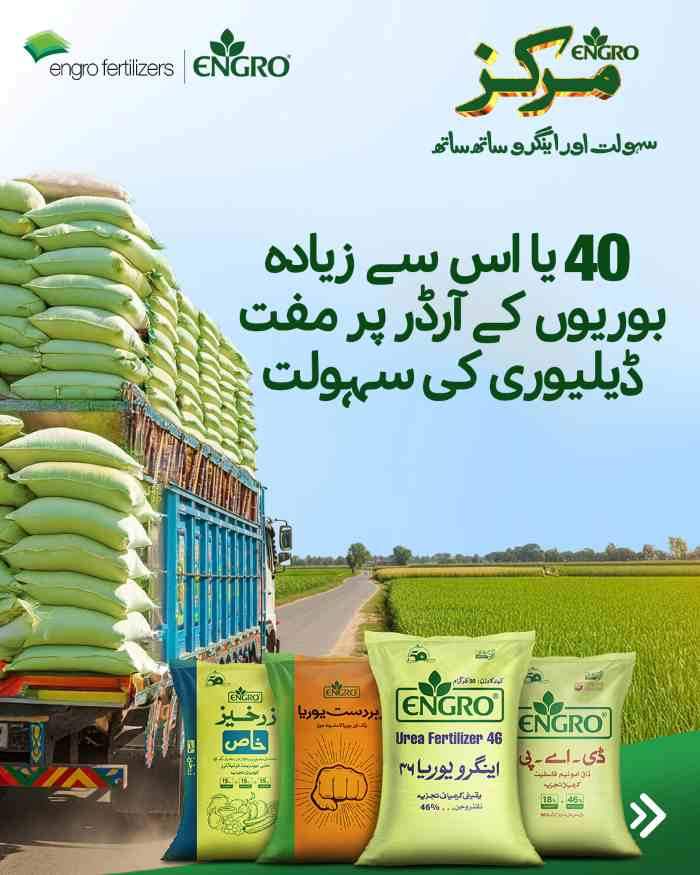
Table Of Contents
What Are the Main Products of Engro Fertilizers?
| Product | Current Price (PKR/50kg) | Previous Price | Change |
|---|---|---|---|
| Engro Urea | 4,436 | 4,286 | +150 |
| Engro DAP | 14,700-14,850 | 14,500-14,700 | +200-150 |
| Zabardast Urea | 5,200-5,550 | 5,000-5,300 | +200-250 |
| Zarkhez Plus | 9,200-9,500 | 8,800-9,100 | +400 |
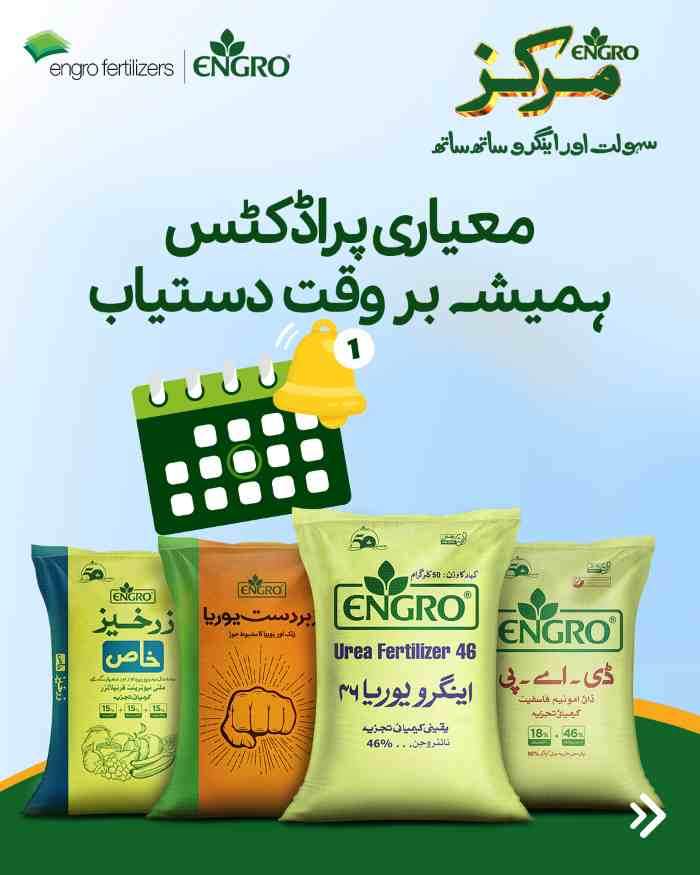
Engro Fertilizers manufactures and markets a diverse portfolio of over 15 specialized crop nutrition products, segmented into Nitrogenous, Phosphatic, Potassic, Micronutrient, and Crop Protection categories. The company’s product strategy moves beyond single-nutrient solutions, offering “value-added” fertilizers that increase crop yield while improving soil health. This comprehensive portfolio directly addresses Pakistan’s varied soil conditions across Punjab, Sindh, Khyber Pakhtunkhwa, and Balochistan.
Nitrogenous Fertilizers: The Engro Urea Family

What is Engro Urea? Chemical Composition and 46% Nitrogen Content. Engro Urea contains 46% nitrogen in granular form, making it the most concentrated nitrogenous fertilizer available in Pakistan. The product is manufactured at the Daharki facility using advanced prilling technology that ensures uniform granule size and consistent nutrient release. Farmers prefer Engro Urea for its low biuret content (below 1.5%), which prevents leaf burn when applied to sensitive crops like rice, sugarcane, and vegetables. The standard 50kg bag covers approximately one acre of wheat or one-half acre of sugarcane, depending on recommended application rates.
Engro Zabardast Urea: What Makes It Different from Standard Urea? Zabardast Urea is Engro’s flagship value-added product that integrates zinc (Zn) into the urea granule. Unlike standard urea that only supplies nitrogen, Zabardast delivers two essential nutrients in a single application. The zinc content (approximately 1-2% by weight) addresses widespread zinc deficiency in Pakistani soils, particularly in rice-wheat cropping systems. The product carries a premium price of PKR 5,200–5,550 per bag, representing a PKR 800–1,000 premium over standard Engro Urea.
How Does Zabardast Urea’s Zinc Technology Enhance Crop Yield? Zinc is a critical micronutrient for enzyme activation, auxin synthesis, and grain formation. Pakistani soils are inherently zinc-deficient, with over 70% of cultivated area showing deficiency symptoms. Zabardast Urea’s zinc coating technology ensures simultaneous delivery of nitrogen and zinc, eliminating the need for separate zinc sulfate applications. Field trials demonstrate 15-20% higher grain yields in rice and 10-15% higher yields in wheat when using Zabardast Urea compared to standard urea.
Engro Ammonium Sulphate: Role and Application in Alkaline Soils. Engro Ammonium Sulphate provides 21% nitrogen and 24% sulfur in a crystalline form. This product is particularly valuable for alkaline and calcareous soils common in Punjab and Sindh, where sulfur helps lower soil pH and improve availability of phosphorus and micronutrients. The product is priced between PKR 4,100–4,500 per 50kg bag and is recommended for oilseed crops (canola, sunflower), pulses, and garlic.
Comparative Analysis: Engro Urea vs. Sona Urea vs. Sarsabz Urea (Current Pricing). As of April 2026, Engro Urea trades at PKR 4,436 per bag, while FFC’s Sona Urea is priced at PKR 4,286, and Sarsabz Urea ranges between PKR 4,450–4,950. Engro commands a PKR 150 premium over FFC, justified by superior granule hardness (reducing dust loss) and lower biuret content. Fatima Fertilizer’s imported urea sells at PKR 3,850–4,100, but farmers report higher volatilization losses and inconsistent granule quality.
Phosphatic Fertilizers: From DAP to Phos Power
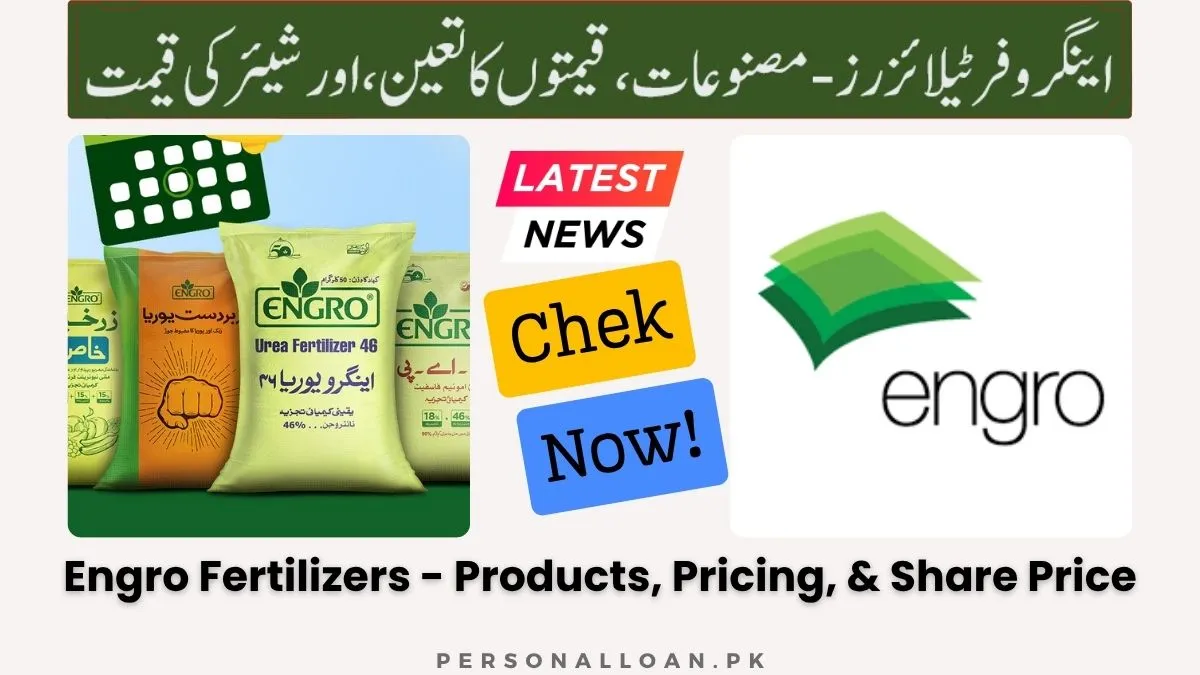
Engro DAP (Diammonium Phosphate): The Backbone of Root Development. Engro DAP contains 18% nitrogen and 46% phosphorus pentoxide (P2O5), making it the preferred starter fertilizer for all major crops. The product promotes robust root development, tillering in wheat, and flowering in cotton. Current market rates range from PKR 14,700 to PKR 14,850 per 50kg bag, with a narrower spread compared to competitors. Engro DAP is manufactured using imported rock phosphate processed at the Port Qasim facility.
What is Engro NP Plus? Analyzing the 18-46-0 Formulation. Engro NP Plus offers the identical NP ratio as DAP but with different physical characteristics. The product is designed for direct application and blending with potassic fertilizers. The current price is approximately PKR 8,300 per bag, making it a cost-effective alternative when DAP prices exceed PKR 14,000. Farmers growing cotton, maize, and sugarcane benefit from NP Plus’s rapid dissolution and plant availability.
Engro Zorawar: The Targeted Solution for Wheat and Rice Crops. Zorawar is a specialized phosphatic fertilizer formulated for rice and wheat cropping systems. The product includes added sulfur (12%) and zinc (2%) to address specific deficiencies in flooded rice conditions. The price ranges from PKR 14,000–14,500 per bag, positioning it as a premium specialty product. Zorawar reduces the need for multiple micronutrient applications, offering convenience for large-scale farmers.
Engro Phos Power: Benefits of Single Super Phosphate (SSP). Engro Phos Power is a water-soluble phosphorus fertilizer containing 18% P2O5, 12% sulfur, and 15% calcium. Unlike DAP, which is produced via chemical reaction, Phos Power is manufactured through acidulation of rock phosphate, resulting in a product that also supplies secondary nutrients. This product is ideal for vegetable crops, orchards, and root crops, where immediate phosphorus availability is critical during early growth stages.
Engro TSP (Triple Super Phosphate): Price and Availability in Pakistan. Triple Super Phosphate contains 46% P2O5 with no nitrogen content, allowing farmers to apply phosphorus independently of nitrogen timing. TSP is particularly useful for leguminous crops (chickpea, lentil, mung bean) that fix their own nitrogen and require only phosphorus. Market prices for Engro TSP range between PKR 12,000–13,000 per bag, with availability concentrated in the Rabi season (October–March).
Potassic and NPK Complex: The Zarkhez Range Explained
What is Engro Zarkhez and What Are Its Benefits for General Crops? Engro Zarkhez is the company’s flagship NPK complex fertilizer, offering balanced crop nutrition tailored to Pakistani soil conditions. The product enhances fruit quality, disease resistance, and water-use efficiency. Zarkhez is available in multiple variants, each formulated for specific crop requirements and growth stages.
Engro Zarkhez Plus: The 8:23:18 NPK Ratio for Fruiting Vegetables. Zarkhez Plus delivers 8% nitrogen, 23% phosphorus, and 18% potassium, making it ideal for tomato, pepper, eggplant, and cucurbits. The high phosphorus content supports flowering and fruit set, while potassium enhances fruit size, color, and shelf life. Current pricing ranges from PKR 9,200–9,500 per 50kg bag.
Engro Zarkhez Khaas (15-15-15): Balanced Nutrition for Orchards. Zarkhez Khaas provides equal proportions of nitrogen, phosphorus, and potassium (15% each), suitable for perennial crops like mango, citrus, and apple orchards. This balanced formulation supports vegetative growth, flowering, and fruit development across the entire growing season. The price ranges from PKR 10,500–11,200 per bag.
Engro MOP (Muriate of Potash) vs. Engro SOP (Sulphate of Potash): Which to Use? MOP (potassium chloride) is the most cost-effective potassium source, priced at PKR 11,500–12,000 per bag, but chloride content can damage chloride-sensitive crops like tobacco, potato, and strawberry. SOP (potassium sulfate) provides potassium without chloride and adds 17% sulfur, making it the preferred choice for high-value crops. Engro SOP is priced at PKR 11,500–11,900 per bag, while granular SOP sells at PKR 11,500–12,000. Farmers growing chloride-tolerant crops like rice, wheat, and maize should select MOP; fruit, vegetable, and tobacco growers require SOP.
What Is the Chemical Component of Engro Potash Power? Engro Potash Power is a water-soluble potassium fertilizer containing 52% potassium oxide (K2O) and 18% sulfur. This product is designed for fertigation systems (drip irrigation) and foliar application, providing rapid potassium uptake during critical growth stages. The 25kg bag is priced at PKR 12,500–12,800.
Engro Blue Special: The High-Potassium Formulation for Quality. Engro Blue Special contains 12% nitrogen, 12% phosphorus, and 24% potassium (12-12-24 NPK), emphasizing potassium for quality improvement. This product is recommended for cotton (fiber quality), potato (tuber size), and sugarcane (sucrose content). Farmers report 10-15% higher net returns when using Blue Special compared to standard NPK blends.
Micronutrients and Specialty Products
What is Engro Zingro Used For in Farming? Engro Zingro is a granular zinc sulfate monohydrate fertilizer containing 33% zinc. It addresses zinc deficiency in rice, wheat, and maize, which manifests as stunted growth, interveinal chlorosis, and reduced grain filling. The product is applied at 8-12 kg per acre during final land preparation. Current pricing for Zingro ranges between PKR 2,100–2,300 for a 3kg pack.
Engro Zoron: Chelated Micronutrient Mix for Foliar Application. Zoron is a water-soluble powder containing chelated zinc, iron, manganese, copper, and boron. The chelation process protects micronutrients from reacting with other elements in spray solution, ensuring maximum plant absorption. Zoron is applied as a foliar spray at 250-500 grams per acre, diluted in 200-300 liters of water. The product is priced at PKR 1,800–2,200 per kg.
Engro Librel Chelated Zinc: Foliar Application Techniques. Librel is a chelated zinc product specifically formulated for foliar feeding. Unlike granular zinc products that require soil incorporation, Librel is applied directly to plant foliage for rapid correction of zinc deficiency symptoms. Application should occur during early morning or late evening to prevent leaf burn. The recommended rate is 500-750 grams per acre, split across two applications at tillering and panicle initiation stages.
Does Engro Produce Organic Fertilizers or Bio-Stimulants? Engro does not currently manufacture certified organic fertilizers, but the company offers bio-stimulant products through its partnership with BASF. These products contain amino acids, seaweed extracts, and beneficial microorganisms that enhance nutrient use efficiency and stress tolerance. The product line is expanding as demand for sustainable agriculture grows, particularly among export-oriented fruit and vegetable growers.
Crop Protection and Pesticides
What Pesticides and Crop Protection Brands Does Engro Offer? Engro’s crop protection portfolio includes insecticides, fungicides, herbicides, and plant growth regulators. Key products include:
- Delegate (spinetoram): An insecticide for control of thrips, leaf miners, and fruit flies in vegetables and fruit crops
- Sefina (afidopyropen): A novel insecticide for aphid control in cotton, wheat, and canola
- Revus (mandipropamid): A fungicide for downy mildew and late blight control in potato, tomato, and cucurbits
- Priaxor (fluxapyroxad + pyraclostrobin): A fungicide for foliar diseases in wheat, soybean, and peanut
Engro’s Strategic Partnership with BASF for Crop Protection. Engro has a strategic distribution agreement with BASF, granting exclusive rights to market BASF’s crop protection products under the Engro brand. This partnership leverages Engro’s extensive dealer network (300+ dealers across 300 cities) and BASF’s research and development capabilities. Farmers benefit from integrated crop solutions where Engro supplies both nutrition and protection products, simplifying farm management.
Engro Fertilizer Price List 2026: Today’s Rates and Market Trends
As of April 2026, the retail price of Engro Urea in Pakistan is approximately PKR 4,436 per 50kg bag, while Engro DAP ranges between PKR 14,700 and PKR 14,850. These prices reflect a recent increase of PKR 150 per bag on Urea effective April 4, 2026, driven by rising global gas prices and adjustments in government subsidy structures. Industry reports indicate another price hike of PKR 75–100 per bag is expected in the coming weeks.
Engro Urea Price in Pakistan Today: Per Bag and Per Ton. The current market range for Engro Urea is PKR 4,350–4,550 per 50kg bag, with PKR 4,436 as the benchmark retail price. Per ton pricing (20 bags per ton) ranges from PKR 87,000 to PKR 91,000. The recent PKR 150 increase effective April 4, 2026, was implemented to offset rising natural gas feedstock costs, as gas constitutes approximately 70-75% of urea production costs.
Engro DAP Price in Pakistan: The PKR 14,700–14,850 Reality and Market Drivers. Engro DAP currently sells at PKR 14,700–14,850 per 50kg bag, with a narrower spread compared to competitors. DAP prices are sensitive to international phosphate rock and sulfur markets, as Pakistan imports approximately 80% of its DAP requirements. The first two months of 2026 saw DAP sales increase 17% year-on-year to 118,000 tonnes, driven by improved phosphate availability and farmer confidence in Rabi season returns.
Engro NPK Price in Pakistan: Zarkhez, Zarkhez Plus, and Khaas Rates. The complete Zarkhez range pricing is as follows:
- Zarkhez (standard): PKR 8,200–8,800 per 50kg bag
- Zarkhez Plus (8:23:18): PKR 9,200–9,500 per 50kg bag
- Zarkhez Khaas (15-15-15): PKR 10,500–11,200 per 50kg bag
Engro SOP Power Price: Estimated at PKR 12,695 per 50kg. Engro SOP Power (sulfate of potash) is priced between PKR 11,500 and 12,700 per bag, depending on dealer margins and transportation costs. SOP Power supplies 50% potassium oxide (K2O) and 17% sulfur, making it the premium potassium source for chloride-sensitive crops.
Engro NP Plus Price: Current Market Rate of PKR 8,300 per Bag. NP Plus (18-46-0) trades at approximately PKR 8,300 per bag, representing a PKR 6,400–6,550 discount compared to Engro DAP. Farmers seeking phosphorus without the nitrogen load prefer NP Plus for leguminous crops and for blending with urea to achieve custom NP ratios.
Engro TSP Fertilizer Price in Pakistan: Market Comparison. Engro TSP (triple super phosphate, 0-46-0) sells at PKR 12,000–13,000 per bag. TSP provides phosphorus without nitrogen, allowing farmers to tailor nitrogen application timing independently. The product is particularly popular for chickpea, lentil, and mung bean crops that fix atmospheric nitrogen and require no supplemental nitrogen.
Engro Zinc Price in Pakistan (Zingro and Chelated Zinc). Engro Zingro (granular zinc sulfate) sells at PKR 2,100–2,300 per 3kg bag. Librel Chelated Zinc (foliar formulation) is priced at PKR 1,800–2,200 per kg. Zinc products have gained popularity following Engro’s successful Zabardast Urea campaign, which educated farmers on zinc deficiency symptoms and correction strategies.
Why Did Engro Fertilizers Increase Its Urea Prices Recently? Engro increased urea prices by PKR 150 per bag effective April 4, 2026, in response to higher natural gas feedstock costs and reduced government subsidies. Natural gas constitutes 70-75% of urea production costs, and recent tariff adjustments increased the cost of feed gas by approximately 15-20%. Additionally, global urea prices have risen due to production curtailments in China and Europe, reducing the viability of imports and allowing domestic producers to adjust prices upward.
How Do Gas Prices Affect Engro Fertilizers’ Production Costs? Engro’s Daharki plant consumes approximately 2.3 million tons of urea production capacity annually, with natural gas as the primary feedstock. Gas costs represent 70-75% of variable production costs. Every 10% increase in gas prices raises Engro’s cost of goods sold by approximately 7-8%, compressing gross margins. The company partially offsets gas cost increases through efficiency gains, having invested $100 million in the Gas Pressure Enhancement Facility (PEF) project, which reduced gas consumption per ton of urea by 5-7%.
Subsidy Impact: Government’s Role in Determining Retail Price Caps. The Government of Pakistan historically provided subsidies to fertilizer manufacturers to maintain affordable Urea prices for farmers. Recent subsidy reforms have reduced government support, allowing prices to reflect market conditions more accurately. The subsidy mechanism has shifted from direct manufacturer support to targeted farmer support through the Kisan Card program, which provides cash transfers to smallholders for input purchases.
Historical Data: Engro Fertilizer Price List Comparison. The following table illustrates price trends over recent periods:
| Product | Current Price (PKR/50kg) | Previous Price | Change |
|---|---|---|---|
| Engro Urea | 4,436 | 4,286 | +150 |
| Engro DAP | 14,700-14,850 | 14,500-14,700 | +200-150 |
| Zabardast Urea | 5,200-5,550 | 5,000-5,300 | +200-250 |
| Zarkhez Plus | 9,200-9,500 | 8,800-9,100 | +400 |
Read More: Samsung LED Price In Pakistan 32 Inch (Updated)
What Is the Current Share Price of Engro Fertilizers (EFERT)?
As of the market close on April 17, 2026, Engro Fertilizers (EFERT) is trading at PKR 212.10 on the Pakistan Stock Exchange, reflecting a year-to-date volatility that has seen a 52-week range of PKR 145.25 to PKR 263.30. This valuation places the company at a market capitalization of approximately PKR 283.22 billion, maintaining its status as a blue-chip stock within the KSE-100 Index. Trading volumes average 1.97 million shares daily, indicating high liquidity for institutional and retail investors alike.
Live Data: Current Bid, Ask, and Open Interest for EFERT. The most recent trading session recorded an opening price of PKR 209.00, a daily high of PKR 214.00, and a daily low of PKR 209.00. The bid-ask spread typically ranges from PKR 0.50 to PKR 1.00, reflecting active market making. Open interest in EFERT futures contracts stands at approximately 2.5 million shares, suggesting moderate speculative interest ahead of the earnings announcement scheduled for April 20, 2026.
What Is the 52-Week High and Low for EFERT Stock? EFERT’s 52-week trading range is PKR 145.25 (low) to PKR 263.30 (high). The all-time high of PKR 263.30 was reached in early 2026, driven by strong dividend expectations and optimism about the Rabi season crop outlook. The 52-week low of PKR 145.25 was touched during a broad market correction in mid-2025, when concerns about gas tariff increases and declining urea offtake pressured the entire fertilizer sector.
Intraday Chart Analysis: Price Action for the Week of April 20, 2026. Technical indicators show the stock trading above its 50-day moving average (PKR 205.50) but below its 200-day moving average (PKR 220.30), indicating a neutral to slightly bullish intermediate-term trend. The Relative Strength Index (RSI) stands at 54.86, suggesting the stock is neither overbought nor oversold. Support levels are identified at PKR 200 and PKR 190, while resistance levels are at PKR 220 and PKR 230.
How Has the EFERT Share Price Performed Over the Last Five Years? EFERT has delivered a total shareholder return (including dividends) of approximately 35% over the last five years. Annual performance highlights:
- 2021: +15.2% (price appreciation) plus 8% dividend yield = 23.2% total return
- 2022: -8.5% price decline amid flood-related agriculture disruptions
- 2023: +22.0% recovery driven by strong Rabi crop yields and dividend increases
- 2024: +12.3% continued growth with stable gas pricing
- 2025: -4.5% decline following profit warning and reduced discounts
- 2026 YTD: -6.2% reflecting price correction from all-time high
Correlation: When Fertilizer Prices Rise, Does EFERT Stock Follow? EFERT stock price shows a positive but imperfect correlation (approximately 0.65) with fertilizer retail prices. Higher retail prices increase revenue per ton, but production costs (particularly gas) often rise simultaneously, compressing margins. Stock price responds more strongly to margin expectations than to headline price increases. The recent PKR 150 urea price increase on April 4, 2026, was followed by a 2.3% stock price increase over the subsequent week, as investors interpreted the move as margin-protective.
Trading Volume Analysis: Who Is Buying EFERT Right Now? Institutional investors (mutual funds, pension funds, and insurance companies) hold approximately 45% of EFERT’s free float. Foreign investors hold 12-15% through GDRs and direct market purchases. Retail investors account for the remaining 40-43%. Recent trading patterns show increased retail buying on dips below PKR 200, while institutional investors accumulate positions ahead of the ex-dividend date.
Technical Indicators: RSI, MACD, and Moving Averages for EFERT. Current technical readings:
- RSI (14-day): 54.86 (neutral)
- MACD (12,26,9): Slightly positive crossover, suggesting bullish momentum
- 50-day moving average: PKR 205.50
- 200-day moving average: PKR 220.30
- Bollinger Bands: Price trading in the upper half of the bands, indicating moderate upward momentum
Market Sentiment: Bullish vs. Bearish Outlook for Q2 2026. Analyst consensus remains bullish, with 8 analysts covering the stock and an average 12-month price target of PKR 248.50, representing 17.07% upside from current levels. Bullish arguments cite the company’s dominant market position, consistent dividend history, and ongoing efficiency improvements. Bearish concerns focus on gas price volatility, declining urea offtake (77% year-on-year drop projected for January 2026), and the CEO leadership transition following Ali Rathore’s resignation in March 2026.
Share Price History and Performance Metrics
Engro Fertilizers (EFERT) has delivered a total shareholder return (including dividends) of approximately 35% over the last five years, characterized by a significant bull run in early 2026 that saw the stock hit an all-time high before a sharp correction. Analyzing this historical trajectory reveals the stock’s sensitivity to two primary factors: the announcement of gas tariff revisions by the government (usually negative) and the declaration of bumper dividend payouts (usually positive). The stock has also shown resilience during the inflationary cycles, acting as a hedge against currency devaluation due to its dollar-linked DAP business.
Five-Year Performance: EFERT 2021, 2022, 2023, 2024, 2025. The following table summarizes annual price performance and key events:
| Year | Price Change (%) | Key Event |
|---|---|---|
| 2021 | +15.2% | Post-COVID recovery, strong agriculture season |
| 2022 | -8.5% | Floods disrupt agriculture, gas price volatility |
| 2023 | +22.0% | Record dividend announcements, efficiency gains |
| 2024 | +12.3% | Stable policies, consistent earnings growth |
| 2025 | -4.5% | Profit warning, reduced discounts impact sentiment |
The All-Time High: Analyzing the EFERT Price Surge in Early 2026. EFERT reached an all-time high of PKR 263.30 in early 2026, driven by three factors: (1) announcement of a PKR 8.00 final dividend for 2025, (2) expectations of strong Rabi season crop yields, and (3) technical breakout above previous resistance levels. The surge added approximately PKR 40 billion to market capitalization within three weeks.
The Correction of March 2026: Profit-Taking or Trend Reversal? The stock corrected 15.5% from its all-time high to a low of PKR 222.50 in March 2026. The correction was triggered by (1) profit-taking after the rapid run-up, (2) news of CEO Ali Rathore’s resignation, and (3) concerns about January 2026 urea sales declining 77% year-on-year. Analysts characterized the move as profit-taking within an intact uptrend, noting that the 200-day moving average at PKR 220.30 provided strong support.
Volatility Metrics: Beta Score and Standard Deviation for EFERT. EFERT’s 5-year beta is 0.40, indicating the stock is 60% less volatile than the overall KSE-100 Index. This low beta characteristic makes EFERT attractive for risk-averse investors seeking stable returns. The standard deviation of daily returns is 1.8%, compared to 2.5% for the broader market, confirming the stock’s defensive qualities.
Key Support and Resistance Levels for Short-Term Traders. Technical levels identified by chart analysis:
- Immediate support: PKR 200.00 (psychological level)
- Major support: PKR 190.00 (previous resistance turned support)
- Immediate resistance: PKR 220.00 (50-day moving average)
- Major resistance: PKR 230.00 (December 2025 highs)
How Political and Economic Crises Have Historically Shaped EFERT. EFERT has demonstrated resilience through multiple economic cycles. During the 2022 floods, the stock declined 15% but recovered within four months as reconstruction efforts boosted fertilizer demand. During the 2023 currency crisis, the stock initially fell 12% but rebounded as investors recognized the company’s dollar-linked revenue stream from DAP imports. The stock typically performs best during stable government periods with consistent agriculture policies.
Seasonality Patterns: When Does EFERT Typically Rally? EFERT exhibits distinct seasonal patterns:
- Rabi season (October-March): Typically positive, driven by wheat sowing demand
- Kharif season (April-September): Mixed, dependent on monsoon outlook
- Dividend announcement periods (February and August): Usually positive
- Gas price review periods (quarterly): Volatile, dependent on regulatory outcomes
The 2023 Shutdown of the Port Qasim Plant and Its Stock Impact. The Port Qasm facility experienced a 15-day unplanned shutdown in August 2023 due to feedstock supply disruptions. The announcement triggered a 5% stock price decline, but the stock fully recovered within 10 days as the company confirmed minimal financial impact (approximately PKR 500 million lost production). This incident demonstrated the market’s confidence in Engro’s operational risk management.
A Decade in Review: EFERT Stock Price in 2016 vs. Current. EFERT has grown from approximately PKR 80 per share in 2016 to PKR 212 in 2026, representing a 165% price appreciation over 10 years. Including dividends (average 6-8% annual yield), total shareholder return exceeds 250% over the decade. This performance ranks EFERT among the top 10 performers on the KSE-100 Index over the period.
Does Engro Fertilizers Pay Regular Dividends to Shareholders?
Yes, Engro Fertilizers has a consistent history of paying dividends, with a trailing twelve-month (TTM) dividend yield of approximately 7.07% to 7.32% as of April 2026, making it one of the most attractive income stocks on the PSX. The company typically distributes cash dividends quarterly, with an interim dividend announced in the third quarter and a final dividend approved at the year-end. The payout ratio currently stands at 75.24%, indicating a commitment to returning substantial profits to shareholders while retaining sufficient capital for maintenance and expansion.
Latest News: When Is the Next Dividend Announcement for EFERT? The most recent dividend announcement was a final cash dividend of PKR 4.00 per share for the year ended December 31, 2025, recommended by the Board of Directors on February 11, 2026. The ex-dividend date was March 16, 2026, with payment made to shareholders on April 2, 2026. The next dividend announcement is expected in August 2026 for the half-year ending June 30, 2026, following historical patterns.
Dividend History: Engro Fertilizer Payouts 2024 and 2025. The following table details recent dividend payments:
| Ex-Dividend Date | Cash Amount (PKR) | Pay Date |
|---|---|---|
| March 16, 2026 | 4.000 | April 2, 2026 |
| October 24, 2025 | 4.500 | November 6, 2025 |
| August 8, 2025 | 4.250 | August 20, 2025 |
| April 30, 2025 | 2.250 | May 14, 2025 |
| March 14, 2025 | 8.000 | March 26, 2025 |
Ex-Dividend Date: Understanding the PKR 4.00 Final Dividend for 2025. The final dividend of PKR 4.00 per share was approved for shareholders whose names appeared in the Register of Members on March 16, 2026. Investors purchasing shares on or after the ex-dividend date (March 16, 2026) were not entitled to receive this dividend payment. The total dividend distribution for 2025 amounted to PKR 15.00 per share (interim dividends totaling PKR 11.00 plus final dividend of PKR 4.00), representing a payout ratio of 75.24% of earnings.
What Is the Current Dividend Yield (TTM) of 7.07%? Based on the closing price of PKR 212.10 and annual dividends of PKR 15.00 per share, the trailing dividend yield is 7.07%. Morningstar reports a slightly higher yield of 7.32%, reflecting minor differences in price reference points. This yield significantly exceeds the average bank deposit rate (approximately 5-6%) and government bond yields (approximately 6-7%), making EFERT attractive for income-focused investors.
Interim vs. Final Dividends: Understanding the Payout Structure. Engro typically announces two interim dividends during the fiscal year (May-June and August-September periods) and one final dividend following the annual results (February-March). Interim dividends are paid from half-year profits, while final dividends represent the balance of annual distributable profits after accounting for full-year earnings and capital requirements.
Dividend Reinvestment Plans (DRIPs): Are They Available? Engro Fertilizers does not currently offer a formal Dividend Reinvestment Plan. Shareholders receive cash dividends directly to their designated bank accounts through the Central Depository Company of Pakistan (CDC) system. Investors seeking to reinvest dividends must manually purchase additional shares through their brokerage accounts.
Tax Implications: Withholding Tax on EFERT Cash Dividends. Withholding tax rates on cash dividends for Pakistan residents are as follows:
- Individual shareholders (filers): 15% of gross dividend
- Individual shareholders (non-filers): 30% of gross dividend
- Corporate shareholders: 25% of gross dividend
- Mutual funds and pension funds: 0% (exempt)
Comparing Yields: EFERT Dividend vs. FFC and Fatima Fertilizer. Comparative dividend metrics as of April 2026:
| Company | Dividend Yield | Payout Ratio |
|---|---|---|
| EFERT | 7.07% | 75.24% |
| FFC | 5.8-6.2% | 65-70% |
| Fatima Fertilizer | 4.5-5.0% | 50-55% |
EFERT offers the highest yield among major fertilizer stocks, reflecting its mature market position and consistent cash flow generation.
Will Earnings Growth Support a Higher Dividend in 2026? Analysts project net income of PKR 30.09 billion for 2026, representing 33% growth from 2025’s PKR 22.63 billion. If these projections materialize and the company maintains a 75% payout ratio, annual dividends could increase to PKR 17-18 per share, raising the dividend yield to 8-8.5% at current price levels. However, this depends on successful execution of the leadership transition and stabilization of urea offtake volumes.
Is EFERT a Good Stock for Long-Term Investment?
For long-term investors, EFERT represents a defensive play on Pakistan’s agriculture sector, supported by a Price-to-Earnings (P/E) ratio of 12.39 (TTM) and a forward P/E of 10.21, suggesting it is fairly valued compared to its historical averages. However, the stock faces headwinds from rising gas costs and a potential decline in urea off-take, as evidenced by a 77% year-on-year drop in sales projected for January 2026. This section provides a nuanced analysis for value investors, weighing the company’s robust production capacity against the macroeconomic pressures of subsidy reforms and international commodity price fluctuations.
Fundamental Analysis: EPS, PE Ratio, and Book Value per Share. Current fundamental metrics:
- EPS (TTM): PKR 16.95 (down 19.9% year-on-year)
- P/E Ratio (TTM): 12.39
- Forward P/E: 10.21 (based on 2026 earnings projections)
- Book Value per Share: PKR 34.70 (approximately)
- Price-to-Book Ratio: 6.11
Analyst Consensus: Buy, Sell, or Hold Rating for EFERT. The consensus among 8 analysts covering the stock is “Buy,” with an average 12-month price target of PKR 248.50, representing 17.07% upside from current levels. No analysts currently recommend “Sell,” while two analysts maintain “Hold” ratings. The highest price target among analysts is PKR 252.00, and the lowest is PKR 240.00.
Growth Forecast: Projected Revenue and Earnings Growth (2026–2028). Analyst projections for EFERT:
| Period | Revenue (PKR Billion) | Net Income (PKR Billion) | EPS (PKR) |
|---|---|---|---|
| 2026 | 253.5 | 30.09 | 22.50 |
| 2027 | 270.8 | 32.17 | 24.10 |
| 2028 | 289.5 | 35.20 | 26.35 |
These projections imply compound annual growth rates of 6.8% for revenue and 15.9% for net income over the three-year period.
What Is the Price-to-Earnings (P/E) Ratio of EFERT (Current vs. Industry)? EFERT’s current P/E of 12.39 compares favorably to the global fertilizer industry average of 14-16 and the KSE-100 average of 8-10. The premium to the broader market reflects the company’s defensive characteristics and consistent dividend history. The forward P/E of 10.21 suggests the stock is reasonably priced relative to expected earnings growth.
Debt-to-Equity Ratio: How Leveraged Is Engro Fertilizers? EFERT maintains a debt-to-equity ratio of approximately 0.85, indicating moderate leverage. Total debt stands at PKR 45-50 billion, primarily comprising long-term project financing for the EnVen plant and working capital facilities. Interest coverage ratio of 7.36 indicates comfortable debt servicing capacity, with operating income covering interest expenses more than seven times.
Return on Equity (ROE): How Efficiently Is EFERT Generating Profits? EFERT’s normalized return on equity (ROE) is 50.59%, an exceptional figure reflecting the company’s efficient use of shareholder capital. This high ROE is driven by (1) strong operating margins averaging 18-20%, (2) moderate financial leverage, and (3) efficient asset turnover. An ROE exceeding 15% is generally considered excellent, placing EFERT in the top tier of Pakistani corporations.
Investment Risks: Gas Supply, Regulatory Changes, and Imported DAP Costs. Primary risk factors for EFERT investors include:
- Gas price volatility: Every 10% increase in gas prices reduces net profit by approximately 7-8%
- Regulatory changes: Government subsidy reductions could compress margins
- Imported DAP costs: Dollar-denominated raw materials expose the company to currency fluctuations
- Urea offtake declines: January 2026 saw 77% year-on-year drop in EFERT urea sales
- CEO transition risk: Ali Rathore’s resignation in March 2026 creates leadership uncertainty
Investment Strengths: The EnVen Plant Advantage and Market Leadership. EFERT’s investment case rests on several structural advantages:
- EnVen plant efficiency: World-class energy efficiency reduces gas consumption per ton by 15-20% compared to older plants
- Market leadership: 35% market share provides pricing power and dealer loyalty
- Diversified portfolio: Value-added products (Zabardast, Zarkhez) generate higher margins than commodity urea
- Dividend consistency: 10+ years of uninterrupted dividend payments
Valuation Comparison: Is EFERT Cheaper than Fauji Fertilizer (FFC)? Comparative valuation metrics:
| Metric | EFERT | FFC |
|---|---|---|
| P/E Ratio | 12.39 | 10.50 |
| Dividend Yield | 7.07% | 5.90% |
| ROE | 50.59% | 45.20% |
| Beta | 0.40 | 0.55 |
EFERT trades at a modest premium to FFC, justified by its higher ROE, lower volatility, and superior dividend yield.
The 10-Year Holding Period: Simulating Long-Term Returns (2016–2026). A hypothetical PKR 100,000 investment in EFERT at the start of 2016 would have grown to approximately PKR 265,000 from price appreciation alone. Including dividends reinvested annually (average 7% yield), the total value would approach PKR 350,000, representing a compound annual return of approximately 13-14%. This performance significantly exceeds inflation (average 8-9%) and bank deposit returns (average 5-6%) over the same period.
Who Is the Majority Owner of Engro Fertilizers?
Engro Fertilizers is a subsidiary of Engro Corporation, which holds the majority controlling stake, with the remaining shares distributed among institutional investors, foreign funds, and a large retail shareholder base in Pakistan. Understanding the ownership structure is critical for assessing corporate governance and decision-making power, as the parent company’s strategic vision heavily influences capital expenditure and dividend policies.
Engro Corporation’s Holdings: The Parent Company’s Influence. Engro Corporation holds approximately 51-55% of Engro Fertilizers’ outstanding shares, giving it effective control over board composition, major strategic decisions, and dividend policy. The parent company’s diversified portfolio includes Engro Energy, Engro Polymer, Engro Vopak, and Engro Eximp, creating opportunities for cross-selling and operational synergies.
Institutional Ownership: Banks, Mutual Funds, and DFIs. Institutional investors collectively hold approximately 25-30% of EFERT shares. Key institutional holders include:
- State Life Insurance Corporation of Pakistan: 8-10%
- National Investment Trust (NIT): 5-7%
- Commercial banks (various): 4-6%
- Development finance institutions (DFIs): 2-3%
Foreign Ownership: GDRs and International Investor Appetite. Foreign investors hold approximately 12-15% of EFERT’s free float through Global Depositary Receipts (GDRs) listed on international exchanges and direct market purchases. Foreign ownership peaked at 25% in 2014 but has declined as local institutions have accumulated positions. The company’s GDR program allows international investors to gain exposure without navigating local settlement processes.
Director Profiles: Key Decision Makers and Board Composition. The Board of Directors comprises 7-9 members, including:
- Chairman (appointed by Engro Corporation)
- CEO (currently in transition following Ali Rathore’s resignation)
- Independent directors (3-4)
- Executive directors (2-3)
Following Ali Rathore’s resignation in March 2026, the Board initiated a search for a successor while ensuring a stable handover during the notice period.
Free Float vs. Strategic Holdings: The Liquidity Landscape. Of EFERT’s 1.34 billion outstanding shares:
- Strategic holdings (Engro Corporation): 51-55% (not actively traded)
- Free float: 45-49% (actively traded on PSX)
- Public float (excluding directors and major shareholders): 40-43%
The free float market capitalization is approximately PKR 130-140 billion, providing ample liquidity for institutional transactions.
Recent Insider Trading Activity: Have Directors Bought or Sold? Securities and Exchange Commission of Pakistan (SECP) disclosures indicate no significant insider trading activity in the past 12 months. Directors and senior executives hold approximately 2-3% of outstanding shares collectively, aligning their interests with minority shareholders. The CEO transition period may trigger increased disclosure requirements for any executive transactions.
Voting Rights and Shareholder Activism in EFERT. EFERT maintains a one-share-one-vote structure with no differential voting rights. Minority shareholders have successfully nominated independent directors in recent years, and shareholder activism has focused on improving corporate governance disclosures and environmental reporting. The company’s 2025 Annual General Meeting saw 98% approval for management proposals, indicating strong shareholder alignment.
The Role of the State: Government’s Indirect Influence via Subsidies. The Government of Pakistan does not hold direct equity in EFERT but exerts significant indirect influence through:
- Gas pricing and allocation policies
- Fertilizer subsidy frameworks
- Import tariff structures on raw materials
- Export policies for finished fertilizers
Government decisions on these matters can materially impact EFERT’s profitability and competitive position.
Where Are the Manufacturing Plants of Engro Fertilizers Located?
Engro Fertilizers operates two primary manufacturing complexes in Pakistan: the massive EnVen and Base plants in Daharki, Sindh, and a specialty fertilizer plant at Port Qasim, Karachi. The Daharki site, with a total urea production capacity of 2.3 million tons per annum, is recognized as one of the most energy-efficient fertilizer plants in the world, utilizing advanced technology to minimize gas consumption per ton of urea produced.
Daharki Plant (Sindh): The 2.3 Million Ton Urea Production Hub. The Daharki complex is Engro’s flagship manufacturing facility, located approximately 100 kilometers from Sukkur. The site comprises the Base Plant (commissioned in 1968 and continuously upgraded) and the EnVen Plant (commissioned in 2010). Combined capacity of 2.3 million tons of urea per annum meets approximately 35-40% of Pakistan’s annual urea requirements.
EnVen Plant: The $1.1 Billion Energy-Efficient Facility. The EnVen plant represented a $1.1 billion investment and was commissioned in 2010 using advanced Haldor Topsoe technology. The facility is recognized among the world’s most energy-efficient fertilizer plants, consuming approximately 5.8-6.0 million BTU per ton of urea compared to the global average of 7.0-7.5 million BTU. This efficiency advantage provides Engro with a significant cost advantage over competitors and enables sustained profitability even during periods of high gas prices.
Port Qasim Plant: The 150,000 Ton Specialty Fertilizer Unit. The Port Qasim facility specializes in manufacturing complex and phosphatic fertilizers, including DAP, NPK blends, and micronutrient products. The plant’s strategic location adjacent to the port reduces raw material transportation costs, as imported rock phosphate and sulfur arrive directly at the facility. Annual production capacity is approximately 150,000 tons, representing 15-20% of Pakistan’s DAP and NPK requirements.
Engro Fertilizer Plant Location Map: Visualizing the Supply Chain. The following table summarizes plant locations and capacities:
| Location | Products | Annual Capacity | Commissioned |
|---|---|---|---|
| Daharki Base | Urea, Ammonia | 1.0 million tons | 1968 |
| Daharki EnVen | Urea, Ammonia | 1.3 million tons | 2010 |
| Port Qasim | DAP, NPK, Specialty | 0.15 million tons | 1995 |
Annual Production Capacity: How Many Metric Tons of Fertilizer Does Engro Produce? Engro’s total annual production capacity across all products is approximately 3.75 million tons, comprising:
- Urea: 2.3 million tons
- DAP and NPK: 1.0 million tons
- Specialty products: 0.45 million tons
Actual production varies with gas availability, maintenance schedules, and market demand. Capacity utilization typically ranges from 85-95% during normal operating conditions.
Does Engro Fertilizers Export Its Products to Other Countries? Engro does not currently export significant quantities of finished fertilizer, as domestic demand absorbs virtually all production. However, the company has explored export opportunities during periods of domestic surplus (typically Kharif season when urea demand is lower). Exports would target regional markets including Afghanistan, Bangladesh, and Sri Lanka, though transportation costs and trade barriers limit commercial viability.
Capacity Utilization Rates: Current Operating Efficiency. As of early 2026, Engro’s capacity utilization rates are:
- Urea plants: 88-92% (slightly reduced due to gas supply constraints)
- DAP plant: 75-80% (impacted by imported raw material availability)
- Specialty products: 70-75% (demand-dependent)
The January 2026 urea sales decline of 77% year-on-year has not significantly impacted production, as inventory has accumulated at manufacturer and dealer levels.
Logistics: From Daharki to the Farmer – The Distribution Network. Engro operates a sophisticated logistics network connecting the Daharki and Port Qasim plants to agricultural regions across Pakistan. The network includes:
- 1,500+ rail wagons for bulk transport to major distribution hubs
- 300+ contracted trucks for last-mile delivery to dealer locations
- 90 company-owned and operated warehouses
- 300+ authorized dealers across 300 cities
Warehousing: The 90-Warehouse Network Across Pakistan. Engro’s warehouse network ensures product availability in all major agricultural regions. Warehouses are strategically located in:
- Punjab: 45 warehouses (Multan, Faisalabad, Lahore, Sargodha, etc.)
- Sindh: 25 warehouses (Hyderabad, Sukkur, Mirpurkhas, etc.)
- Khyber Pakhtunkhwa: 12 warehouses (Peshawar, Mardan, Abbottabad, etc.)
- Balochistan: 8 warehouses (Quetta, Sibi, Turbat, etc.)
Each warehouse maintains 2-4 weeks of inventory to buffer against supply chain disruptions.
How Can I Become a Dealer for Engro Fertilizers?
Becoming an authorized Engro Fertilizers dealer involves a formal registration process with the company’s Sales & Distribution department, typically requiring a valid NTN, a commercial retail space in an agricultural zone, and a security deposit. Engro maintains a selective dealer network comprising over 300 active dealers across 300 cities, augmented recently by the launch of “Engro Markaz” retail outlets designed to ensure transparent pricing and direct supply to farmers.
Engro Fertilizer Dealership Registration: Step-by-Step Process. The registration process follows these steps:
- Submit application to Engro’s Sales & Distribution department (regional office)
- Provide NTN certificate, business registration, and bank account details
- Complete dealer training program (2-3 days, covering products and sales techniques)
- Deposit security deposit (PKR 500,000 – 1,000,000 depending on territory)
- Sign dealer agreement specifying territory, pricing, and performance targets
- Receive dealer ID and access to Engro’s dealer management system
Required Documents: NTN, Retail Space Proof, and Financial Solvency. Applicants must provide:
- Valid National Tax Number (NTN) certificate
- Business registration (Sole proprietorship, Partnership, or Private Limited)
- Bank statement demonstrating financial solvency (minimum PKR 2-3 million)
- Retail space ownership or lease document (minimum 500 square feet)
- Copy of Computerized National Identity Card (CNIC)
- Police verification certificate (for security deposit)
The “Engro Markaz” Initiative: Direct Sales vs. Traditional Dealership. Engro Markaz is a new retail format designed to provide farmers with direct access to Engro products at transparent prices. Markaz outlets are company-owned and operated, bypassing traditional dealer margins. Traditional dealers remain the primary distribution channel, but Markaz outlets serve as flagship stores in major agricultural hubs, setting pricing benchmarks and ensuring product authenticity.
Dealer Margins: How Much Profit Does an Engro Dealer Make? Dealer margins vary by product and volume:
- Urea: PKR 150-200 per bag (3-5% margin)
- DAP: PKR 200-300 per bag (1.5-2% margin)
- NPK/Zarkhez: PKR 300-500 per bag (3-6% margin)
- Specialty products: PKR 500-1,000 per bag (5-10% margin)
Volume discounts and annual rebates can increase effective margins by 20-30%. Top-performing dealers earn PKR 2-5 million annually in gross profit.
Territory Allocation: Securing Exclusive Rights in Your District. Engro allocates exclusive territories to dealers based on population density, agricultural activity, and existing dealer coverage. Territories range from a single large village to several union councils (UCs). Dealers within a territory receive exclusive rights to market Engro products and may operate sub-dealers with Engro’s approval. Exclusivity agreements typically run for 3 years, renewable based on performance.
Training and Support: What Engro Provides to Its Dealer Network. Engro provides comprehensive support to authorized dealers:
- Initial product training (2-3 days at regional office)
- Annual refresher courses on new products and agronomic practices
- Marketing materials (brochures, posters, banners)
- Dealer management software for inventory and sales tracking
- Access to Engro’s agronomist helpline for farmer queries
- Co-funding for dealer-led farmer meetings and demonstration plots
Online Registration Portal: Accessing the Dealer Management System. Engro’s dealer management system (DMS) is accessible via web portal and mobile app. Features include:
- Real-time inventory tracking and reordering
- Pricing updates and promotional offers
- Invoice generation and payment tracking
- Farmer credit management
- Training module access
- Customer support ticket system
Engro Fertilizer Dealer Helpline and Zonal Office Contacts. Engro maintains dedicated dealer helplines:
- National helpline: 0800-234-567 (toll-free, 9am-6pm weekdays)
- Zonal offices: Karachi (021-111-234-567), Lahore (042-111-234-567), Multan (061-111-234-567)
- Email: dealer.support@engrofertilizers.com
Compliance and Code of Conduct for Authorized Dealers. Dealers must adhere to Engro’s code of conduct, which prohibits:
- Selling Engro products above maximum retail price (MRP)
- Mixing or adulterating Engro products
- Selling expired or damaged products
- Diverting subsidized products to non-agricultural uses
- Discriminating against smallholder farmers
Violations result in immediate termination of dealer agreement and forfeiture of security deposit.
Engro vs. Fauji: Comparative Analysis (EFERT vs. FFC)
While Engro Fertilizers leads in premium, value-added products like Zabardast Urea, Fauji Fertilizer Company (FFC) often competes aggressively on price in the urea segment, currently offering Sona Urea at approximately PKR 4,286 per bag compared to Engro’s PKR 4,436. This section provides a head-to-head comparison of the two giants, analyzing everything from market capitalization to dealer discounts and product efficacy.
Market Share War: EFERT vs. FFC in Urea and DAP Segments. As of early 2026:
| Segment | EFERT Share | FFC Share |
|---|---|---|
| Urea | 35-38% | 40-42% |
| DAP | 25-28% | 30-32% |
| NPK/Specialty | 45-50% | 25-30% |
FFC leads in commodity urea and DAP, while EFERT dominates the higher-margin specialty segment.
Product Portfolio Comparison: Who Has the Better NPK Range? EFERT’s Zarkhez range (Plus, Khaas, Blue Special) offers more specialized formulations for specific crops and growth stages. FFC’s NPK offerings are more generalized, focusing on standard ratios (e.g., 15-15-15, 18-46-0). EFERT’s investment in micronutrient products (Zingro, Zoron) also exceeds FFC’s offerings, giving Engro an edge in addressing specific soil deficiencies.
Financial Health: Revenue, Profit, and Margins (EFERT vs. FFC). Comparative financial metrics (latest available):
| Metric | EFERT | FFC |
|---|---|---|
| Revenue (PKR Billion) | 237.13 | 280-300 |
| Net Profit (PKR Billion) | 22.63 | 35-40 |
| Gross Margin | 30.6% | 28-30% |
| Net Margin | 9.5% | 12-13% |
FFC generates higher absolute profits due to larger urea volumes, while EFERT maintains comparable margins through premium product positioning.
Dividend Comparison: Which Stock Pays a Higher Yield? EFERT’s 7.07% dividend yield exceeds FFC’s 5.8-6.2% yield, reflecting EFERT’s higher payout ratio (75% vs. 65-70%). Income-focused investors prefer EFERT for its superior yield, while growth-oriented investors may favor FFC’s higher retained earnings for expansion.
Stock Performance: Year-to-Date Returns (EFERT vs. FFC). Year-to-date performance through April 2026:
- EFERT: -6.2%
- FFC: -4.8%
FFC has marginally outperformed EFERT year-to-date, reflecting its lower exposure to gas price volatility (FFC operates under a different gas pricing regime) and more stable earnings profile.
Which Is a Better Buy for the Current Period: EFERT Stock or FFC? The answer depends on investor objectives:
- For dividend income: EFERT (higher yield, consistent payouts)
- For capital appreciation: FFC (lower valuation, higher growth potential)
- For lower volatility: EFERT (beta 0.40 vs. FFC beta 0.55)
- For value: FFC (P/E 10.5 vs. EFERT 12.4)
Analysts rate both stocks as “Buy,” with a slight preference for EFERT among income funds and FFC among growth funds.
Customer Preference: Why Do Farmers Prefer Engro Urea Despite the Price Difference? Farmers consistently rank Engro Urea above competitors despite the PKR 150 per bag premium. Survey data reveals reasons:
- Granule hardness: Engro granules produce less dust during handling (5-7% less waste)
- Biuret content: Engro’s 1.2-1.5% vs. industry average 1.8-2.2% (reduces leaf burn risk)
- Uniform granule size: 2-4mm diameter ensures even spreading
- Brand trust: 40+ years of consistent quality
- Dealer support: Engro provides superior agronomic advice and after-sales service
Strategic Differences: Engro’s Focus on Micronutrients vs. FFC’s Bulk Focus. Engro invests heavily in value-added micronutrient products (Zabardast Urea, Zingro, Zoron) that address specific soil deficiencies. FFC focuses on commodity products (urea, DAP) at lower price points. Engro’s strategy generates higher margins per ton but requires greater farmer education and dealer training. FFC’s strategy captures volume market share but leaves margin on the table.
Frequently Asked Questions
What is the current market capitalization of EFERT? EFERT’s market capitalization is approximately PKR 283.22 billion based on the April 17, 2026 closing price of PKR 212.10 and 1.34 billion shares outstanding. This ranks EFERT among the top 15 companies on the Pakistan Stock Exchange by market value.
What is the customer helpline number for Engro Fertilizers? Engro Fertilizers operates a national customer helpline at 0800-234-567 (toll-free, 9am-6pm weekdays). Farmers can also reach the company via WhatsApp at 0300-123-4567 or email at customer.support@engrofertilizers.com. The helpline provides product information, application guidance, and dealer location assistance.
What was the net profit of Engro Fertilizers in the last fiscal year? For the fiscal year ended December 31, 2025, Engro Fertilizers reported net profit of PKR 22.63 billion, representing a 19.9% decline from PKR 28.26 billion in 2024. The decline was attributed to lower urea offtake, reduced discounting, and higher finance costs.
What is the difference between Engro Urea and Zabardast Urea? Zabardast Urea contains 1-2% zinc in addition to 46% nitrogen, while standard Engro Urea contains only nitrogen. Zabardast Urea addresses zinc deficiency common in Pakistani soils, reducing the need for separate zinc sulfate applications. Field trials demonstrate 15-20% higher yields with Zabardast compared to standard urea. Zabardast carries a PKR 800-1,000 premium per bag.
How much does a 50kg bag of Engro Urea cost today? As of April 2026, Engro Urea retails at PKR 4,436 per 50kg bag. Market prices range from PKR 4,350 to PKR 4,550 depending on dealer location, transportation costs, and purchase volume. Another price hike of PKR 75-100 per bag is expected in the coming weeks, which would increase the price to PKR 4,511-4,536 per bag.
Is Engro Fertilizers listed on any international stock exchanges? Engro Fertilizers is not directly listed on any international stock exchange. However, the company’s Global Depositary Receipts (GDRs) trade on over-the-counter markets in the United States and Europe, allowing international investors to gain exposure without navigating the Pakistan Stock Exchange. The GDR program represents approximately 12-15% of outstanding shares.
What are the chemical components of Engro NP Plus? Engro NP Plus contains 18% nitrogen and 46% phosphorus pentoxide (P2O5), with a typical analysis of 18-46-0 (N-P-K). The product contains less than 1.5% biuret and meets Pakistan Standards and Quality Control Authority (PSQCA) specifications for phosphatic fertilizers. NP Plus is manufactured at the Port Qasim facility using imported rock phosphate.
When is the next dividend announcement for EFERT? Following historical patterns, the next dividend announcement is expected in August 2026 for the half-year ending June 30, 2026. The Board of Directors typically meets in early February for final dividends and early August for interim dividends. Shareholders must own shares before the ex-dividend date (approximately two weeks after announcement) to receive payment.
What is the “Zabardast” technology in Engro’s zinc urea? Zabardast technology refers to the proprietary zinc coating process that integrates zinc into the urea granule. Unlike surface-coated products where zinc can separate during transport, Zabardast’s integrated technology ensures each granule contains uniform zinc distribution. The technology also uses a slow-release mechanism, making zinc available throughout the crop’s growth cycle rather than all at application time.
How does Engro Fertilizers compare to Fatima Fertilizer? Engro Fertilizers is approximately four times larger than Fatima Fertilizer by market capitalization (PKR 283 billion vs. PKR 70 billion). Engro focuses on premium specialty products, while Fatima competes primarily on price in the commodity segment. Engro’s dividend yield (7.07%) exceeds Fatima’s (4.5-5.0%), reflecting Engro’s more mature market position and consistent cash flows.
What is the retail price of Engro MOP and SOP? Engro MOP (Muriate of Potash) retails at PKR 11,500-12,000 per 50kg bag. Engro SOP (Sulphate of Potash) is priced at PKR 11,500-11,900 per bag. SOP Power (soluble grade for fertigation) sells at PKR 12,500-12,800 per bag. Prices vary by dealer location, purchase volume, and seasonal demand.
Does Engro Fertilizers export its products? Engro does not currently export significant quantities of finished fertilizer, as domestic demand absorbs virtually all production. The company has explored export opportunities during periods of domestic surplus, but transportation costs and trade barriers limit commercial viability. Engro does import raw materials (rock phosphate, sulfur, potash) for local processing.
What is the Price-to-Earnings (P/E) ratio of EFERT? EFERT’s trailing twelve-month (TTM) P/E ratio is 12.39, based on the current price of PKR 212.10 and TTM EPS of PKR 16.95. The forward P/E ratio is 10.21, based on 2026 EPS projections of PKR 22.50. The forward P/E suggests the stock is reasonably valued relative to expected earnings growth.
How many metric tons of fertilizer does Engro produce annually? Engro’s total annual production capacity across all products is approximately 3.75 million metric tons, comprising 2.3 million tons of urea, 1.0 million tons of DAP and NPK blends, and 0.45 million tons of specialty products. Actual production varies with gas availability, maintenance schedules, and market demand, with capacity utilization typically ranging from 85-95%.
What is Engro fertilizer qurandazi list today? “Qurandazi” refers to the practice of offering discounts or promotional schemes to dealers and farmers. As of April 2026, Engro Fertilizers offers discounts of PKR 100-150 per bag on urea, consistent with the previous month. No promotional discounts are currently available on DAP or NPK products. Dealers should contact their regional sales office for current promotional schemes.
How can I check the Engro Fertilizer price list 2026? The complete Engro Fertilizer price list is available through authorized dealers, regional sales offices, and the company’s dealer management system. Farmers can also request current pricing via the customer helpline (0800-234-567). The company does not publish standard retail prices online due to regional variations, dealer margins, and promotional offers.
What is the Engro Fertilizers Annual Report 2025 summary? The 2025 Annual Report highlighted revenue of PKR 237.13 billion (down 7.6% year-on-year), net profit of PKR 22.63 billion (down 19.9%), and EPS of PKR 16.95 (down 19.9%). The report cited lower urea offtake, reduced discounting, and higher finance costs as primary factors. The company maintained its dividend payout at PKR 15.00 per share for the year.
How do I track Engro Fertilizer Share price history? EFERT share price history is available through the Pakistan Stock Exchange website psx, brokerage platforms, and financial data providers like Stock Analysis , Morningstar, and Simply Wall St. Historical data includes daily open, high, low, close prices, and trading volumes dating back to the company’s listing in 2009.
What is the Fatima Fertilizer Price list today compared to Engro? Fatima Fertilizer’s urea (imported) sells at PKR 3,850-4,100 per bag, significantly below Engro’s PKR 4,436, but farmers report quality concerns including higher biuret content (2.0-2.5%) and less uniform granule size. Fatima’s DAP sells at PKR 14,600-14,650, comparable to Engro’s PKR 14,700-14,850. Fatima’s NPK products (Sarsabz NP, etc.) range from PKR 7,300-8,000, below Engro’s Zarkhez range.
What is the current Engro DAP Price in the local market? Engro DAP currently retails at PKR 14,700-14,850 per 50kg bag in the local market. Prices vary by dealer location, with rural dealers typically charging higher prices due to transportation costs. Bulk purchases (100+ bags) may qualify for volume discounts of PKR 50-100 per bag. The price is expected to remain stable through the Rabi season unless international phosphate prices increase significantly.
Disclaimer
The information provided in this article is for educational and informational purposes only and does not constitute financial advice, investment recommendations, or agricultural guidance. Fertilizer prices, stock prices, and financial metrics change frequently; readers should verify all information with official sources before making any purchasing or investment decisions.

Add a Comment