
The Wazir-e-Azam Apna Ghar Program (1CR Home Loan) is a government-subsidized housing finance scheme offering up to PKR 10 million at a 5% fixed markup rate for the first 10 years to facilitate first-time homeownership across Pakistan. This definitive guide breaks down every eligibility requirement, financial calculation, and application step you need to secure this affordable financing.
Key Takeaways
- 5% Fixed Markup: The government subsidizes the interest rate to 5% per annum for the first 10 years, significantly lowering monthly payments.
- 90% Financing: You only need to contribute 10% of the property value as equity; the bank finances the remaining 90%.
- Strict First-Time Buyer Rule: Eligibility requires that you do not already own a housing unit in your name anywhere in Pakistan.
- 1 Crore Maximum: The loan covers up to 10 Marla houses or 1,500 sq. ft. apartments, with a maximum limit of PKR 10 million.
- Read More: Zarai Qarza Scheme – Farmer Loan Scheme (10 Lakh Zarkhez-e App)
- Read More: Zarkhez-e-Asaan Digital Zarai Qarza | 10 Lakh Agriculture Loan Scheme
- Read More: Excise Sindh Fuel Subsidy – People’s Motorcycle Fuel Subsidy Program
- Read More: Motorcycle Fuel Subsidy Program (By Sindh Govt Rs.2K)
Apna Ghar Scheme – Wazir-e-Azam Apna Ghar Program (1CR Home Loan)

Table Of Contents
What is the Wazir-e-Azam Apna Ghar Program (1CR Home Loan) in 2026?
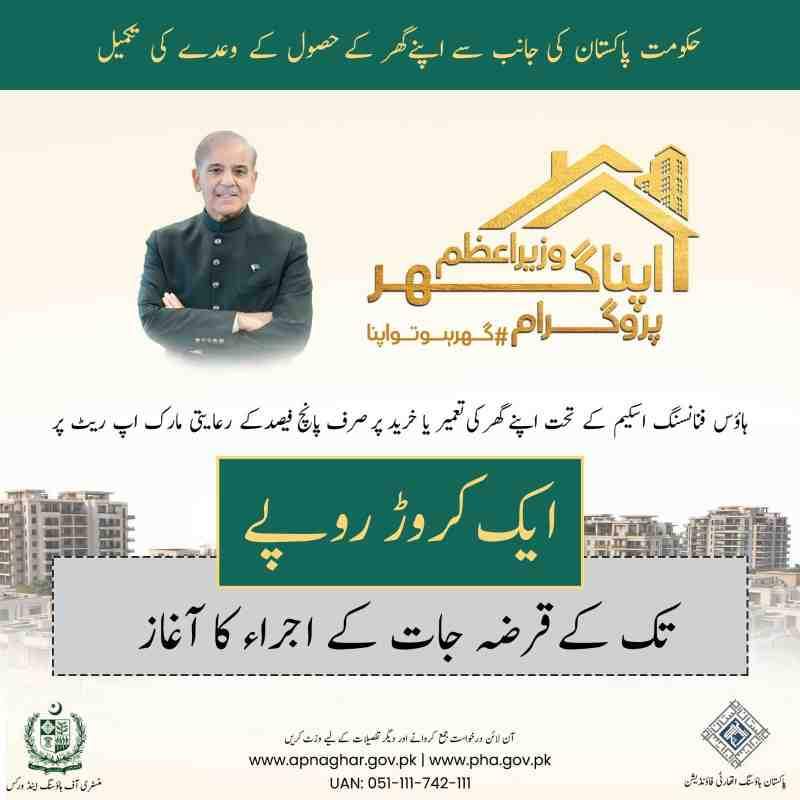
The Wazir-e-Azam Apna Ghar Program, also widely known as “Ghar Ho Tu Apna” and “Mera Ghar Mera Ashiana,” is the flagship subsidized housing finance initiative of the Government of Pakistan, operational under the guidance of the State Bank of Pakistan (SBP). The program provides affordable home loans to low- and middle-income families who wish to purchase a ready-built house, construct a home on an owned plot, or buy an apartment.
Core Financial Framework
- Maximum Financing: Up to PKR 10 million (1 Crore)
- Subsidized Markup Rate: 5% per annum (fixed for the first 10 years)
- Customer’s Equity Contribution: Minimum 10% of the property value
- Maximum Loan Tenure: Up to 20 years (with subsidy for the initial 10 years)
- Property Scope: House up to 10 Marla (2,720 sq. ft.) or apartment up to 1,500 sq. ft.
Key Updates for 2026
- The loan limit has been raised to 1 Crore to keep pace with rising construction costs.
- A fully digital application and tracking system has been rolled out through official portals.
- Processing fees and prepayment penalties have been eliminated to reduce the financial burden on borrowers.
Who is eligible for the 1 Crore (10 million) home loan?
Eligibility for the 1 Crore home loan is strictly defined to ensure the subsidy reaches the intended first-time homebuyers. All applicants must be Pakistani citizens holding a valid CNIC, with no existing housing unit registered in their name. The program specifically targets families who have never availed of any government or bank housing finance scheme.
Primary Eligibility Conditions
- First-Time Homeowner: You must not own any residential property (house or flat) in Pakistan.
- Valid CNIC: Applicant must possess a valid Computerized National Identity Card.
- Minimum Age: Applicant must be between 25 and 60 years for salaried individuals, and up to 65 years for self-employed individuals, at the time of loan maturity.
- Residential Status: Resident Pakistanis are eligible; overseas Pakistanis can also apply through designated Roshan Digital Account channels.
Income Thresholds and Joint Applications
- Minimum Disposable Income: While it varies slightly by bank, the typical net disposable income requirement is around PKR 37,000 per month to qualify for the maximum loan amount.
- Joint Application: Two family members (e.g., husband and wife) can apply jointly, allowing their combined income to be considered for loan eligibility.
- Low Credit Score: A poor credit history may lead to rejection, but applicants with minor issues can apply with a co-applicant who has a strong credit score.
What is the current markup or interest rate for the Apna Ghar Scheme in 2026?
The current markup rate for the Apna Ghar Scheme is a fixed 5% per annum for the first 10 years of the loan tenure. This rate is significantly lower than standard commercial bank home loan rates, which typically range between 18% and 22%. The government provides a direct subsidy to participating banks to cover the difference between this 5% rate and the actual market rate.
Markup Structure Breakdown
- First 10 Years: Fixed markup rate of 5% per annum, applied on the reducing principal balance.
- Remaining 10 Years (if applicable): After the subsidy period ends, the loan rolls over to a floating market rate, typically linked to KIBOR plus a bank spread.
- Subsidy Mechanism: The government reimburses the participating financial institution for the difference between the 5% charged to the borrower and the bank’s cost of funds.
Impact on Monthly Installments
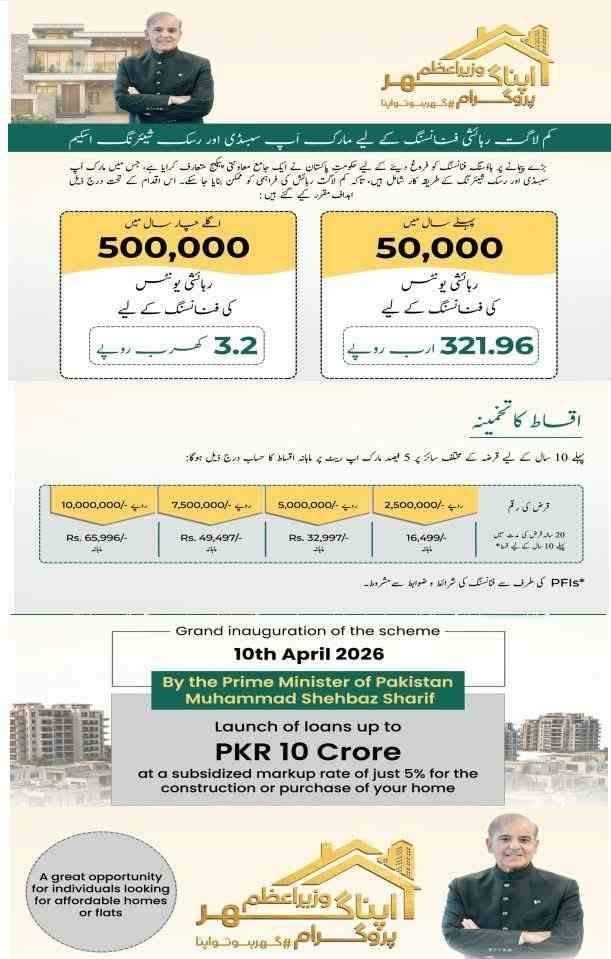
- For a 1 Crore loan over 20 years at 5%, the monthly installment is approximately PKR 66,000.
- Without the subsidy (at a market rate of 20%), the same loan would require a monthly payment exceeding PKR 170,000.
- This subsidy makes homeownership affordable for a much larger segment of the population.
Which banks are providing the 1CR home loan under this program?

The 1CR home loan is available through a wide network of commercial banks, Islamic banks, and microfinance banks across Pakistan. The State Bank of Pakistan has authorized over 24 financial institutions to participate in the markup subsidy scheme, ensuring widespread access for applicants in both urban and rural areas.
List of Participating Financial Institutions (PFIs)
- Commercial Banks: Allied Bank Ltd., Askari Bank Ltd., Bank Alfalah Ltd., Bank Al-Habib Ltd., Faysal Bank Ltd., Habib Bank Ltd. (HBL), Habib Metropolitan Bank Ltd., JS Bank Ltd., MCB Bank Ltd., National Bank of Pakistan (NBP), SAMBA Bank Ltd., Sindh Bank Ltd., Soneri Bank Ltd., Standard Chartered Bank, The Bank of Khyber, The Bank of Punjab (BOP), United Bank Ltd. (UBL).
- Islamic Banks: AlBaraka Bank, BankIslami Pakistan Ltd., Dubai Islamic Bank Pakistan Ltd., MCB Islamic Bank Ltd., Meezan Bank Ltd.
- Microfinance Banks: ASA Pakistan Microfinance Bank, HBL Microfinance Bank, Khushhali Microfinance Bank, Mobilink Microfinance Bank, LOLC Microfinance Bank, U Microfinance Bank.
- Specialized Institution: House Building Finance Company Ltd. (HBFCL).
Applying Through Specific Banks
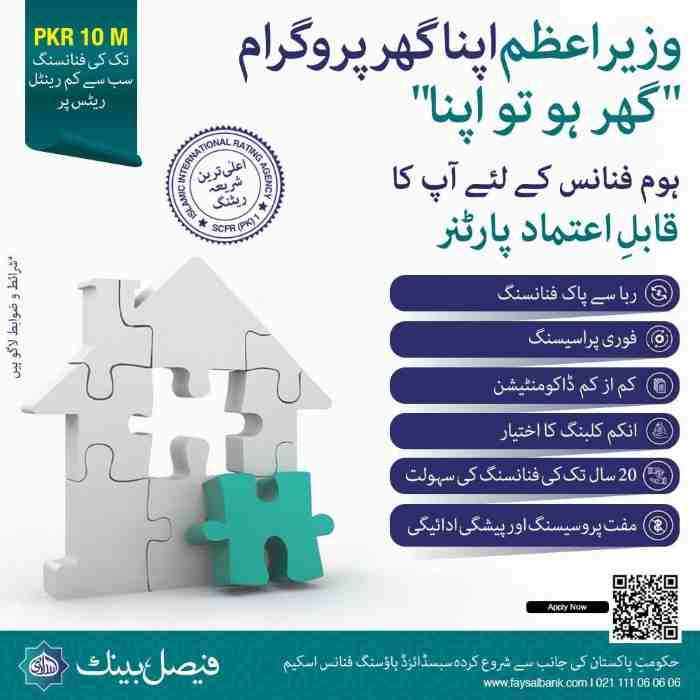
- Meezan Bank: Offers the scheme through a Shariah-compliant Diminishing Musharakah structure with no processing fees.
- Allied Bank (ABL): Processes applications under the “Ghar Ho Tu Apna” markup subsidy scheme with quick turnaround times.
- UBL Ameen: Provides options for both purchase and construction, with dedicated support for overseas Pakistanis through Roshan Digital Accounts.
Can I use the 1 Crore loan to buy a flat or apartment?
Yes, you can use the 1 Crore loan to purchase a flat or apartment, provided the property meets the scheme’s size limitations. The maximum permissible covered area for an apartment is 1,500 square feet. This makes the scheme suitable for families living in high-density urban centers where apartments are more common and affordable than standalone houses.
Permitted Property Types
- Ready-Move-In House: Purchase of a newly constructed house up to 10 Marla.
- Apartment/Flat: Purchase of a flat or apartment with a maximum covered area of 1,500 sq. ft.
- Construction on Owned Plot: Disbursement of funds in tranches to build a house on land you already own.
- Land + Construction: Combined financing for purchasing a plot and constructing a house on it, subject to a single consolidated approval.
Property Valuation and Scope
- The bank will conduct its own valuation of the property to determine the maximum loan amount, which cannot exceed 90% of the lower of the purchase price or the appraised value.
- The loan covers the cost of the property, construction materials, and labor, but does not typically cover luxury items like swimming pools or extensive landscaping.
- Solar panel installation costs can be included in the construction financing scope, as it is considered a part of the house’s fixed infrastructure.
Is the Apna Ghar Scheme available for overseas Pakistanis?
The Apna Ghar Scheme is indeed available for overseas Pakistanis, primarily through the “Roshan Apna Ghar” initiative linked to the Roshan Digital Account (RDA). This product allows non-resident Pakistanis (NRPs) to finance the purchase, construction, or renovation of a residential property in Pakistan for their own use or for their immediate family members living in the country.
Eligibility and Process for Overseas Pakistanis
- Valid NICOP: You must hold a valid NADRA-issued NICOP (National Identity Card for Overseas Pakistanis).
- Roshan Digital Account: You must first open an RDA with any participating bank in Pakistan.
- Co-Applicant Requirement: At least one co-applicant must be a resident of Pakistan, usually a spouse, parent, or adult child.
- Income Clubbing: A non-resident co-borrower’s income can be clubbed with a resident co-applicant’s income to meet eligibility thresholds.
Key Banks Offering Overseas Facilities
- UBL Roshan Apna Ghar: Offers Shariah-compliant and conventional financing for NRPs.
- HBL Ghar Scheme: Provides Islamic home finance based on Diminishing Musharakah for RDA holders.
- JS Bank and Allied Bank: Have dedicated Roshan Apna Ghar products with fully digital application and approval processes, requiring no physical visit to Pakistan.
What documents are required for a salaried person to apply?
A salaried person must submit a comprehensive set of documents to verify their identity, employment, income, and the property’s legal status. The document checklist is standardized across all participating banks to streamline the verification process and reduce processing delays.
Personal Identification Documents
- CNIC: Copy of the applicant’s valid Computerized National Identity Card (front and back).
- Spouse’s CNIC: Copy of the spouse’s CNIC (if married).
- Family Registration Certificate (FRC): Issued by NADRA, showing the composition of the family.
- Passport-Size Photographs: Two recent photographs with a white background.
Income and Employment Verification
- Salary Slips: Last 3 months’ original salary slips, stamped and signed by the employer.
- Bank Statement: Last 6 months’ bank statement showing salary credit and monthly expenses.
- Employment Letter: Original letter from the employer confirming job title, date of joining, and salary details.
- Tax Documents: Last year’s income tax return or tax deduction certificate.
Property Documents
- Sale Agreement: Copy of the agreement to sell or allotment letter from the housing society.
- Approved Map: The approved building plan or layout map from the relevant development authority.
- NOC: No Objection Certificate from the housing society or cooperative society.
- Valuation Report: A bank-approved valuation report of the property.
How long does it take for the bank to approve the 1 Crore home loan?
The total time from application submission to final disbursement typically ranges from 15 to 45 working days, depending on the completeness of your documents and the efficiency of the bank’s credit processing department. The process is divided into two main phases: initial sanction and final disbursement.
Phase 1: Initial Sanction (5-10 working days)
- The bank verifies your personal documents and income eligibility.
- A credit check is performed through the Credit Information Bureau (CIB) of SBP.
- An initial property title search is conducted to ensure the property is free of legal disputes.
- Upon successful verification, the bank issues a “Sanction Letter” outlining the approved loan amount, markup rate, and terms.
Phase 2: Final Disbursement (10-35 working days)
- Legal and Valuation Report: The bank’s approved lawyer and valuer submit their final reports on the property.
- Loan Agreement Signing: You and any co-applicants sign the loan agreement and mortgage deed.
- Disbursement: For a ready house, the full amount is disbursed to the seller. For construction, funds are released in tranches (e.g., foundation, lintel, roof completion).
- Disbursement delays often occur due to incomplete property documents or a low valuation report that reduces the loan amount.
Read More: Sindh Government Petrol Subsidy App (Rs. 2K Apply Online) | Sindh Fuel Relief App
Is the Apna Ghar Scheme Shariah-compliant or available through Islamic banking?
The Apna Ghar Scheme is available in both conventional (interest-based) and Shariah-compliant (Islamic) structures. Islamic banks participate in the scheme by using validated contracts such as Diminishing Musharakah and Murabahah, which replace interest (Riba) with a profit rate derived from an asset-backed transaction.
Shariah-Compliant Structures Used
- Diminishing Musharakah: The bank and customer jointly purchase the property. The customer gradually buys the bank’s shares through periodic payments, with the bank’s ownership decreasing over time. The customer pays a rental amount for the bank’s share, not interest.
- Murabahah: The bank purchases the property and sells it to the customer at a cost-plus-profit price, payable in installments. The profit margin is fixed and agreed upon upfront, avoiding any variable interest.
Participating Islamic Banks
- Meezan Bank: Offers the “Mera Ghar Mera Ashiana” scheme through Diminishing Musharakah, with no processing fees or prepayment penalties.
- BankIslami: Provides a Shariah-compliant version of the scheme, approved by its Shariah board.
- MCB Islamic Bank: Offers financing for both purchase and construction under Islamic principles.
- Dubai Islamic Bank (DIB): Participates through its Roshan Apna Ghar product for overseas Pakistanis.
Important Shariah Consideration
- The conventional 5% markup is considered interest (Riba) and is not permissible in Islam.
- Muslims seeking Shariah compliance must apply through an Islamic bank’s specific product and confirm that the agreement uses a valid Islamic contract, not simply a conventional loan labeled as “Islamic.”
Can I apply for the scheme if I have a low credit score?
Having a low credit score does not automatically disqualify you from the Apna Ghar Scheme, but it significantly reduces your chances of approval. Banks use the credit score as a primary indicator of your repayment behavior and financial discipline. A low score suggests a history of late payments or defaults, which makes you a higher-risk borrower.
Credit Score Thresholds and Impact
- Good Credit Score (700+): High chance of approval with favorable terms and quick processing.
- Average Credit Score (550-699): May be approved with a higher equity requirement (e.g., 20% down payment instead of 10%) or with a strong co-applicant.
- Low Credit Score (Below 550): High probability of rejection. You can improve your chances by:
- Clearing All Outstanding Dues: Pay off any credit card bills, personal loans, or utility arrears.
- Waiting 6-12 Months: Allow time for the credit bureau to update your report after clearing dues.
- Adding a Co-Applicant: Apply jointly with a spouse or family member who has an excellent credit history.
- Choosing a Smaller Loan Amount: A lower loan amount (e.g., 5 Million) may be approved even with a marginal credit score.
How to Check Your Credit Score
- You can obtain your free credit report once a year from the State Bank of Pakistan’s Credit Information Bureau (CIB) through your bank or directly via the SBP portal.
- Review the report for any errors or fraudulent accounts and dispute them immediately.
What is the maximum repayment period (tenure) for the 1 Crore loan?
The maximum repayment period for the 1 Crore loan is 20 years. Within this 20-year tenure, the government subsidy of a 5% markup applies only for the first 10 years. For the remaining 10 years, the loan converts to a floating market rate, typically based on the 6-month KIBOR plus a bank spread.
Tenure Options and Their Impact
- 5-Year Tenure: Very high monthly installments but minimal total interest paid. Suitable for applicants with high disposable income who want to clear debt quickly.
- 10-Year Tenure: Balanced approach where the entire repayment falls within the subsidized period. This maximizes the benefit of the 5% rate.
- 15-Year or 20-Year Tenure: Lower monthly installments, but the last 5 to 10 years are at market rates (potentially 18% or higher). This can result in paying more total interest over the life of the loan despite the initial subsidy.
Strategic Advice on Tenure Selection
- If you can afford higher monthly payments, choose a 10-year tenure. This ensures the entire loan is repaid at the subsidized 5% rate.
- If you need the lowest possible monthly payment, choose 20 years but plan to make extra prepayments during the first 10 years to reduce the principal before the market rate kicks in.
- Avoid extending the loan to 20 years if you do not have a clear plan to prepay, as the market-rate period could become financially burdensome.
Is a down payment or “equity” required from the applicant?
Yes, a minimum down payment or equity contribution of 10% of the property’s value is required from the applicant. The bank finances the remaining 90% under the markup subsidy scheme. This equity requirement ensures that the borrower has a financial stake in the property, reducing the risk of default.
How the Equity Requirement Works
- Property Value Example: If you are buying a house valued at PKR 10 million, you must contribute PKR 1 million as equity.
- Bank Financing: The bank provides PKR 9 million (90% of the value).
- Higher Equity Option: You can choose to contribute more than 10% (e.g., 20% or 30%). A higher down payment reduces the loan amount, lowers your monthly installment, and may lead to faster approval.
- Source of Equity: The equity amount must come from your own savings or a gift from a family member. It cannot be borrowed from another bank or informal lender.
Impact of Equity on Loan Approval
- A 10% down payment is the minimum requirement, but some banks may ask for 15-20% if your income is on the lower side or your credit score is average.
- Providing a higher down payment demonstrates financial stability and reduces the loan-to-value (LTV) ratio, which can lead to a lower markup rate after the subsidy period ends.
- The equity is paid directly to the seller or developer upon loan disbursement; it is not paid to the bank.
Are there any hidden processing fees for the Apna Ghar Scheme?
The government scheme explicitly states that there are no processing fees charged by the bank for the loan application. However, applicants should be aware of certain third-party costs that are not processing fees but are essential for completing the transaction. These costs are legitimate and incurred regardless of the bank.
Mandatory Third-Party Costs
- Legal Fee: PKR 5,000 – 15,000 paid to the bank’s approved lawyer for conducting the title search and drafting the mortgage deed.
- Valuation Fee: PKR 3,000 – 10,000 paid to the bank’s approved valuer for inspecting and valuing the property.
- Stamp Duty and Registration: A government tax ranging from 2% to 5% of the property value, paid to the local revenue authority for registering the sale deed and mortgage.
- Credit Report Fee: A nominal fee (around PKR 200-500) charged by the Credit Information Bureau for providing the applicant’s credit report.
Fees That Are Prohibited Under the Scheme
- Application Processing Fee: Banks cannot charge any fee for submitting or processing the loan application.
- Administrative Fee: No monthly or annual administrative fee is allowed.
- Prepayment Penalty: You can pay off the loan early (partial or full) without any penalty fee.
- Early Settlement Charges: No fee for closing the loan before the end of the tenure.
Total Estimated Out-of-Pocket Costs
- For a 1 Crore loan, you should budget approximately PKR 150,000 to PKR 250,000 for third-party legal, valuation, and government registration charges.
- These costs are payable directly to the service providers and the government, not to the bank.
Can I get a loan to construct a house on a plot I already own?
Yes, you can absolutely use the 1 Crore loan to construct a house on a plot you already own. This is one of the most common use cases for the scheme, particularly for families who inherited land or purchased a plot earlier but lacked the funds to build a house. The construction financing is disbursed in tranches based on the physical progress of the building.
Construction Financing Disbursement Schedule
- Tranche 1 (20%): Disbursed after excavation and foundation work is completed.
- Tranche 2 (30%): Disbursed after the lintel (roof) of the ground floor is cast.
- Tranche 3 (30%): Disbursed after the completion of walls, plumbing, and electrical work.
- Tranche 4 (20%): Disbursed after finishing (plaster, flooring, painting) and final inspection.
Required Documents for Construction
- Plot Ownership Proof: A copy of the sale deed or allotment letter showing your name as the owner.
- Approved Building Plan: The plan must be approved by the relevant municipal corporation or development authority.
- Construction Contract: An agreement with a registered contractor or architect, detailing the scope of work and cost breakdown.
- No Objection Certificate (NOC): From the housing society or local government, allowing construction.
Key Conditions
- You must complete the construction within a specified time, typically 18 to 24 months from the first disbursement.
- The bank will conduct physical inspections before releasing each tranche to ensure funds are used for construction.
- The total loan amount cannot exceed 90% of the total construction cost as per the approved building plan.
What happens if I want to pay off the loan early (prepayment)?
You are permitted to pay off the loan early, either partially or in full, without incurring any prepayment penalty. This is a significant benefit of the government’s markup subsidy scheme, as commercial loans often charge a penalty of 1% to 3% for early settlement. Prepayment reduces your total interest cost and frees you from debt sooner.
Types of Prepayment Allowed
- Partial Prepayment: You can pay a lump sum amount (e.g., PKR 500,000) at any time, which is directly applied to the principal balance. This reduces the outstanding principal and, consequently, the total interest you will pay over the remaining tenure.
- Full Prepayment (Early Settlement): You can pay the entire outstanding principal balance in one go. The bank will calculate the exact amount due, and upon payment, the loan is closed, and the mortgage is released.
- Increased Monthly Installments: Some banks allow you to increase your monthly installment amount without any penalty, effectively paying off the loan faster.
Strategic Prepayment Advice
- During the First 10 Years: Every rupee of prepayment during the subsidized period saves you from paying future interest at the market rate (which could be much higher after year 10).
- Focus on Principal: Always instruct the bank to apply the extra payment to the principal balance, not to future installments.
- Emergency Fund First: Only use surplus funds for prepayment after maintaining an emergency fund of 6 months’ expenses.
Is the 1 Crore loan available in rural areas or only in major cities?
The 1 Crore loan is available in both rural and urban areas, provided there is a participating bank branch and the property meets the scheme’s legal and construction standards. The government has specifically mandated that all participating banks extend the scheme to their rural branch networks to promote equitable access to housing finance.
Urban vs. Rural Parameters
- Maximum House Size in Rural Areas: In rural areas, the maximum permissible house size can be up to 10 Marla (same as urban), but some banks may allow a slightly larger covered area if the plot size is larger.
- Property Valuation: Rural properties are valued based on the prevailing government rates (circle rates) in that area, which may be lower than market rates. The loan amount is still limited to 90% of the lower of the purchase price or the bank’s valuation.
- Bank Branch Availability: All major banks with rural branches (e.g., National Bank of Pakistan, Bank of Punjab, microfinance banks) offer the scheme in rural areas.
Special Provisions for Rural Applicants
- Microfinance Banks: Banks like Khushhali, Mobilink, and U Microfinance have a strong presence in rural areas and offer the scheme with simplified documentation for agricultural income.
- Joint Family Housing: Recent updates to the scheme allow joint families living in a single house to apply for interest-free loans for house expansion in rural and peri-urban areas.
- No Discrimination: The 5% markup subsidy and 90% LTV ratio apply uniformly, regardless of whether the property is in a rural village or an urban city center.
Can I switch my existing high-interest home loan to the Apna Ghar Scheme?
Yes, you can transfer (refinance) your existing high-interest home loan from a commercial bank to the Apna Ghar Scheme, provided your current loan meets the eligibility criteria of the scheme. This is known as “balance transfer” or “refinancing,” and it allows you to benefit from the government’s 5% subsidized markup rate, significantly reducing your monthly payments.
Eligibility for Balance Transfer
- First-Time Homeowner Rule: You must not have previously availed of any government-subsidized housing scheme. Your existing loan must be a standard commercial home loan.
- Loan Amount: The outstanding principal balance must be within the scheme’s limit (up to PKR 10 million).
- Property Size: The house or apartment must be within the allowed size (10 Marla or 1,500 sq. ft.).
- Clean Payment History: You must have a good repayment track record on your existing loan (no defaults in the last 12 months).
The Balance Transfer Process
- Obtain a “Loan Payoff Letter” from your existing bank, stating the outstanding principal amount.
- Apply to a Participating Bank under the Apna Ghar Scheme for a refinance loan of the same amount.
- Approval and Settlement: The new bank approves the loan and directly pays off your old bank.
- Mortgage Transfer: The new bank registers a fresh mortgage on the property, and your old mortgage is released.
Key Benefit
- Switching from a commercial loan at 18-22% markup to the subsidized 5% rate can reduce your monthly installment by more than 60%, saving you millions of rupees in interest over the remaining tenure.
What size of house (in Marla) can be financed under the 1CR category?
The maximum size of a house that can be financed under the 1 Crore loan category is 10 Marla, which translates to approximately 2,720 square feet of covered area. For apartments, the maximum permissible covered area is 1,500 square feet. These size limits are strictly enforced to ensure the subsidy benefits middle-income families and is not used for luxury housing.
Marla to Square Feet Conversion
- 5 Marla: Approximately 1,360 sq. ft. (suitable for a small family).
- 7 Marla: Approximately 1,904 sq. ft. (standard for a family of 4-5 members).
- 10 Marla: Approximately 2,720 sq. ft. (maximum allowed for 1 Crore financing).
Impact of Size on Loan Amount
- The loan amount is not determined solely by the number of Marlas. It is based on the lower of two figures: the purchase price (or construction cost) and the bank’s valuation.
- A 10 Marla house in a premium location may cost PKR 15 million, but the bank will only value it at the prevailing market rate. You will need to contribute the difference (over PKR 5 million) as additional equity beyond the 10% minimum.
- For a 5 Marla house in a mid-range society, the total cost may be PKR 6-7 million, in which case you can finance 90% (up to PKR 6.3 million) under the 1 Crore scheme, well within the limit.
Are widows or retired government employees eligible for this program?
Widows and retired government employees are fully eligible for the Apna Ghar Scheme, provided they meet the standard criteria of being first-time homeowners and having a verifiable source of income to repay the loan. The scheme has special provisions to make it easier for these vulnerable groups to access housing finance.
Eligibility for Widows
- Income Source: A widow’s income can include pension, inheritance income, rental income, or a regular family remittance. Banks may accept a pension book or a notarized affidavit of support from a family member.
- Joint Application: A widow can apply jointly with an adult son or daughter to combine their income and improve eligibility.
- Priority Processing: Some participating banks give priority processing to widows and female-headed households under their corporate social responsibility (CSR) quotas.
Eligibility for Retired Government Employees
- Pension as Income: A retired government employee’s monthly pension is considered a valid and stable source of income for loan qualification.
- Age Limit: The maximum age at loan maturity is 70 years for retired employees (higher than the standard 60 for salaried individuals), as pensions are guaranteed for life.
- Computation of Installment: Banks typically allow a higher debt-to-income ratio for pensioners because pension income is considered extremely stable and risk-free.
- Group Insurance: Some government employee group insurance policies can be assigned to the bank as additional security, potentially reducing the required down payment.
Does the scheme cover the cost of solar panel installation for the house?
Yes, the cost of installing solar panels can be included in the total construction financing under the Apna Ghar Scheme, provided the solar system is considered an integral part of the house’s fixed infrastructure. The bank treats solar panel installation as a home improvement that adds permanent value to the property, similar to plumbing or electrical work.
How Solar Financing Works Under the Scheme
- Inclusion in Construction Budget: When applying for a loan to construct a house, you can add the cost of a solar system (panels, inverter, batteries, wiring) to the total construction budget.
- Separate Solar Loan: If you already have a house and want to add solar panels, you may need to apply for a separate “home improvement” loan under the scheme, subject to the same 5% markup and 90% LTV rules.
- Disbursement: For solar installation, the bank typically disburses the amount directly to the approved solar vendor upon submission of a proforma invoice and after a site inspection.
Conditions and Limitations
- The solar system must be grid-tied or off-grid with proper licensing and warranty from a recognized manufacturer.
- The cost of solar panels is included within the overall 1 Crore limit; it does not increase the maximum loan amount.
- Banks may require that the solar system be insured as part of the property insurance policy.
Can I apply for the 1 Crore loan if I already own a small plot?
Yes, owning a small plot does not disqualify you from the 1 Crore loan, as the eligibility condition is specifically about owning a constructed housing unit (a house or flat). The scheme distinguishes between land ownership and house ownership to allow families who have inherited or purchased land but cannot afford to build a house to still qualify for financing.
Clarification of the “First-Time Homeowner” Rule
- Not Disqualified: You are not disqualified if you own a vacant plot of land, agricultural land, or a commercial property.
- Disqualified: You are disqualified if you own a house, flat, or any other residential unit that is fit for living, regardless of whether you live in it or rent it out.
- Joint Ownership: If you jointly own a house with a family member (e.g., inherited from parents), you may still be eligible if you are not the primary owner and do not reside in that house, but this is subject to bank discretion.
What the Bank Will Verify
- The bank will conduct a search in the local land registry to see if any residential property is registered in your name.
- You will be required to sign an affidavit declaring that you do not own any housing unit.
- If you own a plot, you can apply for a loan to construct a house on that specific plot, as long as you meet all other eligibility criteria.
What is the difference between the “Ghar Ho Tu Apna” and “Mera Ghar Mera Ashiana” schemes?
There is no practical difference between “Ghar Ho Tu Apna” and “Mera Ghar Mera Ashiana” – they are two different marketing names for the same underlying markup subsidy scheme launched by the State Bank of Pakistan and the Government of Pakistan. The confusion arises because different banks and government websites use these names interchangeably.
Origin of the Names
- Mera Ghar Mera Ashiana: This is the original name used by the State Bank of Pakistan for its “Markup Subsidy and Risk Sharing Scheme for Affordable Housing Finance.”
- Ghar Ho Tu Apna: This tagline has been adopted by the Wazir-e-Azam Apna Ghar Program and is often used by the Punjab government and its partner banks to brand the same scheme.
- Wazir-e-Azam Apna Ghar Program: This is the official name used by the Government of Pakistan for the 1 Crore loan initiative, often with the tagline “Ghar Ho Tu Apna.”
Consistency Across All Names
- All three names refer to the same key features: 5% markup for 10 years, 90% financing, up to 10 Marla house or 1,500 sq. ft. apartment, and no processing fees.
- The eligibility criteria, participating banks, and application process are identical regardless of which name is used.
- You can apply for the scheme through any participating bank, and the bank will process it under the SBP’s markup subsidy framework, regardless of the brand name used in their marketing.
Disclaimer
The information provided in this guide is for general informational purposes only and does not constitute financial or legal advice. Loan terms, eligibility criteria, and markup rates are subject to change by the government and participating banks. Always verify all details directly with an authorized bank representative before making any financial commitment.
Frequently Asked Questions (FAQs)
1. What is the maximum loan amount under the Wazir-e-Azam Apna Ghar Program?
The maximum loan amount is PKR 10 million (1 Crore). This limit applies to financing for a house up to 10 Marla or an apartment up to 1,500 sq. ft.
2. Do I need a guarantor to apply for the Wazir-e-Azam Apna Ghar Program?
No, a third-party guarantor is not required. The loan is secured solely by the mortgage of the property being financed.
3. What is the minimum monthly income required to qualify for a 10 million PKR loan?
The minimum net disposable income required is typically around PKR 37,000 per month, though this may vary slightly between participating banks.
4. Can I use the 1 Crore loan to buy a plot only?
No, the loan cannot be used to purchase a plot alone. It is intended for purchasing a ready-built house, constructing a house on an owned plot, or buying a flat/apartment.
5. Is the Apna Ghar Scheme available for overseas Pakistanis?
Yes, overseas Pakistanis can apply through the “Roshan Apna Ghar” facility linked to their Roshan Digital Account (RDA).
6. What happens if I want to pay off the loan early?
There is no prepayment penalty. You can make partial or full prepayment at any time without any extra charges.
7. Is the 5% markup rate fixed for the entire 20-year tenure?
No, the 5% fixed rate applies only for the first 10 years. For the remaining 10 years, the rate converts to a floating market rate (KIBOR + spread).

Add a Comment